On May 19, 1875, a woman was led through a side door of a courthouse in Chicago. She had no warning and no lawyer. When she entered the room, she found 17 witnesses already seated. Her only surviving son stood among them.
By the end of that day, he would have her declared insane and sent to an asylum. Her name was Mary Todd Lincoln. She was the wife of Abraham Lincoln, the man whose face is carved into a mountain.
She believed in him before anyone else did. This is what that cost her.
History has a habit of building monuments to the people it loves and quietly forgetting the ones who stood beside them. We remember Abraham Lincoln. We carry his face in our wallets. We carved his likeness into a mountain in South Dakota.
But there was a woman who stood beside him for 23 years. When Abraham Lincoln was still an unglamorous circuit lawyer in Springfield, Illinois, she told her friends with complete conviction that he would one day be president of the United States. They smiled at her. Some of them laughed. She was right.
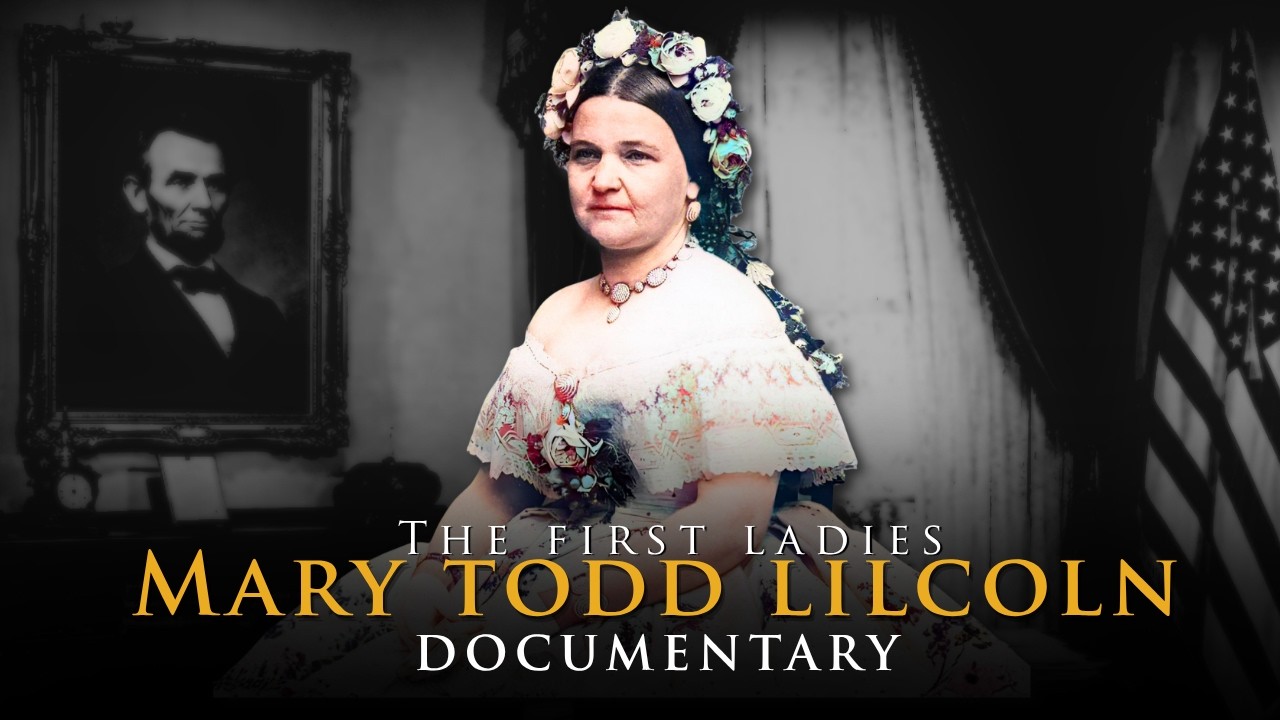
Her name was Mary Todd Lincoln. She served as first lady during the most violent years America had ever known. She sat in the presidential box at Ford’s Theater on the night of April 14th, 1865, holding her husband’s hand, laughing at the play when the gunshot came.
In the decades since, history has not been kind to Mary Todd Lincoln. The story most people know is the story of the difficult woman, the erratic spender, the unstable wife. This is the story that came after, the 17 years that no monument acknowledges.
It is a story about what it costs to love someone who belongs to history before they belong to you. She was not in the end destroyed by war or poverty or tragedy. She was brought down by the one person she had left.
When Abraham Lincoln gave Mary Todd a wedding ring, he had something engraved on the inside of the band. Three words that she wore on her finger for the rest of her life. Through the funerals, through the court hearings, through the long years in the darkened room.
She was 6 years old when her mother died. The household in Lexington, Kentucky, had been a prosperous one. Her father, Robert Smith Todd, was a banker and a politician with standing, ambition, and 14 rooms in a house on West Main Street.
Eliza Parker Todd died in the summer of 1825, not long after giving birth to her seventh child. Mary was 6 years old. She would carry almost no clear memory of her mother’s face.
Within a year, her father had remarried. The new wife would go on to have nine more children with Robert Todd. She was not, by most accounts, a cruel woman, but she was not Eliza. Years later, Mary would describe her childhood in a single word. She called it desolate.
She was educated at private academies in Lexington. Twelve years of serious schooling at a time when most women in America received almost none. She studied grammar, literature, arithmetic. She became fluent in French.
She was sharp. She was funny. She was the kind of person who made every gathering feel more alive. And she was restless.
In 1839, at the age of 20, Mary Todd packed her things and moved to Springfield, Illinois, to live with her married sister. It was there that she met Abraham Lincoln.
He was, by his own description, a poor nobody, a circuit lawyer from the backwoods of Indiana and Illinois, largely self-educated, nearly a foot taller than her. He wore ill-fitting clothes. He was not the kind of man that the Springfield social establishment had in mind for her.
Mary paid the establishment very little attention. What she saw in Abraham Lincoln was not what others saw. She saw the mind, the strange angular brilliance of it. She told friends more than once that Abraham Lincoln would one day be president of the United States.
Their courtship was not a simple thing. There was a period in the winter of 1840 when the engagement was broken, apparently on his initiative. But they found their way back to each other.
On November 4th, 1842, in the parlor of her sister’s house, Mary Todd became Mary Lincoln. She was 23, he was 33. On the inside of the gold band he placed on her finger that evening was an inscription, three words: “Love is eternal.” She never took it off.
Their early years in Springfield were modest. A rented house on the corner of 8th and Jackson, a growing family, the ordinary difficulties of money and weather. They had four sons. Robert, born in 1843. Edward, called Eddie, in 1846. William, called Willie, in 1850. Thomas, called Tad, in 1853.
The house filled with noise, with children and laughter. Abraham Lincoln would say it plainly years later, watching his wife move through a White House reception. “My wife is as handsome as when she was a girl,” he said. “And I fell in love with her. And what is more, I have never fallen out.”
When Abraham Lincoln won the presidential election in November of 1860, Mary Todd Lincoln had been living in the certainty of that moment for two decades. She had packed their trunks for Washington. She had not imagined what it would cost.
The White House she arrived in in the early months of 1861 was not the grand stage she had pictured. It was drafty and badly furnished. Congress gave her $20,000 for renovations. She spent more than that. The press noticed.
In the newspapers of 1861 and 1862, Mary Lincoln was almost never given a charitable reading. She was too southern. Born in Kentucky with half brothers fighting for the Confederacy, she was suspected of harboring rebel sympathies. She was too extravagant. She was too present, too opinionated, too visible.
The attacks accumulated. A letter was produced falsely, it was later established, claiming she had passed military information to Confederate agents. She was called a spy in the pages of newspapers that reached a hundred thousand homes a week.
Abraham Lincoln said very little about it publicly. Privately, according to those close to him, he was pained by what his wife endured. But the presidency was consuming him. They had less time together than either of them had anticipated.
What they still had in the early White House years were their sons. Willie was the one who seemed to have inherited something essential from both parents. He was 11 years old. He had dark eyes and a serious face that broke unexpectedly into something brilliant when he smiled.
In January of 1862, Willie fell ill. The doctors said typhoid. He was sick for several weeks. He died on February 20th, 1862.
Mary Lincoln could not bring herself to enter the room where they laid him out. She stood at the threshold and turned away. Down the hall, Abraham Lincoln sat at his desk weeping. He had gone to his son’s room alone and wept there openly in a way that the men who worked for him had never seen before.
In the weeks that followed, Abraham Lincoln visited the crypt where Willie’s body was temporarily held, not once, but several times, going alone at night in private. He sat with his son in the dark. Mary Lincoln did not know this for a long time.
She wrote to a friend in the months after Willie’s death. “We have met with so overwhelming an affliction in the death of our beloved Willie, a being too precious for Earth, that I am so completely unnerved that I can scarcely command myself to write.”
She wore black every day for nearly three years. She consulted spiritualists. She held seances in the White House. She was looking for Willie in the only places she knew to look.
Abraham Lincoln, watching this, said to a doctor that he was worried that if she did not moderate her grief, he would have to send her to the government hospital for the insane. He had said it gently. She did not forget the words.
The war ended on April 9th, 1865. After four years, after 600,000 dead, the war ended and Abraham Lincoln had won it. Washington celebrated for five days.
On the evening of April 14th, Abraham Lincoln did not especially want to go out. Mary had arranged for them to attend a performance at Ford’s Theater that evening, a comedy called Our American Cousin. They went.
The presidential box was on the upper right of the stage. They arrived late. The play had already begun. When Lincoln appeared at the railing, the audience rose and applauded.
Lincoln acknowledged the room with a small bow. Then he sat down beside his wife. Mary Lincoln leaned toward him. She would say later that she had been happy that night, that they had been laughing, that she had taken his hand.
At 10:13 in the evening, a single shot was fired from behind them. The bullet entered the back of Abraham Lincoln’s head. He slumped forward in his chair. Mary caught him. She screamed.
Lincoln was carried across the street to a boarding house, the Peterson House. They laid him on a bed in a back room. The bed was too short for him. They had to position him diagonally.
Mary Lincoln was not allowed to stay in the room. She sat in the parlor outside in a chair for nine hours. She could hear him breathing through the wall.
At 7:22 in the morning of April 15th, 1865, Abraham Lincoln died. Mary Lincoln, sitting outside the closed door, heard the silence that followed.
She was helped back to the White House. She could not enter the room where her husband had slept. She lay in a guest bedroom, shaking for two days.
The country was mourning. Abraham Lincoln was already becoming a monument. Mary Lincoln was still just a woman in a room, a widow at 46 with three dead sons and one surviving child.
She left the White House five weeks after the assassination. She went to Chicago. She moved with Tad, her youngest, 12 years old and still her closest companion, into a series of hotels and rented rooms.
The money her husband had left was less than she had believed. The pension Congress would eventually grant her after years of public lobbying would not come for three more years.
She had one friend in this period who stayed. Her name was Elizabeth Keckley. She was a formerly enslaved woman who had purchased her own freedom in 1855 and built a life as a dressmaker in Washington.
She had made Mary Lincoln’s gowns throughout the White House years. She had been in the room at the Peterson House. By 1867, Mary Lincoln, in a moment of desperation, had written to Elizabeth Keckley simply, “I consider you my best living friend.”
In the summer of 1867, two years after her husband’s assassination, Mary Lincoln traveled to New York City with a plan. She had arranged to consign her White House wardrobe through a pair of brokers on Broadway. Silk evening dresses, velvet gowns, lace shawls.
It was, she believed, a sensible and private arrangement. She had registered at the hotel under the name Mrs. Clark. Within days, the brokers had leaked her identity to the press.
Newspapers from New York to Chicago ran it on the front page. The widow of Abraham Lincoln was selling off her dresses in a Broadway secondhand shop.
The coverage was not sympathetic. The Chicago Journal put it with the bluntness that the era considered journalism. “The most charitable construction that Mary Lincoln’s friends can put on her strange course is that she is insane.”
That sentence printed in October of 1867 was the first time the word was used publicly about her. It would not be the last.

In 1868, Elizabeth Keckley published a memoir. It was called Behind the Scenes, or 30 Years a Slave and Four Years in the White House. It was one of the first memoirs ever published by a black woman who had served in the White House. It was candid, intimate, and deeply sympathetic to Mary Lincoln.
Mary Lincoln’s eldest son, Robert, did not see it that way. Robert Todd Lincoln was 24 years old in 1868. He was already becoming the man he would remain for the rest of his life: meticulous, controlled, fiercely protective of his father’s legacy, and deeply uncomfortable with his mother’s visibility.
According to multiple contemporary accounts, Robert moved swiftly to suppress the Keckley memoir. He worked through channels, legal, social, reputational, to ensure the book was discredited and its distribution limited. He largely succeeded.
The book disappeared from shelves within months. Elizabeth Keckley’s reputation suffered damage from which it did not recover in her lifetime. The woman Mary had called her best living friend was gone. She was not replaced.
In 1871, Tad Lincoln died. Thomas Lincoln had been 18 years old. He had traveled with his mother through Europe in the years after his father’s assassination. He died of a respiratory illness in Chicago in July with his mother beside him.
She was now the last one. She had outlived Eddie, dead at three. She had outlived Willie, dead at 11 in the White House. She had outlived Abraham, shot in the theater. She had outlived Tad, dead at 18.
She had one surviving child. His name was Robert. He was a prosperous attorney. He visited his mother when propriety required it. He also, beginning in the early 1870s, had her watched.
The behavior he was observing was, by several accounts, becoming increasingly erratic. She moved constantly from hotel to hotel, city to city. She spent in patterns that had no logic he could identify. She was afraid at times of things she could not name.
In 1873, she told her doctor that an Indian spirit was pulling wires from her eyes and bones from her cheeks. Robert hired Pinkerton detectives to follow her. He consulted physicians. He consulted lawyers.
He spent the better part of two years building a case quietly and carefully the way a good attorney builds a case. He told almost no one what he was planning.
In the spring of 1875, Mary Lincoln was in Florida taking the air by the water when she became convinced with a sudden and overwhelming certainty that her son Robert was ill. She sent a panicked telegram to his law partner. She rushed back to Chicago.
Robert was fine, but he had been waiting for her.
On the morning of May 19th, 1875, a lawyer named Leonard Swett arrived at the Grand Pacific Hotel in Chicago where Mary Lincoln was staying. Swett was not a stranger to her. He had been a close friend of her husband’s.
He told her he needed to take her somewhere. He did not tell her where. Mary Lincoln was reluctant. She did not want to go.
According to the account that Swett himself later put into writing, she resisted calmly at first, then with increasing alarm, and he was forced to tell her plainly that if she did not come willingly, the police officers waiting outside the hotel would take her by force. He told her they could use handcuffs if necessary. She went.
The carriage took her to the Cook County Courthouse on North Clark Street. Swett led her in through a side door and brought her into a courtroom.
She stopped when she saw it. There was a judge. There was a jury of 12 men. There were 17 witnesses already seated: physicians, hotel clerks, store attendants, her own personal servants. Her son, Robert, was in the room.
There was also a defense attorney. His name was Isaac Arnold. He had been, in theory, appointed to represent her. What Mary Lincoln did not know was that Isaac Arnold had been arranged for her by Robert, not to protect her, but to manage her.
His instructions, according to accounts that emerged from the trial record, were to offer no rebuttal and no cross-examination. He was not there to defend her. He was there to fulfill the procedural requirement that a defense attorney be present.
She had come to her own trial with no one on her side.
The proceedings lasted less than three hours. Seventeen witnesses testified to her instability, her spending, her fears, her erratic movements, her strange statements about spirits and wires and bones. Each one was called by the prosecution. None were challenged.
Isaac Arnold sat at the defense table and said almost nothing. The jury deliberated for 10 minutes. They returned a verdict of insanity.
Robert Todd Lincoln was appointed conservator of his mother’s estate. Her money, her bonds, her property, the financial remnants of a life, effective immediately.
Later, in a letter that has survived in the historical record, Leonard Swett, the man who had escorted her to the courthouse, would write to a colleague about what had happened that day. He described Mary Lincoln’s response to the proceedings with a directness that is difficult to read without stopping.
She believed, Swett wrote, that I, who ought to be her friend, was conspiring with Robert and you to lock her up and rob her of her money. He did not, in the letter, argue that she was wrong.
Within hours of the verdict, Mary Lincoln left the courthouse and made her way alone to a pharmacy. She asked for laudanum. It was a common remedy of the era, an opium-based tincture used for pain, for sleep. In sufficient quantities, it was lethal.

She knew this. She returned to the hotel and consumed it. She did not die. What the pharmacist had given her was a placebo.
She was admitted to Bellevue Place Sanitarium in Batavia, Illinois on May 20th, 1875, the day after the trial. It was a private institution, well-appointed by the standards of its time, set in quiet grounds outside the city.
Mary Lincoln arrived with a trunk of belongings and immediately began writing letters. She wrote to lawyers. She wrote to friends. She wrote to anyone she could think of who might help her make a case for her own sanity.
A reporter from the Chicago Post and Mail came to interview her during her stay and left, convinced that she was entirely rational. He wrote as much in his newspaper.
Two people, a lawyer named James Bradwell and his wife Myra, one of the first women ever admitted to the Illinois bar, had read it. They began working on her behalf quietly and persistently through the summer of 1875.
On September 10th, 1875, Mary Lincoln walked out of Bellevue Place. She had been inside for less than four months. A second trial the following year formally overturned the insanity verdict and restored her legal independence.
She left the United States shortly after and moved to France, to a small town in the Pyrenees where she was not, for the first time in many years, recognized in the street. She did not speak to Robert for five years.
What she did not know, what none of them knew, was that Robert had kept everything. The letters, the trial records, the private correspondence between himself and the lawyers and doctors he had assembled.
He had kept it all and labeled it carefully in his own handwriting with a name that tells you everything you need to know about how he understood what he had done. He called the folder the “MTL insanity file.” He put it in a cabinet. He closed the drawer.
For decades, historians believed the file had been destroyed. Robert Todd Lincoln spent much of his later life burning documents. It was assumed the insanity file had gone the same way. It had not.
In 2005, a historian named Jason Emerson was going through a collection of papers that had belonged to Robert’s lawyer. Boxes that had been stored in an attic for 40 years, untouched, forgotten.
Inside, in a trunk that had not been opened since the 19th century, he found 25 letters. Twenty of them were in Mary Lincoln’s handwriting. Most had been written from inside the asylum.
She had been writing to the people she trusted, asking them to understand what had happened to her, asking them in the careful and measured language of a woman who knew her words might be used against her to help her get out.
She came home the way people come home when there is nowhere else to go. She spent three years in France, first in a small city called Pau at the foot of the Pyrenees where the air was clean and the winters were mild. She walked the promenade in the mornings. She took the waters.
It was not happiness, but it was quiet.
She returned to the United States in 1880. She was 61 years old. Her health had been failing for years. She needed to come home.
Home in the end was her sister’s house in Springfield. Frances Wallace, the last of the Todd sisters still close to her, had offered her a room. Mary Lincoln accepted.
She arrived with her trunks. By some accounts, there were dozens of them, packed with the possessions of a life lived in transit. The trunks filled the room so completely that there was barely space to stand.
She kept the curtains drawn. Neighbors noticed. The children in the street had grown up hearing the stories. They pointed up at her window as they passed. They called her the crazy lady on the hill. She did not go outside.
In those final years, she and Robert arrived at something that could not quite be called reconciliation, but was at least the absence of open war. He visited occasionally. She did not turn him away.
She died on July 16th, 1882. She was 63 years old. The cause was listed as a stroke.
She was in her sister’s room when it happened, in the same house on Aristocracy Hill from which 40 years before, almost to the day, she had walked as the bride of Abraham Lincoln.
She was buried beside her husband at Lincoln’s tomb in Oak Ridge Cemetery. Beside Abraham, beside Eddie, beside Willie, beside Tad. She was the last one in.
The ring was still on her finger when they laid her down. “Love is eternal.” She had worn it for 40 years.
Through the White House and the war and the assassination and the gowns sold under a false name and the trial she had not known was coming and the asylum in Batavia and the years in France and the room with the curtains always drawn. Through every abandonment, through every verdict, she had never taken it off.
History would spend the next century and a half deciding what to make of her. Whether she was unstable or misunderstood. Whether the grief that defined her later years was illness or simply the accurate response of a human being to an inhuman amount of loss.
Whether Robert had been a frightened son or something colder than that. These questions do not have clean answers. They were not meant to.
What is not in question is this. She was the girl from Lexington who had believed in Abraham Lincoln before the world knew his name. She had been right, completely, exactly right about who he was and what he would become.
She had paid for being right in ways that no monument has ever measured. And when they placed her in the ground beside him, after 40 years and four funerals, and one trial, and one asylum, and a room full of trunks in the dark, she was at last exactly where she had always said she would be.