Lady Sarah Chatto was born directly into the wreckage of a war. Her parents, Princess Margaret and Antony Armstrong-Jones, had promised the world a fairy tale, but by the time Sarah arrived in May 1964, their marriage was already a battlefield of cruelty and resentment. She was the quiet survivor of that wreckage, the daughter who inherited a legacy of chaos and deliberately chose a life of peace. Her mother was the dazzling and troubled Princess Margaret, younger sister of Queen Elizabeth II.
Her father was the glamorous, rebellious photographer-turned-Earl of Snowdon. Their union had seemed like a modern triumph, but behind the doors of Apartment 1A at Kensington Palace, it was a private war. To understand what Sarah was born into, one must first understand her mother. In her youth, Margaret was the nation’s darling.
She was magnetic, witty, and breathtakingly beautiful, a postwar icon of style and vitality. Her father, King George VI, famously said of his daughters: “Lilibet is my pride, and Margaret is my joy. ” But Margaret’s life was permanently altered when she fell in love with Group Captain Peter Townsend, a decorated Battle of Britain hero and former equerry to her late father. He was divorced, and in 1950s Britain, that made their marriage impossible.
The government, the Church, and the monarchy closed ranks. She was forced to choose between the man she loved and her royal life. On October 31, 1955, she issued a heartbroken public statement renouncing him. Something inside her broke that day.
She never recovered. Desperate to escape the suffocating institutions that had denied her happiness, Margaret found a different kind of man. Tony Armstrong-Jones was a brilliant, ambitious photographer from a middle-class background. He was irreverent, creative, and utterly unlike the aristocratic men she had known.
Their courtship was a secret, and their engagement announcement in February 1960 stunned the world. They married in May 1960 at Westminster Abbey in the first royal wedding broadcast on television. They became the undisputed leaders of trendy London, hosting legendary parties and mixing royalty with artists, actors, and fashion icons. But the same qualities that brought them together soon tore them apart.
Their fierce independence, sharp tongues, and need for attention became weapons in a marriage that turned into a toxic competition. Tony left cruel notes for Margaret, once writing in her car: “You look like a Jewish manicurist and I hate you. ” She retaliated with her own cutting remarks about his work and common background. Their violent arguments echoed through the palace.
By the time Sarah was born, the marriage was already over in everything but name. She never knew her parents as a loving couple. She grew up surrounded by cold silences and emotional warfare. Alone in this dazzling and broken world, Sarah found stability in an unlikely place.
The anchor of her childhood was her nanny, Verona Sumner. She created a separate world in the nursery, a sphere of fixed meals, homework schedules, and bedtime stories, a place where emotions were soothed rather than used as weapons. Lord Snowdon later acknowledged that Verona was like a second mother to them. For David and Sarah, she was effectively their first.
They were undeniably privileged children, playing in the private gardens of a royal palace, with a loving aunt who happened to be the Queen. But they were also deeply emotionally neglected. Margaret’s days were a ritual of self-medication: waking late, smoking constantly, drinking vodka tonics from midday. Her children learned to read her moods before approaching her.
Tony was increasingly absent, consumed by his work and affairs. David protected himself, becoming the responsible elder brother. Sarah, naturally quiet and observant, retreated inward. She became emotionally self-sufficient and found her own language in art.
Painting and drawing became her escape, a way to create order and beauty in a world that felt chaotic and ugly. That fragile equilibrium shattered in 1976. The press published photos of Princess Margaret vacationing on her beloved Caribbean island of Mustique with a younger man named Roddy Llewellyn. The implication was clear, and the public turned brutally on her.
She was portrayed as a lazy, parasitic embarrassment to the Crown. The scandal hastened the final separation. Lord Snowdon moved out, and their divorce was finalized in 1978, the first divorce of a senior royal in over four hundred years. For twelve-year-old Sarah, it was the official confirmation of what she had always known: her family was irretrievably broken.
During this turmoil, her father made the most important intervention in her life. Tony, despite his failures as a husband, was determined that his children not be crushed by the monarchy. He refused to send them to a rigid institution like Gordonstoun. Instead, he enrolled them at Bedales, one of Britain’s most progressive boarding schools.
There, pupils called teachers by their first names and studied art and drama alongside Latin and mathematics. For Sarah, Bedales was like taking her first breath of fresh air. For the first time, she was not defined by her royal connections. She was simply Sarah Armstrong-Jones, a quiet, talented student with a passion for art.
It gave her a community of friends who loved her for herself and a vision of a life where worth was determined by talent and hard work, not birthright. She pursued this path with quiet determination. Instead of a conventional royal education, she enrolled in an art foundation course and then trained in costume design. She worked behind the scenes in the film industry, culminating in a two-year stint in India in the early 1980s as an assistant in the wardrobe department for David Lean’s epic film “A Passage to India.
” There, in that collaborative creative environment thousands of miles from the claustrophobic royal court, she met an actor named Daniel Chatto. He came from a theatrical family, was gentle and kind, and shared her quiet seriousness. Their romance was a quiet, unforced bond between two people who valued substance over show. It was the antithesis of her parents’ dramatic, high-society love story.
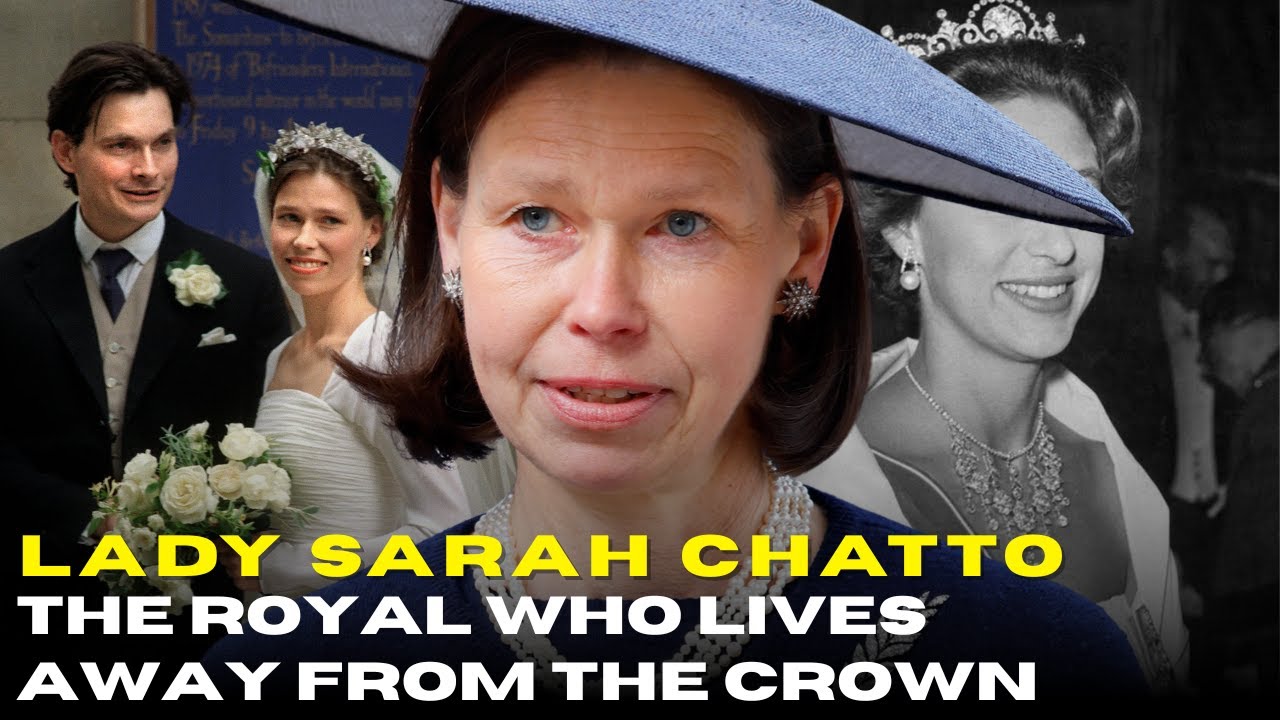
Sarah married Daniel Chatto in July 1994 in a small, beautiful church in London designed by Sir Christopher Wren. The guest list was intimate, and the dress was simple white linen designed by a friend. In a profound and powerful gesture, she wore the Snowdon Floral tiara that her father had designed for her mother to wear at their wedding. It was a symbol of the love that once united her parents, now transformed from a relic of a broken union into a beacon of hope for a new marriage.
She was acknowledged who she was and claimed the future on her own terms. They settled into a comfortable home in Kensington and lived a remarkably ordinary life by royal standards. Daniel pursued his artistic career while Sarah dedicated herself to painting and family. Their sons, Samuel and Arthur, were raised away from the spotlight, encouraged to find their own paths.
Both attended Edinburgh University, and both made their own choices, one becoming a potter and the other joining the Royal Marines. Sarah’s greatest role, however, unfolded within the royal family itself. In private, she became a trusted confidante. Her relationship with her aunt, Queen Elizabeth II, deepened into a bond of genuine affection and trust.
The Queen, a woman of immense loneliness and professional caution, found in Sarah a rare source of simple companionship. Sarah wanted nothing from her, had no agenda, and was simply a loving niece. She also served as a bridge between the warring factions of her generation, maintaining warm relationships with both Prince Charles and Princess Diana. This universal trust was acknowledged through her appointment as godmother to Prince Harry and later to other royal children.
The true test of Sarah’s life came in caring for her own mother. Margaret’s health declined sharply in the 1980s and 90s. A part of her lung was removed in 1985, and she suffered strokes beginning in 1998. The final insult was a tragedy in 1999 when she badly burned her feet in a scalding bath, leaving her with permanent nerve damage and severe mobility problems.
The once-vibrant princess was now a frail, isolated woman confined to a wheelchair. During these dark years, Sarah became her mother’s guardian. She visited her almost daily, reading to her, talking about her sons, and simply being present. It was a task of immense emotional difficulty, but Sarah approached with unwavering, quiet love, caring for the source of her own childhood pain.
When Margaret died on February 9, 2002, at the age of 71, Sarah was at her bedside. At the funeral, cameras caught the one moment in her life when her fierce privacy collapsed. She wept openly, her grief raw and visible, a daughter mourning the mother she had loved and lost. Sarah’s life has often been described as that of a “royal ghost,” a woman retreating from the world because of trauma.
But this is a misreading. She did not run away from the pressures of royal life; she quietly mastered them. She proved that one could remain a loyal, integrated, and even beloved member of the family while building a private, protected life. She broke the cycle of pain.
Where her mother sought fulfillment in public adoration, Sarah found it in private love and creative work. Where her mother’s marriage was a public battlefield, Sarah built a partnership of enduring stability. She did not reject her mother but, through her devoted care and her own achieved happiness, paid her the deepest tribute. The final confirmation of her place came in September 2022.
At the funeral of Queen Elizabeth II, during the solemn vigil held by the monarch’s children and grandchildren in Westminster Hall, the cameras caught a familiar quiet figure standing close to the heart of the proceedings. Lady Sarah Chatto was there, not as a headline-maker, but as an essential member of the tight inner circle. It was her most public appearance ever, yet it was her most private, most profound statement. She was no ghost.
She was a pillar. In her quiet, deliberate choices, in her art, in her marriage, and in her devotion to her difficult family, she broke the curse of her lineage. She built her own kingdom not on pageantry and display, but on integrity, creativity, and love.