On the evening of September 20th, 1978, a four-masted iron bark tall ship anchored in New York Harbor, its masts strung with banners of red, gold, and purple silk, its gangway lit by coral red paper lanterns, and its decks saturated with a fragrance that had not yet been sold on American soil. Two thousand white cattleya orchids flown in from Hawaii hung from every railing. A 1,000-pound bronze Buddha sat at the center of the main deck, gazing over 800 guests who drank champagne, ate caviar, and below decks inhaled cocaine with the indifference of people who believed the 1970s would never end. At midnight, $30,000 worth of fireworks erupted above the water, spelling two words in burning light across the sky: the name of a designer and the name of a perfume.
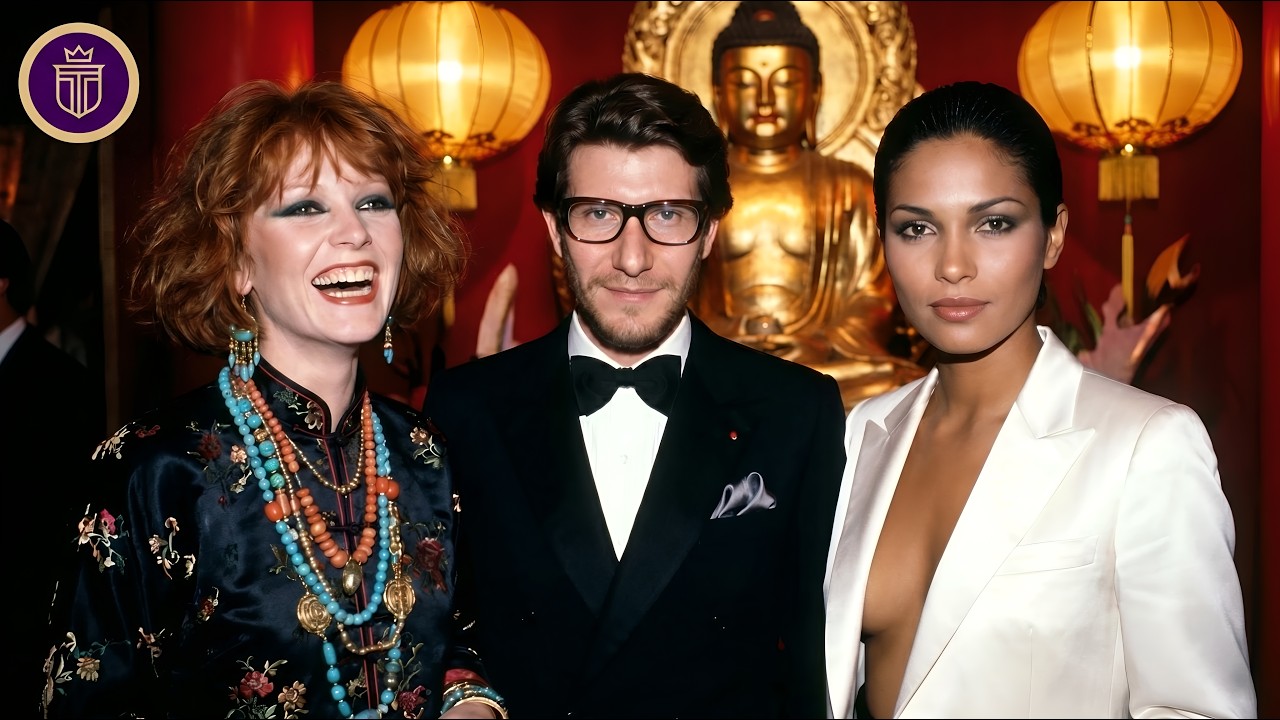
The designer was Yves Saint Laurent. The perfume was called Opium. Within weeks, a coalition of Chinese-Americans would call the name an insult to a century of suffering. Saint Laurent refused to apologize, refused to change the name, and watched Opium outsell Chanel No.
5 across Europe in its first year. The launch party aboard the Peking remains, nearly five decades later, the most expensive, most photographed, and most controversial fragrance debut ever staged. A night so extravagant it turned a perfume into a cultural weapon and a designer into a figure that polite society could neither absorb nor ignore. By 1978, Yves Saint Laurent was the undisputed emperor of French fashion, worth an estimated $600 million at the peak of his fortune, the architect of the le smoking tuxedo that scandalized Paris, the creator of the Mondrian dress that redefined how the world thought about art and clothing, and the man who, with his partner Pierre Bergé, had assembled one of the great private art collections on Earth.
Picasso, Matisse, Brancusi, Mondrian, Eileen Gray furniture, Chinese bronzes, and Renaissance sculptures filled a Paris apartment on the Rue de Babylone and multiple properties in Marrakech. He had already put women in tuxedos when Vogue refused to photograph them, opened a ready-to-wear boutique when the couture establishment said it would destroy high fashion, and named his new fragrance after a drug that colonial empires had weaponized to devastate China. When his business partners at Squibb quietly suggested a name change, Saint Laurent’s response was five words long: “Opium or no perfume. ”
The 800 guests aboard the Peking that September night—Cher, Halston, Grace Jones, Diana Vreeland, Truman Capote, Donna Karan, Nan Kempner, Loulou de la Falaise—were not attending a product launch.
They were attending the coronation of a man who had decided that provocation was a legitimate business strategy, that outrage could be converted into revenue, and that the only thing more profitable than beauty was scandal. The fireworks that spelled his name over New York Harbor were not a celebration. They were a declaration of war against anyone who believed fashion should know its place. But before Yves Saint Laurent could burn his name into the sky above Manhattan, he first had to survive a childhood that had nearly broken him.
Born on August 1st, 1936, in Oran, Algeria, to a family of French pieds-noirs, he grew up in a city of layered identities—French, Spanish, Arab, and Jewish communities stacked atop one another in a sun-soaked Mediterranean port. The city gave him a lifelong obsession with color, exoticism, and sensory overload that would define his aesthetic. But it also gave him cruelty. Painfully shy, introverted, and bookish, he was subjected to relentless bullying by classmates who punished him for refusing to be ordinary.
He drew relentlessly—dresses, gowns, costumes, theatrical sets—filling notebook after notebook. By his early teens, his sketches were so accomplished that his mother and sisters wore his designs as though they came from a Parisian atelier. At 17, his drawing spoke for him in situations where his voice could not. He submitted sketches to the International Wool Secretariat Fashion Design Competition in 1953 and won first prize, defeating a young Karl Lagerfeld, a name that would shadow and rival him for the next half century.
The victory catapulted him into the orbit of Christian Dior himself. After meeting the teenager, an astonished Michel De Brunhoff, editor-in-chief of French Vogue, arranged an introduction to the most famous fashion designer alive. Dior hired him on the spot, recognizing a fluency with fabric, proportion, and the female silhouette that most designers spent decades developing. By June 20th, 1955, he was officially employed at the House of Dior.
In August 1957, Dior confided to Saint Laurent’s mother that he had chosen the 21-year-old as his successor. Two months later, on October 24th, 1957, Christian Dior collapsed from a massive heart attack and died. The House of Dior plunged into crisis, and the solution was the most audacious appointment in the history of couture: the 21-year-old boy from Algeria would take the helm. His debut collection, the Trapeze line of spring 1958, was a sensation—narrow shoulders flaring out to a wide hem just above the knee, youthful, modern, elegant.
Vogue called it brilliant. The collection almost certainly saved the House of Dior from financial ruin. Overnight, Saint Laurent became an international celebrity, the youngest head designer any major fashion house had ever appointed. But the institution that had crowned him would within two years betray him in a manner so devastating it would fracture his psyche for the rest of his life.
In 1960, the French government conscripted him into military service during the Algerian War. The hazing was brutal and immediate. Fellow conscripts, repelled by his effeminacy, subjected him to relentless verbal and physical abuse. Within three weeks, the most celebrated young designer in France suffered a complete mental breakdown.
He was admitted to the Val-de-Grâce military hospital in Paris, the French army’s principal psychiatric facility, where doctors administered heavy doses of sedatives, subjected him to electroshock therapy, and left him so terrified that he later said he lost 35 kilos in two and a half months. He would trace the origins of his lifelong mental illness, his addictions, and his psychological fragility directly to that hospital. And while he lay sedated, unable to defend himself or comprehend what was happening to his career, the House of Dior quietly replaced him with Marc Bohan, a safer, more conservative designer. Saint Laurent was released in November 1960, thinner by 35 kilos, chemically altered, and professionally unemployed for the first time since he was 17.
He sued the House of Dior for breach of contract and won, but the settlement meant nothing compared to the damage done to his mind. The only person who seemed to understand the full catastrophic dimensions of what had been lost was a sharp-tongued bohemian from the Atlantic island of Île d’Oléron who had fallen in love with him 20 months earlier. Pierre Bergé, six years older, a friend of Albert Camus and Jean-Paul Sartre, had attended the first show at the House of Dior in January 1958, where he glimpsed the young designer who had just electrified the fashion world. A few days later, at a dinner organized in Saint Laurent’s honor, they fell in love.
Within six months, they were living together. When Saint Laurent collapsed in the military hospital, Bergé was at his bedside, delivering the crushing news that Dior had replaced him and then, in almost the same breath, proposing that they open their own couture house. Bergé later described standing alone in the courtyard of the hospital after making that promise, saying to himself, “My god, what can I do? ” But he did it.
Their roles were rigidly defined from the first day and never shifted in 40 years. Saint Laurent was the creative genius; Bergé was the CEO, the protector, the fixer, the business strategist, the gatekeeper. They separated as romantic partners in 1976 but remained business partners and intimate friends for the rest of Saint Laurent’s life. Armed with the breach of contract settlement and fresh funding from American millionaire J.
Mack Robinson, Saint Laurent and Bergé founded Yves Saint Laurent Couture in 1961. The house opened at 30 bis rue Spontini in Paris, and the iconic interlocking YSL logo was designed by the French graphic artist Cassandre. The first official collection debuted on January 29th, 1962, and Life magazine called it the most beautiful collection since Chanel. Robinson eventually sold his 80% stake in the mid-1960s for approximately $1 million, a decision he later described as the worst business mistake of his life.
Given that in 1999, the company would sell for an estimated $1 billion. Then came the Mondrian collection of 1965, cocktail dresses inspired by Piet Mondrian’s abstract geometric paintings, so widely copied that they became the most photographed fashion pieces of the entire decade. Then came Le Smoking in 1966, a women’s tuxedo suit that Vogue initially refused to feature and restaurants in Paris and New York refused to honor. Saint Laurent responded by including a version in every single collection from that year until his retirement in 2002.
Then, on September 26th, 1966, he opened the first Rive Gauche boutique, the first time a couturier had successfully launched a ready-to-wear line in France. The first customer was Catherine Deneuve, who would remain his muse for decades. Saint Laurent had effectively invented designer ready-to-wear, the business model that would later define every major luxury brand on the planet. The 1970s would cement him as the single most influential fashion designer of the 20th century, and it would also nearly kill him.
In July 1976, he unveiled the Ballets Russes collection, widely considered his creative masterpiece, an opulent theatrical explosion of embroidered coats and robes inspired by the Russian Imperial Ballet, presented on a raised catwalk that transformed the fashion show into performance art. But his creative life had become inseparable from a private world of escalating recklessness. He and Bergé had bought their Paris apartment at 55 Rue de Babylone in 1970, and it became the setting for some of the most celebrated private gatherings in fashion. In Marrakech, where they had first traveled together in 1966, they acquired a pink mansion, and Saint Laurent discovered kief, Moroccan hashish, smoking it with his muse Loulou de la Falaise while sketching in the garden.
He said that everything was black before Marrakech and that he learned color from that city. But the color came laced with something darker, specifically a six-month affair beginning in 1973 with Jacques de Bascher, Karl Lagerfeld’s long-time partner, who Bergé blamed for drawing Saint Laurent into hard drugs. Bergé forcibly ended the affair, but the addiction had deepened, and the enmity between the Lagerfeld and Saint Laurent camps had crystallized into something permanent. By 1977, Saint Laurent was the most decorated, most wealthy, and most self-destructive designer alive.
And he decided that his next creation would be a fragrance so deliberately provocative it could either make him immortal or destroy everything he and Bergé had built. The perfume was conceived to coincide with his autumn-winter 1977 haute couture collection, which drew on Chinese and broadly Asian imagery. Saint Laurent was involved in every aspect of its creation—the scent, the bottle design, the press kit he wrote personally, and the advertising campaign. The scent, an oriental spicy blend created by perfumers Jean Amic and Jean Louis Sieuzac, was deliberately heavy, languid, and overwhelming—mandarin orange, plum, clove, coriander, and pepper at the top, with amber, patchouli, myrrh, vanilla, and jasmine at the base.
The bottle, designed by Pierre Dinand, was modeled on a Japanese inro, encased in red lacquer that caught light like a jewel. He named it Opium. He knew exactly what he was doing. The word carried a devastating historical resonance.
The Opium Wars of 1839 to 1842 and 1856 to 1860 had been conflicts in which Britain and France forcibly compelled China to legalize the importation of opium, weaponizing drug addiction as an instrument of imperial policy and imposing unequal treaties that remain a foundational national humiliation in Chinese historical memory. Saint Laurent defended the name by saying that he thought of poetry, of the exotic, of Rimbaud, of Baudelaire, of beauty, sensuality, and dreams. The advertising campaign, shot by Helmut Newton, featured Texan model Jerry Hall reclining on a black lamé sofa in front of a golden Ming Dynasty Buddha, looking unmistakably as if she were under the influence of something extremely pleasurable. The original tagline, “For those addicted to Yves Saint Laurent,” made no attempt to be subtle.
The perfume was priced deliberately above Chanel No. 5 as a calculated act of commercial aggression. When it launched in France in the autumn of 1977, stores sold out within days. In the month before Christmas, Opium outsold Chanel No.
5 across Europe for the entire year. Now only the American launch remained. For that, Saint Laurent chose the Peking, a four-masted iron bark tall ship dating to 1911, normally berthed at the South Street Seaport Museum. For the night of September 20th, 1978, the ship was moved into the harbor and transformed into something between an Imperial Chinese fantasy and a fever dream rendered in silk and fire.
The entire ship was saturated with the scent of opium, pumped into the air so aggressively that guests were enveloped by the fragrance before they had climbed halfway up the gangway. Approximately 800 guests arrived in evening dress. Truman Capote presided over the evening from the ship’s helm like a grotesque figurehead. As the night reached its zenith, $30,000 worth of fireworks erupted above the harbor, choreographed to spell two words in burning light: Yves Saint Laurent and Opium.
After the fireworks faded, the entire gathering migrated to Studio 54, which had been specially decorated to resemble an opium den, with velvet drapes, burning incense, and clouds of opium perfume pumped through the ventilation system. Saint Laurent himself stood on the balcony, watching his guests below on the dance floor, observing what one writer described as his very own Sodom and Gomorrah. Truman Capote was photographed sleeping on the balcony while Kate Harrington and Gloria Swanson chatted above him, undisturbed by the unconscious novelist sprawled at their feet. Within weeks of the party, as photographs of the orchid-draped decks and the fireworks spelling opium over New York Harbor saturated every society page, a group of Chinese-Americans organized a formal response.
They called themselves the American Coalition Against Opium and Drug Abuse. Their demands were specific: a public apology from Yves Saint Laurent for his insensitivity to Chinese history and Chinese-American concerns, and a complete name change for the fragrance. The company that owned the YSL fragrance division at the time, Squibb through its subsidiary Charles of the Ritz, received formal appeals and considered them seriously. But Saint Laurent would not negotiate.
His reported response was absolute: Opium or no perfume. The coalition achieved one partial victory: the slogan was changed from “for those who are addicted” to “for those who adore. ” The Middle East banned the fragrance entirely. Australia banned it in one state.
The People’s Republic of China banned it outright as an offensive reminder of the Opium Wars and spiritual pollution. YSL offered no apology. And the sales figures confirmed that his refusal to yield had been the single most profitable decision of his career. European sales in the first full year reached $30 million.
In France alone, the first nine months generated $3 million. In the month before Christmas 1977, Opium’s European sales exceeded Chanel No. 5’s total annual sales across the entire continent. The North American launch from September 1978 through June 1979 generated $3 million and was declared the best fragrance launch of the year, with Saks Fifth Avenue and Bloomingdale’s reporting the biggest opening day sales figures they had ever recorded for a perfume.
At $100 per ounce, Opium was the most expensive mainstream fragrance on the American market, and it sold faster than competitors at half the price. Nearly five decades later, Opium remains one of the ten best-selling perfumes in the world and the best-selling product in the entire YSL portfolio. But the man who had named a perfume after a narcotic was already losing himself to the substances he had so profitably glamorized. The list was staggering: cocaine, his primary drug during the Marrakech years; hashish, introduced by Loulou de la Falaise; heroin, documented in later years; actual opium itself; Valium and other sedatives; whiskey consumed by the liter; amphetamines; and 150 Peter Stuyvesant cigarettes per day.
His manic depression created cycles of euphoria and blackness that fed the addiction and were fed by it in return. By the early 1990s, the deterioration was visible to every editor, journalist, and buyer in the fashion world. He had swollen physically from drinking 25 cans of Coca-Cola daily, a substitute for alcohol prescribed after liver concerns. Bergé sometimes had to physically support him to walk onto the runway after shows.
Saint Laurent said it plainly: he had known fear and the terrors of solitude, and those fair-weather friends called tranquilizers and drugs. On January 7th, 2002, Yves Saint Laurent announced his retirement from fashion at the age of 65. In one of the most extraordinary public confessions in the history of any creative industry, he said he had participated in the transformation of his times, and that he had known fear and the terrors of solitude, and that he had been able to come through all of that, dazzled, yet sober. He invoked Marcel Proust, saying that Proust had taught him that the magnificent and pitiful family of the hypersensitive are the salt of the earth, and that he, without knowing it, had been part of that family.
The final haute couture show was held on January 22nd, 2002, at the Centre Pompidou, a retrospective of his entire 40-year career. Five years later, in April 2007, Saint Laurent was diagnosed with brain cancer. His doctors and Bergé made the decision to withhold the terminal prognosis from him. On Sunday, June 1st, 2008, Yves Saint Laurent died at his Paris residence at the age of 71.
Pierre Bergé was at his side. Days before the end, they had entered into a PACS, France’s solidarity pact for same-sex couples. His ashes were scattered in the Jardin Majorelle in Marrakech. Bergé, delivering the eulogy, made a promise: “I also know that I will never forget what I owe you, and that one day I will join you under the Moroccan palms.
”
The auction of the collection of Yves Saint Laurent and Pierre Bergé took place at the Grand Palais in Paris on February 23rd, 24th, and 25th, 2009. It was the largest and most valuable private art collection ever sold at public auction. Over 30,000 visitors came to the pre-sale exhibition in three days. When the bidding ended, the total realized was approximately $483,835,144, a world record for a private collection at auction.
A 1911 Matisse fetched $46. 4 million, setting a world record for the artist. A Brancusi portrait brought $37. 6 million.
An Eileen Gray Dragons armchair sold for $28. 3 million, a world record for any 20th century decorative art object. Additional world records fell for Marcel Duchamp, de Chirico, Paul Klee, James Ensor, Géricault, and Ingres. Bergé used the proceeds to endow the Fondation Pierre Bergé Yves Saint Laurent and to fund two museums, one in Paris and one in Marrakech.
Bergé did not live to see the Marrakech museum open; on September 8th, 2017, just weeks before the inauguration, he died in his sleep at his home in Saint Rémy de Provence at the age of 86. The garden draws 800,000 visitors a year, and the street outside bears the name Rue Yves Saint Laurent. And the perfume that started all of it—the one with the forbidden name, the one launched on a ship with orchids and a bronze Buddha and fireworks that wrote a designer’s name across the Manhattan sky—still sits on department store shelves around the world nearly half a century later.
Proof that Yves Saint Laurent understood something the protesters, the governments, and the moralists never quite grasped: that the most dangerous luxury is the one people are told they should not want.