In November 1975, the same year she was diagnosed with lung cancer, Barbara “Babe” Paley learned what one of her closest friends had done with the secrets she had trusted him with over twenty years. The friend was Truman Capote, and the betrayal appeared in Esquire magazine as a chapter from his long-promised novel. Titled “La Côte Basque 1965,” the story was fiction in name only. Everyone who moved in the social world Capote had inhabited for two decades recognized the people behind the characters, and none more clearly than the figure of Babe herself.
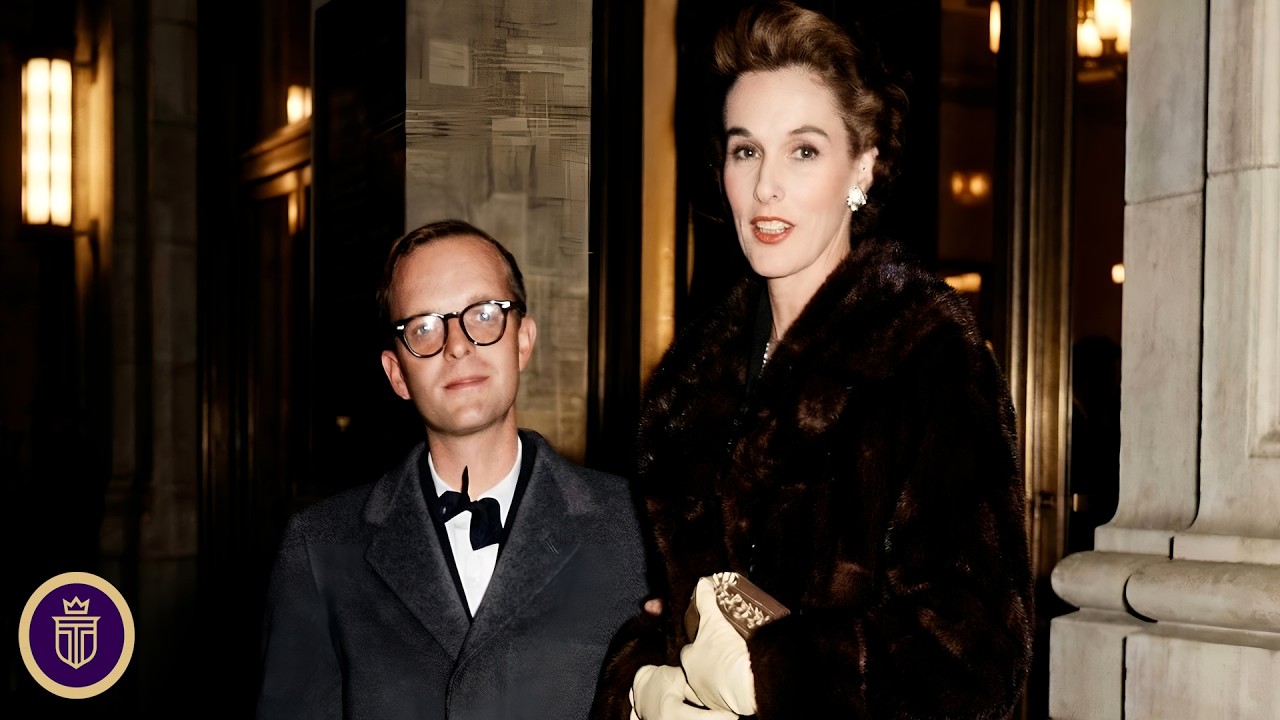
What cut deepest was not what Capote wrote about her directly. It was what he wrote about her husband, William S. Paley. The story of a prominent man, a wife, and a hotel room left no room for doubt.
The humiliation was precise, the identity unmistakable, and the wound entirely private. Babe had told Capote things she had never told anyone else. She had trusted him because he had made himself the one safe place in a life built on performance. Now he had turned that trust into material, published it for millions of readers, and called it literature.
She did not call him. She did not write. She did not ask friends to seek an explanation or an apology. She simply fell silent, and she held that silence until her death.
It was the most disciplined and devastating response she could have made. To understand it fully, one has to understand how she was made. Babe was born Barbara Cushing in Boston on July 5, 1915, the youngest of three daughters of Harvey Cushing, one of the most famous physicians in American history, a pioneer of neurosurgery and the namesake of Cushing’s disease. He was brilliant, exacting, and emotionally cold, largely absent from his daughters’ lives.
Her mother, Katherine Stone Crain, made her daughters her project. She raised them to understand beauty the way a chess player understands a powerful piece: as a strategic asset, valuable when used correctly and dangerous when neglected. Social standing in the Cushing household was not an accident. It was practice, discipline, something worked at daily without complaint, because the alternative was obscurity.
The strategy worked. The eldest sister, Betsey, married James Roosevelt, the son of Franklin Delano Roosevelt, and after that marriage ended, she married Jock Whitney, a man whose fortune eventually exceeded two hundred million dollars and who served as ambassador to the Court of St. James’s. The middle sister, Minnie, married Vincent Astor, heir to one of America’s greatest fortunes, and after that marriage ended, she married the painter James Fosburgh.
All three sisters trained to marry important men, and two of them did so with apparent success. Babe was the youngest and, by most accounts, the most beautiful. The pressure on her was therefore greatest. She began her career at Glamour in 1935 at the age of twenty, and by 1939 she had moved to Vogue, where she worked as a fashion editor.
In 1937, at the age of twenty-two, she was in a serious car accident. She shattered her jaw, lost her front teeth, and required extensive reconstructive surgery. What was remarkable was the aftermath: she emerged, by general testimony, more beautiful than before. The accident taught her a lesson she would apply for the rest of her life.
Personal pain was to be converted into public composure. One did not discuss it, because pity weakened the image, and the image was survival. Her first marriage came in 1940 to Stanley Mortimer Jr. , handsome, wealthy, and well connected.
They had two children, Stanley III and Amanda. Stanley went to war and returned a different man, an alcoholic suffering from what would later be called manic depression. Babe spent two years trying to manage the situation with the discipline she had been raised to apply to difficult people, then concluded it was hopeless. She filed for divorce in 1946.
At not quite thirty-one, she was one of the most photographed women in America. Her second marriage, in 1947, was to William S. Paley, who had built CBS from sixteen struggling radio stations into the most powerful broadcasting empire in America. He was Jewish at a time when American high society still closed certain doors to him.
Babe gave him what money could not buy: access, belonging, protection in the social worlds where he sometimes felt the awkwardness of his origins. He gave her the stage on which to practice her discipline on an unprecedented scale. The apartment at 965 Fifth Avenue had fourteen rooms and overlooked Central Park. There was Kiluna Farm in Manhasset, a working farm with formal gardens that became one of the great private entertaining places of mid-century America, and houses in Jamaica and the Bahamas.
They had two children together, William and Kate, who joined Paley’s two adopted children from his first marriage. Babe ran the household as she ran everything, with meticulous attention, absolute public calm, and a private life she shared with almost no one. The marriage was not what it appeared. Paley’s affairs were an open secret, the kind New York society maintained by not discussing them in front of the most affected person while discussing them freely everywhere else.
He humiliated her chronically and with apparent carelessness. Babe never complained publicly, not once in thirty years. She maintained the appearance of a happy, elegant, successful marriage at enormous cost, because the rules of her world required it. What she did with her pain was architectural.
She placed it where it could not be seen, in the perfection of her houses, her gardens, her table settings, her clothing. Style was the only realm where she had absolute authority. No one could take it from her or misuse it on her behalf. She did confide in one person.
Truman Capote entered her life in the early 1950s, at the peak of his talent. He was the most entertaining man at any party, brilliant, witty, and safe in a way other men were not. He was openly gay, uninterested in Babe as a conquest or a prize, and genuinely fascinated by her as a person. He named his circle of women friends his “swans” and made himself their confidant.
With Babe, he became the closest female friendship she ever had, though he was a man. She told him things she told no one else, about Paley’s affairs, about the humiliation of maintaining a happy marriage while her husband betrayed her so openly, about the price of being Babe Paley. He listened with complete attention and a total memory. She thought she was talking to a friend.
She was also talking to a journalist, and she did not know it. In November 1975, Capote published the chapter from Answered Prayers, the novel he had been promising for years. The story took place at La Côte Basque, the fashionable East 55th Street restaurant where Manhattan’s social elite lunched. The narrator sat with a character based on Lee Radziwill, and the descriptions were so accurate that no explanation was needed.
But the most destructive element was the story of the prominent man and his wife, the sheets in the hotel room, the precise detail of the humiliation. It was understood immediately and unanimously that the man was William S. Paley and the wife was Babe. The other swans understood exactly what had happened, because it could have happened to any of them.
Slim Keith was furious. Gloria Guinness was furious. C. Z.
Guest was furious. Marella Agnelli was furious. Overnight, Capote was cut from the social world he had spent twenty years entering as a favored guest. He had not anticipated this.
He had convinced himself that the work would be so brilliant that the people who served as his material would forgive him, as literary figures were historically expected to submit their personal objections to the public cultural good. He was wrong. Babe’s response was total silence. The other women could rage, giving him something to respond to, some drama he could play a role in and try to resolve.
Babe simply withdrew, permanently, and thereby demonstrated that her discipline was not superficial but structural, running through every layer of the self she had spent sixty years building. The year 1975 was cruel to her in a way that seemed deliberately timed. The lung cancer diagnosis came in the same year as Esquire. She had smoked all her adult life, as was common in her generation and class.
The cigarette had been as much a part of her image as a Hermès scarf or a Balenciaga dress. Now the habit revealed itself as something closer to self-destruction. She handled the illness as she handled everything else, quietly, with discipline, determined not to become a spectacle of suffering. She continued to appear at events when her health allowed, continued to dress carefully, continued to maintain her apartment and her routines.
What was hardest to maintain was the pretense that Paley was managing her decline with appropriate devotion. He was not. He continued to travel and socialize through her illness, present abroad when she needed him at home, at parties while she was confined to the apartment. She never saw Capote again.
She never sent word. Her silence continued through her entire illness, unbroken. She died in New York on July 6, 1978, one day after her sixty-third birthday. Paley remarried within the year.
Capote was informed of her death. He wept, the weeping of someone who had destroyed something he loved and knew it was his own doing. He tried to express condolences to her family and was refused. He never completed Answered Prayers.
The chapters he published, of which “La Côte Basque 1965” was the most famous and destructive, were all that existed in any publishable form. The rest of the manuscript, if it ever existed, did not survive him. He died on August 25, 1984, at the age of fifty-nine, of liver disease complicated by years of drug and alcohol addiction, having spent his last decade in slow, public decline. He destroyed his closest friendships for material he never used.
Babe Paley took her silence to the grave, and then her silence became permanent. She left no memoir, no interviews settling accounts, no explanation of her position. She did not complain. She closed the door quietly, without drama, and walked away from it.
In a life dominated by performance, that choice was the truest thing she ever did.