In 1751, English artist William Hogarth published an engraving titled *Gin Lane*. It depicts a London street descending into chaos, with a drunken mother letting her baby fall from a staircase while an exhausted man pawns his carpenter’s tools for another drink, a coffin is nailed together in the background, and a rundown building bears a sign promising that anyone can get drunk for just a penny. The image was not purely artistic exaggeration. It was political propaganda commissioned by supporters of new legislation intended to restrict gin, and it drew on a very real social catastrophe that had been unfolding in London for decades.
The print was sold cheaply on the streets, making it one of the most influential visual propaganda tools of its era, reaching the very poorest citizens it depicted. At the height of the crisis, historians estimate that the average adult in London consumed the equivalent of several dozen liters of pure alcohol per year through gin. In the poorest districts, the consequences were devastating: mortality rates rose sharply, birth rates fell, and documented cases of violence, child neglect, and family breakdown reached alarming levels. The affordability of gin lay at the heart of the problem, as tavern keepers openly advertised that for a single penny, one could get drunk.
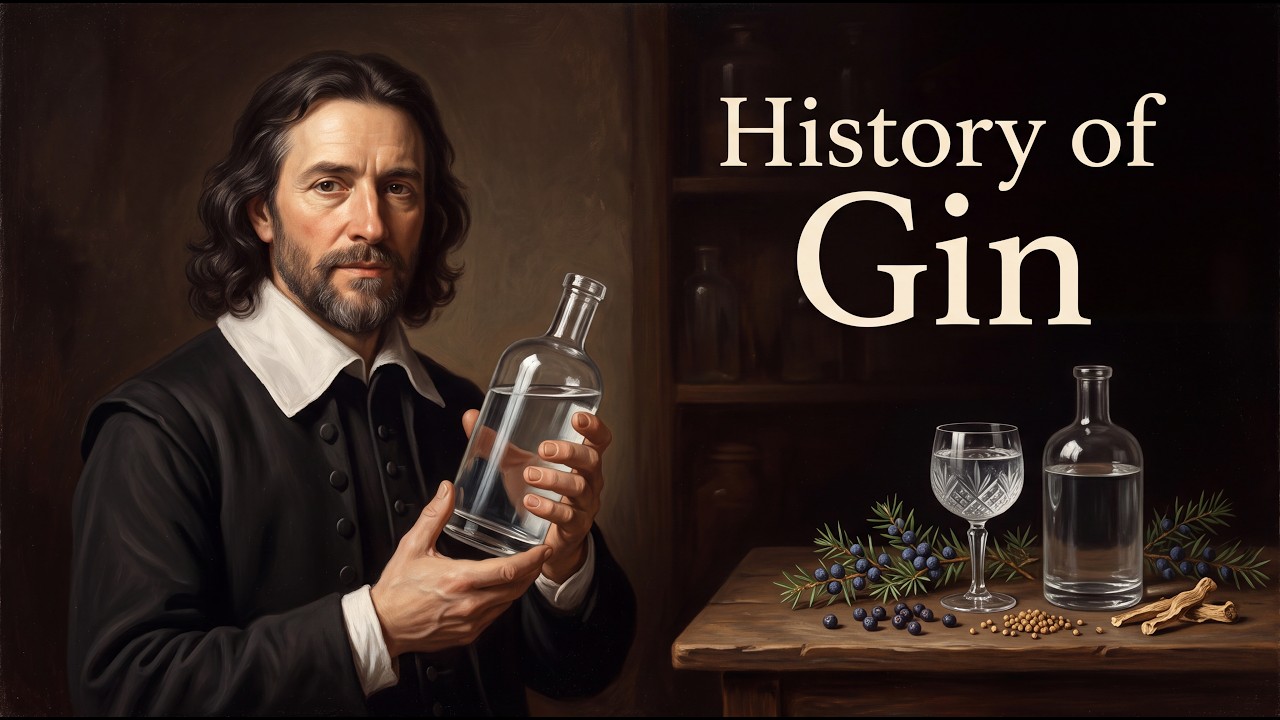
Some establishments even offered free straw in their cellars so patrons could sleep off their intoxication on the premises. The roots of this catastrophe stretch back to the 17th century. Gin’s precursor, jenever, was developed in what is now the Netherlands, where apothecaries prepared herbal infusions based on juniper berries as medicines believed to ease stomach ailments, support kidney function, and act as general tonics. For years, popular tradition credited Dutch physician Franciscus Sylvius, who taught at Leiden University in the mid-17th century, with inventing the drink.
Modern historians, however, treat this story with caution, as written references to juniper-based alcoholic infusions appear in Dutch and Flemish sources well before his time. Sylvius likely promoted an existing product rather than creating it, though the legend proved too appealing to disappear entirely. English soldiers first encountered the drink in large numbers while fighting alongside their Dutch allies in the 17th century. They adopted not only the habit but also the associated expression, which entered English as “Dutch courage,” meaning bravery derived from alcohol rather than character.
The word “gin” itself is a shortened form that gradually filtered down from the French “genièvre” through the Dutch “jenever” into English pronunciation. A pivotal turning point came in 1688, when William of Orange ascended the English throne. His government deliberately imposed heavy tariffs on imported French brandy while relaxing regulations on domestic gin production. Almost anyone with modest capital could obtain a license to distill and sell gin, bypassing the complex guild rules that applied to other alcoholic drinks.
The policy was designed as economic protectionism to support English grain farmers and reduce dependence on French imports, but the long-term consequences vastly exceeded what lawmakers had anticipated. Parliament, dominated by landowners who profited from converting surplus grain into gin, resisted repeated attempts at stricter regulation despite mounting evidence of social damage. By the 1730s, London was experiencing what modern historians describe as one of the first well-documented epidemics of mass alcoholism in European history. Hogarth’s *Gin Lane* was created as a counterpart to another engraving, *Beer Street*, which showed the same neighborhood filled with healthy, cheerful people enjoying ale.
Beer brewed from English grain was presented as a source of national prosperity, while gin, associated with foreign origins and extreme cheapness, was portrayed as a direct threat to society. The Gin Act of 1751, the final and most effective in a series of laws, introduced licensing requirements and taxes strict enough to curb the uncontrolled spread of cheap gin. Earlier attempts in 1729 and 1736 had largely failed, with the 1736 law’s prohibitive license fees causing the legal trade to collapse while illegal distilleries and underground sales proliferated. Illegal vendors developed nicknames for their hidden drinking establishments, with the most famous being the “cat and mutton” or “Old Tom” system, where customers dropped a coin into a slot and received their gin through a hidden pipe without ever seeing the seller.
While gin struggled to restore its reputation at home, a different story unfolded thousands of miles away. During the 19th century, British colonial administrators in India faced the constant threat of malaria. The only known effective treatment and preventive measure was quinine, a compound extracted from the bark of the cinchona tree, which had an intensely bitter, almost unbearable taste. Many British soldiers avoided their regular preventive doses despite the obvious danger.
To make the medicine more palatable, the East India Company distributed what became known as tonic, a mixture of quinine, sugar, and carbonated water. Officers soon discovered that adding a splash of gin transformed the medicine from merely tolerable into genuinely enjoyable. Thus the gin and tonic was born, not as a cocktail for pleasure but as a practical way to mask the taste of a malaria drug so soldiers would actually take it daily. The quinine concentration in modern tonic water is far lower than in the original 19th-century colonial version, so a contemporary gin and tonic has no significant malaria-fighting properties.
Nevertheless, Schweppes, one of the first companies to mass-produce tonic water in the mid-19th century, owes much of its early commercial success to this chapter of colonial medical history. A separate chapter of colonial history connects gin to scurvy, the vitamin C deficiency that killed more British sailors than many naval battles. By the mid-19th century, the Royal Navy required every ship to carry lime or lemon juice to prevent scurvy, but the sharp, sour taste was unpopular with many sailors. The same logic that created the gin and tonic found its way aboard naval vessels.
Lime juice was mixed with gin to create a drink later known as the gimlet. According to one popular theory, the cocktail is named after the small hand drill used by ship’s surgeons, though the true origin of the name remains a matter of debate among cocktail historians. A major technological turning point came in 1830, when Irish inventor Aeneas Coffey patented an improved continuous distillation apparatus. Unlike the traditional copper pot still, which had to be stopped and emptied after each batch, the Coffey still allowed distillation to run as a continuous process, producing much cleaner spirits with higher alcohol content while using less time and fuel.
This invention made possible a new style of spirit known as London dry gin. Unlike jenever, which retained a pronounced cereal character from traditional distillation, London dry gin was purer and more neutral, allowing juniper and other botanical flavors to take center stage without competing with heavy grain notes. By the end of the 19th century, this style had overtaken the original Dutch jenever and become the dominant form of gin worldwide, a position it still holds today. Jenever has survived as a separate historical category and continues to be produced in both Belgium and the Netherlands.
During American Prohibition, gin became the de facto spirit of the underground alcohol trade. Unlike whisky or brandy, which require years of aging in wooden barrels, gin can be produced and consumed almost immediately after distillation because its characteristic flavor comes from botanicals rather than long interaction with oak. In the 1920s, people produced rough homemade neutral spirits and steeped them with juniper berries and whatever other botanicals were available, often literally in their bathtubs. This gave rise to the term “bathtub gin,” which became firmly embedded in American English to describe the poor-quality homemade alcohol of the Prohibition era.
The simplicity of production explains why gin, rather than more time-consuming spirits, dominated the illegal American market. It also helps explain why the cocktail culture of the jazz age, designed to mask the harsh taste of inferior alcohol with fruit juices, syrups, and other mixers, became so closely associated with gin. Many classic cocktails still found on bar menus worldwide, including the early form of the martini and the entire family of fizz cocktails, owe much of their popularity to the need to disguise the unpleasant taste of illicit homemade spirits. Bartenders of that era were forced to be inventive out of practical necessity, and much of that ingenuity survived Prohibition and remained embedded in cocktail culture for decades.
By the late 20th century, gin was largely seen as a drink for an older generation, associated with traditional bars and classic cocktails. Younger consumers gravitated toward vodka and more neutral spirits considered more versatile and modern. That perception began to shift in the late 1990s and accelerated through the 2000s and 2010s, as a wave of craft distilleries, especially in the United Kingdom and the United States, began experimenting with botanical recipes far beyond the traditional combination of juniper, coriander, and citrus peel. Modern craft gins often contain dozens of unconventional botanicals, ranging from lavender and cucumber to seaweed and locally foraged herbs, chosen to express the unique character of the region where the spirit is produced, much like wine.
This renaissance has transformed gin from an old-fashioned drink into one of the fastest-growing segments of the premium spirits market. The journey of gin, from a pharmacist’s medicinal brew to a national social crisis, then to a practical medical solution of the British Empire, and finally to a symbol of modern cocktail culture, spans nearly four centuries. In each phase, its evolution was shaped less by the drink itself than by circumstances: a single king’s political decision, the military necessity of masking bitter medicine, the technological breakthrough of an Irish engineer, and the legal loophole that made it possible to produce a drink that did not require years of aging during Prohibition. Remarkably, almost none of the major turning points were driven by people who drank gin simply for pleasure.
Kings thought about trade tariffs, doctors focused on preventing malaria, engineers sought to improve distillation efficiency, and Prohibition-era bootleggers cared more about production speed than taste. Only in recent decades, with the rise of the craft distilling movement, has gin truly become a drink made primarily for its own flavor rather than as a solution to an unrelated practical problem. Hogarth’s *Gin Lane* still hangs in British museums as a reminder of how destructive unlimited access to cheap alcohol can be in conditions of extreme poverty, yet today the same juniper-based spirit stands on shelves in some of the world’s finest bars alongside the rarest wines.