On Monday, December 22, 2003, just after ten in the evening, three days before Christmas, Broadway singer Reena Strobel had just finished performing “Don’t Rain on My Parade” to warm applause at Rao’s, a small Italian restaurant on the corner of East 114th Street and Pleasant Avenue in East Harlem. She sat back down at her table, then heard a sound she thought was a waiter dropping a glass. It wasn’t. A 67-year-old man named Louis Barone pulled a Smith & Wesson .
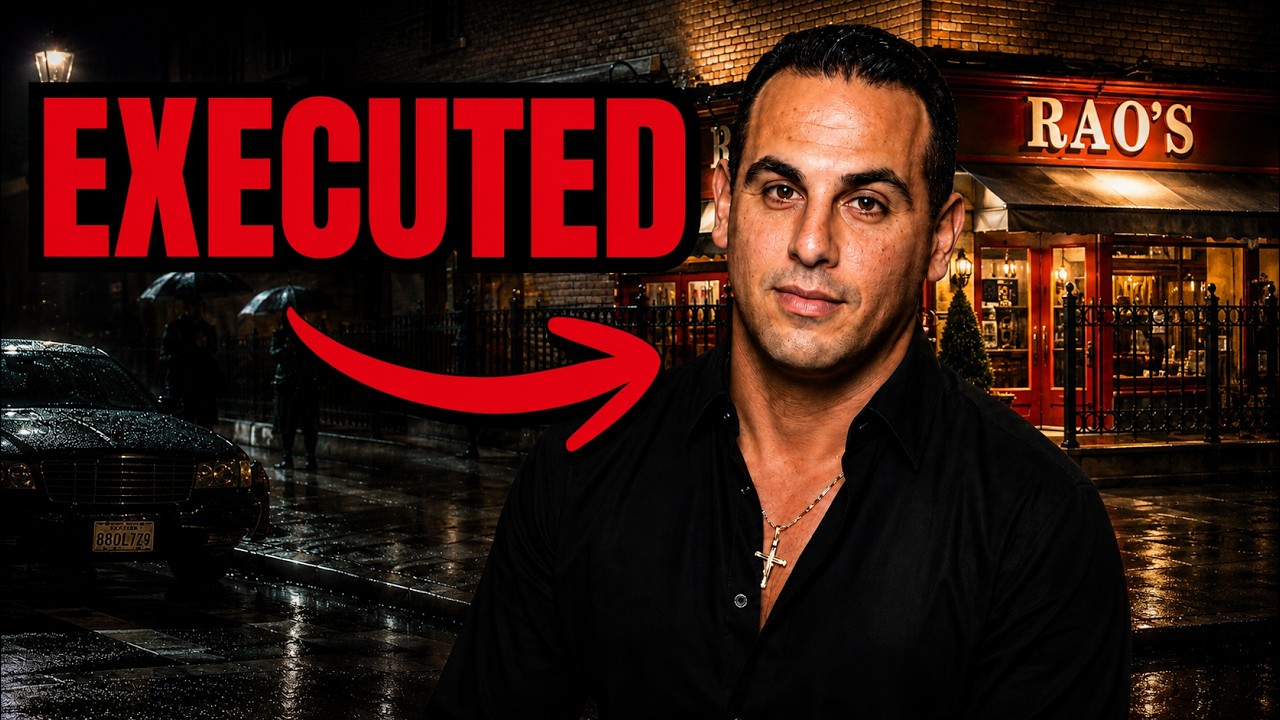
38 from his coat pocket and fired into the back of a man standing at the crowded bar. Albert Cirelli, 37, dropped face-first onto the floor. A second shot pierced the foot of an innocent diner sitting nearby. It all ended in seconds.
The man was dead before the Christmas lights on the wall had time to blink again. This was not a hit. There was no contract, no crew, no getaway car waiting outside. Louis Barone wasn’t even a formal member of the Mafia.
He was an aging associate of the Lucchese crime family who got involved in disputes perhaps once a year. The man he killed died over something remarkably trivial. Not money. Not power.
Not an informant. A man died because he wouldn’t stop talking while a young actress sang a Barbra Streisand song. This is the story of New York City’s most exclusive restaurant, a room so hard to enter that presidents, movie stars, and billionaires couldn’t buy a table. And this is the story of that December night when its unwritten codes turned into catastrophe.
Rao’s opened in 1896 when a family of immigrants bought a small bar at the corner of 114th and Pleasant, back when East Harlem was the largest Italian-American neighborhood in the country, bigger than downtown’s Little Italy. The place remained a single room, ten tables, four booths and six seats, fitting about sixty people. The walls were covered in Christmas lights kept up year-round, alongside framed photos of Frank Sinatra and Frankie Valli. For decades, it was a neighborhood secret.
Homestyle Southern Italian food, lemon chicken, fist-sized meatballs, and a marinara sauce that would later make the family millions when they sold it in jars on grocery store shelves. Then in 1977, New York Times critic Mimi Sheraton gave the tiny spot three stars, and everything changed. The phone rang constantly. Suddenly, 10,000 people wanted to sit in a room with just ten tables.
So owner Frank Pellegrino did something no other restaurant in the world did. He stopped taking reservations entirely. Instead, he assigned tables permanently. If you were a regular, that table was yours every night of your life.
When you died, your family inherited it. If you couldn’t come, you gave your table to a friend or donated it to charity. If you weren’t among the chosen, you didn’t get in. That simple.
Pellegrino turned so many people away he earned a nickname: Frankie No. On some nights, he couldn’t even find a seat for his celebrity friends. You have to understand how strange that was. This was a place frequented by Bill Clinton, Billy Joel, and Martha Stewart.
The table itself was a currency that outweighed money, because money couldn’t buy one. In such an intimate, club-like room, cut off from the outside world, everyone knew everyone. Each person had their place. Everyone understood the rules.
Some of the regulars, whose history went back generations, were men of influence, mob men. People joked it was the safest corner of Manhattan to park your car, because no one would dare touch anything near Rao’s. That’s the world Albert Cirelli walked into that Monday night. Cirelli was 37 and lived in Yonkers, just north of the city.
According to accounts that were accepted, he was either a worker for the Lucchese family or a low-ranking associate. That detail was genuinely disputed. The First Wire reported the night of the shooting that he was simply a customer. Later reports called him a worker.
What wasn’t in dispute was that he acted like someone who belonged, someone who deserved respect. That night, he came to Rao’s for a drink. Then there was the other man, Louis Barone, 67, silver-haired, unremarkable, the type you might pass on the street. Barone also had ties to the Lucchese family, but marginally.
A man who came to Rao’s about once a year, sat at the bar, and blended in. He wasn’t a professional killer. He wasn’t there for business. He was there, like everyone else, to eat and drink three days before Christmas.
Two men connected to the fringe of the same fading old world, in a room where honor still mattered and everyone watched to see if you had it. The singer, Reena Strobel, was 27 that December. Blue eyes, red hair, a rising Broadway actress, part of the national touring cast of Les Misérables. She had no ties to the Mafia.
She wasn’t from that world at all. She was Jewish, from a different New York than the one inside Rao’s. She got her seat at the table thanks to Sonny Grosso, a former NYPD detective, and not just any detective. Grosso was one of the real cops whose work helped solve the famous French Connection heroin case, later immortalized in the film.
Grosso became a television producer and embraced Strobel like a loving father. He had a table at Rao’s on Monday nights and took Reena with him every week. She ate oysters and lemon chicken, mixing with the elite. At some point during the evening, Frank Pellegrino would ask her to sing, because that was the ritual.
Pellegrino had decided some time ago that “Don’t Rain on My Parade,” that great song from Funny Girl, made famous by Barbra Streisand, was her signature. He knew she was a real Broadway performer, and he loved showing her off. On her nights, the jukebox would play, Reena would stand and sing for the crowd, and everyone would cheer. But this Monday was different.
It was three days before Christmas, and the place was packed. All ten tables were full, and customers stood in tight rows. The noise was loud, like a boisterous party. When Pellegrino asked her to sing, Reena hesitated.
The room was too loud, she thought. Too chaotic. Maybe she should wait until the crowd calmed down. But Pellegrino had made up his mind.
He hit the button on the jukebox. Once the instrumental began, it was her cue. She stood and started singing, walking toward the back of the restaurant, letting her powerful voice out while the room roared with cheers. She didn’t know what was happening at the bar behind her, because Albert Cirelli wasn’t impressed by her performance.
According to Barone’s own confession to police later, Cirelli turned to a friend at the bar and growled, “Ah, shut up. Get her off. She’s terrible. ” Louis Barone was standing there.
For Barone in that room that night, this wasn’t just rudeness. It was a violation. Someone was insulting a guest, a singer, in front of everyone. So Barone did the simplest thing possible.
He raised his index finger to his lips and signaled for silence. “Calm down. Let her sing. ”
It should have ended there.
But things escalated quickly. Cirelli didn’t accept the rebuke. He confronted Barone. He put his finger in the old man’s face, and according to the confession, threatened him crudely and viciously, telling him exactly what he’d do to him.
Barone told police, “I don’t have to be talked to that way. ” But the insults continued, and something snapped in the 67-year-old, in his chilling words to investigators later: “I was so angry. My eyes were tearing. ” Then Barone said the sentence that explains this entire tragedy.
The sentence that reveals the secret of an old code, a code most of the world had abandoned. He told police, “I lost face. I had to defend my honor. I had no choice but to shoot him.
I had no choice but to kill him. ”
Think about what that means. He had no choice. In Louis Barone’s world, at that back corner of an old subculture, the fate of a man who allowed himself to be publicly humiliated in front of influential people in tight rows was death.
Backing down meant a different kind of death. And so a marginal old man, who visited that restaurant once a year, decided in a matter of seconds that a stranger’s rudeness left him no choice but to kill. Here’s what happened next. As Cirelli finally turned and moved to leave the bar, Barone reached into his right coat pocket.
He brought out a Smith & Wesson . 38 and shot Albert Cirelli in the back. Cirelli hit the floor instantly, face down on the restaurant floor. Then Barone did something that shows how far gone he was in that moment.
Cirelli was already down. It was over. But Barone, in his own words, blacked out. He admitted, “I lost my temper.
” He fired a second time. The bullet missed Cirelli entirely. Instead, it flew across the room and hit a 57-year-old man named Albert Petrula in the foot. Petrula wasn’t involved in any of this.
He was a court clerk, a regular man having dinner, and suddenly a body dropped right in front of him and a bullet settled in his foot. Petrula described that horrible moment simply: he was staring at the dying man, and the dying man was staring back. Petrula said he felt sorry because he knew he’d be taken to the hospital, and he knew the other man would be taken to the morgue. Meanwhile, Reena Strobel, who had just finished her song and sat down, dove under her table.
She thought the first shot was a glass falling. When the second shot rang out, she understood, and this young Jewish actress, hiding under a table in a packed Mafia Italian restaurant three days before Christmas, began to pray. She recited the Shema, the holiest prayer in Judaism, the words traditionally recited at deathbeds. Because in that moment, she truly believed she might be about to die.
Now look at what Louis Barone did next, because it tells you everything. He didn’t run. He didn’t try to hide the weapon. He simply dropped the gun on the floor, right there, just like you see in the old gangster movies.
Then he walked out. He stepped onto the sidewalk in the cold December night and walked straight toward two uniformed police officers. He told them calmly that someone had been shot inside. An off-duty cop who had been eating dinner in the restaurant ran out behind him and pointed at Barone as the shooter.
That was it. The old man was arrested on the spot. He defended his honor, and it cost him a man’s life, wounded a court clerk, and traumatized a young singer, all in under a minute. The consequences came quickly and harshly.
Albert Cirelli died from his wounds. Albert Petrula was treated at the hospital and survived a wound to his foot. As for Louis Barone, he didn’t defend himself like a hardened killer. In 2004, Barone pleaded guilty to manslaughter and assault, and was sentenced to 15 years in state prison.
He never walked out of prison. Louis Barone died behind bars of natural causes, according to the New York State Department of Corrections. An elderly man who gave away the rest of his life over moments of wounded pride in a bar. But the fallout extended far beyond the two men at the center of it.
Suddenly, Rao’s, that untouchable little restaurant, found itself facing what it had avoided for a century. The story was too tempting. A real mob shooting at New York’s most exclusive restaurant over a singer, three days before Christmas. It felt like a missing episode of The Sopranos.
In fact, the writers of Law & Order turned it into an entire episode, building a fictional murder in a restaurant on what happened that night. Even late-night talk show hosts cracked jokes about it. And Frank Pellegrino seized the moment. He was a record store owner and an actor too.
He played a chef in Goodfellas and an FBI chief on The Sopranos. The line between the real Rao’s and fictional Mafia lore collapsed completely. Then there was Reena Strobel. Overnight, she went from an unknown touring actress to, in her own words, the singer of the Mafia song.
Journalists knocked on her door. The trauma was real. She lived with PTSD, with memories of her prayers under that table, with every move she made being followed. She never went back to her usual Monday nights at Rao’s.
Not once. Instead, she joined the Friars Club and sang there on Thursday nights, telling herself that a room full of elderly unarmed Jewish men might be a safer place to perform. But she also said that night changed her permanently. It made her afraid of nothing.
She decided life was short. She stopped playing it safe. Years later, she turned the entire surreal experience into a one-woman show called Spaghetti and Matzo Balls, about a nice Jewish girl who accidentally found herself in the middle ofCONTENT:
On the night of Monday, December 22, 2003, just after ten o’clock, three days before Christmas, Broadway singer Reena Strobel had finished performing “Don’t Rain on My Parade” to warm applause at Rao’s, a small Italian restaurant on the corner of East 114th Street and Pleasant Avenue in East Harlem. She sat back down at her table and heard a sound she assumed was a waiter dropping a glass.
It wasn’t. A 67-year-old man named Louis Barone pulled a Smith & Wesson . 38 from his coat pocket and fired at the back of a man standing at the crowded bar. Albert Cirelli, 37, fell face-first to the floor.
A second shot pierced the foot of an innocent diner nearby. It was all over in seconds. The man was dead before the Christmas lights on the wall had flickered again. This was not an orchestrated hit.
There was no contract, no crew, and no getaway car waiting outside. Barone was not even an official member of the Mafia. He was an aging associate of the Lucchese crime family, involved in disputes perhaps once a year. The man he killed died over something trivial.
Not money. Not power. Not an informant. A man died because he would not stop talking while a young actress sang a Barbra Streisand song.
This is the story of the most exclusive restaurant in New York City, a room so hard to enter that presidents, movie stars, and billionaires could not buy a table. And it is the story of the December night when its unwritten rules turned into catastrophe. To understand how a man could die over a show tune, you must first understand the place. Rao’s opened in 1896.
A family of immigrants bought a small bar at the corner of 114th and Pleasant, back when East Harlem was the largest Italian-American neighborhood in the country, bigger even than downtown’s Little Italy. The bar remained a single room of ten tables, four booths and six seats, fitting roughly sixty people. The walls were covered in Christmas lights left up all year round, plus framed photos of Frank Sinatra and Frankie Valli. For decades, it was a neighborhood secret.
Homestyle Southern Italian food, lemon chicken, fist-sized meatballs, and a marinara sauce that would later earn the family millions when sold in jars on grocery shelves. Then in 1977, New York Times critic Mimi Sheraton gave the small spot three stars, and everything changed. The phone rang endlessly. Suddenly there were 10,000 people wanting to sit in a room with only ten tables.
So the owner, a man named Frank Pellegrino, did something no other restaurant in the world did. He stopped taking reservations completely. Instead, he permanently assigned the tables. If you were a regular, that table was yours for life.
When you died, your family inherited it. If you could not come, you gave your table to a friend or donated it to charity. If you were not among the chosen, you did not get in. Simple as that.
Pellegrino turned away so many people that he earned a nickname: Frankie No. There were nights he could not even find a seat for his own celebrity friends. You need to grasp how strange that was. This was a place frequented by Bill Clinton, Billy Joel, and Martha Stewart.
The table itself was the currency, worth more than money, because money could not buy one. In such an intimate, club-like room, isolated from the outside world, everyone knew everyone. Each person had their place. Everyone understood the rules.
Some of the regulars, with histories stretching back generations, were men of influence, mob men. People joked it was the safest corner of Manhattan to park your car, because no one would dare touch anything near Rao’s. That was the world Albert Cirelli walked into that Monday night. Cirelli was 37 and lived in Yonkers, just north of the city.
According to the account generally accepted, he was either a worker for the Lucchese crime family or a low-ranking associate. That detail is genuinely disputed. The First Wire reported the night of the shooting that he was simply a patron. Later reports described him as a worker.
What is beyond dispute is that he acted like someone who belonged, someone deserving respect. That night, he came to Rao’s to drink. Then there was the other man. Louis Barone, 67, silver-haired, unassuming, the kind you would overlook on the street.
Barone was also connected to the Luccheses, but marginally. A man who came to Rao’s about once a year, sat at the bar, and blended in. He was not a professional killer. He was not there for business.
He was there, like everyone else, to eat and drink three days before Christmas. Two men connected at the fringe of the same fading old world, in a room where honor still mattered and everyone watched to see if you had it. The singer, Reena Strobel, was 27 that December. Blue eyes, red hair, a rising Broadway actress, part of the national touring company of Les Misérables.
She had no ties to the Mafia. She did not come from that world at all. She was Jewish, from a different New York entirely. She received her seat at the table thanks to a man named Sonny Grosso, a former NYPD detective.
Not just any detective. Grosso was one of the real cops whose work helped solve the famous French Connection heroin case, later immortalized in film. Grosso had become a television producer and embraced Strobel like a loving father. He had a table at Rao’s on Monday nights and brought Reena with him every week.
She ate oysters and lemon chicken, mingling with the elite. At some point during the evening, Frank Pellegrino would ask her to sing, because that was the tradition. Pellegrino had decided some time before that “Don’t Rain on My Parade,” that wonderful number from Funny Girl made famous by Barbra Streisand, was her song. He knew she was a real Broadway performer and loved to show her off.
On her nights, the jukebox would play, Reena would stand and sing for the room, and the crowd would cheer. But this Monday was different. It was three days before Christmas, and the place was packed. All ten tables were full, and customers stood in tight rows.
It was loud, more like a raucous party. When Pellegrino asked her to sing, Reena hesitated. The room was too loud, she thought. Too chaotic.
Maybe she should wait for the crowd to settle. But Pellegrino had made up his mind. He pressed the button on the jukebox. Once the instrumental began, it was her turn.
She stood and started singing, moving toward the back of the restaurant, letting her powerful voice out while the room roared with cheers. She did not know what was happening at the bar behind her, because Albert Cirelli was not impressed by her performance. According to Barone’s own confession to police later, Cirelli turned to a friend at the bar and growled, quoting him, “Ah, shut up. Get her off.
She’s terrible. ” Louis Barone was standing there. For Barone, in that room that night, this was not just rudeness. It was a violation.
Someone was insulting a guest, a singer, in front of everyone. So Barone did the simplest thing possible. He raised his index finger to his lips and signaled for silence. “Calm down.
Let her sing. ”
It should have ended there. But things escalated quickly. Cirelli did not accept the rebuke.
He confronted Barone. He put his finger in the old man’s face, and according to the confession, threatened him crudely and viciously, telling him exactly what he would do to him. Barone told police, “I don’t have to be talked to that way. ” But the insults continued, and something snapped in the 67-year-old, in his chilling words to investigators later.
He said, “I was so angry. My eyes were tearing. ” Then Barone spoke the sentence that explains this whole tragedy. The sentence that reveals the secret of a dying code, a code most of the world had abandoned.
He told police, “I lost face. I had to defend my honor. I had no choice but to shoot him. I had no choice but to kill him.
”
Think about what that means. He had no choice. In Louis Barone’s world, at that back corner of an old subculture, the fate of a man who allowed himself to be publicly humiliated in front of influential people in tight rows was death. Backing down meant another kind of death.
And so a marginal old man who visited that restaurant once a year decided, within seconds, that a stranger’s rudeness left him no choice but to kill. Here is what happened. As Cirelli finally turned to leave the bar, Barone reached into his right coat pocket. He brought out a Smith & Wesson .
38 and shot Albert Cirelli in the back. Cirelli hit the floor immediately, face down. Then Barone did something that shows how far gone he was in that moment. Cirelli was already down.
It was over. But Barone, in his own words, blacked out. He admitted, “I lost my temper. ” He fired a second time.
The bullet missed Cirelli entirely. Instead, it flew across the room and hit a 57-year-old man named Albert Petrula in the foot. Petrula was not involved in any of this. He was a court clerk, a regular man dining out, and suddenly a body dropped in front of him and a bullet lodged in his foot.
Petrula described that terrible moment later, simply. He was staring at the dying man, and the dying man was staring back. Petrula said he felt sorry, because he knew he would be taken to the hospital and he knew the other man would be taken to the morgue. Meanwhile, Reena Strobel, who had just finished her song and sat down, dove under her table.
She thought the first shot was a falling glass. When the second shot rang out, she understood, and this young Jewish actress, hiding under a table in a packed Mafia Italian restaurant three days before Christmas, began to pray. She recited the Shema, the holiest prayer in Judaism, the words traditionally said at the deathbed. Because in that moment she truly believed she might be about to die.
Now look at what Louis Barone did next, because it tells you everything. He did not run. He did not try to hide the weapon. He simply dropped the gun on the floor right there, just as you see in the old gangster movies.
Then he walked out. He went onto the sidewalk in the cold December night and walked straight toward two uniformed police officers. He told them calmly that someone had been shot inside. An off-duty cop who had been eating dinner in the restaurant ran out behind him and pointed at Barone as the shooter.
That was it. The old man was arrested on the spot. He defended his honor, and it cost a man his life, wounded a court clerk, and traumatized a young singer, all in less than a minute. The consequences came quickly and harshly.
Albert Cirelli died from his wounds. Albert Petrula was treated in the hospital and survived his foot injury. As for Louis Barone, he did not defend himself like a hardened killer. In 2004, Barone pleaded guilty to manslaughter and assault, and was sentenced to fifteen years in state prison.
He never left prison. Louis Barone died behind bars of natural causes, according to the New York State Department of Corrections. An elderly man who gave away the rest of his life over moments of wounded pride in a bar. But the fallout reached far beyond the two men at the center of it.
Suddenly, Rao’s, the untouchable little restaurant, found itself facing what it had avoided for a century. The story was too tempting. A real mob shooting at New York’s most exclusive restaurant, over a singer, three days before Christmas. It sounded like a lost episode of The Sopranos.
In fact, the writers of Law & Order turned it into a full episode, building a fictional murder in a restaurant on what happened that night. Even late-night talk show hosts told jokes about it. And Frank Pellegrino seized the moment. He was a record store owner and also an actor.
He played a chef in Goodfellas and an FBI chief on The Sopranos. The line between the real Rao’s and fictional Mafia lore collapsed entirely. Then there was Reena Strobel. Overnight, she went from an unknown touring actress to, in her own words, the singer of the Mafia song.
Journalists knocked on her door. The trauma was real. She lived with PTSD, with memories of her prayers under that table, and with scrutiny following her every move. She never went back to her usual Monday nights at Rao’s.
Not once. Instead, she joined the Friars Club and sang there on Thursday nights, telling herself that a room full of elderly unarmed Jewish men might be a safer place to perform. But she also said that night changed her permanently. It made her afraid of nothing.
She decided life was short. She stopped playing it safe. Years later, she turned the whole surreal experience into a one-woman show titled Spaghetti and Matzo Balls, about a nice Jewish girl who accidentally found herself at the center of a mob murder.