By 1945, more than eight million Panzerfaust launchers had been distributed across a crumbling Germany. They were simple, cheap, and terrifyingly effective. A metal tube, a shaped charge, and the promise that even a farm boy could stop a tank.
In reality, the Panzerfaust did not save its wielders. It condemned them. For every tank destroyed, another man disappeared into smoke—burned, crushed, or erased from the chaos he had dared to challenge.
The weapon was supposed to equalize the battlefield, allowing ordinary men to fight the unstoppable steel beasts of the Red Army. Propaganda called it the fist of the Reich. Soldiers called it something else: the last chance.
When handed to old men and teenage boys in the ruins of Berlin, the Panzerfaust became more than a weapon. It became a confession of how far Germany had fallen, and how little life it had left to trade for its dying dream.
The Panzerfaust did not appear out of genius. It appeared out of panic. By 1942, the German army had marched deep into the Soviet Union and discovered that its greatest enemy wasn’t manpower or weather. It was armor.
The new Soviet T-34 and KV-1 tanks were a nightmare. Sloped armor, wide tracks, heavy guns. They shrugged off Germany’s 37 mm anti-tank cannons, the same weapons once advertised as tank killers.
Frontline reports grew desperate. Units described shooting entire magazines into Soviet tanks with no effect. Crews watched shells bounce off steel, while the tanks simply rolled forward and crushed their positions.
Something had to change fast. But the solution would not come from the factories building massive Tigers or Panthers. It would come from an idea small enough to fit in one man’s hands.
Engineers in Leipzig began sketching what the Wehrmacht desperately needed: a one-shot weapon any soldier could carry, cheap enough to make by the millions. Its name would echo simplicity. Panzerfaust. Armor fist.
At first, it seemed laughable. A thin steel tube, black powder inside, a shaped charge perched like a hammerhead on top. But this crude design held a radical principle: recoilless launch.
When fired, gases burst backward through the open tube, canceling recoil but creating a deadly blast behind the operator. It was disposable, meant to be fired once and thrown away. A single-use salvation.
The engineers solved the physics. They didn’t solve the human problem. The weapon could pierce 200 mm of armor, but it offered almost no distance to live.
At the heart of the Panzerfaust lay a piece of genius physics. Instead of relying on speed, it used shape. The warhead’s conical cavity focused the explosive’s energy into a molten jet of copper that could burn through tank armor like butter.
For 1943, this was revolutionary. A five-kilogram tube that could kill a fifty-ton tank. German soldiers were astonished. At last, they could fight armor with something other than courage.
But there was a catch: accuracy and range. The primitive sight was marked for 30, 60, and 80 meters. Hitting a moving tank while shells exploded around you was less a skill than a miracle.
To use it effectively, you had to let the tank come close. Too close. Until you could smell its exhaust and hear the grinding of its tracks. The Panzerfaust was powerful, but it was a power that demanded suicidal proximity.
Once testing proved its lethal promise, production exploded. By late 1943, the first Panzerfaust 30s rolled off assembly lines. Factories converted civilian labor, prisoners, and even school workshops to meet quotas.
Each weapon was stamped with red warnings: “Achtung! Feuerstrahl!” Danger. Fire jet. Soldiers received minutes of training. Aim low. Stand clear behind. Fire once.
On the Eastern Front, the first shipments reached infantry trapped under Soviet counter-offensives. Reports came back glowing. T-34s destroyed at point blank range. Tank columns halted by men with nothing but these tubes.
Berlin took notice. Propaganda hailed the weapon as proof that faith and courage could still win the war. But behind the posters, officers knew what it really meant. Every man was now expected to fight armor alone.
Each new version promised longer range. Panzerfaust 30, then 60, then 100. Numbers that sounded reassuring but rarely matched battlefield reality. In practice, accuracy dropped fast beyond 40 meters.
The back blast was deadly in confined spaces. After firing, a glowing flash and smoke plume exposed the operator instantly. Yet millions were distributed anyway. It was cheap, fast, and symbolic. The perfect tool for a collapsing Reich that needed the illusion of resistance.
September 1943. The first Panzerfausts reached the Eastern Front. Small tubes carried by men who barely understood them. Soviet tanks were already breaking through in waves, their armor glinting under the gray sky.
When the first German infantryman fired, the blast was deafening. The warhead struck a T-34’s side and tore it open like paper. Black smoke poured upward. The weapon worked.
Commanders cheered. Reports called it a miracle. For the first time in months, the infantry felt they could fight back.
But as more units received the weapon, patterns emerged. The miracle came at a cost. Every Panzerfaust success seemed followed by another death: the man who fired it.
Many were burned by their own back blast. Others were caught in the open, revealed by the fiery flash. In a world of armor and artillery, standing 30 meters from a tank was not bravery. It was suicide disguised as duty.
To use the weapon effectively, new hunter teams were formed. Panzerjäger commandos, two or three men armed only with Panzerfausts and grenades. They lay hidden in ruins or forests, waiting for Soviet tanks to turn their flanks.
Timing was everything. A second too early and the shot would miss. A second too late and the tank’s machine guns would erase them.
These were not professional soldiers anymore. Many were clerks, students, or farmers drafted in desperation. The Reich told them they were tank killers. In truth, they were men sent to die within shouting distance of the enemy.
Still, they fought. In street battles from Warsaw to Budapest, small Panzerfaust teams managed to stall entire armored brigades. Cheap tubes destroyed machines worth thousands of man-hours. But every shot drew return fire so fierce that few lived long enough to reload.
By 1944, the war had moved into cities—dense, shattered labyrinths where tanks were blind and infantry ruled. Here, the Panzerfaust became both hero and executioner.
From basements and corners, men aimed at silhouettes rolling between ruins. At 30 meters, there was no margin for error. Soviet crews responded brutally. Tanks advanced with flamethrowers and machine guns sweeping every window.
After a single Panzerfaust shot, artillery leveled entire blocks. Casualties among German tank hunters were staggering. Records from late-war Berlin suggest survival rates under 20% per engagement.
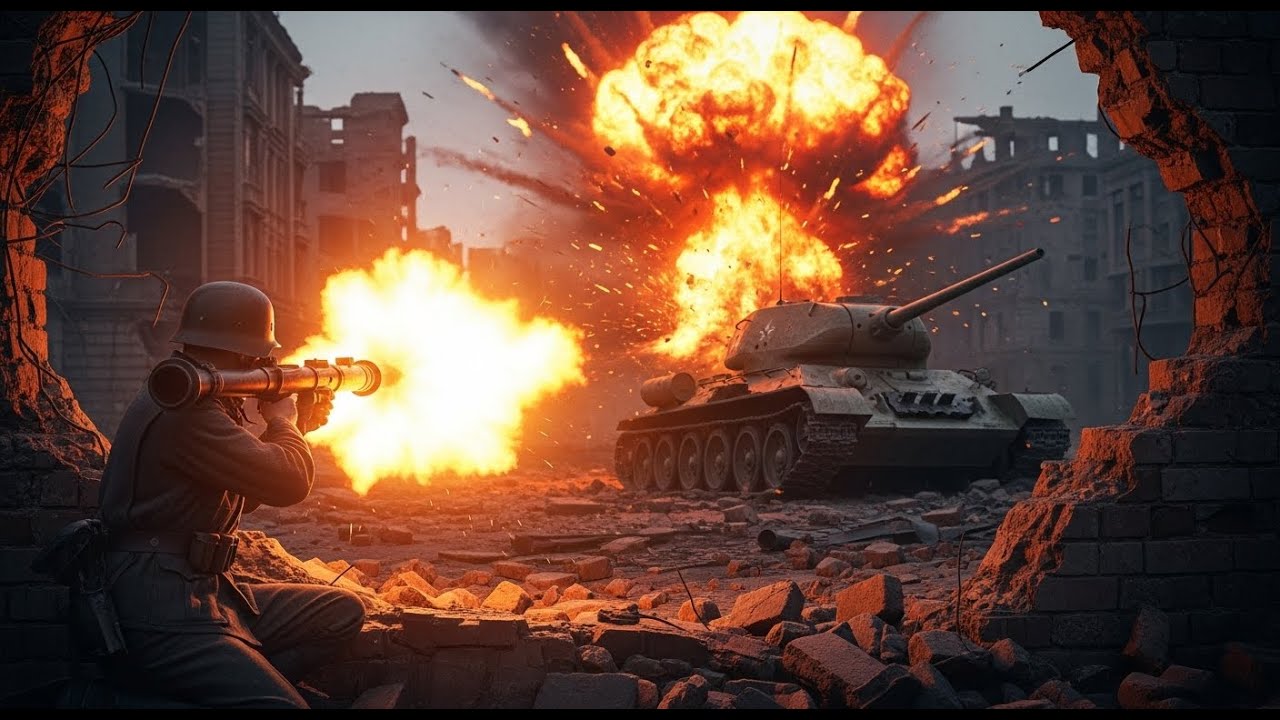
A soldier could destroy a tank, yes, but he rarely survived to see it burn. To civilians hiding nearby, these firefights sounded like thunder trapped in stone corridors. Explosions, screams, silence, then another shot somewhere else.
The Reich called it courage. The men called it inevitability.
By early 1945, roughly 70% of Soviet tank losses on the Eastern Front were attributed not to Tigers or Panthers, but to handheld weapons, mostly Panzerfausts. The weapon worked. Statistically, it was the deadliest anti-tank system of the war.
But those numbers hid the truth. The cost was measured not in marks or metal, but in bodies. For every tank destroyed, multiple infantrymen died attempting it.
The average engagement distance of 30 to 40 meters meant the operator had seconds to act before being crushed or vaporized. Back blast injuries filled field hospitals: scorched faces, deafened ears, fractured skulls from firing too close to walls.
Training manuals warned, “Never shoot from enclosed space.” Yet in city fighting, there was no choice. Soldiers fired from doorways, cellars, even sewers. The flash that killed a tank often blinded the man who caused it.
In the end, the Panzerfaust didn’t save infantry. It consumed them.
When Germany’s reserves ran dry, the weapon spread to the unthinkable: the Volkssturm, the People’s Storm. Boys as young as 16. Men as old as 60. They were handed Panzerfausts and told they were now the last line of defense.
In Berlin, propaganda films showed them smiling, firing at mock targets. In reality, they had only minutes of training. Many never even test-fired the weapon before facing real tanks.
Eyewitnesses recalled children crouched behind debris, waiting for the massive shadows to pass. Some hit their targets. Most were crushed where they knelt.
The Panzerfaust turned ordinary citizens into symbols of fanatic resistance. Armed, doomed, and used. When the Soviets finally entered the capital, they found streets littered with spent launchers and bodies still gripping them, as if death itself had frozen in defiance.
The Panzerfaust was a weapon of engineering brilliance, but also of moral collapse. It embodied everything the Reich had become: ingenious yet suicidal, efficient yet senseless.
By giving every civilian a chance to fight tanks, Berlin also gave them a death sentence. The weapon did not extend the war by months. It extended the suffering by millions of seconds. Each one belonging to a boy, a worker, a father, standing alone with a tube of steel and a handful of courage.
When the smoke cleared, the factories that built it lay in ruins, and the myth of the armor fist vanished into silence. It had served its purpose—not to win, but to show the world what a dying empire looks like when it refuses to fall quietly.
Even as the Reich collapsed, its engineers continued refining the weapon that had already become its symbol. The Panzerfaust 60, the most produced version, doubled the range and improved accuracy, but not survival.
Then came the Panzerfaust 100, boasting 100 meters of safety that never truly existed. In 1945, the Panzerfaust 150 arrived. Sleeker, faster, with a two-stage propellant and a smaller, sharper warhead capable of piercing 300 mm of armor.
It could even be fitted with a fragmentation sleeve to kill infantry. But it was too late. The factories were bombed, the front was gone, and the soldiers were children.
Still, engineers dreamed of one final version: the Panzerfaust 250, a reloadable launcher with a pistol grip and electric firing mechanism. The true ancestor of the modern RPG. It never reached production. The war ended before desperation could evolve any further.
When Soviet engineers entered captured German arsenals, they studied every detail of the Panzerfaust. By 1949, their findings materialized as the RPG-2, a weapon eerily similar in shape, size, and purpose.
The design spread worldwide—from Korea to Vietnam to countless proxy war zones where soldiers once again fired from alleys and jungles at armored beasts they could barely see.
The spirit of the Panzerfaust lived on. Simple, deadly, disposable. Its philosophy—empowering the powerless at suicidal range—became a doctrine.
The irony was cruel. A weapon born in the death throes of Nazi Germany became the foundation of guerrilla warfare across the post-war world. From the ruins of Berlin to the rice fields of Asia, its echo remained the same. One man, one shot, and one heartbeat between life and death.
After the war, German veterans rarely spoke of the Panzerfaust. In Allied museums, it stood on display as a technical curiosity: “An efficient solution to a desperate problem.”
But for those who fired it, it was never a symbol of pride. It was a memory of fear. The heat of the back blast, the roar of tank engines, the scream of dying friends.
Historians later called it the poor man’s tank killer. Yet the name hides the truth. It was the poor man’s death sentence.
Every launcher represented a tactical success and a human failure. Proof that technology can give power without protection, and that bravery, when stripped of reason, becomes tragedy.
Berlin, April 1945. A street reduced to rubble. Smoke drifts between the shells of buildings. A Soviet tank rolls forward, its gun scanning the debris.
Beneath a shattered window, a boy crouches, his hands trembling around a Panzerfaust. He aims, fires, and the world explodes.
When the dust clears, both the tank and the boy are gone.
That image—captured in memory more than film—became the final chapter of the Panzerfaust story. Courage without survival. Invention without mercy.
It was Germany’s last fist raised against fate, and the moment it finally struck itself.
In the end, the Panzerfaust changed the nature of warfare. Not because of what it destroyed, but because of what it revealed. It showed that even in the twilight of total defeat, a nation could still innovate, still believe, still send its sons to die for one last explosion of defiance.
Its legacy was not victory. It was the realization that technology cannot save a lost cause. It can only make the dying more efficient.
The armor fist may have shattered steel, but it could never protect flesh and bone.
So when history speaks of the Panzerfaust, it should not speak of ingenuity or glory, but of silence. The silence that follows a single shot echoing through the ruins of a war that forgot its humanity.