In July 1948, two parolees from the Ohio State Reformatory shot John Neble, his wife Nolina, and their 21-year-old daughter Phyllis in a cornfield off Fleming Falls Road. The men, Robert Daniels and John West, had been released by the same institution that had been built to reform young offenders. Neble ran the farm at the prison, which stood a few hundred yards from his home north of Mansfield, Ohio. The Ohio State Reformatory was built in the shape of a cathedral at enormous expense, with one stated purpose: to take young men who had made mistakes and return them to the world with a trade, an education, and their own name.
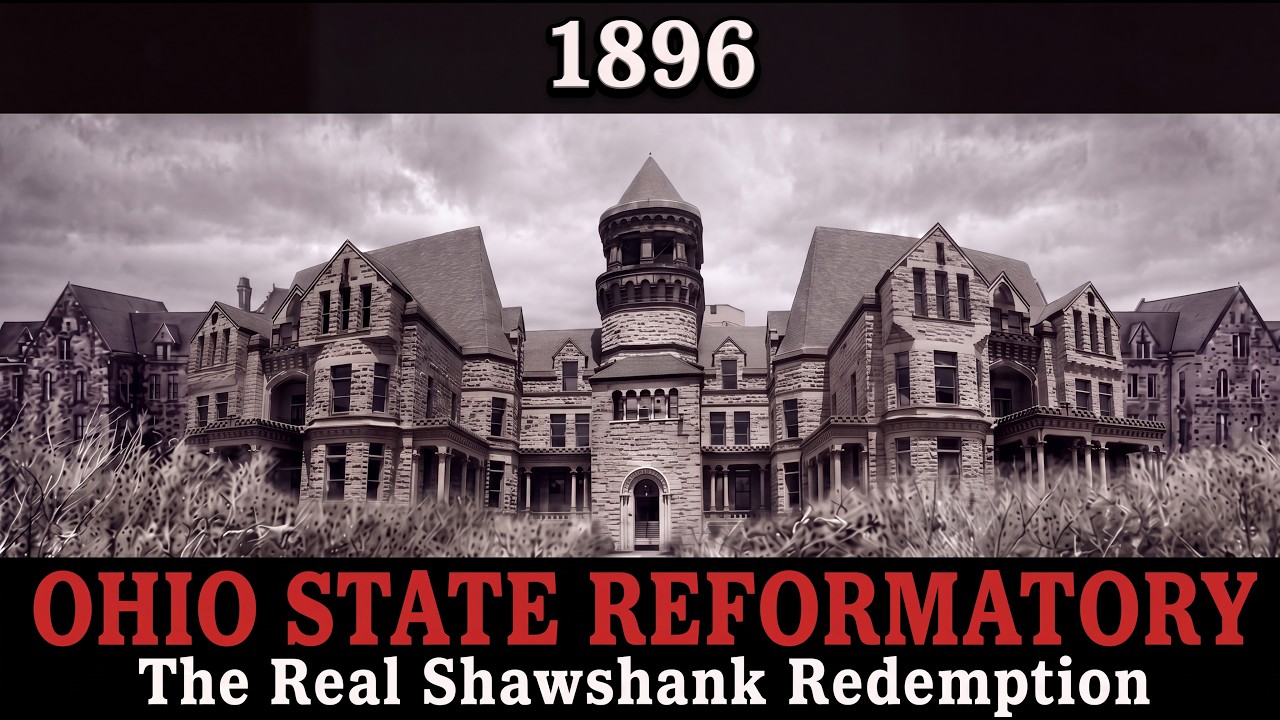
Roughly 155,000 men passed through its gates between 1896 and 1990. The institution stopped operating not because of scandal or riot, but because a federal judge ordered Ohio to shut it down. The building’s origins date to a Civil War training ground on the same meadow outside Mansfield. In 1862, regiments formed up on that slope and marched south.
When construction began in 1886, some of the wooden quartermaster buildings from the war were still standing. The state used the same field twice, both times for young men: the first time it sent them out to war, the second time it kept them confined. Ohio faced a real problem in the 1880s. A 19-year-old convicted of burglary or theft had only two possible destinations: the boys’ industrial school at Lancaster for children, or the Ohio Penitentiary at Columbus for everyone else.
Reformers argued the penitentiary was a school where young offenders learned from hardened criminals, and the state was paying the tuition. On April 14, 1884, the Ohio legislature created what it called the “intermediate penitentiary” — a place between the school for children and the prison for men. The model came from New York, where superintendent Zebulon Brockway had opened an institution at Elmira in 1876. Brockway’s radical idea was that a sentence should not be a fixed number of years but an open range, with the institution itself deciding when a man had earned his way out through his own conduct.
Ohio hired architect Levi Scofield of Cleveland, who had designed the Soldiers’ and Sailors’ Monument on Public Square. When the state handed him a prison to design, he designed a church, working in Romanesque and Gothic styles. The reasoning was treatment: the argument was that a young man who woke up inside a building that looked like a house of God would be moved toward becoming a better man. The cornerstone was laid on November 4, 1886, but construction took far longer than expected.
Work continued for ten years before a single prisoner was housed there, meaning the men who finished building the reformatory were the men it was built to hold. In September 1896, 150 men were transferred from the Ohio Penitentiary to Mansfield. All were between 16 and 30, all were in state prison for the first time, and none had been convicted of murder. The first thing they did was finish building their own prison, digging the sewer system and building the 25-foot stone wall around the complex.
For its first decades, the reformatory worked as intended for many. There was a school with mandatory attendance, a chapel, and a substantial trade school where men made shoes, furniture, harnesses, and vehicles. There was a print shop, a machine shop, a barber shop, a power plant, and a farm with its own superintendent. A young man who arrived unable to read and left with a skill and a suit of clothes often never returned.
A family lived inside the walls from early on. The superintendent and his wife and children had quarters on the second floor of the administration building, with a dining room, a kitchen, a cook, and a piano on the prison side of the gate. Children did their homework on the second floor of a prison and walked through the gate to school each morning. The entire system depended on one assumption: that the population would stay small enough for the institution to see each individual man.
Men were given indeterminate sentences, and the administration decided when they left based on their conduct, work, and schooling, tracked through a grade system. A man’s release date was not a date but an opinion held by people he mostly never spoke to, based on a file. By the 1930s, that system had collapsed under its own weight. The east cell block, completed between 1908 and 1910, was six tiers of steel cells in a single hall, 600 cells total, standing free of any outer wall.
It holds the Guinness World Record as the largest freestanding steel cell block in the world. Each cell measured about seven by nine feet, roughly the size of a small bathroom, designed for one man. By the mid-1930s, most cells held two men and sometimes three. The case of Merrill Chandler shows how far the system had drifted from its purpose.
A 22-year-old from Columbus sent to the reformatory for stealing a car, he was exactly the person the 1884 act had been built for. On October 2, 1932, four men attempted an escape. A guard named Frank Hanger, 48, was struck on the head with an iron bar and died four days later. Two of the men were sentenced to death and executed in the electric chair on November 23, 1933.
Chandler, 23, was one of them. A young man sent to the institution for stealing a car left it 16 months later for the electric chair, and a 48-year-old guard was dead as well. In 1934, Superintendent Thomas Jenkins wrote that “reform rather than punishment is the ultimate objective of the Ohio State Reformatory. ” He wrote that with sincerity, in a building where most cells held two or three men.
Discipline in the overcrowded institution relied on a basement block of 20 solitary confinement cells known as “the hole. ” The cells had no windows, only a bare bulb, and ceilings so low a tall man could not stand straight. In 1957, a serious disturbance broke out in the west cell block. Accounts describe men taking control of the block for two days, hostages, and the National Guard being called in.
Afterwards, some 120 men were reportedly put into the 20-cell basement for 30 days — six men to a cell in a windowless basement for a month. The most famous tragedy occurred outside the walls. On July 21, 1948, a disturbance inside the reformatory began over a baseball game the men had been told they would not attend. A fire damaged the chapel and administration block, and several men escaped.
But the two men central to the story were already out. Robert Daniels and John West were parolees of the institution, judged ready by its own machinery to reenter society. That same month, they went across Ohio, leaving six people dead. One of the places they went was the reformatory farm.
John Neble had spent his working life running that farm, living on the property with his wife Nolina and their 21-year-old daughter Phyllis. According to accounts, the two men came to the house armed, looking for a guard who lived nearby, and came to the wrong door. They took the family to a cornfield off Fleming Falls Road, where Daniels shot each of them. Two days later, on the morning of July 23, 1948, Daniels and West were driving west on US Route 224 in a stolen auto transport truck.
Ahead was a roadblock manned by three men: Van Wert County Sheriff Roy Schaffer, game warden Frank Freemoth, and Sergeant Leonard Kahn of the Van Wert city police. West came out shooting, hitting Kahn in the chest and Freemoth in the arm. Kahn, shot through the chest, stayed on his feet long enough to return fire and killed West. Daniels was taken alive, tried, convicted, and executed in the electric chair at the Ohio Penitentiary on January 3, 1949 — the very institution the reformatory had been built to keep young men out of.
A state historical marker at the corner commemorates the event. Two years later, the building claimed someone from the other side of the bars. By 1950, Superintendent Arthur Glatkey lived in the second-floor apartment with his wife Helen and their sons. On November 5, 1950, Helen was in the quarters when a handgun left on a closet shelf was dislodged, fell, and discharged.
She was wounded and died three days later at age 41, with the recorded cause of death being pneumonia. The official finding was that it was an accident. Glatkey remained at the reformatory for another eight years, dying of a heart attack at his desk on February 10, 1959. The famous events at the reformatory were all stories about individuals.
The thing that finally closed the institution was not a person but a number. By the summer of 1978, the building designed for 1,200 people was holding about 2,140. In August 1978, a man held in the building did the one thing the institution could not stop him from doing: he wrote to a federal court. Four men — remembered today by one surname, Boyd — filed a class action complaint against the state of Ohio, the director of the Department of Corrections, and the superintendent of the reformatory.
Their claims were under the Eighth Amendment, which forbids cruel and unusual punishment, and the Fourteenth Amendment, which guarantees due process. The complaint described the building as “put up in the 1800s and deteriorated to a condition the Constitution doesn’t permit. ” It alleged “brutalizing and inhuman conditions. ” The case was carried by a coalition of church and civic groups called the Council for Human Dignity, acting for the roughly 2,200 men then inside.
The case number was C78-1679 in the United States District Court for the Northern District of Ohio. Almost five years passed between the complaint and the order that resolved it. The plaintiffs lived inside the exhibit the entire time. On February 1, 1983, Chief Judge Frank Batisti approved a consent decree.
Batisti was the judge who had spent years running the desegregation of the Cleveland public schools, and he was not hesitant to order state government to rebuild itself. The decree required that no man be crowded into a cell beyond capacity, that men not in solitary confinement receive at least 40 hours a week out of their cells, and that visiting rights be broadened. Then it did the extraordinary thing: it permanently enjoined the defendants from operating the Ohio State Reformatory at all as of December 31, 1987. A federal court did not order Ohio to fix the prison.
It ordered Ohio to stop having it. The deadline passed, and the reformatory remained open. The state had nowhere to put the men. The replacement, Mansfield Correctional Institution, was to be built immediately west of the old prison and was not finished.
Men continued to be held in a building a federal judge had ruled the state could not lawfully run for three more years. Men arrived in 1988, a full year after the institution was legally supposed to have ceased to exist, and did their time in the condemned building. A journalist who saw the inside in 1990 called it “decaying and inhumane and very active,” describing roughly 2,000 men whose crimes, in his words, could not have merited the horrible lives they were forced to endure. The last prisoners were moved out of the Ohio State Reformatory on December 31, 1990.
The consent decree had worked, but a deadline only closes a prison at the speed the state can build another one. Double-celling was formally prohibited, time out of cells widened, visits expanded, and the population came down hard. The four men who filed the complaint did not sue only for themselves. They sued as a class action for everybody held in the building — a 19-year-old sentenced in 1985 walked through the gate already carrying rights that four strangers had won for him before he was old enough to drive.
On the far side of where the wall used to stand, on the prison’s own ground, there is a cemetery with 215 graves. Each stone is small, flat, and marked with a number — the number the institution assigned on the day a man arrived. No name, no dates, no age, no county. The men buried there died mostly of disease in the crowded decades, of influenza and tuberculosis, which is what happens when you put three men in a room built for one.
When a man died and no family claimed the body, the institution buried him on its own land. The institution was good at reducing people to numbers. But the burial records survived, and volunteers have matched the numbers to the names and published the list. You can take a number off a stone and get back a man — a name, a year, sometimes a county.
The building itself survived, barely. After the last prisoners left, the state planned to demolish it. The wall was pulled apart by machines, reduced to a line in the grass. In 1993, a film crew arrived to shoot an adaptation of a Stephen King novella directed by Frank Darabont, and they needed a prison.
The reformatory was empty, enormous, and photogenic. According to the warden of the new institution next door, the day they wanted to start shooting was the day the building was scheduled for the wrecking ball, which was physically on site that morning. The film bought the reformatory a stay of execution and then an afterlife. The Mansfield Reformatory Preservation Society was formed in 1995 and bought the building from the state for $1.
It is a museum now, visited by more than 170,000 people a year, with much of the funding coming from tickets, events, filming fees, and ghost hunts. The Ohio State Reformatory spent 94 years turning men into numbers. For 94 years, almost nobody could make it write a name down. Then, in 1978, it was four men with a complaint.
Today, it is a handful of volunteers with a burial register. The cathedral still stands on the rise above Mansfield with a new roof over 600 empty cells. The wall the first men built is gone.
And out on the open grass where it used to run, the numbers are still lying in their rows, waiting for somebody to look them up.