A U. S. Army chaplain bought 640 acres of Sonoran Desert in 1888 for about $1,600. Today, a single home on that same land can list for $10 million.
Scottsdale, Arizona, went from a place where almost nobody lived to a destination celebrated by travel magazines — and then became the city that seasoned travelers quietly avoid. The story of Scottsdale isn’t about decline. It’s about a place that got everything it wanted and lost the only thing it had: the desert itself. The man who started it all was Winfield Scott.
Born in 1837, he had fought in the Civil War, become a Baptist minister, and served as an army chaplain at posts across the frontier. By 1888, he was past 50, tired of cold winters, and looking for a place where the climate might ease his joints and cheap land might ease his finances. The Salt River Valley in central Arizona looked like opportunity. Water could be diverted.
The soil, once irrigated, was surprisingly fertile. And the land cost almost nothing because almost nobody wanted it. Scott paid $2. 50 per acre.
It was desert — rattlesnakes, creosote bush, and summer temperatures that could kill you. Scott planted citrus trees, barley, and alfalfa. An adobe schoolhouse was built in 1896, and someone suggested naming the settlement after its founder. That was Scottsdale, a farming community in the middle of nowhere.
For the next three decades, Scottsdale was cotton and cattle. Long-staple Pima cotton grew well in the irrigated desert soil, and demand was enormous during World War I. The fabric was strong enough for airplane wings and balloon cloth, and the military needed all it could get. By the 1920s, Scottsdale had maybe a couple hundred residents, a general store, a church, and a few dusty streets.
Nobody was coming to Scottsdale to visit. The summer heat was genuinely dangerous, reaching 110, 115, sometimes more. It was a place where people worked hard and lived quiet lives that no newspaper would cover. What changed everything was tuberculosis.
In the early 20th century, the dry desert air of Arizona became one of the few treatments doctors could recommend for lung disease. There was no antibiotic for TB until the 1940s. Thousands of people moved to the Salt River Valley seeking a cure. They came from the East Coast and the Midwest, from cities thick with coal smoke and factory exhaust.
Some got better. Enough recovered that Arizona developed a nationwide reputation as a place of healing. The health seekers brought something more lasting than a medical economy. They brought awareness.
Letters went home to families in Cincinnati, Philadelphia, and St. Louis. Articles appeared in Eastern newspapers. Through the 1920s and 1930s, a second wave arrived — wealthier, healthier, drawn not by illness but by curiosity and leisure.
They came to see the extraordinary landscape for themselves. Guest ranches opened, and they were something genuinely special. The Jokake Inn, built in the late 1920s from adobe bricks and desert stone, sat at the base of Camelback Mountain. Guests rode horses through the open desert before breakfast, watched sunsets from a patio, and went home to Boston or Chicago telling everyone about this unspoiled place in Arizona.
The Camelback Inn opened in 1936, the brainchild of Jack Stewart, a cattleman from Sedona. He built it on 35 acres with individual adobe casitas scattered across the grounds and riding trails that disappeared into the open desert. It wasn’t selling luxury the way a city hotel sold luxury — marble lobbies and crystal chandeliers. It was selling the desert: the emptiness, the light, the experience of being somewhere remote while still having someone press your shirts.
This was the bargain Scottsdale made with the world. For a while, it worked perfectly. The desert was the product. The emptiness was the amenity.
It was a business model that depended on restraint — and restraint is the hardest thing to maintain when the money gets good. Then Frank Lloyd Wright arrived. He first came to Arizona in 1928 to consult on the Arizona Biltmore in Phoenix. He came back in the winter of 1937 with a specific mission: a permanent winter home and studio for himself and his fellowship of architecture students.
He chose a site in the foothills of the McDowell Mountains, northeast of Scottsdale’s little downtown, where the land was nothing but volcanic rock, ironwood trees, barrel cactus, and astonishing desert light. What Wright built was Taliesin West, one of the most important structures in the history of American architecture. He designed it using materials from the landscape itself — desert rocks set in concrete forms, redwood beams, canvas stretched across angled frames. He called it “a look over the rim of the world.
” From the terrace, you could see miles of empty desert toward Phoenix and almost nothing man-made between you and the horizon. That emptiness was the point. Wright believed the desert was a living masterpiece, and anything built in it should defer to it. That would matter later.
Wright worked at Taliesin West every winter until his death in April 1959 at age 91. His presence attracted other artists and architects. Paolo Soleri established his studio near Paradise Valley in 1956. Painters arrived, sculptors arrived, craftspeople who worked in silver, turquoise, leather, and clay.
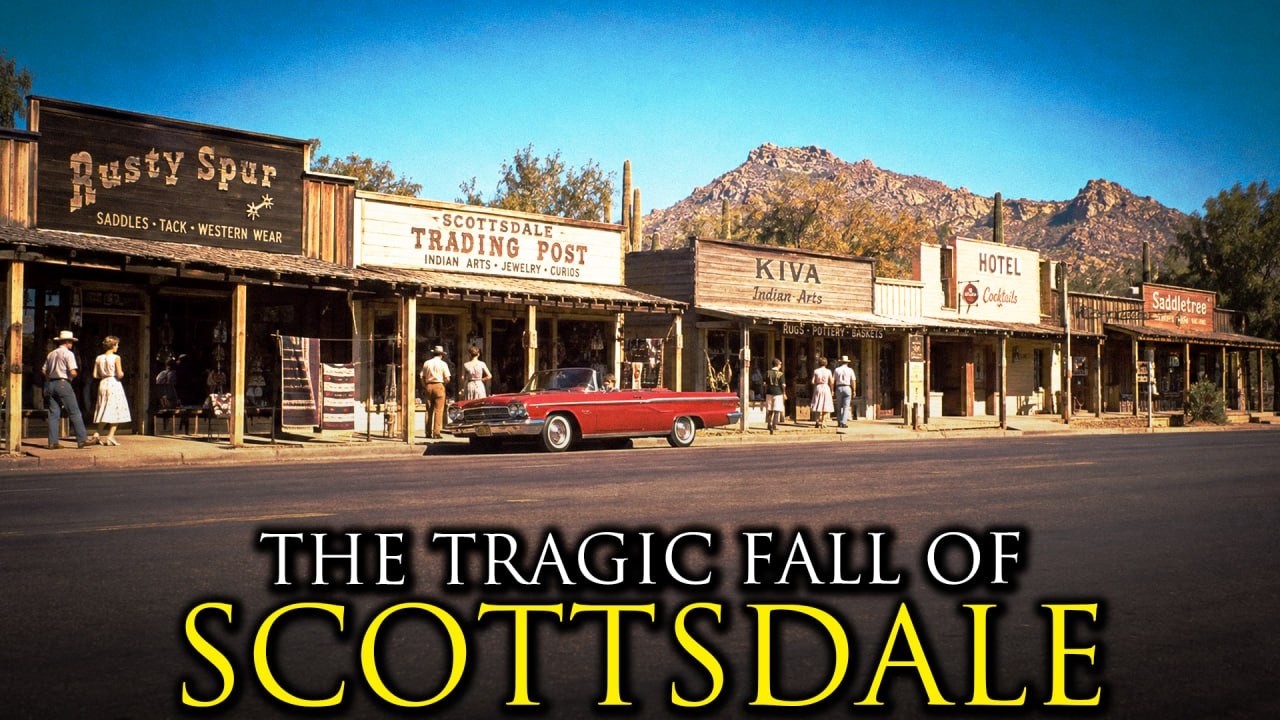
By the 1950s, Scottsdale had become a small, authentic, artistic community in the desert. But at the same time, the town’s civic leaders were discovering something more profitable: marketing. In the late 1940s, Scottsdale adopted the slogan “The West’s Most Western Town. ” After World War II, Americans had disposable income and a romantic appetite for the frontier.
Scottsdale — never a serious cow town, with no gunfight or cattle drive legend — decided to sell itself as the genuine article. The town required western-themed architecture downtown. Storefronts went up with board-and-batten facades nailed over ordinary commercial buildings. Hitching posts appeared on sidewalks.
In 1954, Scottsdale launched the Parada del Sol, an annual rodeo and parade celebrating its “cowboy heritage” — a heritage that was, generously speaking, about six years old. Real ranching was brutal and unglamorous. What Scottsdale was selling was the idea of ranching: the romance, the costume, the myth. Tourists bought it enthusiastically.
The population, barely 2,000 when the town incorporated in 1951, more than quintupled by 1960. Two versions of Scottsdale now existed simultaneously. There was the Scottsdale of the artists and architects — the real desert, the serious creative work. And there was the Scottsdale of the promoters — the stage-set western town designed to attract visitors and their money.
Only one of those versions scaled. Through the 1960s and 1970s, the population climbed relentlessly: 10,000 in 1960, nearly 68,000 by 1970, pushing toward 90,000 by 1980. Phoenix was exploding, driven by air conditioning, interstate highways, defense industry jobs, and Sun Belt migration. Scottsdale was riding the same wave, but it had something Phoenix didn’t: a reputation as the classy, artistic neighbor.
The art gallery scene accelerated. In 1975, the Scottsdale Gallery Association launched the Thursday night art walk. Galleries along Main Street and Marshall Way opened their doors, poured wine, and let visitors wander from show to show on warm desert evenings. By the late 1980s and into the 1990s, the district was one of the most significant art markets in the American West.
At its peak, the area may have had well over a hundred galleries. Scottsdale was mentioned alongside Santa Fe as one of the two essential art destinations in the American Southwest. During this period, Scottsdale was close to perfect for a certain kind of traveler — someone who cared about art, appreciated the desert landscape, and wanted sophistication without pretension. That visitor is the one who eventually stopped coming.
The resort era was already building pressure. The Camelback Inn had been acquired by Marriott in 1967. New luxury properties were going up along Camelback Mountain and in the North Scottsdale foothills. And then came Charles Keating and the most expensive hotel in Scottsdale history, built with money that didn’t belong to him.
Keating was a Cincinnati financier and political power broker. In the early 1980s, his company, American Continental Corporation, acquired Lincoln Savings and Loan Association. Keating decided to build the most lavish resort in the American Southwest at the base of Camelback Mountain, on land where the Jokake Inn had once stood. Construction consumed the mid-1980s at a reported cost estimated between $250 million and $300 million.
The Phoenician opened in December 1988 with Italian marble, a mother-of-pearl lined swimming pool, a reported $25 million art collection, and an 18-hole golf course carved into the mountainside. The answer to what it all meant arrived four months later. In April 1989, Lincoln Savings and Loan was seized by federal regulators. Approximately 23,000 bondholders lost their savings, some of them their entire retirement.
The total cost to taxpayers was estimated at roughly $3. 4 billion. And sitting at the base of Camelback Mountain was a $300 million resort built substantially with those depositors’ money. Keating was convicted on state fraud charges in California in 1991 and on federal fraud charges in 1993.
Both convictions were later overturned on legal technicalities. He pleaded guilty to lesser fraud charges in 1999 and served about four and a half years in total. He lived quietly in Phoenix until his death in 2014. The Phoenician was seized by the Resolution Trust Corporation and eventually sold for reportedly around $170 million — roughly half what it cost to build.
Today, it operates as a luxury Marriott property. The fact that it was built with stolen retirement savings is not mentioned on the website or by the staff at check-in. The resort was the logical endpoint of a philosophy that had been forming for years: the desert was not enough. What visitors really wanted was luxury laid on top of desert.
The landscape became backdrop rather than substance. The lesson, if there was one, went unlearned. What Scottsdale took away from the Phoenician saga was that there was clearly a market for this. The resorts multiplied.
By the 1990s, the city had crossed a threshold that couldn’t be uncrossed. The population passed 130,000 in 1990 and hit 200,000 by 2000. The city now covered roughly 184 square miles. Most of that land, open desert within living memory, was being covered.
Golf courses led the charge. The greater Phoenix metro area has over 200 golf courses, and a disproportionate number are in or near Scottsdale. Each consumes between 100 million and 150 million gallons of water per year — in a desert where average annual rainfall is roughly 7 to 8 inches. Scottsdale’s water situation is more complicated than critics usually acknowledge.
The city draws from the Salt River Project, the Central Arizona Project, and groundwater. The city has invested aggressively in water recycling and banks water underground for future use. By many measures, Scottsdale’s water management is among the most sophisticated of any desert city in America. But the Colorado River, which supplies a critical share of Arizona’s supply, has been in sustained crisis.
Lake Mead fell to levels not seen since the 1930s, and Arizona has faced mandatory cutbacks. There’s a specific kind of cognitive dissonance in standing on a manicured fairway and looking up to see a saguaro cactus on the adjacent hillside — a plant that evolved to survive on 8 inches of rain a year, standing 50 feet from a sprinkler system that puts out that much water before lunch. The cactus has been there for 200 years. The golf course has been there for 20.
The deeper change, the one that altered what Scottsdale actually felt like as a place, was happening downtown. Oldtown — where Winfield Scott’s original settlement once stood, where the western storefronts went up, where the art galleries clustered — underwent a change through the 2000s and 2010s that longtime residents describe with a vocabulary ranging from resignation to fury. The bars came first. Sports bars, cocktail lounges, then nightclubs with DJs and bottle service.
Bachelorette parties began arriving in waves — groups of women in matching pink t-shirts and tiaras moving from bar to bar, documenting every stop for Instagram and TikTok. By the mid-2010s, “Oldtown” had become, for a significant demographic, essentially synonymous with “party district” — Scottsdale’s version of Sixth Street in Austin or Bourbon Street in New Orleans. Social media accelerated everything. Scottsdale became a content destination.
People didn’t just visit; they performed their visit, curated it, posted it, and moved on. The galleries started closing. The 2008 financial crisis crushed the market for fine art. Online art sales ate into walk-in traffic.
And the rents — landlords in Oldtown discovered they could charge substantially more to a nightclub than to a gallery. A bar generates revenue per square foot per hour. A gallery generates revenue per square foot per month. When the landlord’s mortgage payment doesn’t care about the cultural value of what’s inside the building, the math is simple.
Some galleries held on. The Scottsdale Museum of Contemporary Art continued operating. But by the 2010s, the gallery count had dropped dramatically from its peak. A city that once had one of the densest concentrations of art galleries in the country became better known for its bar scene than its art scene.
What replaced the art was luxury retail. Scottsdale Fashion Square, which began as a modest open-air shopping center in 1961, was expanded into one of the largest malls in the American Southwest — roughly 2 million square feet of climate-controlled retail with Neiman Marcus, Gucci, Prada, Tiffany, and Cartier. The mall is, by the standards of American luxury retail, excellent. It is also, in every meaningful sense, the opposite of what Scottsdale once was.
The desert has been completely removed from the equation. You could shop at Scottsdale Fashion Square with your eyes closed and never know what state you were in. North Scottsdale filled with master-planned communities whose names tell you the target market: DC Ranch, Silverleaf, Greyhawk, Desert Mountain, Troon North. Homes with price tags starting in the low millions and climbing past $20 million in the most exclusive enclaves.
The neighborhoods are beautiful in the way all well-funded developments are beautiful. They could also be in Calabasas or Boca Raton or any other high-income Sun Belt suburb. Nothing about living in a Scottsdale master-planned community is substantially different from living in any other prosperous Sun Belt city. The desert is visible, but it is decoration — tamed, bordered, incorporated into a landscape plan.
What made Scottsdale different — the thing no developer’s budget could replicate, no architect could design, no marketing campaign could manufacture — was the desert. And the desert within the city limits has been consumed acre by acre. Drive through South Scottsdale today and the landscape is strip malls, car dealerships, chain restaurants, and six lanes of traffic. The saguaros that once defined the horizon have been transplanted to the medians of boulevards, standing in decorative rows.
Wright would barely recognize the approach to Taliesin West. The empty desert he looked out across from his terrace is filled with subdivisions. The silence he prized is gone. Taliesin West became a UNESCO World Heritage Site in 2019 and draws architecture enthusiasts from around the globe.
The building is magnificent, but the landscape it was designed to harmonize with no longer exists in that location. The masterwork survives. The context that gave it meaning has been developed. Scottsdale has more amenities than at any point in its history.
The Waste Management Phoenix Open has become the most attended tournament on the PGA Tour. Barrett-Jackson brings its massive collector car auction every January. Spring training brings major league baseball teams every February and March. There is no shortage of things to do.
The question is whether any of them require Scottsdale — whether they couldn’t happen just as easily in any warm-weather city with enough hotel rooms. The golf could be anywhere with flat land and water. The shopping could be anywhere with retail square footage. The nightlife could be anywhere with liquor licenses.
Even the resorts, stripped of the desert context, are increasingly interchangeable with luxury properties elsewhere. What can’t be replicated anywhere else is the Sonoran Desert — and that’s what keeps shrinking. There is a counterargument, and it’s one Scottsdale deserves credit for. In 1994, voters passed a ballot measure to create the McDowell Sonoran Preserve, a protected area of desert and mountainland permanently off-limits to development.
In 1995, they approved Proposition 400, a sales tax increase to fund the acquisition. Over the following decades, the preserve expanded parcel by parcel. By the mid-2020s, it covered approximately 30,000 acres — one of the largest urban preserves in the United States. The preserve is genuinely remarkable: a city that had been consuming its desert at an alarming rate looked at what remained and said at least some of this has to be permanent.
But the preserve also reveals the depth of what had already been lost. The fact that Scottsdale needed to pass a special tax and spend hundreds of millions of dollars buying its own desert back from developers tells you how far the transformation had gone. Land that was worth $2. 50 an acre in 1888 had become so valuable that the public had to outbid the market just to keep it empty.
The desert wasn’t a given anymore. It was a luxury. Ask someone under 40 what they associate with Scottsdale, and the answer is bachelorette weekends, expensive brunch spots, influencer culture, luxury shopping, golf, and maybe spring training. Ask someone over 60 who visited in the 1970s or 1980s, and the list sounds like a different city: the galleries, the art walk, the desert light, the feeling of being somewhere that genuinely wasn’t like anywhere else in the country.
Both versions are accurate, but they can’t both be the same place. The comparison people reach for most often is Santa Fe, another southwestern city that built its reputation on art, landscape, and a distinctive architectural tradition. Santa Fe enforced strict building codes and maintained its cultural institutions even as tourism boomed. A visitor today still encounters a city that looks and feels like nowhere else.
Scottsdale chose differently. It chose growth and allowed the market to determine what that growth would look like. The result is a city that works extremely well for its residents. Schools are funded.
Infrastructure is maintained. Property values have appreciated spectacularly. But it no longer has a cultural identity distinctive enough to justify a trip from someone who could go anywhere in the world. The resorts still sell the desert in their brochures, but the experience increasingly is not southwestern.
A guest who spends the day at the pool, eats dinner at a steakhouse available in 12 other cities, and shops at brands available in every major American mall has consumed a product in which the desert was wallpaper. By every metric a tourism board would use — visitor counts, hotel revenue, occupancy rates, tax receipts — Scottsdale is thriving. Millions visit. Spring training alone brings hundreds of thousands of fans.
The WM Phoenix Open draws more spectators per year than the Masters. Resort occupancy is consistently strong. The numbers go up. The hotels get built.
The money flows. But the people who would have loved the real Scottsdale — who would have stood on Wright’s terrace at Taliesin West and understood what he was looking at, who would have walked the art walk when the galleries were serious, who would have ridden horses into the open desert from the Camelback Inn in 1950 — those people don’t come anymore. What they were looking for has been built over. It’s still there, but the city is no longer organized around it.
Drive north, past the shopping centers and the master-planned communities, past the golf courses, to the preserve or beyond, to the places where the desert hasn’t been improved or landscaped or developed. At the golden hour, when the light goes horizontal and the saguaros throw long shadows across the land, you can still see what they all saw — what Winfield Scott saw when he looked at 640 acres of nothing, what the health seekers felt when the dry air filled their damaged lungs, what Frank Lloyd Wright understood when he set his canvas roofs at the angle of the McDowell Mountains. The Sonoran Desert at sunset is still there — 30,000 protected acres of it. You can stand among saguaros that were old when Scottsdale was a name scrawled on a schoolhouse wall.
The desert doesn’t need a spa. It doesn’t need a tasting menu or a bottle service table. The desert is the thing. It was always the thing.
Drive south on Scottsdale Road at sunset. On the left, a new mixed-use development. On the right, across a vacant lot that probably won’t be vacant much longer, a saguaro, maybe 20 feet tall, two arms. At 75 years to grow its first arm, this one has been standing in this spot since before the town incorporated — since before the western storefronts, the resorts, the galleries, the golf courses, and all of it.
The light hits it and turns it gold. Still there. Still gold.
Still not for sale.