Before a single tent went up, before the legionaries even reached the campsite, a team of specialists called the mensores had already been there. These were the army’s surveyors and engineers. Their task was not to scout for enemy positions; it was to design the camp itself, and the placement of the latrines was one of their first priorities. The Roman military camp, the castra, was not a random collection of tents.
It was a precisely planned, geometrically organized structure that followed the same basic blueprint whether the army was in Gaul, Syria, or Britain. Every century, cohort, and unit had a designated zone. At the edges of the camp, downhill from the sleeping quarters and cooking areas, were the latrina, the latrines. The positioning followed strict logic.
Roman engineers, even without germ theory, understood that waste needed to remain separate from water and food. Latrines were placed at the lowest elevation of the camp so runoff moved away from living areas, positioned downwind according to prevailing seasonal winds, and placed downstream from any water source the army used. This was not guesswork. It was systematic thinking built into military doctrine, and it formed a key part of why an army of 50,000 men, marching through deserts, mountains, and foreign lands, did not collapse from disease the way almost every other ancient army did.
The Roman army’s hygiene protocol was not a cultural preference. It was a tactical weapon. On permanent campaign bases and fortified positions, the Romans built full stone latrine structures. Archaeological work at Hadrian’s Wall, at Roman forts in Germany, and at Vindolanda in northern Britain has revealed the remains of these facilities, and they are remarkably advanced.
The typical permanent military latrine was a long rectangular room built over a deep trench. Stone or wooden seats, sometimes a dozen or more in a row, were cut with rounded holes above the trench. There was no privacy between seats. Roman soldiers sat side by side, which modern visitors to reconstructed sites often find startling.
But this was entirely normal. Bathing together in the balnea, eating together in organized units, fighting together in formation, the Roman military was a collective enterprise, and the latrine was simply another shared space. Beneath the seats, a channel of flowing water ran continuously, flushing waste away. This was not a passive system.
Roman engineers diverted water from nearby streams or aqueducts specifically to power the flushing mechanism. The water moved fast enough to carry waste out of the facility and into a drainage channel that led well beyond the camp perimeter. In front of the seats, a second, shallower channel of clean water ran at knee level. This was for washing the xylospongium, the sponge on a stick that Romans used for personal cleaning after using the toilet.
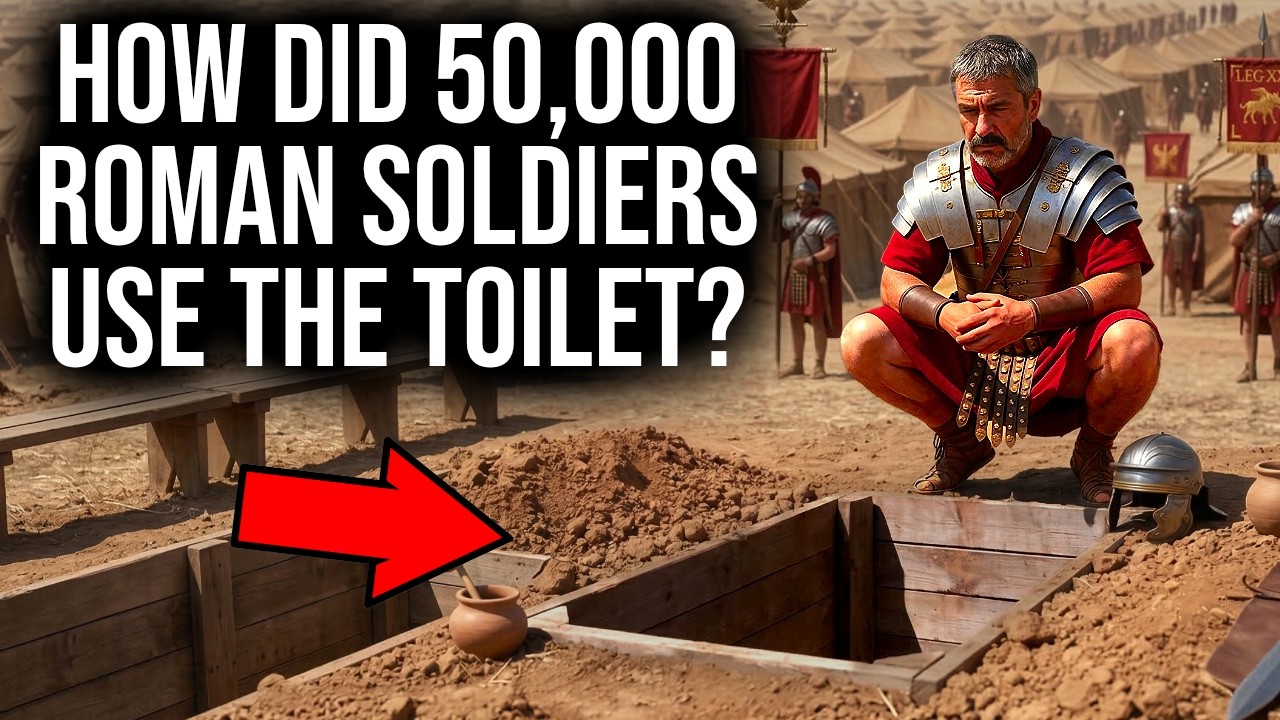
Soldiers would rinse theirs in the shallow channel before and after use. By modern standards this seems deeply unsanitary, but compared to most of the ancient world, where no cleaning at all was standard, it was a meaningful step. On campaign, when permanent structures were unavailable, Roman soldiers dug field latrines, long trenches typically about a meter deep, excavated outside the camp perimeter. Regulations in the Epitoma Rei Militaris, the military manual compiled by Vegetius, and in earlier writings, suggest these field latrines were standardized in dimensions and placement.
Soldiers were not permitted to relieve themselves anywhere else. Roman military hygiene cannot be separated from Roman water engineering. The two were inseparable. Every permanent Roman fort was built with water access as a non-negotiable requirement, and not just any water access, but reliable, clean, flowing water.
The Romans understood empirically that still water was dangerous and moving water safer. They did not know about bacteria, but they observed patterns. Camps near stagnant ponds suffered more disease than camps near fast-moving streams, and doctrine evolved accordingly. When natural water sources were insufficient, Roman engineers built aqueducts even in temporary military contexts.
At siege camps, at long-term frontier postings, wherever the army expected to stay for more than a few weeks, water infrastructure was constructed. The most famous example is the siege of Masada in Judea, where Roman engineers not only built a complete siege wall around the fortress but also constructed water storage and distribution systems to supply their own camp in the Judean desert. Water management was inseparable from military planning at every level. This water served multiple purposes: drinking, cooking, bathing in the balnea, and continuously flushing the latrine system.
The same water that entered the fort from uphill exited through the latrine drainage system downhill. The camp was designed as a flow-through system, not a closed one. Nothing stagnated. Nothing accumulated to dangerous levels.
Waste was moved through and out of the human environment as quickly as engineering allowed. Roman soldiers were also expected to bathe regularly. The balnea, bathhouses, were standard features of permanent Roman forts. This was not a luxury but medical policy.
Roman military physicians understood that clean skin reduced the incidence of skin infections, festering wounds, and certain fevers. Bathing was mandatory, not optional. At some frontier forts, the bathhouse was the largest single structure in the entire installation, larger than the commanding officer’s quarters and larger than the granary. That says something about priorities.
There is also evidence from ancient sources that Roman soldiers were instructed not to drink from water sources downstream of the camp. The direction of water flow mattered. Polluted water flowing downstream was understood to be dangerous, even if the underlying biological mechanism was not. This practical wisdom, accumulated over generations of military experience, constituted an informal epidemiology long before the science existed to explain it.
The contrast with other armies of the ancient world is striking. Contemporary accounts of Carthaginian, Persian, and later medieval European armies describe camps where waste was disposed of wherever convenient, water sources were frequently contaminated, and epidemic disease routinely destroyed fighting strength before battles ever began. The Roman advantage was not just iron discipline and tactical innovation. It was plumbing.
The Roman military also had physicians, which sounds obvious but was genuinely unusual in the ancient world. The medici were trained military doctors attached to legions with dedicated facilities called the valetudinaria, military hospitals. These were real buildings with wards, operating rooms, and storage for medical supplies, and they have been excavated at Novaesium in Germany, at Inchtuthil in Scotland, and at other Roman frontier sites. Roman military medicine understood more about hygiene than is commonly credited.
Medical writers like Galen, Celsus, and the military theorist Vegetius all emphasized the connection between camp sanitation and soldier health. Galen wrote extensively about what he called miasma, the idea that bad air from decomposing matter caused disease. He was wrong about the mechanism, but the practical conclusion he reached was correct: keep waste away from soldiers, ensure clean air and clean water, and the army stays healthy. Vegetius, writing in the 4th century AD but drawing on earlier Republican and Imperial military practice, is explicit on this point.
He writes that latrines must be dug before tents are erected, describes the correct placement relative to water sources, and discusses the dangers of camping too long in one location, because even with proper latrines, prolonged occupation of a site allows waste contamination to spread into soil and groundwater. Roman doctrine therefore included the practice of relocating camps periodically on extended campaigns. The medici also performed regular inspections. Not unlike modern military hygiene officers, they walked the camp perimeter, checked the latrines, assessed the water supply, and reported conditions to senior commanders.
If camp hygiene was deteriorating, the commander was informed and expected to act. Putting this in context makes the contrast even clearer. Greek city-state armies on campaign had no standardized sanitation protocols. Soldiers dug individual holes or simply used the nearest available open space.
Thucydides, describing the Athenian plague of 430 BC, makes clear that crowded, unsanitary conditions, including improper waste disposal, accelerated the spread of disease catastrophically. The plague killed perhaps a quarter of Athens’ population during the Peloponnesian War, and Athens never fully recovered its strategic position. The armies of Alexander the Great, for all their tactical brilliance, suffered severe disease losses on campaign. Alexander’s march through India and back through the Gedrosian desert was catastrophic not only because of the terrain but because of the breakdown in camp discipline and sanitation that accompanied the army’s deteriorating morale.
Disease, not enemy action, was the primary killer. In later centuries, medieval European armies were dramatically worse. Accounts from the Crusades describe camps that became disease-ridden wastelands within weeks of establishment. Dysentery, typhoid, and cholera moved through Crusader forces with devastating efficiency.
At the Siege of Acre in 1189, disease killed more Crusaders than Muslim defenders did. At Antioch in 1097 to 1098, starvation and disease nearly destroyed the entire First Crusade, and contemporary chroniclers describe the camps in terms that make the connection to poor sanitation unmistakable, though they attributed the outbreaks to divine punishment rather than contaminated water. The pattern repeated itself for centuries. During the Hundred Years War, French and English armies alike suffered catastrophic losses to camp disease.
During the Thirty Years War in the 17th century, well over a thousand years after the height of Roman military hygiene, armies were still dying from preventable disease at rates that would have appalled Roman military physicians. Some historians estimate the Thirty Years War killed more people through disease and famine than through direct military action. One study of pre-modern European warfare has estimated that for every soldier killed in battle before the 19th century, two to three died of disease. For Roman legions at their organizational peak, that ratio was significantly better, not because Romans were immune to disease but because their sanitation systems reduced exposure.
The Roman advantage was measurable and sustained over centuries of consistent institutional practice. Roman military hygiene, however, was not a permanent achievement. It was a maintained system, and like all maintained systems, it degraded when the organization that supported it degraded. As the Western Roman Empire contracted in the 4th and 5th centuries AD, military discipline loosened.
Units shrank. Irregular troops replaced trained legionaries, and the elaborate infrastructure of permanent forts gave way to more improvised arrangements. The mensores still existed on paper. The medical corps still existed on paper.
But in practice the standards slipped. Byzantine sources from the Eastern Roman Empire, which survived the Western collapse, explicitly describe the contrast. Sixth-century Byzantine military manuals like the Strategikon, attributed to Emperor Maurice, include hygiene regulations clearly derived from earlier Roman practice, but they also include complaints that these regulations were not being followed in contemporary armies and specific instructions for officers to enforce them. The knowledge survived.
The enforcement did not always follow. This matters because it suggests something important. Roman military hygiene was not a natural cultural behavior. It was an institutional achievement, the result of sustained organizational investment in training, inspection, and enforcement.
When the institution weakened, the behavior weakened with it. Infrastructure without enforcement is just archaeology waiting to happen. The lesson was not rediscovered in the Western world until the 19th century. Florence Nightingale’s work during the Crimean War, reducing mortality in British military hospitals through sanitation improvements, essentially reproduced insights the Roman army had institutionalized three hundred years earlier.
Her data showed that more soldiers were dying of preventable disease than of battle wounds, and her reforms, clean water, proper waste disposal, ventilation, were precisely the principles the Roman military had embedded into doctrine in the 2nd century BC. The wheel had turned full circle. The real story of Roman military latrines was never just about managing an unpleasant necessity. It was a deliberate, engineered system built on observation, doctrine, and institutional discipline.
The mensores who placed the latrines before the tents went up were not following common sense. They were following a manual enforced by commanders, supported by physicians, powered by aqueducts, and refined over centuries of hard-won experience. The Roman army did not dominate the ancient world simply because it had better swords or more disciplined soldiers, though both were true. It dominated in part because it kept its men alive between battles.
That required solving a problem most other armies never even tried to solve systematically. Disease was the silent killer of ancient warfare, and Rome, alone among the great military powers of its era, developed a systematic institutional response to that threat. An army that loses fewer soldiers to dysentery in the weeks before a major battle arrives at that battle stronger. An army that does not have to divert resources to managing a disease outbreak can concentrate those resources on tactics and logistics.
An army whose soldiers trust that they will be fed, housed, and kept reasonably healthy is an army with better morale, and morale is a force multiplier. The Romans built their sanitation system not out of sentiment and not because they were unusually squeamish about dirt. They built it because generations of military experience had taught them empirically that armies with better hygiene win more battles. The connection between the latrine trench and the battlefield victory was real, the Romans understood it, and they systematized it.
At any Roman fort, the latrine block is usually in the corner, near the drainage outlet, often the last thing a tour guide mentions. It is not a curiosity or a footnote. It is one of the structural foundations of Roman military power, and one of the reasons Rome lasted as long as it did.