On June 25, 1876, under the scorching Montana sun, George Armstrong Custer led the 7th Cavalry toward the valley of the Little Bighorn River. With his blond hair falling to his shoulders, he carried the familiar reckless confidence that had defined his career. But the camp he was approaching was far larger than anything he had anticipated. The Lakota Sioux and Northern Cheyenne had gathered near Crow Agency on land they called the Greasy Grass, with more than five thousand people and between two and three thousand warriors concentrated in thousands of tipis.
Custer had been assigned a supporting role in General Terry’s three-pronged plan to squeeze the native forces into submission, but he had no intention of merely following orders. Political ambition and the hunger for a decisive victory drove him forward, and when scout reports warned that the camp was enormous, he dismissed the caution of his officers. Instead of waiting for reinforcements, he divided his regiment, planning to strike from multiple directions at once. The plan looked sound on paper, but the reality on the ground was very different.
Major Reno crossed the river with the vanguard and attacked the southern end of the camp. The first moments brought confusion, but within minutes the warriors poured out from every side, and Reno’s men were forced into a panicked retreat, leaving their dead behind as they struggled back across the water. Meanwhile, Custer reached the ridge above Medicine Tail Coulee and looked down at the camp below. From that vantage point, the immense scale of what he faced must have finally become clear, but it was already too late.
Warriors moved north and encircled his forces. The battle on Custer’s front did not stretch across hours. Historians later estimated that his command collapsed within forty-five minutes to an hour, and in that short time, 215 soldiers lost their lives. Custer himself fell on a hill surrounded by his dead men, a defeat that would soon become legend.
But the battle was only part of the story. Down in the valley, the camps held women and the elderly, people who had walked for days in the cold, endured starvation, and fled the expanding borders of America. That day, their men had protected them, and the victory was one of the greatest their peoples had ever achieved. What followed on the battlefield was not a random outburst of violence.
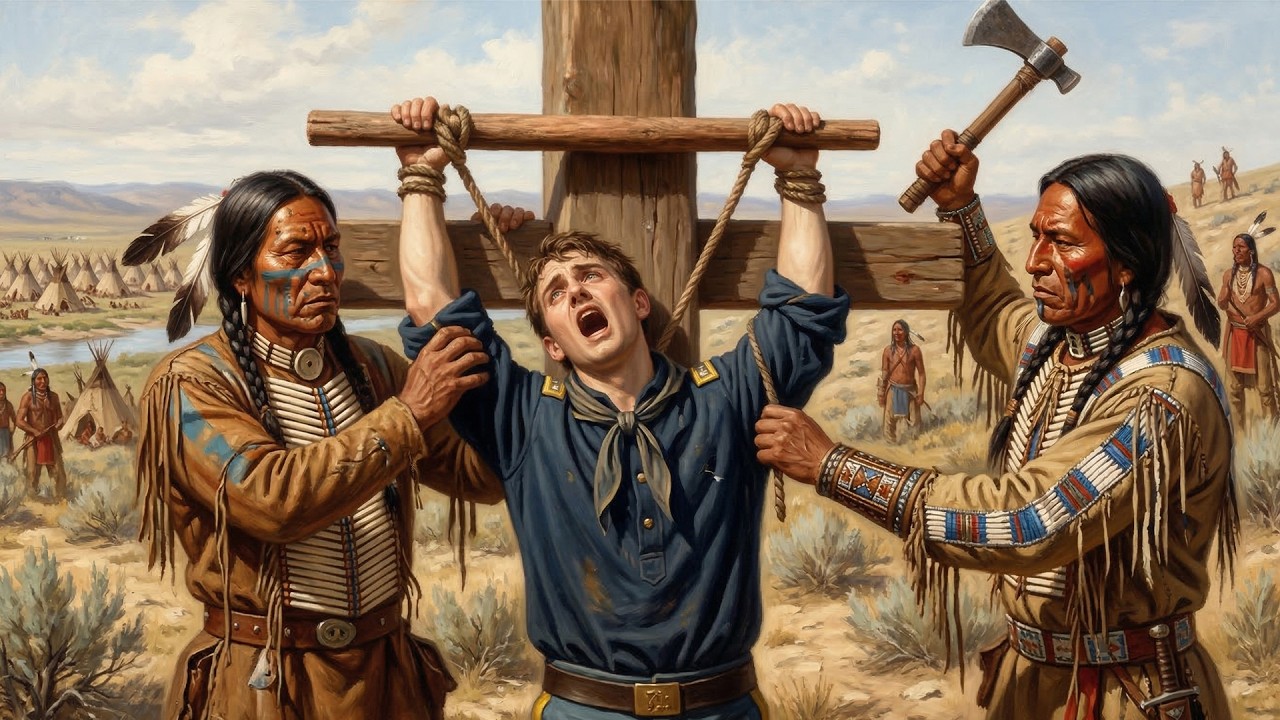
The Lakota and Cheyenne carried out systematic rituals rooted in a deep belief system. In their worldview, the integrity of a fallen warrior’s body determined the condition of his soul in the next world. An unharmed body allowed the soul to pass over strong and intact, where it could fight again and even return to exact vengeance. The mutilations inflicted on the enemy dead were therefore an act of neutralizing future threats.
Cutting off an arm meant the soldier could not hold a weapon in the afterlife. Cutting off a leg meant he could not chase them. Gouging out his eyes meant he could never find them again. These were not merely expressions of rage, but calculated acts intended to disarm the enemy in the world beyond.
Behind these practices lay decades of accumulated pain. The people who fought at Little Bighorn remembered the Sand Creek Massacre of 1864, when Colorado militia under Chivington’s command had attacked a peaceful Cheyenne camp. Men, women, and children who believed they were safe under the American flag had been slaughtered in their sleep, and some of the soldiers had mutilated the dead and displayed body parts in Denver. That memory was still alive among the warriors in the valley.
The practices at Little Bighorn were tied to that history, a response shaped by years of broken treaties, forced displacement, and massacres that had gone unanswered. American soldiers who arrived on the battlefield days later struggled to describe what they found. Custer’s body was relatively well preserved, which some researchers attributed to the fact that he was not recognized, lacking his uniform and distinctive long hair. Others suggested it may have been a deliberate choice.
His men were another matter. Most of the bodies were unrecognizable, their identities guessed only from small belongings, scraps of uniform, or physical characteristics. Benito Martinez, one of the witnesses, reached the area two days after the battle and later wrote to his family. His letter, discovered in an archive, spoke first of the smell, which in the June heat could be felt for miles.
Then he wrote of the silence. There were no birds, no insects, no animal sounds. There was only the wind and the sound of footsteps. Investigations over the following weeks revealed repeating patterns in the mutilations.
Dismemberment was common, with hands, arms, and legs cut or torn away across many parts of the battlefield. The precision of the cutting tools and the consistency of the interventions made clear that this was a practiced ritual rather than random violence. The Lakota treated their own dead with equal care, washing and wrapping them so the soul could recognize the body and find peace. The treatment of the enemy dead was the mirror image of that belief.
Interventions to the eyes were particularly striking and were reported in the examination of multiple bodies. A warrior who was blind in the next world could not track his enemy or threaten him. In Cheyenne tradition, similar practices prevailed, including the cutting of ears so that the enemy could not hear orders whispered to him in the afterlife. Every act carried meaning.
The American press, however, presented the events differently. Little Bighorn was framed as a tragic massacre of heroic soldiers by barbaric natives, and Custer was turned into a martyr. Paintings, poems, and plays celebrated him, and the mutilations were cited as proof of savagery rather than understood as part of a coherent belief system. This narrative shaped public opinion and was used to legitimate harsher policies against Native American communities.
General Philip Sheridan’s attributed remark that a good Indian was a dead Indian reflected the hardening attitudes of the period. The defeat fueled anger, and anger hardened policy. The consequences came swiftly. Crazy Horse was forced to surrender in 1877, less than a year after the battle, and was killed at Fort Robinson under controversial circumstances a few months later.
Sitting Bull continued resisting for years, taking refuge in Canada before eventually returning and surrendering. In 1890, a few weeks before the massacre at Wounded Knee, he was killed through the betrayal of an informant from his own people. The journey from victory at Little Bighorn to defeat at Wounded Knee took fourteen years. On December 29, 1890, troops of the 7th Cavalry Regiment opened fire on a camp of unarmed Lakota Sioux in South Dakota.
Even the most conservative estimates place the civilian death toll at over two hundred, including women, children, and the elderly who were shot down in a snowy field as they tried to flee. Some historians call it a massacre, while some official documents still classify it as a battle. Twenty-four soldiers from the regiment that had been shattered at Little Bighorn received the Medal of Honor for their actions that day. The Lakota communities demanded the return of those medals for decades, and their requests were repeatedly denied.
The battlefield itself became a monument to one side only. White marble stones marked where each American soldier fell, and for years there was no marker for the Lakota and Cheyenne dead. The site was officially named the Custer Battlefield National Monument, a designation that carried its own judgment about who was worth remembering and whose death deserved mourning. That silence was not accidental.
In 1991, Congress changed the name to the Little Bighorn Battlefield National Monument and decided to erect a separate monument for the Lakota and Cheyenne warriors, though the decision remained contested for years. Today, visitors see both the white stones and the red granite markers added later, bearing the names of the Lakota and Cheyenne warriors who died there. Two different stones, two different colors, standing on the same soil. The valley holds the anger, the pain, the belief, and the weight of history together.
The 215 American soldiers who died were part of an empire’s advance, sent by policies and an arrogance that led them to that defeat. Those who fought against them were defending their own land and their own children. The rituals performed on that battlefield can appear senseless or savage from the outside, but viewed from within the depth of that belief, they form part of a consistent and ancient worldview, one that understood the battle on the field and the battle of the soul as inseparable.
The earth still carries every drop of blood, every bone, and every scream it witnessed that June afternoon, silently holding both Custer’s hair and Crazy Horse’s war paint, both the severed limbs and the shed tears, all in the same valley, under the same sun.