The assassination of Henry IV of France on May 14, 1610, was carried out by a Catholic zealot named François Ravaillac, who lunged into the king’s chest with a kitchen knife. Officially, Ravaillac was a lone madman, but suspicions of a wider conspiracy have persisted for over four centuries. Henry had been preparing to launch a major military campaign against the Habsburgs, and his death, coming weeks before the planned offensive, decapitated that strategy. His widow, Marie de Medici, was crowned queen just 24 hours before the killing, a ceremony she had delayed for a decade.
Modern historians note that Ravaillac had once lodged with Jesuits, an order previously expelled for suspected regicide, yet no crackdown followed. She suppressed conspiracy rumors not because they were false but because pursuing them threatened the stability of the fledgling dynasty. Henry IV had come to the throne in 1589 after France was shattered by four decades of religious civil war. A king without a capital, barred from Paris by the Catholic League and distrusted by his own Protestant allies, he secured power through a calculated conversion to Catholicism in 1593.
The move gave him access to the state’s tax-collecting machinery, but the treasury was hollow. To stabilize the dynasty financially, he married Marie de Medici in 1600. She was the daughter of the Grand Duke of Tuscany and brought a dowry of 600,000 gold crowns, the largest single payment in the history of the French monarchy. The influx of Italian banking capital functioned as venture capital for the state, allowing Henry to refinance French debt and pay off foreign creditors.
With the new capital, Henry and his superintendent of finances, the Duke of Sully, began transforming the law into a tool for extracting wealth. They introduced the Paulette in 1604, a tax that allowed government officials to make their positions hereditary in exchange for an annual payment of one-sixtieth of the value of their office. This created a loyal bureaucratic class, the nobility of the robe, whose fortunes were tied directly to the survival of the Bourbon line. Sully also conducted predatory audits, traveling the provinces to inspect ledgers of the gabelle salt tax and replacing those found with missing capital with royal intendants who answered only to the crown.
Henry planted millions of mulberry trees to break the Italian silk monopoly and drained marshes to create arable farmland, building an economy capable of supporting a permanent standing army. Henry’s power rested on a centralized system of financial surveillance. Sully’s memoirs recorded not only the flow of taxes but also the vulnerabilities of the nobility, knowing which families were overleveraged and which officials were skimming revenue. This data was weaponized, allowing the king to control defiance through debt collection or threatened audits rather than military force.
Henry also built the Cabinet Noir, a sophisticated spy network that intercepted and decoded the dispatches of Spanish diplomats and Vatican legates. His geopolitical goal was to break the Habsburg encirclement of France, and he used royal funds to bankroll Protestant rebels in the Netherlands and support clandestine sabotage within the Holy Roman Empire. By 1610, Henry had amassed an army of 30,000 men and the war chest needed for a campaign against Spain and the Holy Roman Empire. Catholic hardliners saw the Protestant-friendly king as leading a Catholic nation into a war that would benefit heretics abroad.
The atmosphere in Paris grew suffocating with tension. When Ravaillac struck, the king was in his carriage on the Rue de la Ferronnerie. The official investigation appeared designed to avoid finding a wider conspiracy, and the questions surrounding the scattered guards and Marie de Medici’s sudden coronation were buried under royal privilege. In the aftermath, Marie de Medici reversed Henry’s anti-Habsburg foreign policy, marrying her son, the future Louis XIII, into the Spanish royal family that many believed had ordered Henry’s death.
She bought the loyalty of rebellious nobles with her remaining fortune and suppressed potentially destabilizing truths. The dynasty created a cult of Henry the Great, turning a pragmatic, often unpopular king into a national martyr. The Bourbons had survived their first great crisis, learning that royal stability mattered more than transparency or courtroom truth. The dynasty’s second great transformation came under Louis XIV, who turned Versailles into a golden cage designed to bankrupt the French nobility and centralize control.
Mandating that the high nobility reside at the palace for most of the year, he uprooted them from their provincial power bases. Once at court, status was measured by proximity to the king, and maintaining that status required astronomical spending on fashion, gambling, and ritualized luxury. The nobles drained their ancestral wealth competing for royal favor and became dependent on royal pensions. Louis became the sole venture capitalist of the realm, redirecting aristocratic ambition from rebellion to ceremonial service.
The cost of Versailles, estimated at up to 25% of national revenue at its peak, was extracted from the peasantry through taxes like the gabelle. This state monopoly forced every citizen over the age of seven to purchase a fixed amount of salt each week at inflated crown-set prices. The taille, a land tax, fell almost exclusively on the poor while the nobility and clergy were exempt. Louis also expanded the sale of royal offices, turning the bureaucracy into a source of immediate liquidity.
Wealthy bourgeois families bought titles, providing cash for the king’s endless wars while receiving prestige and tax exemptions. Louis XIV also perfected mechanisms of state secrecy culminating in the legend of the Man in the Iron Mask. Under the lettre de cachet, royal warrants allowed for indefinite imprisonment without trial or formal charge. In the eyes of the law, a prisoner held under such a warrant ceased to exist as a legal entity.
The masked prisoner was transported between fortress prisons in a covered, reinforced litter, with orders that he be executed on the spot if he attempted to communicate or revealed his face. He received high-quality meals and fine linens, indicating high social status, yet was denied the most basic human right to be known. The system functioned as psychological deterrence, signaling that the king could erase a person’s very existence. The Cabinet Noir, positioned within the postal service, intercepted, copied, and decoded thousands of private letters, ensuring the king maintained an informational monopoly to complement his financial one.
By the final decades of the 17th century, the cost of Versailles and Louis’s insatiable expansionist wars began to fracture the state’s finances. In 1695, Louis introduced the capitation, a direct poll tax that for the first time officially included the nobility and clergy. Inside Versailles, the atmosphere shifted from opulent display to suffocating ritualized competition for survival. In 1709, during the Great Winter, as famine gripped France, Louis ordered the melting down of his legendary silver furniture, the physical embodiment of his Sun King persona.
The revocation of the Edict of Nantes in 1685 had already driven over 200,000 Huguenots, skilled merchants and bankers, into exile in England, Prussia, and the Netherlands. By his death in 1715, Louis had succeeded in centralizing power but left behind an empty purse and a mountain of debt. The dawn of the 18th century offered the Bourbons a global opportunity. In 1700, Charles II of Spain, known as the Bewitched, died without an heir.
Louis XIV installed his grandson, Philip V, on the Spanish throne, triggering the War of the Spanish Succession. Philip arrived in Madrid to find a kingdom drained by centuries of Habsburg mismanagement. He and his French advisers set about centralizing the Spanish state. Through the Nueva Planta decrees between 1707 and 1716, they abolished the traditional rights of Catalonia, Aragon, and Valencia, dismantling regional parliaments and centralizing administrative, judicial, and financial power in Madrid.
Philip V also weaponized the Spanish Inquisition, repurposing it from a tool of religious orthodoxy into a mechanism for political and financial surveillance. He used it to hunt Jansenist sympathizers and anyone suspected of loyalty to the old Habsburg regime. The royal treasury, drained by the war of succession, was replenished through systematic seizures of estates from rebellious nobles and wealthy conversos. The Inquisition’s network of informants became the eyes and ears of the new centralized state.
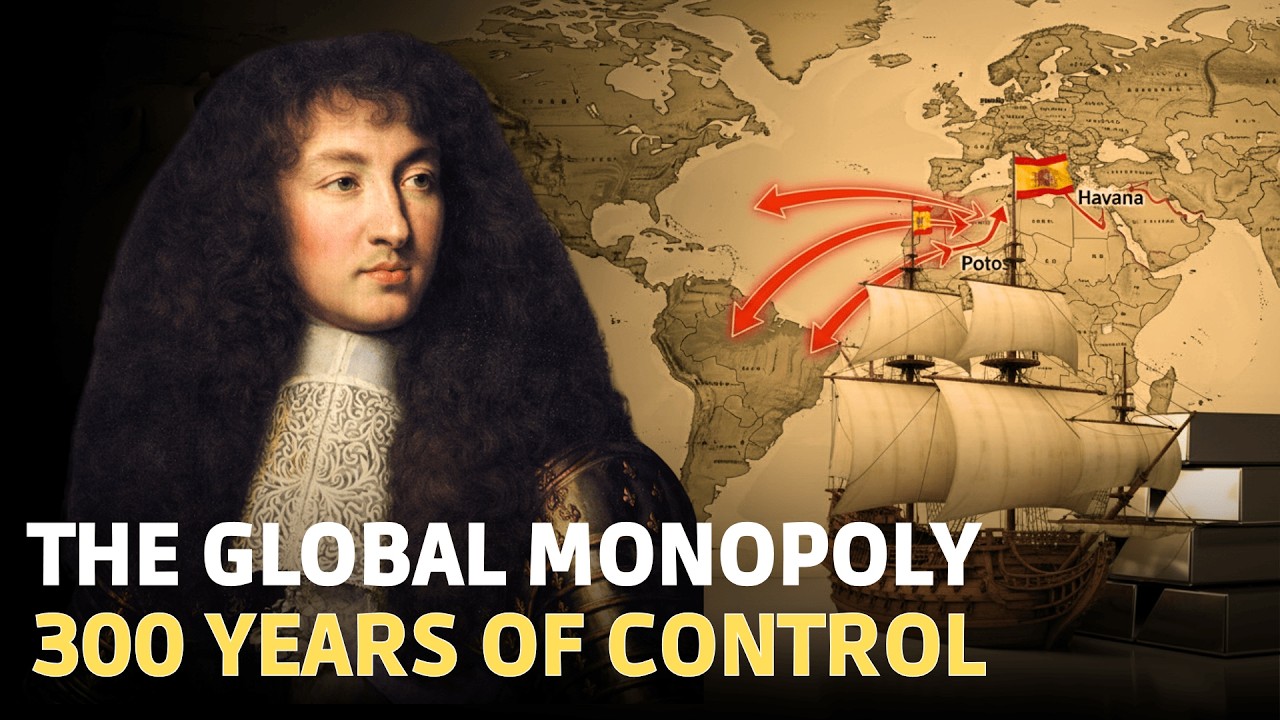
To fund his expansion, Philip began the Bourbonization of the colonial administration, introducing intendants modeled after French bureaucrats to oversee the silver mines of Potosí and Mexico. Under the Bourbons, the silver extraction at Potosí reached unprecedented levels. Thousands of indigenous workers were forced through the mita system into the dark, toxic, mercury-laden shafts. The Bourbons maintained a total monopoly on the production, minting, and distribution of the Spanish dollar, the only global currency accepted from the Americas to the Philippines and China.
They held a death grip on the world’s two primary mercury sources, the Almadén mine in Spain and Huancavelica in Peru, ensuring no private mining enterprise could operate without royal approval. Under the Bourbon reforms, silver production in Mexico and Peru tripled compared to the Habsburg era. Between 1722 and 1726 alone, manifests from Veracruz listed millions of silver pesos earmarked for state purposes. The silver funded the rebuilding of the Spanish Navy and a global intelligence network.
The reign of Charles III, from 1759 to 1788, marked the dynasty’s transition into a modern corporate state. Often hailed as an enlightened despot, Charles III implemented the Bourbon reforms, which modernized the empire by opening trade between Spanish ports. But by allowing more ports to trade directly with Spain, he bypassed local Creole elites in Mexico City and Lima, ensuring wealth flowed into the royal treasury. He dispatched scientific expeditions to the Americas to conduct resource audits and identify new sources of silver.
He also seized total control of the tobacco trade, forcing farmers to sell their crops at fixed low prices while the state resold them at a massive markup. Under his reign, revenue reaching Madrid from the Americas increased fivefold. By 1780, Mexico was producing over two-thirds of the world’s silver. To maintain these industrial production levels, the Bourbons turned to the transatlantic slave trade with renewed vigor.
Under Charles III, the trade was deregulated and expanded to ensure a constant supply of enslaved labor for Cuba’s booming plantations. In royal ledgers, enslaved Africans were recorded not as individuals but as piezas de indias, standardized units of labor based on the physical condition of a healthy adult male. Between 1760 and 1788, approximately 140,000 enslaved Africans were brought to Spanish America, a dramatic escalation from the estimated 60,000 in the 45 years prior. The profits from this trafficking became indistinguishable from silver in the royal treasury.
By the late 1780s, the Bourbon monopoly in France was collapsing under catastrophic debt. Decades of global conflict and financial support for the American Revolution had drained the treasury. Consecutive harvest failures left Paris hungry. Marie Antoinette became the ultimate visual scapegoat, branded as Madame Déficit.
Her retreat to the Petit Trianon broke the visual monopoly of the throne, and the public redirected rage from systemic state debt toward an invisible figure of extravagance. Marie Antoinette’s bond with the Swedish Count Axel von Fersen was a profound political liability. Their connection was maintained through illicit letters written in ciphers, and recent scientific analysis using X-ray fluorescence has revealed redacted phrases of adoration that the Bourbon state tried for centuries to censor. The Diamond Necklace Affair of 1785, although the queen was technically a victim of fraud, convinced the public that the monarchy was using the nation’s credit for royal excess.
The climax of the collapse came with the flight to Varennes in June 1791. Fersen masterminded the escape, personally driving the first stage disguised as a coachman. The royal family traveled in a heavy yellow coach with false passports. At a small post house in Varennes, Louis XVI was not recognized by a spy or soldier but by a commoner who identified his profile from the image stamped on the state’s currency.
The king’s image, once a tool of divine intimidation, had become a common commodity. The family was dragged back to Paris as prisoners. Louis XVI was executed in 1793, and Marie Antoinette months later. In exile, the remaining Bourbons, led by the future Louis XVIII, became a ghost corporation.
They relied on secret subsidies from the British government and funded royalist insurgents inside France. Louis XVIII drafted the Charter, a constitution designed to preserve the essence of the dynasty under a modern brand. Fersen spent his remaining fortune funding anti-revolutionary propaganda and became an architect of the reactionary ultra movement. Napoleon’s defeat brought the Bourbon restoration in 1814.
Louis XVIII returned to Paris in a royal carriage, but he faced a France rebuilt by revolution and empire. The absolute power of Louis XIV was replaced by a parliamentary framework. The Ultras, hardline royalists led by the king’s brother, the future Charles X, wanted their titles, lands, and lost monopoly back. Following the assassination of the Duke of Berry, the Ultras seized control and turned fiscal policy into dynastic revenge.
The most audacious maneuver was the Law of the Billion Francs in 1825, under Charles X. Unable to seize lands legally sold during the revolution, the king compensated the old nobility with one billion francs from national credit, paid for by the same taxpayers whose fathers had fought to overthrow feudalism. The Bourbons forcibly reduced the interest rate on government bonds from 5% to 3%, robbing the middle class to provide a windfall for the aristocracy. Charles X also pushed through the Sacrilege Law, making the desecration of church vessels a capital offense, and revived the ceremony of touching for the king’s evil, attempting to restore the Catholic Church as the dynasty’s ideological police.
In July 1830, Charles X issued the July Ordinances, dissolving the newly elected Chamber of Deputies, restricting the franchise, and abolishing press freedom. The streets of Paris exploded in three days of revolution. Barricades built from cobblestones blocked royal troops. A coalition of journalists, merchants, and workers brought down the king.
Charles X was forced to abdicate and fled into exile, marking the permanent end of the senior Bourbon line on the French throne. The Bourbon monopoly, however, did not die. Over centuries, the family had siphoned enormous private wealth into vaults detached from the fate of the throne. In the following decades, they converted their remaining palaces and estates into trusts and foundations.
Properties like the Château de Chambord and vast Spanish estates were reorganized into historical monuments, shielding the family’s wealth from inheritance taxes and public audits while preserving their heritage. The Spanish branch established by Philip V continues to hold the throne under King Felipe VI. In France, the Bourbon name persists in museums and heritage sites. Versailles has become a global tourist machine, extracting revenue from millions of visitors each year.
The dynasty moved from political rule to a permanent invisible infrastructure of power, using foundations, trusts, and corporate structures to protect their assets. Heritage palaces in Spain, technically owned by the state, are reserved for the exclusive use of the Bourbon family, with taxpayers bearing the costs of maintenance and security while the family retains the prestige. The family’s art collections, housed in national galleries, serve as permanent anchors of historical legitimacy. In the 21st century, the Bourbon network operates through family offices and private trusts, with portions of their real estate and art holdings tokenized through blockchain technology.
The family maintains deep connections across global diplomacy, acting as high-level fixers and stakeholders in sovereign wealth fund investments. They have shifted from the Cabinet Noir to reputation management, aligning the Bourbon name with sustainability and philanthropy to deflect scrutiny of their historical extraction. The dynasty has survived the transition from absolute monarchy to the digital age, proving that a monopoly, once engineered, never truly dies, it only changes state.