The story of the Hilton family begins with Augustus Halverson Hilton, a Norwegian immigrant who reached the United States in 1870 and settled in what was then the frontier territory of New Mexico, an area that would not achieve statehood until 1912. He and his wife Mary Genevieve raised eight children, including Conrad Hilton, the son who would build one of the most famous hotel empires in the world. Conrad began his adult life in politics, becoming one of New Mexico’s first Republican representatives, but he quickly grew disillusioned with what he called the bureaucracy, slowness, cheating, lying, and inside deals of political life. Seeking a more honest profession, he looked toward Texas, which was booming with oil money.
He first attempted to buy a bank but failed to secure the purchase. Forced to change direction, he bought the Mobley Hotel in Cisco, Texas, in 1919. The forty-room property was constantly filled with guests, and Conrad realized that if one hotel could generate such profit, several more could do even better. By 1930, he owned five hotels across the state.
The stock market crash of 1929 and the Great Depression devastated the American economy, and hotel stays became luxuries few could afford. Despite the collapse around him, Conrad held on to both his mental stability and his business, retaining control of his remaining eight hotels and even beginning to expand beyond Texas. The Depression proved to be a setback, not a defeat. He married Adelaide Barron in 1925, and the couple had three sons: Conrad Hilton Jr.
, known as Nikki, Barron Hilton, and Eric Hilton. The marriage ended one year after the birth of their third son, and Conrad spent roughly eight years nursing his heartbreak before turning his attention to a far more famous bride. In 1942, he married Hungarian socialite and actress Zsa Zsa Gabor. She had been in the United States for only about a year, having fled the violence spreading across Europe.
At first, Conrad seemed like a rescuer to her; he even helped her parents escape from Hungary. But the marriage quickly soured. Gabor later wrote that Conrad seemed more interested in possessing her than in loving her, insisting on changing her name from Zsa Zsa to Georgia. She described this act as symbolic of everything the marriage would become, writing that her Hungarian roots were ripped out, her background ignored, and her freedom ended.
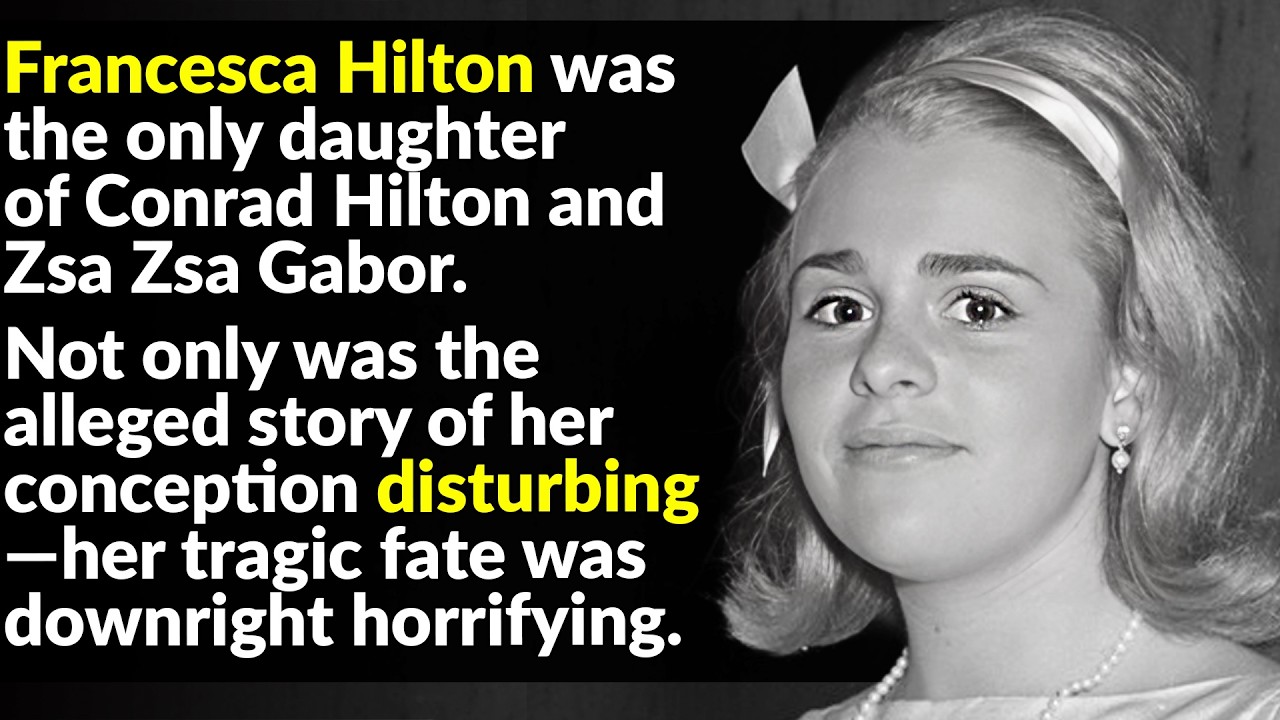
A few months before their divorce was finalized in October 1947, Gabor gave birth to their only child, Francesca Gabor Hilton. According to Gabor’s biography, she did not consent to the intimate encounter that resulted in Francesca’s conception, a horrifying allegation that permanently tainted the marriage in her memory. Conrad’s eldest son, Nikki, proved to be a problem from an early age. He was expelled from or dropped out of most schools he attended, showed no interest in the family business, and devoted himself to wild parties and beautiful women.
According to Zsa Zsa Gabor, Nikki had more in common with his father than one might expect; she claimed to have gotten to know her stepson much too well whether during the marriage or after it. Nikki married superstar Elizabeth Taylor in October 1949. MGM, Taylor’s studio, paid for the public ceremony, turning the wedding into a Hollywood spectacle. Taylor was only eighteen, while Nikki was twenty-three and already deeply dependent on several substances and struggling with gambling.
What looked like a fairy tale soon became a nightmare. Nikki’s temper and dangerous habits made him an aggressive husband, and during one violent rage, he assaulted Taylor, causing her to miscarry. The marriage lasted less than a year, ending on the grounds of mental cruelty. Still considered an eligible bachelor, Nikki announced his engagement to another actress, Betsy Von Furstenberg, before 1951 was over.
She recalled that he slept until late afternoon, woke up, started drinking and playing cards, and never went to work. The relationship ended before any marriage took place. While Nikki stumbled through his life, his father and younger brothers continued building the family legacy. Conrad spent the 1940s and 1950s expanding the Hilton name across America, including acquiring management rights to the historic Waldorf Astoria, thus absorbing the legacy of another famous American family, the Astors.
But Conrad had no intention of allowing his own family name to collapse through his descendants’ carelessness. The country alone was not enough. He founded the Hilton Hotels Corporation in 1946 and the Hilton International Company in 1949, making his enterprise the first international hotel chain. This grand legacy presented a problem: what would happen to it once he was gone?
Conrad gave Nikki a chance, appointing him vice president of the corporation in 1951 and manager of the Bel Air Hotel, but he remained deeply concerned about what would happen to the family name if his party-loving son took control. Nikki could not keep his life together. He ran into trouble with authorities in 1954, remarried in 1958, and had two sons, but that marriage also fell apart. His reckless lifestyle settled the matter tragically: Nikki died ten years before his father, suffering a heart attack at age forty-two.
That left Conrad’s remaining two sons and his daughter to be considered in his will. Barron Hilton, the second son, proved to be everything his father could have hoped for. He entered the hotel business at an early age and showed a sharp business sense. But the reality of Conrad’s will turned out to be complicated.
Conrad died in 1979 at age ninety-one, leaving behind a multi-million dollar business and three surviving children. Shockingly, his children received very little. He left 97% of his estate to the charitable organization he had founded more than thirty years earlier, the Conrad Hilton Foundation. However, Conrad had kept his son Barron in mind.
He gave him the right to purchase the 13. 5 million shares left to the foundation, a provision intended to keep control of the company within the family. But Conrad failed to anticipate that the foundation would not want to surrender those shares. When the clause was revealed, the foundation challenged it, sending the matter to probate and locking the funds in legal limbo for years.
An appeals court finally ruled in Barron’s favor in March 1988. During that time, Barron continued to steer the company successfully, so by the time he received the shares, they had quadrupled in value. Not everyone in the family was satisfied. Conrad had not treated his children equally.
Despite the family’s vast fortune, he left his daughter Francesca only $100,000. She was furious. It was possible Conrad believed she did not need his money because through her mother she was the only child of the three wealthy Gabor sisters and might one day inherit the Gabor family’s wealth. Whatever his reasoning, Francesca contested the will, but the courts ruled against her, forcing her to accept the original amount.
This marked the beginning of her misfortune. Conrad was Gabor’s second husband, and over the course of her life Francesca had seven stepfathers. None caused her as much grief as her final stepfather, Frederick Prinz von Anhalt, who remained married to Gabor for the rest of her life. Gabor became paralyzed after a severe car crash at the end of 2002, and her health continued to decline while von Anhalt gained increasing control over her life.
In 2005, he accused Francesca of attempting to manipulate her mother for personal gain, claiming she tried to use her mother’s house to obtain a loan and interfered with Gabor’s will. He filed lawsuits against her, but when Gabor failed to appear in court, the cases were dropped. By 2012, Gabor’s health had deteriorated so badly she could no longer care for herself. Francesca sued to establish an independent conservatorship, likely hoping to gain some control over her mother’s estate.
The judge instead granted that power to von Anhalt, leaving Francesca out in the cold financially and emotionally. By the end of her life, she could desperately have used even a fraction of either parent’s fortune. Despite being the daughter of two wealthy families, she died in poverty. Reports suggest she was homeless just a month before she died from complications of a stroke, living between short-term rentals and her car.
Her mother never learned of her daughter’s death; von Anhalt chose not to tell her. The younger Hilton sons managed to build stable lives. Barron married Marilyn June Hawley in 1947, and they remained married their entire lives, raising eight children. Most of those children lived quiet lives, but not all.
His son Richard Howard Hilton followed his father into the business world, founding Hilton Realty Investment, which helped further expand the empire. In 1979, the same year Conrad died, Richard married Kathy Avanzino, an American socialite and actress. Richard was twenty-four, Kathy twenty. Their marriage became one of the strongest in the family and remains intact today.
They had four children, including two instantly recognizable names: Paris and Nicky Hilton. Nicky, named after her troublesome great-uncle, avoided most of his vices, launching her own fashion line in 2004 and settling down after a brief failed Las Vegas marriage. But she still lives in the shadow of her more famous sister. Before Paris Hilton, the name Hilton was synonymous with hotels.
A few people might have been aware of the scandals of earlier generations, but most thought little about the family beyond their business success. Then Paris Hilton arrived on the scene with The Simple Life, a reality show she starred in with her friend Nicole Richie. During her rise to fame in the early 2000s, she proved that there is no such thing as bad publicity, at least not for the Hiltons.