In the summer of 480 BC, a Greek farmer named Ephialtes made a decision that would etch his name into history as the ultimate betrayal. He walked into the camp of the Persian king Xerxes and offered to sell the one piece of information that could destroy the Greek resistance: a secret mountain path that led around the defensive line at Thermopylae. The pass itself was a bottleneck between mountain and sea, wide enough only for a narrow column of men. For two days, the Greeks had held it against the vast Persian army.
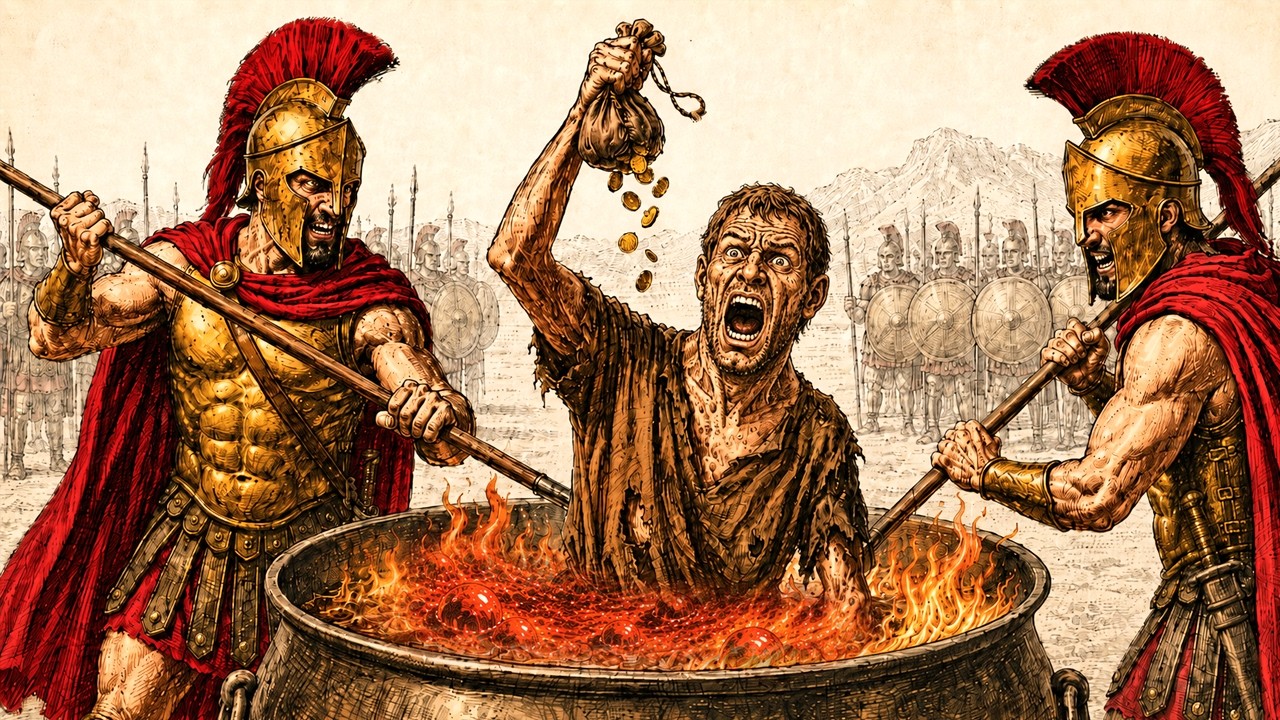
King Leonidas of Sparta commanded the defense with three hundred hand-picked Spartans, each one a father, so that no family line would be extinguished in the coming fight. Alongside them stood several thousand allies from cities that history has largely forgotten. The Persians, drawn from dozens of conquered peoples, were mostly unwilling conscripts who had marched hundreds of miles under the August sun to die in a pass they could not even name. Leonidas anticipated the danger of the mountain route.
He stationed a contingent of roughly one thousand Phocians on the heights to guard it. His commanders watched the dry, wooded slopes, knowing that if the Persians ever found that path, the pass would become a trap. The men accepted the mission and moved up the mountain in silence. What happened next is recorded by the historian Herodotus in stark, simple words.
Ephialtes, son of Eurydemus, a man from Malis, came to Xerxes expecting a great reward. He told the king about the path that led through the mountains to Thermopylae. That was all. A local man traded a piece of geography for a piece of gold, and the fate of the Greek defense was sealed.
The first two days of battle had been devastating for the Persians. Xerxes, confident in his overwhelming numbers, sent wave after wave of infantry into the narrow pass. The Greek phalanx, with its interlocking bronze shields and long spears, turned the cramped ground into a killing zone. The Persian arrows bounced harmlessly off Greek armor, and their shorter spears could not reach the enemy behind the wall of shields.
Hundreds of Persian bodies piled up before the Greek line. Herodotus tells us that Xerxes, watching from a throne on a hillside, leapt up three times in fear for his army. When he committed his elite troops, the ten thousand Immortals, to the attack, they fared no better. In a corridor only meters wide, their numbers meant nothing.
The terrain did not care that they were elite. On the second night, Xerxes summoned the Immortal commander Hydarnes and ordered him to take his men through the mountain path. Ephialtes walked ahead of them, torch in hand, leading an empire around the back of a king. The climb took the entire night, ten to fifteen kilometers of rugged terrain that could break any formation.
In the predawn hours, the column reached the ridge where the Phocians were camped. The Greeks heard the noise of footsteps on dry leaves and the clatter of equipment. Believing they were under attack, they seized their weapons and formed ranks. But the Immortals simply walked past them.
They had a guide, and their target was not the men on the ridge. It was the king waiting below. Somehow, word reached Leonidas before dawn on the third day. A scout arrived, gasping for breath, and told the Spartan king that the Persians were behind him.
The pass was no longer a fortress. It was a trap. Leonidas called his commanders together. There was disagreement.
Some wanted to withdraw immediately. Others wanted to hold the line. The council did not last long. Leonidas made the decision that would preserve his name forever.
He dismissed most of the allied troops, sending the Locrians and Corinthians away. Then he did the opposite of what any defensive commander would do. He ordered his men to advance outside the narrow pass, into the wider ground where they could kill more Persians before being overwhelmed. The Persian officers in the front line could not believe what they saw.
Herodotus records that they had to whip their men forward, driving them toward the Greek attack. Soldiers who had spent two days watching their comrades die in the bottleneck were now being pushed toward the same killers in open ground. The slaughter that followed stunned even the ancient observers. The Greeks fought until their spears shattered, then drew their swords, then fought with their bare hands and teeth.
Persian corpses piled so high that men were trampled under the feet of their own advancing ranks. Some were driven off the path toward the sea and drowned under the weight of their armor. Leonidas fell in the thick of the fighting. Herodotus does not tell us how he died.
A spear, an arrow, a sword thrust. The fight around his body took on a new shape. The Spartans formed a circle around their fallen king, while the Persians surged forward to seize the corpse, a prize of immense value for Xerxes. Four separate attacks were repelled around the body of a dead man.
Men from both sides died for the sake of a corpse, and the Greeks managed to pull their king back toward their lines each time. Then Hydarnes arrived. The Immortals who had marched all night descended onto the road behind the Greek position. The pass was closed.
There was no direction a Greek could face without finding a Persian in front of him. The survivors pulled back to a small hill and formed a final cluster. With no spears left, they fought with swords, then daggers, then the hilts of their weapons, then rocks torn from the ground. Herodotus writes that they fought with their hands and teeth until the Persian archers were ordered to hold back and simply shoot arrows down onto the hill until every man on it was dead.
Xerxes walked the field afterward. He found the body of Leonidas and ordered the head cut off and the corpse crucified. This was not standard Persian practice for defeated enemy commanders. It was personal.
The most honored king in Greece had been beheaded in a Persian camp because a farmer had accepted a bribe. And where was Ephialtes during all of this? He is entirely absent from every account of the final battle. He was not at the pass.
He was not with Hydarnes. He had done his job, led the Persians through the dark, delivered them behind the Greek lines, and then vanished from the story. Herodotus does not say where he was during the final fight. Perhaps he was in the Persian camp waiting for his gold.
Perhaps he was beginning to understand what he had actually done. The war was not over. The Greek cities to the south still stood. And there were a great many very angry Spartans who now knew his name.
His next recorded action was flight. Not celebration, not reward. Flight. North to Thessaly, beyond the reach of anyone who might come looking for him.
Herodotus writes that the Amphictyonic council, the league of Greek states, posted a reward for his head. Think about what that meant for his life. He could not go to Delphi. He could not attend the great festivals.
He could not enter a temple or appear in any public gathering. Every path was danger. Every stranger was a possible executioner. He waited in Thessaly for years, perhaps as long as a decade, until the anger cooled, until the generation that fought at Thermopylae aged, until the world forgot.
The world did not forget, but he convinced himself it had. Eventually, Ephialtes made the decision that ended his life. He returned home, not to Malis, but to Anticyra in Phocis, near his original region. Perhaps he could no longer bear another day of exile.
Perhaps he gambled that the pursuit had ended. He was wrong about that. But what killed him was not the reward. Not exactly.
Herodotus records the circumstances. A man named Athenades, from Trachis, killed Ephialtes in Anticyra. But the killing had nothing to do with Thermopylae. It was a personal quarrel, a private dispute over some matter Herodotus intended to explain elsewhere.
The text has been lost, or he never wrote it. What matters is how the Spartans responded. They honored Athenades for the killing. Whatever his reasons, he had done what an entire league of Greek states had tried for a decade to accomplish.
That was enough. The most infamous traitor in Greek history died in a personal argument with a neighbor over something unrelated to the battle that made his name immortal. Every mechanism of revenge, the decrees, the priests, the price on his head, was bypassed by the simple fact that he made an enemy of a man who stood beside him. This is the final detail that reshapes everything.
In modern films and novels, Ephialtes is depicted as a deformed hunchback, a social outcast whose betrayal is a psychological response to rejection. None of this has any basis in Herodotus. The historical Ephialtes was an ordinary middle-aged farmer from Malis. His motive was money, reward from a wealthy king.
The hunchback is a modern invention, a narrative shortcut. The real story is more disturbing. An ordinary man walked through ordinary hills and sold seven thousand of his countrymen for a bag of gold. There was nothing wrong with him.
That is the point. The Spartans did not send an assassin after him. They did not stalk him across Thessaly. They pressured the Amphictyonic council into proclaiming the reward.
They turned his life into currency. They waited. When a man in Trachis killed Ephialtes in a quarrel that had nothing to do with the battle, Sparta stepped forward and blessed the killing after the fact. The private dispute became history because Sparta chose to make it history.
Ephialtes had spent ten years waiting for the anger to subside. He had returned home, thinking of ordinary things, debts, neighbors, a piece of land. He did not know that his death was about to be given two meanings. The private reason, a quarrel we will never recover, and the public reason, delayed justice for a king who had died a decade earlier.
His name had already begun its transformation into the Greek word for nightmare. In modern Greek, the word for nightmare is derived from his name. The man became the language itself.
That was a punishment Sparta did not need to design.