Barbara Hutton inherited a fortune that made her one of the wealthiest women in the world, yet by the time she died in 1979, she was widely believed to have only $3,500 left to her name. Born in New York City on November 14, 1912, Barbara was the daughter of Franklin Hutton, co-founder of the investment firm E. F. Hutton and Company, and Edna Woolworth, daughter of Frank Winfield Woolworth, the retail pioneer who built a vast empire on five-and-dime stores.
Just months after Barbara’s birth, her grandfather opened the Woolworth Building in New York, the tallest structure in the world at the time, paid for with a fortune built on selling cheap goods. Barbara’s childhood was not a happy one. Her father was a serial womanizer, a heavy drinker, and a neglectful parent. When her mother died suddenly in May 1917 at age thirty-three, the coroner ruled that she had suffocated from mastoiditis, but because no autopsy was performed, many suspected suicide.
Barbara, only five years old, was the one who found her mother’s body. After that, her father sent her to be raised by governesses and packed her off to private schools. Her maternal grandfather died in 1919, and her grandmother followed in 1924. As the only child of her mother, Barbara inherited one-third of the Woolworth estate, worth nearly $30 million at the time, a sum equal to more than half a billion dollars today.
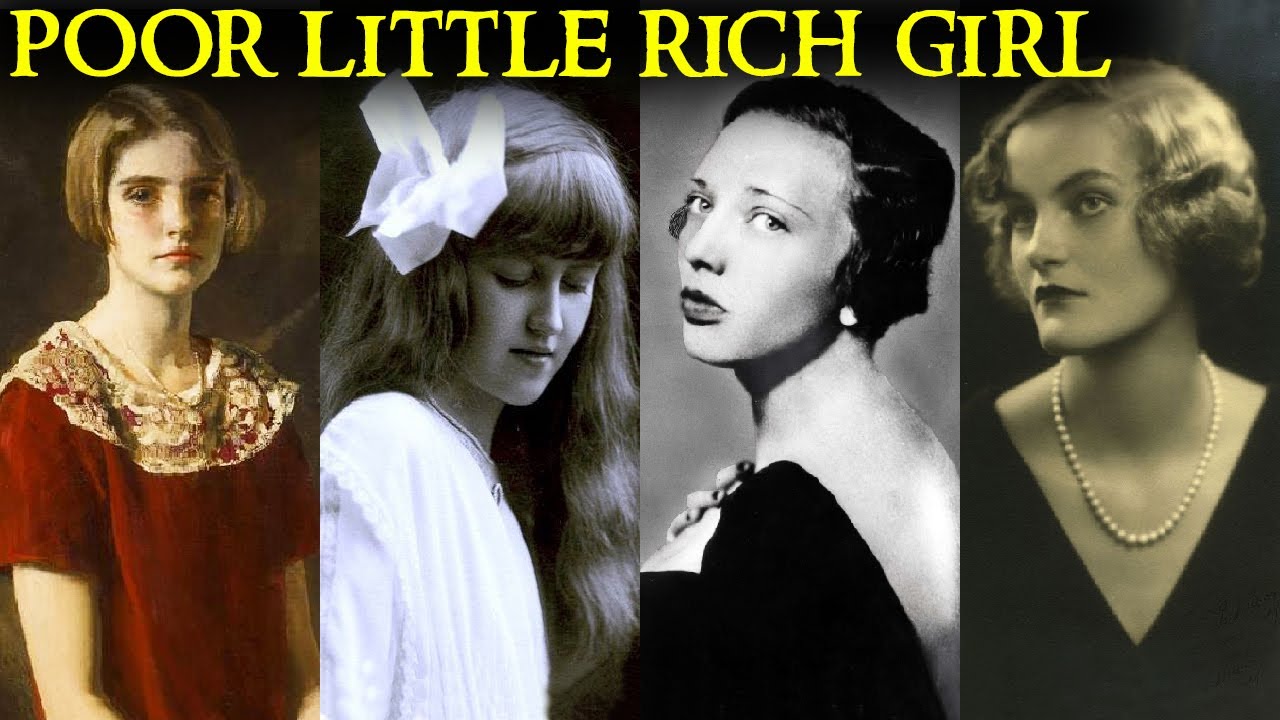
Because she was still young, her father managed the money well, and by the time she gained control in the early 1930s, it had grown to over $50 million. She came into this wealth during the Great Depression, and her family chose that moment to host an ostentatious debutante ball for her eighteenth birthday in November 1930. With guest singing by Rudy Vallée and a price tag of $60,000, the event was widely condemned as tone-deaf while millions of Americans were out of work. The press savaged Barbara, dubbing her the “Poor Little Rich Girl,” a label that would haunt her for the rest of her life.
Her personal life became a series of disastrous marriages, seven in all. At twenty, she married Alexis Mdivani, a Georgian social climber who divorced his previous wife to marry her. He immediately began spending her money on a grand scale, and by the time Barbara divorced him in 1935, she had lost a considerable fortune. Weeks later, she married Kurt von Haugwitz-Reventlow, a minor Danish noble who was physically and emotionally abusive.
During those three years, Barbara developed a dependence on alcohol and drugs, as well as anorexia. She gave birth to her only child, a son named Lance, in 1937, and won custody of him when she divorced Kurt in 1938. The outbreak of the Second World War brought a somewhat happier period. Barbara became a prominent fundraiser for the Allied cause and sold war bonds after the United States entered the conflict.
During this time, she renewed her acquaintance with actor Cary Grant, whom she married in July 1942. The media mocked them as “Cash and Cary,” but the marriage was relatively happy, and Grant never touched her money. They divorced in 1945 but remained friends. After the war, Barbara moved to Europe.
She married Prince Igor Troubetzkoy, a French aristocrat and race car driver, in 1947, and funded his racing ambitions until their divorce in 1951. The collapse of this fourth marriage, combined with her worsening addictions, drove her to attempt suicide, news of which leaked to the press. In December 1953, she married Porfirio Rubirosa, a Dominican diplomat and playboy who had previously been married to Doris Duke, another of the world’s wealthiest women. The marriage lasted just fifty-three days, and Rubirosa walked away with a large settlement, as he had from Duke.
Barbara married twice more: Baron Gottfried von Cramm, a German tennis player, from 1955 to 1959, and Prince Raymond Doan Vinh Champasak in the mid-1960s. By then, her health was failing. Alcohol, drugs, and anorexia had taken a heavy toll, while her lavish spending, generous gifts, and divorce settlements had consumed much of her wealth. In 1972, her son Lance died in a plane crash.
After that, she became increasingly reclusive, eventually settling into a penthouse at the Beverly Wilshire Hotel in Los Angeles. Nearly blind and addicted to painkillers, she died of a heart attack on May 11, 1979, at sixty-six. Doris Duke, born in New York City on November 22, 1912, was Barbara Hutton’s great rival. She was the only child of James Buchanan Duke, founder of the American Tobacco Company, which by the end of the nineteenth century sold roughly ninety percent of all cigarettes consumed in the United States.
James Duke also made major philanthropic gifts, including to Trinity College in North Carolina, which was renamed Duke University in his honor. When he died in 1925, Doris inherited an estate worth over $100 million, though she would only gain control of it gradually as she moved through her twenties. In 1935, Doris married Jimmy Cromwell, an aspiring politician sixteen years her senior who used her wealth to further his ambitions. They settled in Hawaii and built a mansion called Shangri-La, but the marriage deteriorated after their first child was born prematurely and died the next day.
They divorced in 1943, and Doris, devastated and unable to have more children, turned to alcohol, prescription drugs, and fortune tellers. In 1947, she married Porfirio Rubirosa, but the union ended in 1951 with Rubirosa receiving a large settlement that bizarrely included a converted B-25 bomber plane. Doris never remarried. She poured her wealth into philanthropy, particularly the arts and horticulture, building an extensive collection of Islamic and Southeast Asian art and developing Duke Gardens at her family’s New Jersey estate.
But her later years were overshadowed by scandal. In October 1966, she was involved in the death of Eduardo Tirella, a curator who was leaving her employ to pursue a career in Hollywood. After an argument, Tirella got out of their car to open the gates of her Newport mansion. Doris then got into the driver’s seat and struck him with the vehicle, crushing him against the gate.
She claimed it was an accident, but a 2020 investigation concluded she had deliberately run him over, then hit him a second time, and that official reports had been altered. A wrongful death lawsuit was settled, and she avoided criminal charges. In her final years, her health and mind declined. After a botched knee replacement, she was confined to a wheelchair, and her butler, Bernard Lafferty, became the primary beneficiary of her will.
When she died on October 28, 1993, at eighty, her estate was valued at $1. 3 billion. The courts eventually intervened, awarding most of it to the Doris Duke Charitable Foundation, though Lafferty still received millions. Questions about her final months remained unresolved.
Huguette Clark, born in Paris on June 9, 1906, was the daughter of William A. Clark, a copper magnate and former senator for Montana. When he died in 1925, his fortune of roughly $300 million was divided among his wife and children, leaving Huguette with about $50 million. She lived quietly, engaging in philanthropy and the arts.
After a brief marriage in 1928 that ended after less than a year, she never remarried and grew increasingly reclusive. Following her mother’s death in 1963, she became almost entirely isolated, distrusting everyone around her and preferring to speak French to prevent others from understanding her. By the late 1980s, she was frail and disfigured by untreated cancerous lesions on her face. In 1991, she was finally admitted to a hospital for surgery and recovery.
She refused to leave, paying privately to remain in hospital rooms overlooking Central Park, where she spent the last twenty years of her life. She continued to pay her staff to maintain her properties, which they did without knowing where she was. Before her death on May 24, 2011, at 104, she gave away enormous sums, including over $30 million to one of her private nurses. A will disinheriting her extended family was overturned by a judge, and most of her $300 million estate went to relatives she had never met.
Several of her valuable paintings had disappeared from her mansions during her years in the hospital. Anne Cooper Hewitt was born in Paris on July 28, 1914, the day Austria-Hungary declared war on Serbia. She was the daughter of an affair between her mother, Marian Andrews, and Peter Cooper Hewitt, a wealthy inventor who had patented the mercury vapor lamp, a breakthrough that made him a fortune. Peter married Marian and adopted Anne, but he died in 1921, leaving two-thirds of his estate to Anne and the remainder to her mother.
Marian was cruel to her daughter, calling her an ugly duckling and an imbecile, and she soon began squandering her wealth on alcohol and gambling. As Anne approached her twenty-first birthday, Marian saw an opportunity. A condition of Peter’s will meant that if Anne died without children, the money would revert to Marian. In August 1934, Anne was hospitalized for what a doctor claimed was appendicitis.
She underwent surgery, but later discovered she had also been sterilized. Her mother had bribed the doctors to perform the procedure, telling them Anne was mentally deficient, a claim plausible enough in an era still influenced by eugenics. Anne sued her mother for $500,000, and the case became a national sensation. The police charged Marian and the two doctors with mayhem, but when Marian attempted suicide and landed in the hospital, Anne refused to testify against her, and the case was dropped.
Marian died in 1939, never having gained control of her daughter’s inheritance. Anne went on to marry six times, mostly to modest men, including a miner, a banker, and a cowboy who doubled as a disc jockey and whom she married twice. In the 1950s, she ran for the U. S.
Senate in Nevada on the Republican ticket, while her husband publicly said he would vote for her Democratic opponent. She died of cancer in Mexico in February 1956, at forty-one. Consuelo Vanderbilt was born in New York City on March 2, 1877, into one of the wealthiest families in America. Her great-grandfather, Cornelius Vanderbilt, had amassed a fortune in shipping and railroads, and her father inherited roughly $55 million.
Her mother, Alva, was a domineering figure who forced Consuelo to wear a steel rod to improve her posture and dictated every aspect of her life. When she became a young woman, Alva was determined to marry her into the British aristocracy, partly to restore her own social standing after her divorce from Consuelo’s father. The chosen husband was Charles Spencer-Churchill, the ninth Duke of Marlborough, who needed money to preserve Blenheim Palace. Consuelo had secretly become engaged to someone else, but her mother emotionally blackmailed her into the marriage, claiming her health was failing because of Consuelo’s refusal.
They married on November 6, 1895, when Consuelo was eighteen, and she wept under her veil at the altar. The duke received $2. 5 million in railway stock, but the marriage was deeply unhappy. Both took other partners, though they had two sons who would go on to serve with distinction.
Consuelo was adored by the staff and community at Blenheim, and during the First World War she co-founded the American Women’s War Relief Fund, which equipped a military hospital that treated over 7,000 wounded soldiers. Consuelo and the duke finally divorced in 1921. She immediately married Jacques Balsan, a wealthy aviation pioneer, and the second marriage was a happy one. They lived in Paris until the Nazis approached in 1940, then fled through Spain and Portugal to the United States.
They settled in Florida, building a mansion called Casa Alva. In 1946, Winston Churchill stayed there on his way to deliver his Iron Curtain speech in Missouri. Consuelo’s ghostwritten autobiography, The Glitter and the Gold, appeared in 1953. Jacques died in 1956, and Consuelo passed away at her home in Southampton, Long Island, on December 6, 1964, at eighty-seven.
She was buried in Oxfordshire, near Blenheim Palace, beside her son Ivor.