In April 1876, George Armstrong Custer sat in a Washington hotel room and waited. He had sent letters. He had worked through intermediaries. He had done everything short of standing outside the White House and shouting, and none of it had worked.
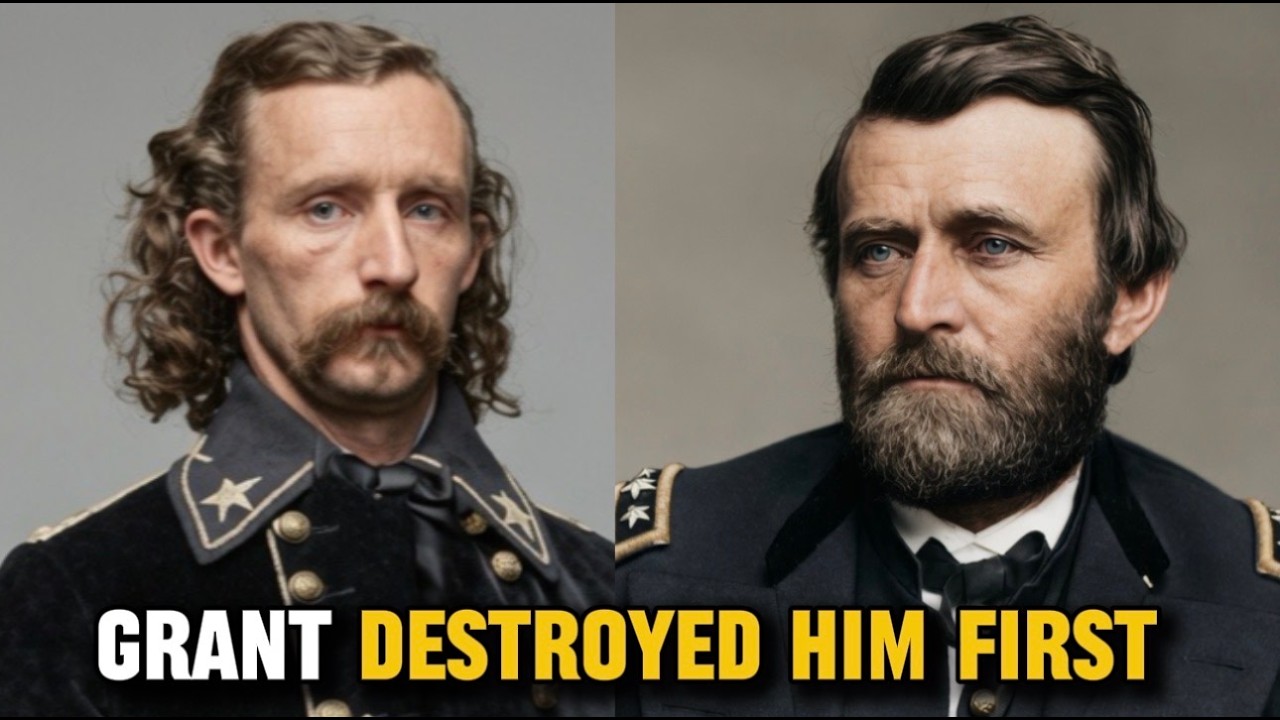
President Ulysses S. Grant would not see him, would not receive him, would not even acknowledge his letters. The most famous cavalry officer in America, the man the press still called the boy general, the hero of Appomattox, was being made to cool his heels like a man applying for a clerk’s position, ignored by a president who had once shaken his hand and thanked him for his service. Custer wrote to his wife, Libby, from that hotel room, describing Washington’s indifference and the averted eyes of men who had courted him when he was useful.
He wrote carefully, knowing letters could be read by others, but even in that careful language the bitterness came through. He felt that Grant had done something to him that no enemy on any battlefield had managed, and had taken something that could not be recovered by a charge or a counterattack. What Grant truly thought of Custer is a question historians have answered reasonably well. What Custer truly thought of Grant is more complicated, because it changed across fifteen years in ways that reveal something important about both men, and about the particular corruption of the era that put them on a collision course.
Custer had not always despised Grant. That part of the story tends to get lost in the drama of 1876. During the Civil War, when Grant commanded the Union armies in Virginia and Custer served as one of Philip Sheridan’s cavalry division commanders, Custer’s private correspondence reflected genuine respect for what Grant was doing. His references to Grant were measured and serious.
Part of this was pragmatic. Custer was twenty-four when he received his first general’s star, promoted over dozens of more experienced officers because Sheridan believed he had found something the war required. A general’s career ran through Sheridan, and Sheridan ran through Grant. Respecting Grant was simply understanding how the machine worked.
But there was something beyond calculation. The final campaigns in Virginia, the Overland Campaign, the siege of Petersburg, the pursuit to Appomattox, were fought with a strategic ferocity Custer found compatible with his own nature. Grant did not turn away from the cost. He pressed forward when other commanders paused.
At Appomattox, when Lee sent out the flag, Custer was among the first Union officers on the scene, and the moment acquired for him an almost religious significance. Grant had made that ending happen. The table on which Lee and Grant signed the surrender terms was purchased by Sheridan as a gift for Libby Custer, and she kept it for the rest of her long life. The postwar years began the work of revising that story.
The volunteer army that had won the war dissolved almost overnight, leaving a small, underfunded regular force assigned to occupation in the South and frontier operations in the West. Custer, who had commanded a division in the most consequential cavalry campaign of the century, was reduced to lieutenant colonel. The actual colonel of his regiment, the Seventh Cavalry, was an administrative fiction who rarely appeared for duty. He was in command without being in command, famous without anything commensurate with that fame to do.
His court-martial in 1867 deepened his understanding of how the army worked when it worked against you. The charges were serious: abandoning his command in Kansas without authorization, ordering deserters shot without trial, misusing government property. Some charges had merit. Custer had left his troops in the field to travel and see Libby, a breach of duty that could not be explained away.
He served his suspension largely at Fort Leavenworth, and during those months something shifted in how he thought about military and political authority. He had always known careers were made and destroyed in Washington as much as on the battlefield. The court-martial made that knowledge personal. He began paying closer attention to who was making decisions in Washington and why.
Grant became president in 1869. Custer, who had voted for Democrat Horatio Seymour over Grant in 1868, watched the inauguration with the attention of a man who understood that a new administration meant new alignments of power. Grant’s secretary of war would determine the army’s priorities. Grant’s Indian policy would determine what the Seventh Cavalry was asked to do.
Grant’s favor or disfavor would determine whether Custer’s career advanced or stagnated. Grant’s approach to the Plains Indians, called the Peace Policy, was a sincere if paternalistic attempt to reduce frontier violence by placing reservation management under Quaker missionaries and church-affiliated agents rather than army officers and government contractors. The army despised it. Officers who had spent years on the frontier had no patience for what they considered a naive experiment.
When the policy failed to prevent raids, as it regularly did, it was the army called in to clean up the mess. Custer was called in repeatedly, most famously in 1868 when he led the Seventh Cavalry on the Washita campaign, attacking Black Kettle’s Cheyenne village in a dawn assault that killed warriors and civilians. He became in those years the blunt instrument of a policy more complicated than either its architects or its critics acknowledged. What Custer saw up close was that the Peace Policy was being managed by men less interested in peace than in profit.
Government trading posts, contracts for army supplies, the post traderships that controlled commercial life at every frontier fort—these were political appointments handed out the way the Grant administration handed out most appointments: to friends, relatives, and contributors. The army was expected to do the dying while civilian contractors did the profiting. Custer paid attention to the gap between official explanations and practical realities, and his Democratic connections kept him informed about investigations the Republican press preferred to minimize. By the mid-1870s, the Grant administration’s reputation for corruption had become one of the defining political facts of American life.
The Credit Mobilier scandal had implicated members of Congress. The Whiskey Ring exposed a conspiracy among Treasury officials and distillers to defraud the government of tax revenue, reaching into Grant’s own inner circle. The president’s personal secretary, Orville Babcock, was indicted; Grant testified by deposition in his defense. What was happening at frontier army posts was the same story at a smaller scale.
Secretary of War William Belknap had been selling post traderships in exchange for regular cash payments. Belknap’s wife had received the payments initially; after her death they continued to Belknap directly. It was a straightforward bribery scheme, distinguished from the administration’s other corruption primarily by how directly it affected the men Custer commanded. When the House Committee on Expenditures in the War Department, chaired by Democrat Hester Clymer, began investigating the tradership scandal in early 1876, Custer was called to testify.
He went to Washington in late March and testified far beyond what the committee had asked. He named Orville Grant, the president’s brother, as a participant in the tradership corruption, describing his activities with a specificity that made clear he had been watching and cataloging for years. He alleged post traders overcharged soldiers and that army commanders had been pressured not to interfere. He painted a picture of systematic corruption running from the frontier posts to the War Department to the president’s own family.
Whether his testimony was purely civic outrage is a question worth asking. He was a Democrat testifying against a Republican administration before a Democratic committee in an election year. His friend James Gordon Bennett Jr. at the New York Herald had published anti-Grant material for years.
The timing, scope, and detail were not the actions of a reluctant witness. Custer walked into that hearing room with something he wanted to accomplish. But the testimony also reflected things he genuinely believed and had genuinely observed. The corruption was real.
Belknap had already resigned in disgrace before Custer took the stand, resigning the morning the committee was set to vote on impeachment. Grant’s reaction was immediate and personal. He ordered Custer kept in Washington. When Custer tried to leave without permission, Grant had him stopped in Chicago and detained.
He relieved Custer of command of the Seventh Cavalry and ordered him excluded from the upcoming summer campaign against the Sioux—the most significant Indian campaign in years, the expedition Custer had been preparing for and expecting to lead. This was not a subtle punishment. It was designed to be public and humiliating. It was professional death delivered in installments.
Custer wrote letters less careful than those from the Washington hotel room, to Terry, to Sheridan, to anyone who might intervene. He described Grant’s action as political vengeance dressed in military authority. He was not entirely wrong, but he was also not entirely right. He had told a selective version of events framed for maximum political damage at a moment chosen for maximum political effect, and a president who had survived the Whiskey Ring and Credit Mobilier would not absorb that quietly.
What strikes you reading Custer’s correspondence from those weeks is not primarily the rage, though the rage is there, but the genuine disbelief. Custer had spent his adult life in a world where boldness was rewarded. He had built his career on the assumption that results justified methods, that the man willing to take risks others declined could accumulate a kind of moral credit that would protect him when the accounting came. What he could not fully process was that Grant operated by the same logic, and that by Grant’s reward system—loyalty—a man who named the president’s brother as a corrupt actor had committed an act of betrayal, not civic courage.
Sheridan and Alfred Terry eventually worked on Grant to relent. Pulling Custer from the expedition weakened it. The Seventh Cavalry was Custer’s regiment in the real sense; the officers knew him, the sergeants knew his methods, the enterprise had been built around his particular way of doing things. Grant relented to the degree the argument required.
Custer could go. He could command his regiment. He would not command the overall operation; Terry remained in command. Grant made clear this was a concession, not a rehabilitation.
Custer sent a telegram of gratitude, probably the most carefully written sentence of his life, thanking Grant without sounding as though he meant it. He rode west in May 1876 toward the Yellowstone and the Little Bighorn. Custer’s private views of Grant in those final months emerge from letters and diary entries examined for a century and a half. They do not tell a simple story.
There is open contempt for a man Custer regarded as small and vindictive, protected by the machinery of power in ways real accomplishment could not compete with. But underneath the contempt lies something that looks in certain passages remarkably like envy. Custer was thirty-six in 1876. Grant had been president.
Grant had commanded all the armies of the United States and translated that power into the highest civilian office. Custer had a brevet rank that meant nothing in peacetime, a regiment, and a notoriety that fed on itself without producing institutional weight. He was famous the way figures in illustrated newspapers are famous: vivid, colorful, replaceable. Whether Custer had serious political ambitions in 1876 has never been fully settled.
His Democratic connections were real, and the Democrats were looking for a candidate who could cut into Grant’s legacy and the Republican grip on the soldier vote. What is clear is that his attack on the Grant administration before the Clymer committee was not a politically neutral act, and he knew it. He never came back from the Little Bighorn to find out how the political calculations would resolve. On June 25, 1876, he led five companies of the Seventh Cavalry into a battle the regiment could not win against a force larger and better prepared than his intelligence indicated.
The result was the most complete defeat suffered by the United States Army in its campaigns against the Plains Indians. Grant’s reaction to the news of Custer’s death was reported by those present as notably devoid of grief. He was quoted as saying Custer had brought it on himself, that the disaster resulted from Custer’s own disobedience and recklessness in attacking without waiting for other columns to converge. It was a military judgment with considerable merit, delivered with a coldness people noticed.
The president’s brother had been publicly accused by the man who had just died leading a cavalry charge, and Grant was not a man who forgot such things. History has generally treated Custer’s death as a tragedy that eclipsed what preceded it. But those weeks in 1876 are where the truth of Custer’s view of Grant lives, in the letters from the hotel room written by a man who understood, possibly for the first time with complete clarity, what it meant to make a powerful enemy of a more powerful man. He had charged into more dangerous ground than that before, and it had always worked.
He had built an entire identity around the proposition that boldness was its own protection. At the Little Bighorn, and in a Washington hotel room before it, he found out what happened when the ground refused to cooperate. The table from Appomattox stayed in Libby Custer’s possession for decades. She outlived nearly everyone in the story, surviving until 1933, more than half a century past her husband’s death, building and protecting and refining his legend with a dedication that amounted to a second career.
She never wrote, at least for publication, what George Custer truly thought of Ulysses Grant. She understood the value of managing which parts of a story got told. But the letters exist. The testimony exists.
The weeks of waiting in that hotel room exist in the record, plain enough for anyone willing to read past the heroics and mythology. What Custer thought of Grant, stripped down to its simplest form, was that Grant had used the machinery of government to punish an enemy while calling it discipline, wrapped a personal grievance in military authority, protected his brother and his political allies, and called anyone who named them a traitor to his administration. Custer thought Grant was corrupt, or at least corruption-adjacent, in ways postwar mythology would paper over for a generation. He was not entirely wrong.
He was also not entirely right. And he was not, to be honest, a disinterested observer. But that is the nature of what George Custer truly thought of Ulysses Grant: not a simple verdict, but a complicated, personal, politically inflected conviction held by a man who understood power well enough to see how it was being used against him, and not quite well enough to understand how badly he had underestimated the man using it.