In the fall of 1923, a surveyor named Cordell Foss drove a borrowed truck along a supply road deep in McDowell County, West Virginia, toward a place called Barren Lake. He worked for the Allegheny Land and Mineral Company, and his job was simple: survey remote areas and file reports. He had done it for six years. But this assignment was different.
His supervisor, Apprentice Galt, had handed him the file without making eye contact, which was unusual. The file contained only a name, coordinates, and a pencil note: “Survey the area and submit a report. Do not engage with the locals. ” Galt’s apprentice, who had once been sent to the same place in 1909, warned Cordell: “Just do the survey and come back.
Don’t stay after dark. And if anyone speaks to you, be polite, but don’t listen too closely. ”
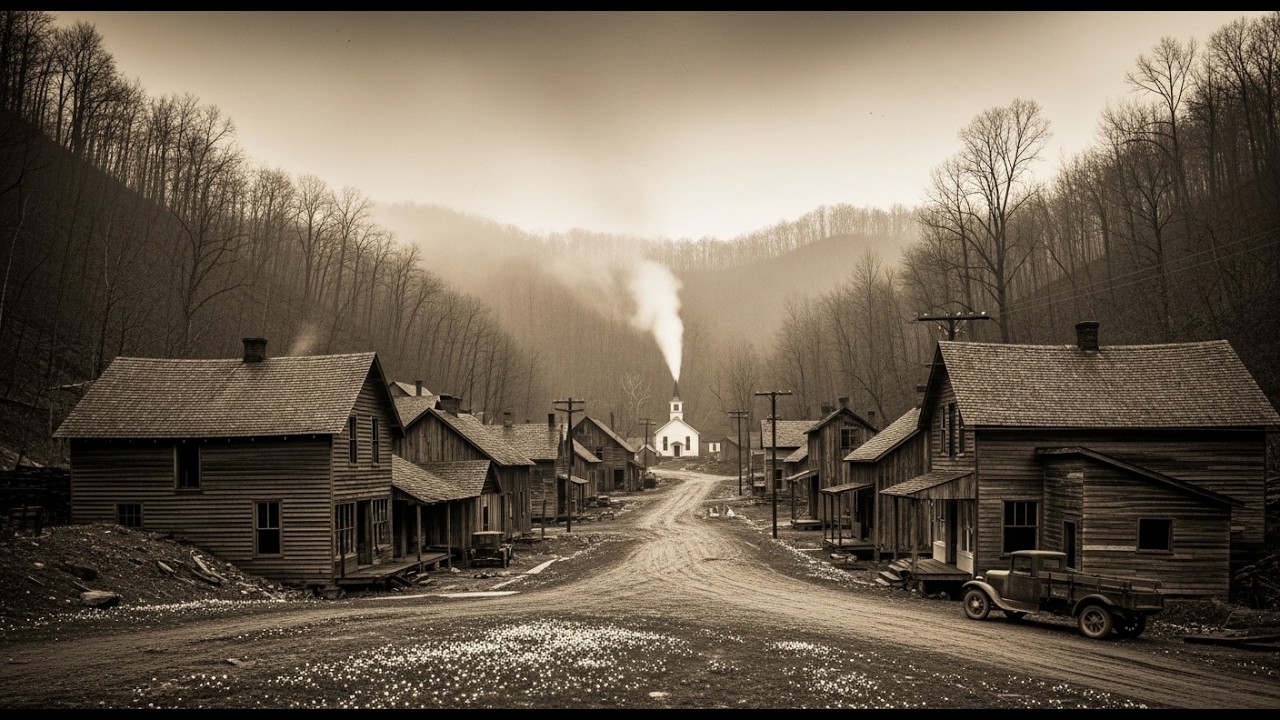
Cordell drove for nearly four hours. When the road dropped and the trees fell away, he saw Barren Lake: a coal town that looked abandoned for decades, with sagging roofs and dark windows.
Yet smoke rose from some chimneys. Someone still lived there. He parked near the company store and stepped out. The silence was unlike anything he had known.
It did not feel like absence. It felt like presence, as if the silence itself was watching him. He set up his surveying equipment and began measuring. The work calmed him.
But after about forty minutes, he caught movement in his peripheral vision, a flicker at a window on the hillside. When he looked, the window was empty. It happened again five minutes later, in a different house. Someone was stepping back as he turned.
Over the next two hours, Cordell mapped most of the main street and the first row of hillside structures. The measurements told him something strange. The buildings were not aligned the way buildings in a small town usually are. The angles were off by only a few degrees.
The distances between structures were inconsistent in ways that seemed deliberate. Then he measured the distance between the company store and the church: 67 feet, 4 inches. Later, he measured again: 68 feet, 9 inches. The angle of the main street had shifted from 6 degrees to 8 degrees.
The town was changing, slowly, imperceptibly, but measurably. The buildings were moving. A woman appeared on the porch of the company store. She was tall and thin, wearing a faded dress, her gray hair pulled back tightly.
She told him she had been there since 1862, when she was a nurse traveling with a medical wagon during the war. She had taken a wrong turn and found this place. The town built her a house that very night. She had been there for 61 years and did not look it.
In the church, Cordell found eight candles burning in a circle on the altar, and a ledger in the center. It contained rows of names and dates, going back to 1847. Beside each name, in a separate column, was one word: “stayed. ” The only exception was the final entry: “Apprentice G.
, 1909, left. ”
When he turned to leave, the woman was standing in the doorway. Behind her, filling the street, stood dozens of people, all motionless, all staring with the same pale, colorless eyes. They were dressed in clothing from different eras.
At the end of the street, where Cordell had surveyed an empty lot that morning, there now stood a small, well-kept house, with a light in the window and smoke rising from the chimney. “That’s your house,” the woman said. “Everyone who comes to Barren Lake gets a house. That’s how the town grows.
”
Cordell understood. The town was not dying. It was feeding. Every surveyor, every traveler who had ever gone missing in these hills, came to Barren Lake, and the town built them a house, and they stayed.
The buildings were not shifting from thermal expansion. They were growing, like cells in a living organism. “What happens if I leave? ” he asked.
“No one is stopping you,” said the woman. But she added: “You’ll want to check your measurements before you go. ”
He did. The distance from the company store to the church was now 71 feet, 2 inches, nearly four feet longer than an hour before.
The house at the end of the street had moved closer, and its light was brighter, its smoke thicker. When he tried to start his truck, the engine would not turn over. The woman said the ground seeped into the machines. No matter what he did, the truck stayed dead.
He decided to walk out. After thirty minutes on a road that went only one direction, he crested a hill and saw Barren Lake below him, exactly as he had left it. The town had brought him back. He tried again, cutting through the forest at a right angle, walking due east for forty minutes by compass.
Again, the town lay below him, and now the new house, his house, was closer to the center of town. Beside it stood another new house, also lit. He returned to the town and spoke with the woman again. She told him about the surveyor who came before Cordell, a man named Orville Danley, who arrived in 1901.
He fought the place for three days, walked in every direction, tried to follow the stream. On the third night, exhausted, he fell asleep on the church steps. When he woke, he was inside his house, the house the town had built for him. He said it had the most comfortable bed he had ever slept in, that it smelled like his mother’s kitchen.
He said it was the first time he felt like he was exactly where he belonged. He never left. “How did the apprentice leave? ” Cordell asked.
The woman’s expression hardened. The apprentice was different. He brought something the town had not expected, something it could not digest. On the second night, the town began to shake, not like an earthquake but like a fever.
By morning, the apprentice was gone. His house vanished. The town was smaller by two buildings than it had been the day before. “The question,” she said, “is whether you have what he had, or whether you are like the rest of us.
”
Night fell over Barren Lake quickly, not gradually. The cold was sudden and hostile. The house, his house, had grown to three stories in the middle of the main street, casting golden light through the dark. The warmth and the scent of coffee and baking bread called to him.
He stayed in the truck. He thought of his wife, Dorothea, and their home in Welch: the wobbly kitchen table he always meant to fix, the stuck window in the bedroom, the way she hummed while she cooked. He held onto those thoughts because he realized the town was reaching for those very things, reaching for what was warm and familiar and loved, to bait its trap. He saw figures walking the street, moving with the careful gait of people who had not used their legs in a long time.
Their eyes were open but empty. Their mouths moved silently, forming words that made no sound. One of them entered his house. The house fed.
In the morning, Cordell found a white-painted fence across the road at the southern edge of town, with a gate in the middle. The gate was open, but the fence was there. The woman said the town built it sometimes, after someone resisted. It was just a suggestion, a hint that inside was inside and outside was not an option.
She explained what she understood of the town. It had been there before anyone built on it. The first structures went up around 1845, when coal companies sent scouts into the valley: a geologist, a cartographer, and a foreman. They never left.
Their names were the first three entries in the ledger. Then came the workers who built the camp, then the surveyors who came to inspect the camp, then the people who came looking for the surveyors who never returned. That cycle had continued for 78 years. “But the apprentice left,” she said.
“The town has never forgotten that. You are here because of the apprentice. Not because the company sent you. The company does not even remember this place exists.
You are here because the town wants to understand what happened with the apprentice. You are here because the town is testing whether it can hold anyone again. ”
Cordell asked what the apprentice had possessed that the rest of them lacked. The woman thought for a long time.
People who stayed, she said, were running from something, or searching for something, or missing something. The geologist wanted recognition. The cartographer wanted adventure. The foreman wanted money.
She herself had wanted something she would not name. They all had a gap, an empty space, and the town filled it. That was enough. It had always been enough.
“But the apprentice was not missing anything,” she said. “He was not running. He was not searching. He was just doing his job.
And when the town offered him a house, he looked at it and felt nothing. Not anger, not fear, not longing. Because he already had everything he needed, and he knew it. ”
“The town could not build a house for a man who was already home,” Cordell said.
The woman did not answer, but something like hope moved behind her pale eyes. Cordell spent the second day walking through the town, studying it. In the houses on the hillside, he saw people performing the motions of life without its substance: a man stirring an empty pot, a woman sewing cloth with no thread, an old man reading a book with blank pages. They never looked at him.
Beyond the church, in the oldest part of the settlement, he found thousands of white flowers growing out of the gray dust, blooming out of season. They had no visible roots. In the center of the field, nearly hidden by the flowers, was a round hole about four feet across. When he looked into it, he saw nothing.
Not darkness, but nothing, an absence so complete it felt like staring into a gap in the world itself. From the hole, faintly, came the slow, deep, rhythmic breathing he had heard since he arrived. This was the source. This was the mouth, or the throat, or the lung of whatever Barren Lake was.
He stepped back. The flowers tilted toward him as he moved, tracking him. They were tracking something he carried, something warm and alive and full that the town wanted. That afternoon, Cordell sat and thought.
He thought about the apprentice, and about what the woman had said: the town cannot build a house for a man who already owns a house. He thought about his own life. He loved his wife. He loved the house he had built with his own hands, the real house in Welch, with its wobbly table and its stuck window.
But there was a “but. ” Sometimes late at night, when Dorothea slept and the house was quiet, he lay in bed and felt a weight on his chest, a feeling that something was unfinished, that there was a room in his life he had never found the door to, a question he never knew how to ask. The house in Barren Lake knew about that room. It had found the door.
Its warmth was the color of an answer to a question he had carried for thirty-eight years. That was what the town did. It did not feed on fear or weakness. It fed on lack, on the spaces between what you had and what you almost had, on the gaps too small to name but too large to ignore.
Night fell a second time. The cold was sharper than before. Six figures walked the street and entered his house. Cordell stayed in the truck.
He shivered. He bit his cheek. He recited surveying tables to keep his mind tethered to facts and figures. Then, around what felt like two in the morning, the town went silent in a different way, as if the whole valley were holding its breath.
The house called to him, not in words but in feeling. A wave of warmth and comfort and belonging spread through the cold truck cab, bringing images, not memories but promises: a life in Barren Lake where the weight lifted from his chest, where the unknown room was open and full of light, where he never felt incomplete. All he had to do was cross the threshold. His hand was on the truck door handle before he knew it.
His fingers closed around the cold metal. His arm was pushing. The door creaked open. The night air rushed in, and it was no longer cold.
It was warm, warm as July, warm as Dorothea’s hands. He stopped because he saw something in the rearview mirror. In the dim light from the house, he saw his own face, and his eyes were changing. The color was fading.
The depth was flattening. For just a second, he saw the beginning of what he had seen in the hollow faces that walked the street. The beginning of absence. He slammed the door.
He punched the steering wheel. He made sounds that were not words. The pain in his fists brought him back. He resisted the warmth and the light.
The house trembled. The ground shook, and for the first time, the breathing from underground became unsteady. Dawn came. Cordell had not slept in two days.
His eyes were bloodshot. His hands were swollen. But his mind was clear. He walked to the middle of the street.
The house had grown enormous now, five or six stories, its tower nearly touching the church steeple. The white flowers now covered the entire street. The woman was on the store porch. She looked older, more tired, as if the trembling in the night had cost her something.
“You are still here,” she said. “Most people are gone by the third morning, one way or another. ”
Cordell asked her: “The people in the ledger, the ones who stayed. Were any of them happy?
”
She was silent for a long time. “At first, yes. Happier than they had ever been. The town gave them everything they were missing.
Everything they always wanted. For a while, it is perfect. More than perfect. It is the life you always imagined but never believed you could have.
Then, slowly, it begins to take. So slowly you do not notice at first. A memory here. A feeling there.
The things that make you who you are, it takes them away, like a river taking soil from its banks. Gently. Constantly. Until one day you look in the mirror and do not recognize the person looking back.
Then one day you do not look in the mirror at all. Then one day you walk into the house and you do not come out again. ”
“Has that happened to you? ”
She looked at her hands.
They were thin, translucent. She could almost see the bones beneath the skin. “Not yet,” she whispered. “I have been fighting this for 61 years.
I remember less every year. I used to remember the names of the soldiers I treated during the war. Now they are just faces. I used to remember the town where I grew up.
Now it is just a color. Green. That is all that is left. The color green.
”
“But you are still here,” Cordell said. “Still yourself. Most of the time. But the town is patient, and I am very tired.
”
Cordell nodded slowly. Then he did something he had not planned. He opened his field notebook, found an empty page, and wrote. He wrote Dorothea’s name.
He wrote their address. He wrote the date of their wedding. He wrote the name of the dog they had owned before it died. He wrote the smell of the kitchen in December.
He wrote the sound of rain on their tin roof. He wrote the color of the sky on the evening he proposed, and how she said yes before he finished asking. He wrote about the wobbly table and the stuck window and the loose floorboard. Every imperfect, ordinary, unremarkable detail of his life that the town was trying to replace with something better.
Because that was the trick. He understood it now. The town offered perfection, and perfection was the trap. A perfect house is not a house.
It is a painting of a house. It has no loose floorboards, no wobbly legs, no stuck windows. It has nothing that catches on your fingers and reminds you that you are real, that the place you live is real, that the life you have, with all its flaws and ordinariness and occasional heaviness, is yours. The town searched for perfection.
He already knew perfection was a lie. He tore the page from the notebook and held it up, not toward the house, but toward the ground, toward the thing breathing below. “I know what you are offering,” he said. “And I do not want it.
Not because it is not good. Because it is not mine. My house has flaws. My life has flaws.
I have flaws. And those flaws are the only things you cannot copy. They are the only things that truly belong to me. ”
The ground began to tremble.
“You can build a house with warm light and the smell of coffee and everything good I have ever known. But you cannot build the man with the wobbly table. You cannot build the window that always sticks. You cannot build the way Dorothea burns the bread every third Sunday and laughs about it.
You cannot build the flaws, because you do not understand them. You do not understand that the broken things are the real things. The cracks are where the life gets in. ”
The trembling became a shaking.
The white flowers folded in on themselves, their cold petals contracting like fingers closing into fists. The house in the middle of the street groaned, a long, low sound like a ship’s hull bending in a storm. “I am leaving now,” Cordell said. “And this time, the road will take me home.
”
He walked to his truck. He turned the key. The engine roared to life. He drove down the main street through the white flowers that parted before his tires like water.
He passed the church with its cracked steeple. He passed the house that was collapsing in on itself, its impossible floors folding inward. He drove up the road through the trees, past the gate in the white fence swinging violently on its hinges, up the hill, around the turns. This time, the road let him go.
He drove for three hours without stopping. He drove until the trees parted and the sky opened and the world felt like the world again. He drove until he could hear birds and feel the wind, and smell only mountain air, clean and cold and free of anything sweet. He stopped at a gas station outside Bluefield.
The man behind the counter, a heavyset man in his forties with oil-stained hands, looked at him and said, “Mister, you look like you have seen the devil himself. ” Cordell ordered coffee. Black. It tasted terrible, weak and bitter and slightly burnt.
It was the best thing he had ever tasted. He drove home. He walked through the front door. Dorothea was in the kitchen, and the toast was burning, and she was laughing about it, and the kitchen table wobbled when he set his keys on it, and the bedroom window was stuck again, because it was that time of year.
He held her for a long time. He did not explain. She did not ask. She just held him with her warm hands while the house creaked around them in the wind.
Imperfect and ordinary and completely real, and irreplaceable. Cordell filed his report the next day. Two sentences only. The apprentice read it, nodded, and filed it away.
They never spoke of Barren Lake again. But there is always a “but. ” Every year in late autumn, when the leaves fall and the ground looks bare and exposed, a new file appears on someone’s desk at the Allegheny Land and Mineral Company. A thin file containing one name, coordinates, and a pencil note: “Survey the area and submit a report.
Do not engage with the locals. ” The name on the file is always the same. Barren Lake. And the road is always there, hidden in the folds of the mountains, waiting.
At the end of that road, in a valley the maps forgot, the town sits, smaller than it was, perhaps wounded, but not dead. It will never die. The town is patient. Patient as stone.
Patient as dust. Patient as the silence that fills a room when someone has just left it, and you know, you know deep down, that it will come back. Cordell Foss lived for 34 more years. He and Dorothea grew old together in their house in Welch.
He never fixed the wobbly table. He said it reminded him of something. Dorothea never asked what it reminded him of. She already knew.
Not the details, but the weight, the shape of whatever he had brought home with him from those mountains. He died in the winter of 1957, peacefully, in his sleep, in his own bed, in his own house, the real one. When they cleared out his belongings, they found his old surveying notebook in the bottom drawer of his desk. On the last page, someone had written something.
It was not Cordell’s handwriting. It was precise, almost printed. It read: “Cordell Foss, 1923, left. ”
Beneath that, in newer ink, as if written recently: “The room is still available.
”