For forty-seven years, the most intimate record of Jacqueline Kennedy’s marriage remained locked away, its contents known only to a few. In 2011, her daughter Caroline released eight and a half hours of audio recordings from 1964, and America finally heard the widow speak in private. She called Martin Luther King Jr. a pretender.
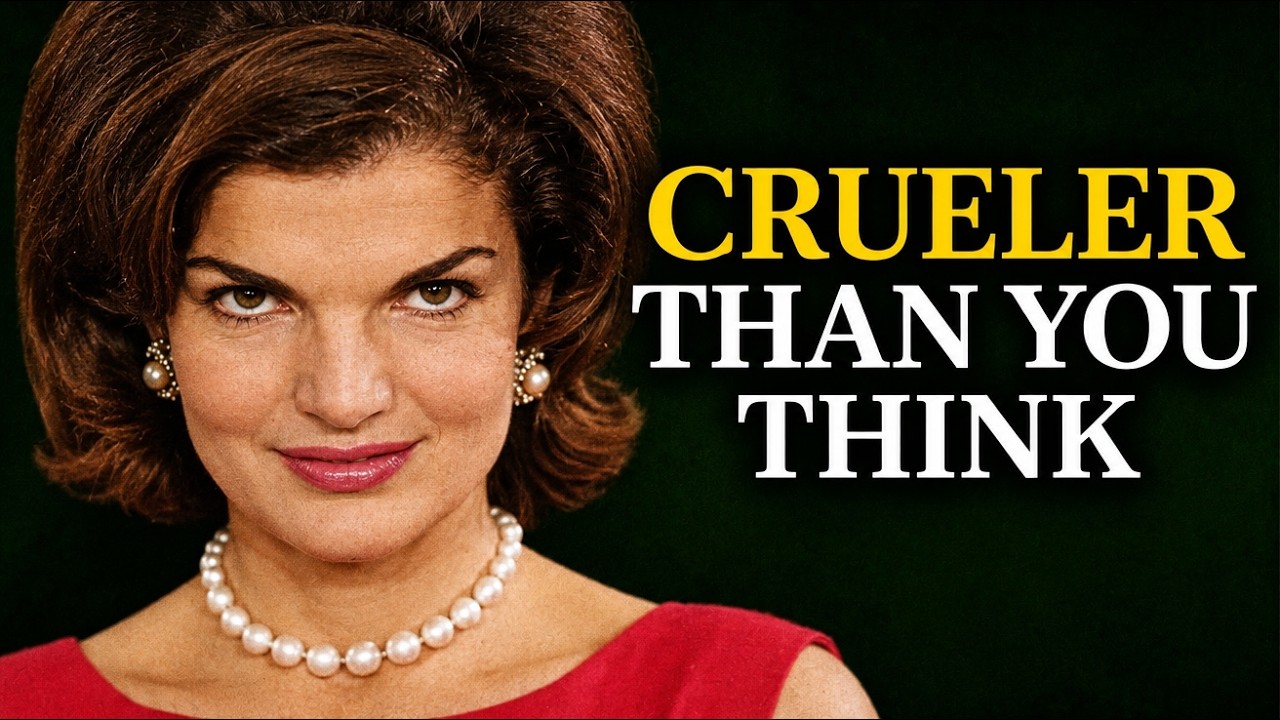
She described Indira Gandhi as domineering and unpleasant. She said women in politics were a mistake. The grieving widow’s opinions were sharp as razor blades, and she had decided the public would not hear them for nearly half a century. Her bloodstained pink suit remains sealed in the National Archives, not to be displayed until 2103.
And the word “Camelot,” the enduring myth of her husband’s presidency, was her own invention. The wife everyone pitied had written the script. The recordings came from seven interviews conducted in spring 1964 by historian Arthur Schlesinger Jr. at her Georgetown home, just months after the assassination.
The woman on tape is not the veiled figure of funeral photographs. She is witty, cutting, precise, and utterly unromantic about those around her. She evaluates her husband’s cabinet ministers as if assessing furniture she did not choose. Lyndon Johnson seems a man she merely tolerated.
Charles de Gaulle is dismissed as selfish. King is reduced to a single word, with her attributing the criticism to information her husband and Robert Kennedy received from the FBI, a glimpse of what she heard at the dinner table. In the same breath, she declares women should stay out of politics, saying she took her views from her husband, reciting them like company policy. She said this in 1964 and then ensured no one would hear it for two generations.
The recordings entered the Kennedy Library on her terms, released by Caroline for the fiftieth anniversary of the inauguration, framed, edited, and packaged as a book and CD set. This was not an accident of archival politics but the story in miniature. The same applies to the suit. It was a replica Chanel design in pink wool bouclé with navy trim, worn in Dallas because her husband asked her to look her best for Texas.
She refused to change out of it for nearly twenty-eight hours. Lady Bird Johnson recalled offering help on the plane and being refused. The famous phrase that she wanted them to see what they had done comes from Lady Bird and Kennedy aides, a memory refined over time rather than verbatim text. But the behavior is beyond dispute.
She stood aboard Air Force One as Johnson took the oath, blood still on her skirt, deliberately. The suit was never cleaned. It went to her mother’s house, then to the National Archives in 1964. In 2003, Caroline Kennedy signed a deed of gift transferring ownership to the American people on one condition: no display for one hundred years, until 2103.
The two most powerful pieces of evidence from the Kennedy marriage, her own voice and the clothes she wore when it ended, were placed under tight family control on terms the widow set. The question is obvious: what exactly was she protecting? Jackie Kennedy learned the answer long before she met him. Her distinguishing trait was not her education or French fluency but her upbringing in wealth while living in other people’s houses.
Her father, John Vernou Bouvier III, known as Black Jack, was a Wall Street stockbroker with a permanent tan, a taste for younger women, and a talent for losing money. His divorce from her mother in 1940, on grounds of adultery with irrefutable evidence, was splashed across New York tabloids. Eleven-year-old Jackie adored him anyway, despite his absences, unpaid alimony, and drinking. Two years later her mother married Hugh Auchincloss, a Standard Oil heir with two grand estates.
Suddenly Jackie had stables, servants, and a room with a view, none of it hers. She and her sister were literal guests in excellent rooms. When she was presented to society in 1947, she was a girl of good status, her stepfather’s address, and no capital. Every later decision about money, from the shopping that infuriated her husband to her marriage to Onassis and her editorial salary at forty-six, traces directly back to being simultaneously rich and broke from age thirteen.
Then came the work. In 1951 she took a job at the Washington Times-Herald as a reporter earning $42. 50 a week. She carried a Graflex camera, stopped strangers on the street, asked them the question of the day, photographed them, and wrote it up.
She interviewed Richard Nixon. She snuck into Eisenhower’s inauguration to interview people. She asked questions like whether the Irish lacked the art of love and whether wives should tell husbands the truth about their appearance. It seemed like a novelty column, but it was practical training.
She spent two years learning precisely how a story is shaped, which quotes run, which photos appear, how deadlines press editors, and what the press needs and what it will give in return. Everyone in the Kennedy circle learned journalism from the outside, as subjects. She learned it from the inside. No one in this story, not Joe, not Jack, not Bobby, had that training.
She met him at a Georgetown dinner party in May 1951. He was a thirty-four-year-old congressman running for Senate with a bad back and a reputation that preceded him. She was twenty-one. She later said he leaned over the asparagus and asked her for a date.
The courtship was mostly phone calls and postcards while he campaigned statewide and she chased witnesses on Washington streets. This was not a whirlwind romance but a calculated one, and she wrote about it. Since 1950, she had been writing long, candid letters to a Dublin priest named Joseph Leonard. In 2014, when those letters surfaced, she had written that Jack was like her father, that he loved the chase and was bored by the conquest, and she wondered whether she loved him or her idea of him.
She married him fully aware of her expectations, with a written record of them. The engagement was announced in late June 1953, deliberately delayed until the Saturday Evening Post ran a profile of him as the gay young bachelor, allowing the Kennedys to build an article around his possible marriage, then announce. This was the first documented instance of the couple coordinating their relationship with the press. It would not be the last.
What did each actually get? He got a Catholic wife, critical for a man planning a national campaign against Protestant America. He got a woman fluent in French, educated at Vassar, the Sorbonne, and George Washington University, able to sit beside an ambassador. He got a bride twelve years younger, beautiful in photographs, preselected by society pages.
His father, who had spent two decades constructing a public family, saw her and recognized wealth he did not have to manufacture. She got escape from dependence in her stepfather’s house. She also got a genuinely attractive, funny, physically brave man who paid attention to her as almost no one had. Attraction and calculation were both real.
Anyone who tells you one cancels the other has not read the letters. She was entering not a marriage but a corporation, and its owner had predetermined her role. Joseph P. Kennedy Sr.
first exercised control by taking away her wedding. She wanted a simple ceremony. Her mother wanted an elegant Newport affair. Joe wanted a massive spectacle, and Joe was paying.
On September 12, 1953, eight hundred guests filled St. Mary’s Church in Newport while three thousand people waited outside. The archbishop of Boston celebrated the nuptial mass and read a blessing from Pope Pius XII. The dress was ivory silk taffeta by Ann Lowe, a Black New York designer who for decades dressed women without her name appearing in print.
A week before the wedding, a pipe burst in Lowe’s workshop, destroying most of the dresses. She and her team rebuilt them at her own loss. The bride did not like the dress. She wore what she was given.
Her father was to walk her down the aisle. Black Jack arrived in Newport, checked into a hotel, and never reached the church, drunk according to most biographers. Her stepfather Hugh Auchincloss gave her away. The most photographed American wedding of the decade began with a bride in a dress she did not choose, escorted by a man who was not her father, before a crowd her father-in-law had assembled for reasons that had nothing to do with her.
For years afterward she had no home of her own. Hickory Hill, purchased in 1955, sold to Bobby and Ethel two years later. A rented house on N Street. Much time at Hyannis Port, less a vacation home than a corporate compound where Joe senior managed schedules, guests, and assessments of who measured up.
She hated it, dryly calling the sisters-in-law “the raw girls” and behaving like a visiting anthropologist. She could not leave because she owned nothing. Her husband was a literal millionaire, with trust income of hundreds of thousands a year, but his father controlled the money. Even her clothing bills went to Joe’s office.
Her spending during the Senate years ran to tens of thousands annually, far exceeding his salary. He complained about the bills, to aides, to his father, to her. His father paid without argument. One Kennedy considered her a burden; the other considered her an investment.
She spent because a dress was the only asset she truly controlled, and because it was production cost for the only thing she owned: her image in photographs. The marriage itself was in poor health. In October 1954, he underwent spinal surgery, developed an infection, and received last rites, followed by a second operation in February 1955. She nursed him for months, changing dressings, reading aloud, running the room.
It was the closest their early marriage came to conventional intimacy, at a moment when he was physically incapable of leaving bed. In 1955 she had a miscarriage. In 1956 she was pregnant again. During the Democratic Convention in Chicago that August, he lost the vice-presidential nomination by a narrow margin, then sailed to the Mediterranean with his brother Ted and Senator George Smathers.
On August 23 in Newport she began hemorrhaging. She was rushed to the hospital, delivered a stillborn daughter by emergency cesarean, and was under anesthesia. Bobby Kennedy handled the hospital and burial arrangements. Her husband remained at sea for nearly three days.
When finally reached, according to Smathers, his first instinct was to continue the cruise. Smathers told him bluntly that if he wanted to run for president, he should take a plane. He flew back. The verifiable facts need no embellishment: she lost a child while he was on a boat in the Mediterranean, and the person who sat with her was his brother.
Something ended in that hospital room. Those close to her described the following months as the worst of the marriage, and she reportedly considered separation. She spent long periods back at her mother’s estates, returning to the dependency she had married to escape. The famous story that Joe Kennedy offered her a million dollars not to divorce his son is widely repeated but unproven.
It emerged years later, attributed mainly to Gore Vidal and indirect accounts. No contemporary document or financial record supports it. Most careful biographers treat it as unsubstantiated. The truth is more mundane.
In 1956 she was a twenty-seven-year-old Catholic woman with no income, no property, a dead child, a famous husband, and a mother who had demonstrated what divorce did to a woman in that world. Staying was not a decision. It was arithmetic. What changed the course was the birth of Caroline in November 1957 and what her husband did with the photographs.
He was a genuinely devoted father, well documented by staff, friends, photographers, and later by his habit of bringing his children to the Oval Office. Within ninety days, that tenderness became a campaign asset. Running for Senate reelection in 1958, he appeared in print constantly with wife and child. He won by the largest margin in Massachusetts history.
His marriage coverage transformed from playboy senator to national serial drama. The same two years that produced those images produced a marriage those around them described as formal and cold. In Paris in May 1961, everything shifted. The state visit was meant to showcase de Gaulle, NATO, Berlin, whether a forty-four-year-old American president could match a man who considered himself France incarnate.
Instead, the French crowds chanted her name. She spoke fluent French with de Gaulle without an interpreter, discussing the Bourbons and Louis XVI. He was visibly impressed. The French press lost composure entirely.
At a luncheon, her husband stood and introduced himself as the man who accompanied Jacqueline Kennedy to Paris. The self-deprecating joke was also a professional politician recognizing a story he could not control. He had married her for her Catholicism, her French, and her photographs. In Paris, those assets performed before the world press, and his image improved by association.
She noticed. Everyone noticed. Her behavior changed markedly. She began making demands, and they were met.
The most important was the house. She had toured the White House in December 1960, pregnant, with Mamie Eisenhower, and found it in deplorable condition after sixty years of cheap renovation: hotel furniture, department store reproductions, almost nothing of documented historical value. She described it as looking like a Statler Hilton. She could not ask Congress for redecoration money; her husband had won by 112,000 votes.
So she did not ask. In February 1961 she established the White House Fine Arts Committee, chaired by Henry du Pont, staffed with collectors and museum curators, soliciting private donations in exchange for social status for donating a chair or painting. In September she pushed through Public Law 87-286, declaring White House furniture non-transferable property, so future administrations could add pieces rather than sell them. She created the position of White House curator, founded the White House Historical Association, and produced a guidebook that sold hundreds of thousands of copies at one dollar each, funding further acquisitions.
This was not decoration. This was a thirty-one-year-old woman with no official authority, no budget, and no title, building a permanent institution inside the presidential palace using only donors, lawyers, and the press. On February 14, 1962, CBS broadcast a White House tour with Mrs. John F.
Kennedy. Charles Collingwood walked beside her as she spoke of Monroe furniture and Lincoln’s bed in that whispered voice people have mocked for sixty years. An estimated 56 million people watched, nearly three-quarters of active televisions, in more than one hundred countries. She won an honorary Emmy, which Lady Bird Johnson accepted because she refused.
Fifty-six million viewers for a furniture tour. The Kennedy administration, elected by the slimmest margin, had its most successful mass media event of the entire presidency produced by the wife, about a house, entirely devoid of politics. She had become indispensable. Not just beloved.
Indispensable. There is a difference, and that difference is leverage. She now refused events she did not care for, with the White House press office inventing excuses. She was famously unavailable for routine first lady duties.
Lady Bird Johnson covered her absences without complaint. She built her own spaces, leasing a four-hundred-acre Virginia farm where she spent long periods with the children, then building a house there, completed in 1963. She traveled without him to India and Pakistan for three weeks in spring 1962 in a massive media event. That summer she spent a month on the Amalfi Coast, photographed swimming in Ravello while her husband remained in Washington.
Articles asked whether a first lady should spend August in Italy. This is the paradox: the most admired woman in the world, at peak usefulness to her husband’s presidency, arranged her life to be physically elsewhere for long stretches. Separate house, separate holidays, separate travel. She was not hiding.
She was building rooms of her own, publicly, financed by her family, in plain sight of the press. The affairs continued. White House records are stronger than Senate-era evidence because staff and Secret Service agents testified formally. The point of contention is narrative quality, not whether they occurred.
She knew. Her friend and social secretary from those years and her biographers who interviewed those closest to her all agree she knew early. She had told a Dublin priest what to expect before the wedding. Knowledge, however, does not equal complicity.
By mid-1962 the marriage had settled into something practical and cold. For the first time, he needed her more than she needed him. She had a house he did not live in, a public role he could not perform, and an international constituency of her own. In spring 1963 she was pregnant again.
Everything that had briefly held together collapsed. Her pregnancy, announced in April, was medically terrifying from the start. She cancelled her official schedule for the year and summered on Squaw Island. On August 7, five and a half weeks early, labor began.
She delivered a son, Patrick, weighing 2. 9 kilograms, suffering from hyaline membrane disease, respiratory distress syndrome. The child was transferred to Boston Children’s Hospital and placed in a hyperbaric oxygen chamber. The president spent the night of August 8 in a hospital room and was with the baby when he died at dawn on August 9, thirty-nine hours after birth.
He returned to Otis Air Force Base to tell her. Numerous witnesses described his crying and holding her hand. Nurses at Otis remembered that he stayed with her in a way he never had before. She remained in the hospital another week; he flew to see her daily.
People who had worked with them for a decade said they had never seen him touch her in public. After Patrick, they did. Photographs from that autumn show them leaving the hospital holding hands. Staff who saw those images understood them as news.
The reconciliation was real. Everyone close to the marriage in fall 1963 described a change. Eight weeks after burying her son, she boarded Aristotle Onassis’s yacht Christina. The 325-foot vessel had been converted from a Canadian frigate, with a pool that became a dance floor and bar stools upholstered in whale foreskin.
The invitation came through her sister Lee, who was involved with Onassis at the time. The two-week cruise through the Aegean to Istanbul took place in October 1963. Her husband did not want her to go, and said so. Onassis was a genuine political problem: indicted in the United States in 1954 for purchasing surplus ships, settled for $7 million, precisely the figure no president could be photographed beside.
Kennedy insisted Franklin D. Roosevelt Jr. accompany them. Onassis, aware of the problem, avoided boarding for part of the voyage.
It did not help. Photographs ran. Congress raised questions. The scene was catastrophic: the president’s wife, weeks after a family death, on a Greek shipping magnate’s yacht in a swimsuit in the Mediterranean.
Within days of her return in mid-October, she agreed to something she had refused for three years: a campaign trip. The 1964 election was scheduled to pass through Texas, where the party was sharply divided and Kennedy had won by only two points in 1960. She had not done a domestic political trip since before the 1960 election and hated them. She told her husband she would go to Texas.
She reportedly added that she would campaign with him wherever he wanted in 1964. That sequence is documented: the yacht, the coverage, the political damage, the offer. The yacht trip and offer were not about political calculation alone. After Patrick, she wanted to be with him, and Texas was where he was going.
She chose the suit. Pink wool bouclé with navy trim, a Chanel replica from the house of Chez Ninon, made in New York from French fabric because Paris haute couture on a president’s wife was a scandal and this suit avoided it. He had asked her to look her best for Texas. She had worn the suit at least six times before.
In Fort Worth that morning she told the breakfast crowd that no one cared what he or Lyndon wore. Dallas, 12:30 p. m. Parkland Hospital.
Air Force One at Love Field, where Lyndon Johnson took the oath at 2:38, with her standing beside him in that suit. Asked on the plane, and again at Bethesda, whether she wanted to change, she declined. Lady Bird Johnson wrote that she offered help and was refused. Clint Hill, the agent who climbed onto the back of the car, and others confirmed the refusal.
She stayed in the suit through the flight, through the arrival at Andrews, through the autopsy at Bethesda, not removing it until nearly 5:00 a. m. Every photograph taken that afternoon exists because she decided not to change. The act itself was freighted with intent: she stood deliberately, refused repeatedly, and made certain every photographer in Washington did their work.
It was the last piece of evidence she could control directly, and she made sure they saw it. Over the next six days she planned the funeral. She drew on Library of Congress researchers overnight to study the details of Lincoln’s 1865 funeral. Based on those descriptions, she ordered the East Room draped in black crepe.
She insisted on a funeral procession walking from the White House to St. Matthew’s Cathedral over Secret Service objections, putting the new president and some ninety foreign leaders on the street eight miles from the assassination site. She chose the riderless horse. She ordered the eternal flame installed at Arlington, an idea she conceived about a day before, requiring the army to improvise plumbing overnight.
She had her two dead children reinterred at Arlington beside him. An estimated 180 million Americans watched part of the funeral. It was the most-watched collective experience in the country’s history to that point, designed by a thirty-four-year-old widow in under seventy-two hours using Civil War archives. She then performed a role almost no one knew about until 1995.
On November 29, a week after Dallas, she called Life magazine from Hyannis Port and requested an interview with Theodore H. White, the journalist she knew and trusted, author of The Making of the President. He drove from New York in the rain; his mother had suffered a heart attack that day, but he went anyway. She spoke with him for nearly four hours.
She told him her husband had suffered insomnia, listening to records at night, and that the record he loved was the original cast album of Camelot with Richard Burton. She quoted the final lines about one brief shining moment. She said there would be great presidents again, but there would never be another Camelot. White wrote it at a servant’s table.
Life editors in New York were on the phone demanding he cut the Camelot material as too sentimental, too shallow, not journalism. She stood in the room while he argued with them. White later said she listened to his call and shook her head. He capitulated.
The article ran in the December 6, 1963 issue. The Camelot myth came not from the administration, not from the press, not from history, but from an interview conducted by the widow seven days after the assassination, with a journalist she chose, held against his editors’ objections by her presence. What was she protecting? Her husband’s Addison’s disease had been publicly denied through two campaigns.
His amphetamine injections from Max Jacobson were unknown. His affairs were known to journalists but unpublished. The Bay of Pigs, the wiretapping of Martin Luther King authorized by his brother, the civil rights bill that never passed: all real, all contestable, all vulnerable. Camelot did not directly conceal any of it.
It did something more lasting. It transformed the presidency from an administration one could argue about into a tragedy one could only mourn. The most intimate record of the marriage stayed sealed on the family’s schedule. The pink suit stayed in its box, examined periodically, never displayed.
In subsequent years she moved from making the story to policing it. She sued to suppress a memoir by the children’s nanny. She commissioned William Manchester to write the official account of the assassination, granted him review rights, then sued to stop publication when his manuscript contained material she objected to, including personal details from her interviews and hostility toward Johnson that threatened Robert Kennedy’s political ambitions. The lawsuit made the book a bestseller.
Her popularity dropped for the first time since 1961, briefly and harshly. She reportedly said anyone who fought her would look like a mouse chasing a swan. She was right. The full original manuscript remained sealed at Wesleyan University until 2067.
When Robert Kennedy was assassinated in June 1968, she flew immediately, was in his hospital room when he died, and helped plan his funeral. Something inside her broke that had not broken in 1963. The statement attributed to her is the clearest motive she ever expressed publicly: if they were killing Kennedys, her children were targets, and she wanted to leave the country. Four months later, on October 20, 1968, she married Aristotle Onassis on his private Greek island.
Vatican newspapers debated whether she had committed a public sin. She was thirty-nine; he was sixty-two. He had been, for a decade, Maria Callas’s acknowledged companion, who learned of the marriage from the papers. The moment she signed the marriage register she lost her $10,000 annual widow’s pension and Secret Service protection.
She was no longer the nation’s property. That was the point. She traded the myth for money and distance. What she actually received is murkier than claimed.
The famous figures, $3 million up front, $1 million per child in trust, a prenuptial agreement with 170 clauses, come from a former Christina steward and from Onassis’s lawyer in a later, hostile context. Treat them as unconfirmed. The documented outcome was the end. Onassis died in Paris in March 1975 before completing divorce proceedings.
Greek law entitled the widow to a compulsory share of the estate regardless of agreement. After a two-year legal battle, she settled with Christina Onassis in 1977 for approximately $26 million in exchange for relinquishing all further claims. This figure is real and recorded. It was the first time in her life, at age forty-eight, that Jacqueline Bouvier possessed capital of her own.
Beneath that story lies a detail almost always omitted. Two years before the settlement, in September 1975, she took a job. Consulting editor at Viking Press, four days a week, $200 per week. She was forty-six.
Her last salary had been $42. 50 a week in 1953. She worked for nineteen years. After leaving Viking over the Jeffrey Archer novel about a plot to kill Ted Kennedy, she moved to Doubleday, where she became a senior editor, acquiring some one hundred books, including Michael Jackson’s Moonwalk and works by Naguib Mahfouz.
Editors who worked with her described her as a real editor, taking quick notes, meeting authors for lunch, making phone calls to steady nervous writers. She had her own office, rode the subway, carried manuscripts in her lap. The woman who spent thirty thousand dollars a year on clothing in 1955 because a dress was the only thing she owned now worked for a salary and purchased books with other people’s money, never putting her name on anything she edited. In the late 1970s Maurice Tempelsman entered her life, a Belgian-born diamond merchant who eventually obtained a religious divorce and moved into her apartment around 1982.
He managed her money, and by most accounts turned the Onassis settlement into something exceeding one hundred million dollars. He lived with her for the last twelve years of her life and was in the apartment when she died. She never married him. The first marriage had made her public property of a family corporation.
The second bought escape at the cost of her reputation. The third she refused to formalize. No evidence suggests anyone ever asked why. She was diagnosed with non-Hodgkin’s lymphoma in January 1994.
She continued working into spring. She died at home on May 19, 1994, at sixty-four, and was buried at Arlington beside her husband and her two lost children. Her will, filed in New York and published as customary, included a provision to destroy certain personal papers, including letters from her husband and family members, or return them at her children’s discretion. Her last instructions concerned the papers.
In 1996, Sotheby’s auctioned her belongings. Four days, 1,300 pieces, $34 million against a pre-sale estimate of $4 million. Her fake pearls sold for $211,000. A cigar box belonging to JFK sold for $574,000.
People paid $4,000 for a footstool. The papers stayed sealed. The recordings stayed sealed. The suit stayed in its box.
Fifteen years later, Caroline Kennedy opened the Schlesinger interviews with an introduction in a slipcased set marking the fiftieth anniversary. Every review noted how shocking it was to hear the widow speak harshly of Martin Luther King. It was shocking because she had spent her life ensuring no one would hear it until her family chose the moment. Then, in 2014 in Ireland, the one file she had never controlled surfaced.
A college entrusted her letters to Father Joseph Leonard to an auction house, valued at one million euros. Irish journalists who read them published the contents. Kennedy lawyers raised ownership claims, the sale was cancelled, and the letters returned to private hands. But the coverage had happened.
The letters revealed a woman in her early twenties writing to a priest that the man she would marry was like her father, that he loved the chase and was bored by the conquest, and asking whether she loved him or her idea of him. She wrote that before the wedding. People call her a monster for being cruel to a nanny, for suing a grieving writer, for speaking ill of a civil rights leader on tape, for marrying a Greek shipping tycoon for money and protection, for spending her life deciding what the public could know about her marriage. All of these facts are true.
Every one of these portraits was taken by a woman who married into a family that had already decided her value lay in her image, who lost two children while her husband was elsewhere, who owned nothing until she was forty-eight, and who discovered somewhere between the Graflex camera and the servant’s room at Hyannis Port that the only permanent form of power available to her was authorship. She could not control the marriage. She did control its documentation. There is a dress preserved in an air-conditioned vault in Maryland, examined periodically, in a box no one is allowed to open.
It is the most important thing she ever owned and the most famous thing she ever wore. The only reason the world knows what it looks like is that she refused to take it off. The only reason the world will not see it again is that she decided that too.