He was the emperor’s brother, a prince who glittered through Vienna’s salons with wit, art, and scandal trailing behind him. For decades, Archduke Ludwig Viktor of Austria seemed untouchable, charming enough to survive any rumor, sharp-tongued enough to make enemies of nearly everyone who mattered. But in the end, the Habsburgs did what they always did with inconvenient truths: they buried him alive in elegance and silence. Born on May 15, 1842, Ludwig Viktor was the youngest son of Archduke Franz Karl and Princess Sophie of Bavaria, and the youngest brother of Emperor Franz Joseph I.
His parents had hoped for a girl after losing their only daughter, Maria Anna, at age four. Instead they received another boy, lively, mischievous, and impossibly charming. The family called him by affectionate nicknames, first Hetzi, then later the crueler Buzz-Wuzzy, a pet name that sounded playful but carried a sting. His mother adored him, dressing him in elaborate costumes for the parlor games known as tableau vivant, where noble families recreated scenes from art and history.
Ludwig loved it: the costumes, the drama, the attention. It was his first taste of performance, and he never lost the appetite. Unlike his brothers, Franz Joseph and Maximilian, who were raised for responsibility, Ludwig grew up pampered and indulged. The large age gap between him and his siblings meant he spent his early years surrounded by women, his mother’s ladies-in-waiting, musicians, tutors, and servants.
From them he absorbed grace, wit, and a flair for conversation. Even in childhood, it was clear he was no ordinary Habsburg. Where his brothers followed rules, Ludwig invented his own. Where others were solemn, he was exuberant.
Like every Habsburg prince, he was expected to serve the empire through the army. Discipline, loyalty, obedience: these were the virtues that defined his dynasty. But for Ludwig, they felt like chains. On paper, his military rise seemed impressive.
In 1860 he became titular head of the 65th Infantry Regiment, proudly named Archduke Ludwig Viktor, and decades later he would hold the rank of General of Infantry. But behind the medals, he remained uninterested in war. He preferred silk to steel, art to arms. Officers whispered that his mind wandered during drills, lost in thoughts of music or conversation.
His brother, Emperor Franz Joseph, understood the problem. Ludwig had no purpose, no direction. So in 1861, the emperor sent him to Salzburg as the imperial representative, a move that was both an honor and a subtle exile. Ludwig adored the city.
In the summer months he stayed at Schloss Kleßheim, hosting guests and staging small performances. He was polite, generous, and flamboyant, and the local elite adored him. But the real stage awaited him in Vienna. When he returned to the capital, the city was in the middle of a cultural awakening.
In 1863 he commissioned a grand residence on Schwarzenbergplatz, a palace designed by Heinrich von Ferstel in the opulent neo-Renaissance style. It was his statement to the world: if he could not command armies, he would command attention. The palace featured a massive ballroom glittering with chandeliers, a lavish dining hall, and a winter garden filled with exotic plants and statues. Inside, Ludwig hosted dazzling dinners, masquerade balls, and musical evenings that drew the cream of Viennese high society.
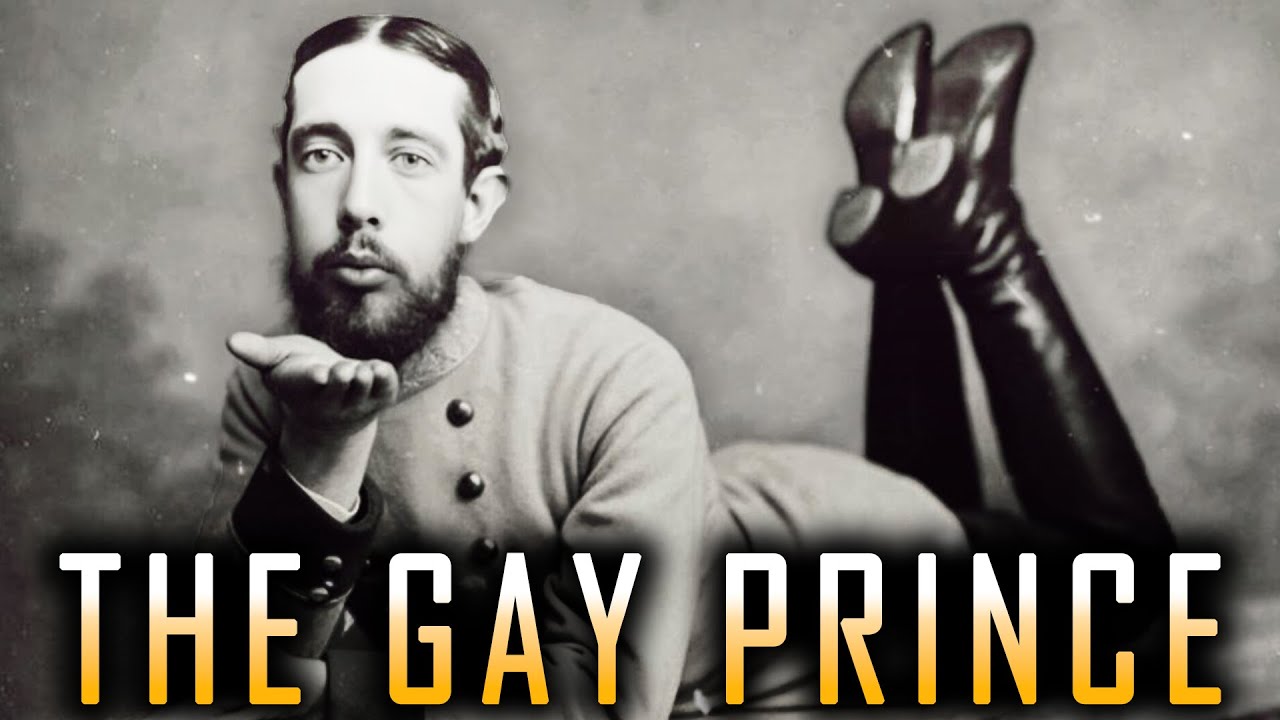
Even Emperor Franz Joseph and Empress Elisabeth occasionally attended, amused and perhaps a little uneasy. Ludwig collected art obsessively, developed a fascination with photography, and posed for portraits that raised eyebrows. In one famous image he appeared dressed as a woman, bouquet in hand, with a playful smirk on his face. It was likely from a court performance, yet the photograph only fueled the rumors about his private life.
The more Vienna gossiped, the more he leaned into his eccentric reputation. He strolled through the city in elegant English suits, frequented the opera and the cafés, and surrounded himself with beautiful young men. Society whispered that he was too charming, too theatrical, too different. Behind those whispers was a truth no one dared say aloud: Ludwig Viktor was attracted to men, in an age when such a thing was forbidden by law and religion.
Within the Habsburg court, everyone knew. No one said it. His brother joked that Ludwig should be assigned a ballerina as his adjutant, so nothing scandalous could happen. It was a cruel kind of affection, the sort that pretends not to see what it cannot accept.
The nickname Buzz-Wuzzy took on a sharper edge, a way to diminish him when he refused to hide. And for a time, he was protected. His chief of staff discreetly handled threats and blackmail attempts, often with quiet payments. But when that man was replaced in 1899 by Count Max Thun-Hohenstein, who disliked Ludwig and saw no reason to shield him, the protection vanished.
Ludwig’s sharp tongue had been making enemies for years. He had repeated gossip about Empress Elisabeth, calling her vain and obsessed with her appearance, and she responded with mocking verses describing him as frail, deceitful, and ridiculous. Rumor had it that he had revealed the affair of Princess Louise of Belgium, which ended with Louise declared insane and confined to an asylum. No one could prove it, but the suspicion stuck.
Even his nephew, Archduke Franz Ferdinand, grew to despise him after Ludwig mocked his marriage to Countess Sophie Chotek as a misalliance. By the early 1900s, nearly everyone at court wanted him gone. In 1904, they got their wish. According to multiple accounts, Ludwig was at the Kaiserbründl, a luxurious bathhouse in the heart of Vienna, a known meeting place for men seeking company the city refused to acknowledge.
An incident occurred there that would end his public life. The story varied with each retelling, but the core remained the same: the archduke made an advance toward another man, who responded by slapping him across the face. In Vienna, a slap was not just an insult. It was humiliation.
And when that humiliation involved the emperor’s brother, it could not be ignored. Some claimed the encounter had been staged to bring him down. Among those suspected of orchestrating the scandal was Franz Ferdinand, who had never forgiven Ludwig for mocking his marriage. His allies made sure the story was repeated in all the right places.
The Austrian newspapers, bound by loyalty and fear, said nothing. But behind palace walls, the message was clear. On February 1, 1904, Archduke Ludwig Viktor departed quietly from Vienna. Officially, he was leaving for his health.
In truth, it was exile. His new home was Schloss Kleßheim, the grand estate outside Salzburg where he had spent many happy summers. Now it became his gilded prison. He was allowed a small household: two noble adjutants, a chamberlain, a secretary, and a personal valet.
But his circle of visitors was sharply limited. The great and powerful who once crowded his ballroom were replaced by silence, servants, and routine. Still, he refused to live like a defeated man. He dressed impeccably in English suits and a white hat that became his signature.
He supported local charities, funded the Salzburg Art Association, and became a quiet patron of museums and artists. His nieces, Archduchesses Gisela and Marie Valerie, visited him often, treating him with kindness rare in the formal Habsburg family. But isolation erodes even the strongest spirit. By 1910, visitors noticed changes.
He would lose track of conversations, forget faces, drift between moments of sharp wit and confusion. In 1915, Emperor Franz Joseph ordered that his younger brother be placed under legal guardianship. Ludwig’s world shrank even further. He was moved into a small section of Kleßheim, confined to three rooms, the windows barred, the doors locked.
The man who had once dazzled Vienna lived like a secret, hidden from view. The war changed everything outside those walls. The Austro-Hungarian Empire was collapsing under the weight of loss and revolution. Franz Joseph died in 1916, leaving behind a broken dynasty.
Ludwig Viktor, the last surviving son of his generation, outlived his brother by only a few years. In January 1919, two months after the Habsburg monarchy officially ended, Archduke Ludwig Viktor of Austria passed away at the age of 76. There was no royal procession, no grand funeral, no fanfare. He was buried quietly in the cemetery of Siezenheim beside the small parish church near Salzburg, with no royal guards and no imperial banners, just the cold winter air and the sound of earth falling softly over the coffin of the man Vienna had chosen to forget.
The scandal that had destroyed his name had faded into history, while the empire that silenced him had vanished entirely.