On the afternoon of October 20, 1968, on a small island in the Ionian Sea, a Greek Orthodox priest prepared a candlelit chapel for a wedding. The bride had told almost no one she was coming. Rain fell over the island of Skorpios, and outside the courtyard, roughly fifty journalists who had come by boat from a neighboring island waited under the downpour for a glimpse of her. The service began at four in the afternoon.
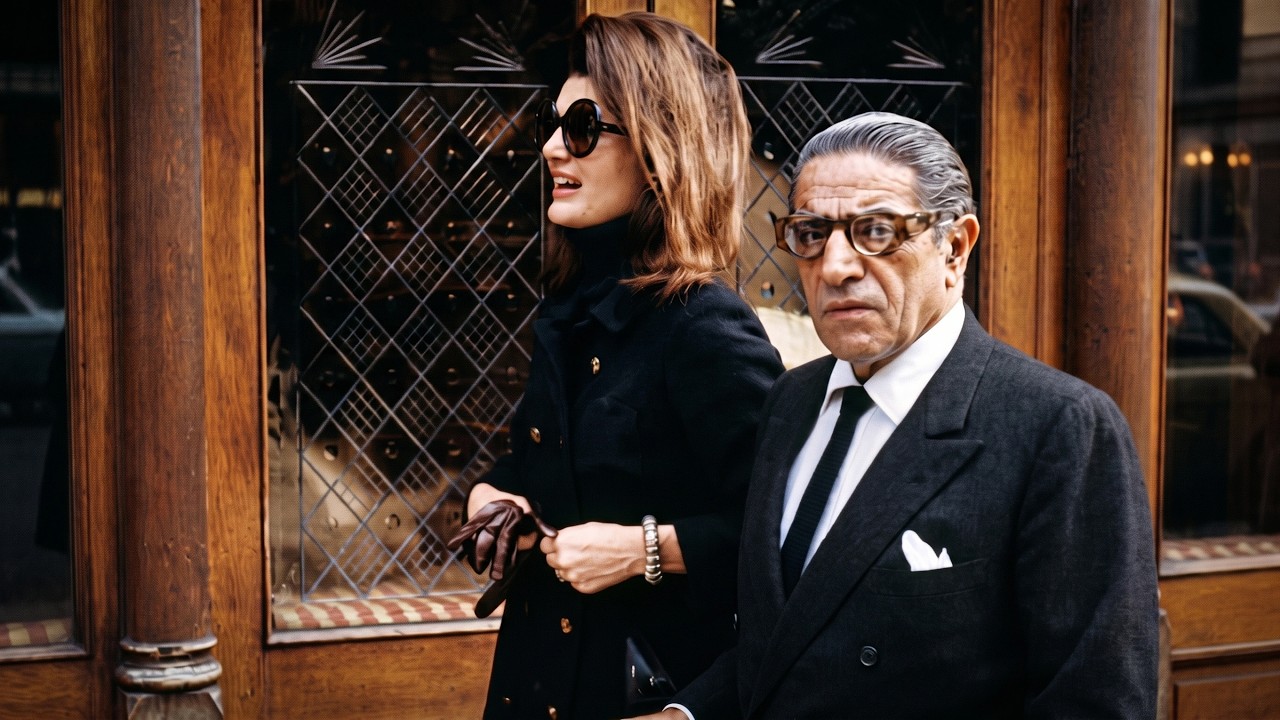
Two children carried the candles, a seven-year-old boy and a ten-year-old girl, the children of an assassinated American president. The bride was Jacqueline Bouvier Kennedy, then thirty-nine years old and perhaps the most admired woman in the world. The groom was Aristotle Socrates Onassis, the shipping magnate from Smyrna who had built the largest privately owned fleet on earth, conducted his affairs the way corporations managed acquisitions, and had just married the most admired woman in the world after the death of the one Kennedy who might have prevented it. He kept a mistress in Paris two streets away from his marital apartment.
He died in 1975 while his lawyers were still preparing divorce papers meant to humiliate his wife. Onassis was born in January 1906 in the Karataş district of Smyrna, then part of the Ottoman Empire. The exact day cannot be confirmed because the records were burned with most of the city in 1922. The commonly accepted date is January 20.
The destruction of records left room for dispute; one historian placed his birth in 1903, suggesting Onassis later subtracted three years to avoid Turkish conscription. His Argentine passport showed a different year and an entirely different birthplace. A man whose birth date was negotiable would later treat the facts of his life as equally adjustable. His father, Socrates Onassis, was a tobacco merchant and banker among the city’s wealthy.
The boy grew up in comfort that made what followed crueler. In September 1922, at sixteen, he watched from a ship in the harbor as the Turkish army entered Smyrna and the fire began. His family’s fortune was destroyed. Three uncles and an aunt were among the dead.
His father was imprisoned and sentenced to death. According to the account Onassis later gave journalist Peter Evans, whom he personally summoned to write his biography, the teenager entered a sexual relationship with an older Turkish lieutenant, and that relationship secured his father’s release and the return of some confiscated family property. The story cannot be independently confirmed. Evans, who spent nine months in intense conversations with him, would later describe Onassis as a monster.
What matters is what the man believed the incident taught him: that intimacy was currency for buying a way out of a burning place. The lesson he carried from Smyrna governed the rest of his dealings with the world. In August 1923, Onassis sailed to Argentina on a Nansen passport, a document issued to stateless refugees, with between sixty and 250 dollars in his pocket, depending on the account. He worked nights as a keyboard operator in Buenos Aires and ran a tobacco import business by day.
Within six years he had Argentine citizenship. Shortly after, he had his first million dollars in capital. In 1932, as the Great Depression crushed ship prices, he bought his first six freighters. He moved into oil tankers, building ever larger vessels, and in 1954 alone contracted for seventeen supertankers at once.
Within two decades of stepping off the boat in Buenos Aires, he owned the largest private shipping fleet on earth. The methods by which it was built did not remain clean, and the United States government eventually made that a matter of public record. The investigation began in 1950 when CIA agents identified Greek shipping magnates based in New York, moving cargo on American-built ships for North Korea and China as well as the United States and its allies. The resulting charge was narrower and more technical: conspiracy to defraud the United States in the illegal acquisition of twenty-three surplus American ships under a 1946 law prohibiting non-citizen control of vessels flying the American flag.
In December 1955, Onassis agreed to pay 7 million dollars in fines. Six of his companies pled guilty. Onassis himself emerged without a conviction in his own name, as the corporate entities absorbed the official stigma. It was the pattern of his life: place the liability on the structure, keep the man clean.
The corporation was registered in half a dozen jurisdictions, Panama, Liberia, Argentina, Greece, each chosen for a particular tax or regulatory advantage. The 7 million dollar fine, enormous for its time, was to him a parking ticket. Smyrna had taught him that one could buy one’s way out of the world, and the Department of Justice had just confirmed the lesson on a grand scale. What he needed now was a stage.
He named his yacht Christina O after his daughter and turned it into a 500-foot advertisement for what unlimited money could buy. Originally HMCS Stormont, a Canadian corvette that had escorted Atlantic convoys in World War II, it was acquired cheap and rebuilt over four years at a cost of millions. It carried a crew of more than fifty. There was a swimming pool whose mosaic floor rose hydraulically to become a dance floor.
There was an operating room. The bar was called the Ari Bar, and its footrests were made from the teeth of sperm whales; the bar stools were upholstered in whale foreskin. Some of the whales came from his own whaling fleet, which the Peruvian navy had intercepted in November 1954 for hunting inside waters Peru claimed. He built a comic routine around making guests sit on them.
The yacht was also where the affair that ended two marriages began. On December 28, 1946, Onassis married Athina Livanos, called Tina, the seventeen-year-old daughter of shipping magnate Stavros Livanos. He was forty. The marriage was by all accounts a shipping alliance between two Greek families.
They had two children, Alexander in 1948 and Christina in 1950. Then, on September 3, 1957, at a party in Venice, Onassis met Maria Callas, the most famous opera singer of her generation. She was married to Italian industrialist Giovanni Battista Meneghini. Within two years, their connection had become the central fact in four people’s lives.
In July 1959, Onassis organized a Mediterranean cruise on Christina O. Among the guests were Sir Winston Churchill, Callas, her husband Meneghini, and Onassis’s wife Tina. By the time the cruise ended, both marriages were effectively finished. Callas left Meneghini.
Tina filed for divorce in New York, citing adultery. What Callas gave up to be near Onassis was more than a husband. The discipline that produced her voice required isolation and a schedule built around performances. Life with Onassis meant nightclubs and dinners and travel arranged around his agenda.
By the early sixties, her voice had audibly weakened. The critics who had called her the greatest singer of her generation began writing about a decline they could only speculate about. Onassis had taken her out of the training regimen her voice required, and the voice responded. She would remain two streets from his deathbed sixteen years after the cruise that began it all.
Before Jackie, there was her sister. During the early sixties, while Jacqueline Kennedy was First Lady, Onassis was having an affair with her younger sister, Caroline Lee Bouvier, then Princess Lee Radziwill, married to a Polish prince. The relationship put Onassis inside the Kennedy orbit, a situation the president’s brother found intolerable. According to Evans, Robert Kennedy, then Attorney General, was so angered by Onassis’s proximity to the White House that he ordered Jackie to tell her Greek friend he could not return until after Jack’s reelection.
This account rests solely on Evans’s 2004 book Nemesis and has never been confirmed by any independent document or witness. On November 22, 1963, President Kennedy was assassinated in Dallas. Onassis was in Washington that night, stayed at the White House during the funeral period, and afterward was invited into the widow’s private quarters. In the years that followed, there was also money moving to Jackie.
Evans reported that she received cash from Onassis in envelopes, up to 100, 000 dollars annually, a claim resting on Evans alone. Congress’s widow’s pension and income from her late husband’s estate were real but limited; the costs of the life Jackie was expected to maintain were not. Historians of the period accept that generous allowances from Onassis were welcome by 1968. The most sensational claim of those years is that Jackie and Robert Kennedy became lovers.
The source for this is David Heymon, whose 2009 book Bobby and Jackie claimed a four-year affair beginning in late 1963. Heymon’s credibility collapsed under examination. A 2014 Newsweek investigation found his biography riddled with errors and fabrications; NPR issued a public correction in 2015 after relying on one of his books; John Dean stated plainly that Heymon was a fraud. One dramatic scene illustrates the problem.
On May 27, 1964, the family gathered on the presidential yacht Sequoia. Heymon claims Bobby and Jackie disappeared below deck and quotes Arthur Schlesinger describing them as intimate when they returned. The quote does not appear in the published edition of Schlesinger’s diary. It cannot be verified.
The honest conclusion is that Bobby and Jackie shared a deep relationship of some kind, that the romantic claims rest largely on a discredited author, and that the true version cannot be reconstructed from available sources. What is certain is that the hostility between Onassis and Robert Kennedy was real, and that whoever swore Jackie would marry Onassis only over his corpse was about to enter the kitchen corridor of a Los Angeles hotel. On June 5, 1968, moments after his California primary victory speech, Sirhan Sirhan shot Robert Kennedy at the Ambassador Hotel. He died the next day, aged forty-two.
His death removed the last Kennedy standing between Jackie and Aristotle Onassis. Four and a half months later, she married him. Jackie kept the decision so secret she did not tell her sister. Lee learned of the engagement not from Jackie but from Onassis himself, who called her while she was on holiday in Tunisia to extend a personal invitation and, by several accounts, to beg her to attend.
Lee had been his mistress. Now he asked her to stand at her sister’s wedding. Distraught, Lee called Truman Capote. She came anyway, arriving in time to be part of the ceremony on the invitation of Aristotle, not her sister.
The rift between the sisters never fully healed. The accounts of that betrayal would be settled decades later, coldly: when Jackie died in 1994, her will stated she left Lee nothing because she had already done so during her lifetime, while establishing trusts for Lee’s children. The wedding contract was negotiated by professionals on both sides. Ted Kennedy began negotiations on Jackie’s behalf, prepared to accept around 1.
5 million dollars. Hugh Auchincloss urged asking for more. Andre Meyer, the Lazard Frères banker trusted by the Kennedys, pushed the number higher. The notarized document confirms 2 million dollars paid at the marriage.
Under Greek compulsory inheritance rules of 1968, a widow was entitled to one-eighth of her husband’s estate, from a fortune later estimated at 500 million, roughly 62 million at his death. By signing the contract, Jackie traded the larger automatic inheritance for guaranteed cash in the present and a fixed number in the future. It made sense for a woman who had watched from the passenger seat in Dallas how quickly wealth could become widowhood. What the contract could not buy her was the man’s attention, because that belonged to someone else.
Onassis kept his apartment at 88 Avenue Foch in Paris’s sixteenth arrondissement. Maria Callas kept hers a short walk away at 36 Rue Georges Mandel. According to his personal secretary Kiki Moutatsos, they never stopped seeing each other; everyone in the household knew. Jackie knew too, and defended herself with public composure.
The cruelty inside the household extended beyond adultery. Biographer Arianna Stassinopoulos, drawing on more than 2, 000 letters and extensive interviews, reported that Callas underwent an abortion in 1966 at Onassis’s insistence; he told her he would end the relationship if she kept the child, having already resolved to marry Mrs. Kennedy. A 2021 biography by Lindsay Spence claimed Onassis kept an abortion doctor on his personal staff, used not only with Callas but with his first wife Tina and with his daughter Christina when she became pregnant at nineteen.
What she could not prevent was the transformation of her humiliation into public consumption in the one place she believed was entirely private. In the summer of the early seventies, a team of ten photographers conducted a covert operation against Jackie on Skorpios, working from fast boats, wearing underwater breathing apparatus, approaching a beach she believed no lens could reach. First published across nine pages in the Italian men’s magazine Playmen in November 1972, the photographs were later bought for American rights by Larry Flynt, who printed four full-page images in the August 1975 issue of Hustler. The issue sold out within days, jumping from a few thousand copies to more than two million.
Flynt would call the purchase the smartest investment of his life. According to one account, Onassis himself orchestrated it, providing the photographers with detailed maps and Jackie’s expected whereabouts, having grown tired of financing his wife’s privacy lawsuits. A photographer’s daughter disputed this. The photographer himself never confirmed Onassis gave the order.
What is certain: images of a woman who could not prevent it were sold for profit, and she bore the exposure in public silence. Then grief broke her husband first. On January 22, 1973, Alexander Onassis, his only son and the heir for whom everything had been built, was killed when his seaplane crashed at takeoff at Athens’s Hellinikon airport. He was twenty-four.
The loss broke something no fortune could repair. Onassis began privately calling Jackie the witch, telling aides she carried a curse. His daughter Christina, who had called Jackie a fortune hunter from the start, fed the belief. In 1974 he began divorce proceedings through lawyer Roy Cone, intending to make the process as humiliating as possible.
He would die before it was filed. Onassis died on March 15, 1975 at the American Hospital in Paris of pneumonia from myasthenia gravis, an autoimmune disease that strips muscles of their ability to respond. In his final months he appeared in public with his eyelids taped open. His will left 55 percent of his fortune to Christina and 45 percent to the foundation in his dead son’s name, reducing his widow’s share to the minimum a Greek widow could receive, about 3 million.
After two years of legal struggle, Christina and Jackie settled for roughly 26 million dollars in exchange for Jackie renouncing further claims. Jackie entrusted the money to Maurice Tempelsman, who would multiply it fourfold. Maria Callas reached Onassis in his hospital room, according to one account, through the service elevator while he was in a coma. Her red Hermès blanket was kept close to him in his final moments.
She died on September 16, 1977, in her apartment, aged fifty-three. According to Constantine Gratsos, Onassis’s closest aide who held the unfiled divorce papers, Onassis said in his final months that Maria was his true love, that his marriage to Jackie had been the greatest betrayal of her, and that he had been preparing to leave Jackie and return to Maria when his body failed. In her public statement on his death, Jackie said Onassis had saved her at a moment when her life was drowned in shadows, that they had shared many beautiful experiences, and that she would be grateful to him forever. She said nothing about love.
She said nothing about grief. The woman who had decided every word she released to the public for thirty years had chosen each one carefully. Jackie lived until May 19, 1994, when she died of non-Hodgkin lymphoma. In her final months she burned her letters and photographs with her own hands.
The man who spent his life arranging what people were allowed to see was finally outmatched by a woman whose discretion equaled his appetite.