The debate over whether Adolf Hitler was a strategic genius or simply an extraordinarily lucky gambler is one of the most persistent questions to emerge from the wreckage of the Second World War. Between 1938 and 1941, Hitler appeared almost invincible. He remilitarized the Rhineland without firing a shot, absorbed Austria and Czechoslovakia without a battle, smashed Poland in five weeks and France in six, and drove deep into the Soviet Union in what seemed at first an unstoppable tide. The question historians have debated for eighty years is whether that record represented genuine mastery or a lethal combination of audacity, bluff, and good fortune that eventually ran out.
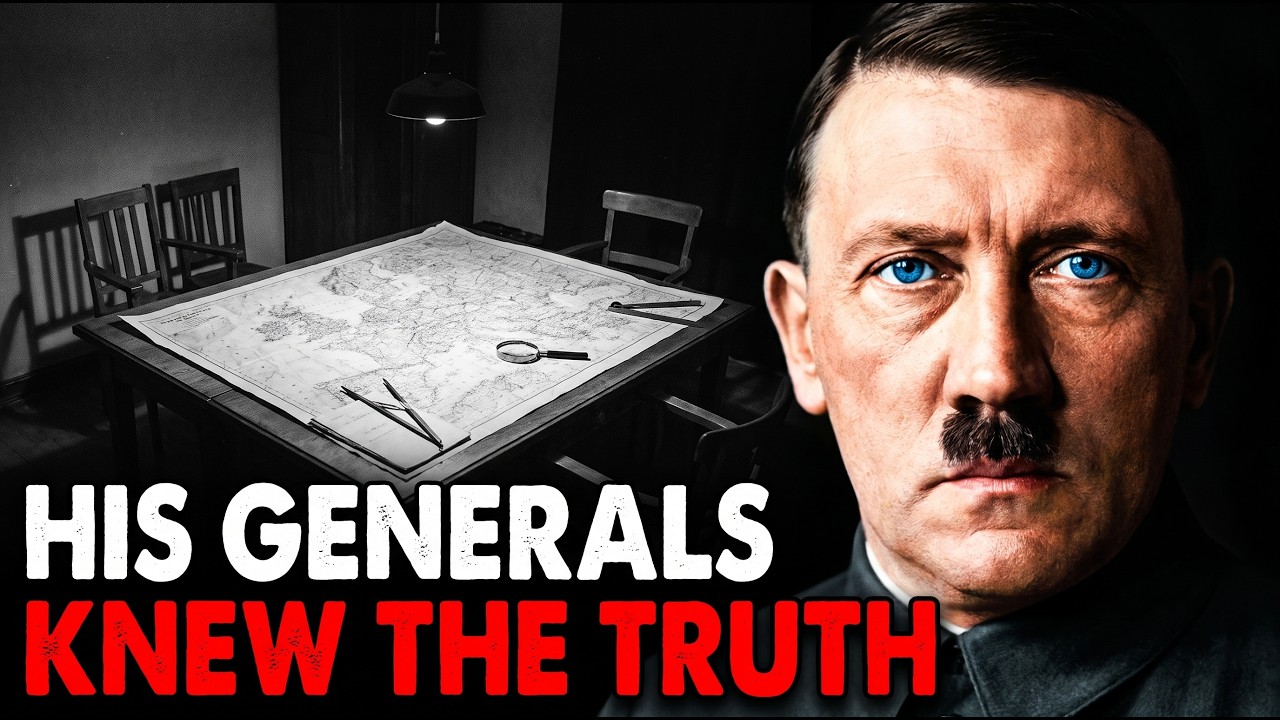
A true strategist does not merely win battles. He shapes the entire environment in which battles are fought, calculates risk with cold precision, understands long-term consequences, and knows when to stop as well as when to strike. Hitler possessed certain qualities that genuinely impressed professional soldiers. He understood the psychology of the fighting man with real insight and mass morale with genuine sophistication.
But he never truly grasped the grinding arithmetic of industrial warfare at scale, and his early life gave him little conventional military or diplomatic training. A corporal on the Western Front in the First World War, he saw the tactical realities of trenches and machine guns, not the larger picture of supply lines, coalition warfare, or economic endurance. That limited vantage point shaped both his strengths and his fatal weaknesses. The years between 1933 and 1939 were Hitler’s most impressive period as a political operator.
The reoccupation of the Rhineland in March 1936 was a perfect example. His generals were terrified, warning that if France responded militarily the small German force would be annihilated. Hitler ordered his troops to withdraw if the French moved, but the French did not move. The British did not move.
Hitler won a massive strategic victory without firing a shot. The annexation of Austria in March 1938 followed a similar pattern, exploiting political weakness, applying relentless pressure, and absorbing the entire country in a weekend while the Western powers watched in shock. At Munich in September 1938, Britain and France handed him the Sudetenland in exchange for a promise of peace. Six months later he marched into the rest of Czechoslovakia.
He had correctly judged that the Western powers would not fight, but in doing so he taught himself that there were no limits on what he could take. The invasion of Poland in September 1939 appeared to confirm his boldest instincts. The Wehrmacht smashed through Polish defenses with stunning speed, and the campaign was over in just over five weeks. But Poland was always going to be defeated quickly.
The country was surrounded on three sides by German-controlled territory, outnumbered in virtually every category of modern weaponry, and abandoned by its Western allies. Crushing Poland was not a test of genius. The campaign in the West in May and June 1940 is the episode most often cited by those who argue Hitler was a strategic visionary. The German offensive against France produced one of the most stunning military victories in history, with France, Belgium, the Netherlands, and Luxembourg falling within six weeks.
But the plan that made it possible was not Hitler’s creation. It was the idea of General Erich von Manstein, who proposed sending the main armored thrust through the Ardennes forest, which Allied planners had assumed was impassable for large armored formations. Hitler was captivated by the plan and pushed it through against institutional resistance. Recognizing the value of Manstein’s plan and forcing it through the military establishment may constitute genuine strategic insight, or it may have been a gambler’s instinct for the bold stroke filtered through an institution that contained enough professional competence to execute it.
The decision at Dunkirk strikes at the heart of the genius-versus-luck debate. On May 24, 1940, as German armored forces closed in on the trapped British and French armies, Hitler issued the famous halt order, stopping the panzers and allowing the evacuation to proceed. Over nine days, more than 330,000 British and Allied troops were evacuated across the English Channel. Hermann Göring had convinced Hitler the Luftwaffe could finish off the pocket from the air.
Field Marshal Gerd von Rundstedt had recommended the halt on tactical grounds. Whatever the reason, those 330,000 evacuated troops formed the core of the British army that would eventually fight its way back into France. A true genius would not have given his principal enemy the gift of a second chance. The decision to invade the Soviet Union on June 22, 1941, under the codename Operation Barbarossa, is where the debate becomes most consequential.
Hitler had always intended to destroy the Soviet Union, and he believed, fatally, that it was a rotten structure that would collapse once given a good kick. The campaign began with spectacular success. German forces advanced hundreds of miles, and enormous encirclement battles trapped millions of Soviet troops. But the Soviet Union did not collapse.
Soviet factories moved east of the Urals and began producing tanks and artillery at a rate Germany could not match. On December 5, 1941, the Red Army launched a massive counteroffensive before Moscow that pushed the exhausted German forces back. Hitler’s fundamental strategic premise had failed. From that moment, the question was not whether Germany would win the war, but how long it would take to lose it.
Hitler’s relationship with his generals deteriorated dramatically as the war progressed, and that deterioration itself reveals much about the nature of his supposed genius. In the early years, he frequently overruled cautious professional advice and was vindicated by events, drawing from these experiences the lesson that his intuitions were infallible. The result was a command culture in which honest military advice became increasingly unwelcome. The summer campaign of 1942 illustrates this dynamic with particular clarity.
Hitler decided to drive simultaneously toward Stalingrad and the oil fields of the Caucasus, splitting his forces with resources barely adequate for one objective. His generals warned him that the flanks of the deep Stalingrad salient would be dangerously exposed, held by weaker Romanian, Italian, and Hungarian forces. Hitler dismissed these warnings. On November 19, 1942, the Soviet counteroffensive at Stalingrad crashed through the Romanian flanks exactly where the generals had predicted.
Within four days, the trap had closed behind the German Sixth Army, trapping more than 300,000 men. Hitler refused to authorize a breakout, trusting Göring’s promise of aerial supply that most Luftwaffe commanders knew was impossible. The Sixth Army died in the ruins of Stalingrad, the most catastrophic German defeat of the war and a turning point from which Germany never recovered. Hitler’s decision to declare war on the United States on December 11, 1941 was one of his most consequential and least explicable.
He was under no treaty obligation to do so, and the United States had enormous industrial capacity. Hitler apparently believed America would be too preoccupied with Japan in the Pacific to mount a significant effort in Europe for years. American troops landed in North Africa in November 1942, barely eleven months later. That decision alone disqualifies him from the category of strategic genius.
What about the luck dimension? Hitler survived more than forty documented assassination plots, including the July 20, 1944 bomb plot that came extraordinarily close to killing him. He survived because another officer had inadvertently moved the briefcase to the far side of a heavy table leg, and because the meeting had been moved at the last minute from a planned underground bunker to the surface because of warm weather. A man who is a strategic genius does not rely on the happy coincidence of furniture placement to survive his own war.
The battle of Kursk in July 1943 offers one of the clearest examples of Hitler’s limitations. The attack on the Kursk salient was planned for May and then repeatedly postponed to allow more Tiger and Panther tanks to be delivered. Each postponement gave the Soviets time to construct the most formidable defensive system in the history of warfare. When the offensive was finally launched on July 5, it immediately bogged down and was called off within days.
Kursk was the last major German strategic offensive on the Eastern Front. Hitler had converted a plan that might have worked in May into one with no realistic chance of success by July. In the final years of the war, Hitler’s decision-making was characterized by an increasingly desperate commitment to holding fixed positions regardless of cost. Again and again, when Soviet or Allied forces threatened to encircle German formations, he refused to authorize withdrawal.
The destruction of Army Group Centre in Operation Bagration in June and July 1944, when Soviet forces shattered German lines and destroyed approximately twenty-eight divisions in the single most catastrophic German defeat of the war, was in large part a consequence of that thinking. The Allied landing in Normandy provided another window into his degraded judgment. The Panzer reserves had been placed under Hitler’s personal control, and when they were needed on the morning of June 6, 1944, Hitler was asleep and his staff were too intimidated to wake him. The reserves were not released until the afternoon, by which time the critical moment had passed.
The reserves remained held back for weeks waiting for an attack at Pas-de-Calais that never came. What is the verdict? Hitler was a political genius of a narrow and destructive kind, possessing extraordinary gifts for mass mobilization and psychological manipulation. He was also a military strategist of considerable but limited and declining competence.
His strategic vision was fundamentally flawed by an inability to think beyond the single campaign to the longer war, by an ideology that systematically distorted his assessment of enemies and resources, and by a psychological structure that made him incapable of absorbing honest negative feedback. He was extraordinarily lucky at critical moments, but when the luck ran out, what remained was a mind that had built its entire strategic framework on a run of good fortune that had never truly tested its assumptions against a resilient, adaptive adversary. The most accurate answer is that Hitler was neither purely a genius nor purely lucky, but that the balance between the two shifted decisively over the course of his career. In the period between 1933 and 1941, he operated in an environment that amplified his genuine political gifts while concealing his strategic limitations.
After December 1941, the trajectory was one of almost unrelieved strategic deterioration. The armies destroyed at Stalingrad and in the collapse of Army Group Centre were destroyed in large part because Hitler refused to allow timely withdrawals. The war against the United States was one Germany had chosen to start. The Holocaust consumed resources that could have been used to fight the war.
These were not products of bad luck. They were products of bad strategy. The generals who served him acknowledged his political gifts, his memory for technical detail, and his occasional operational insights, but they agreed with remarkable consistency that his fundamental strategic conception was flawed, that his refusal to accept military advice was a serious liability, and that his inability to accept reality in the final years had cost hundreds of thousands of German lives. The brilliance of the German military instrument could not overcome the inadequacy of the hand that wielded it.
Hitler spent the final months of the war issuing orders to formations that no longer existed, demanding counterattacks from divisions reduced to a few hundred exhausted men, and alternating between raging at the incompetence of his generals and expressing a fatalistic conviction that Germany deserved destruction because it had proved unworthy of his genius. By March and April 1945, even his own officials were ignoring his orders. The supreme commander who had imposed his will on an entire continent had lost the capacity to impose it even on the officials in his own bunker. A genius knows the limits of his own knowledge.
Hitler never did, and the world paid an incalculable price for that specific catastrophic failure of self-awareness.