On the morning of May 27, 1942, Reinhard Heydrich, the man Adolf Hitler called the man with the iron heart, was riding through the streets of Prague in an open-topped Mercedes. He was the acting Reich protector of Bohemia and Moravia, the chief of the Reich Main Security Office, and the man widely regarded as the primary architect of the Holocaust. He traveled without fear, a deliberate display of defiance. At a hairpin bend in the suburb of Hlubočepy, a Czech-trained paratrooper stepped forward and raised his submachine gun.
It jammed. A second paratrooper threw a modified anti-tank grenade. It exploded beneath the car, driving metal and upholstery into Heydrich’s body. He staggered, drew his pistol, tried to pursue his attackers, then collapsed.
Eight days later, on June 4, 1942, he died of sepsis, just weeks before his fourth child was born. He was 38 years old. The assassination, code-named Operation Anthropoid, was planned by the Czech government-in-exile in London with British support. Josef Gabčík and Jan Kubiš, the two men chosen for the attack, had parachuted into Czechoslovakia in December 1941 and spent months waiting for the right moment with the help of local resistance families.
Their success sent shockwaves through the Nazi high command and triggered one of the most savage reprisal operations of the war. The village of Lidice was destroyed on June 10, 1942, its 173 men shot, its 184 women sent to Ravensbrück, and its 90 children taken away, most never to return. A second village, Ležáky, was razed later that month. In total, about 5,000 Czech civilians died in the reprisals that followed Heydrich’s assassination.
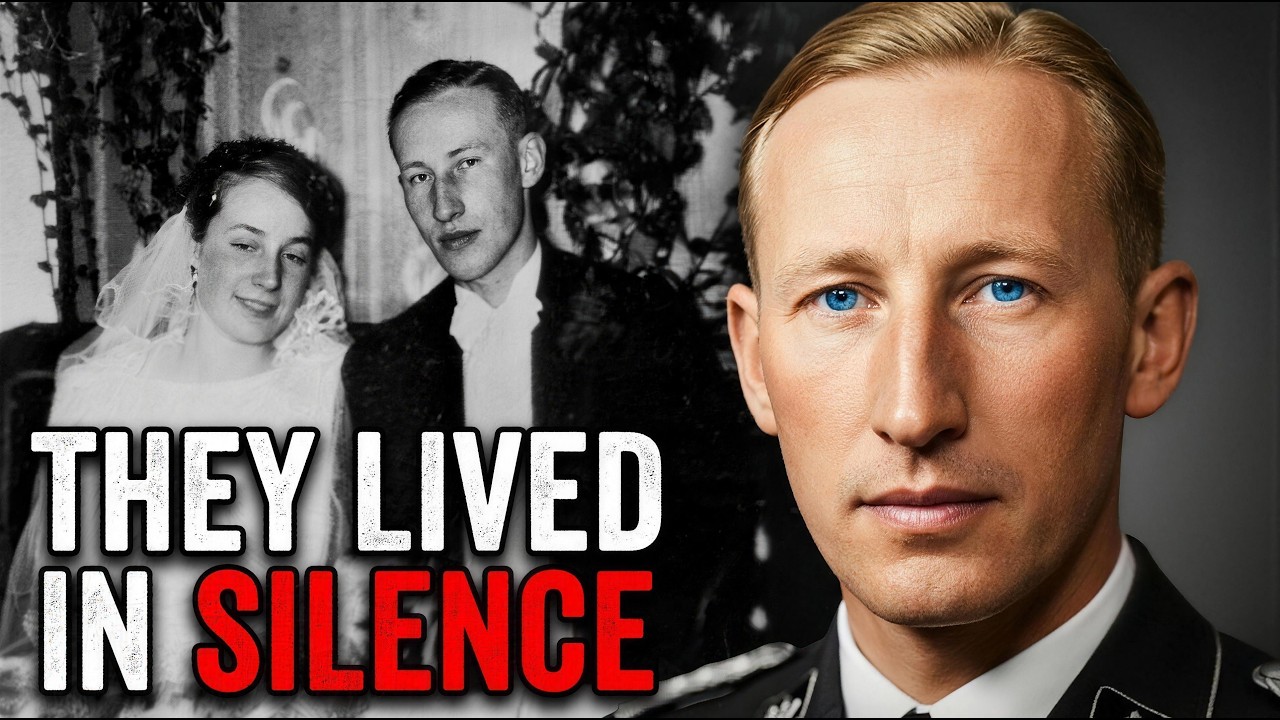
The assassins themselves were eventually cornered in a Prague church and died there rather than surrender. Left behind was a widow, Lina, and four children. Lina had married Reinhard in 1931 in a ceremony attended by Heinrich Himmler. She was a convinced National Socialist, strong-willed and outspoken, and during the war she lived with her children in considerable comfort at the Panenské Břežany estate north of Prague.
The property had been seized from its Jewish owners, and German military vehicles passed constantly on the road outside. On October 24, 1943, that road killed the couple’s eldest son. Klaus, just ten years old, rode his bicycle into the path of a German military truck and died instantly. Less than a year and a half after losing her husband, Lina buried her firstborn son.
In July 1942, Lina had given birth to Marte, a daughter who never saw her father at all. The third child, Silke, had been born in April 1939 and was only three when Heydrich was killed. Heider, born in December 1934, was seven. When the war ended in May 1945, Lina was expelled from Czechoslovakia with her three surviving children.
The estate was returned to Czech state control. She arrived in Bavaria with little more than what she could carry, a refugee in a ruined country that was beginning a slow, painful reckoning with the crimes of the regime her husband had served. Lina was interrogated by Allied investigators and processed through denazification proceedings, but she was never charged criminally. The evidence against her personally was judged insufficient.
That legal outcome, which she considered a great injustice, only sharpened her determination. Rather than retreat into obscurity, she spent the next four decades fighting. She pursued a widow’s pension based on her husband’s official rank, and the case wound through German courts for more than twenty years. At various points she received partial awards, at other points they were challenged.
The proceedings drew intense press coverage, and the final compromise satisfied no one. Her persistence contributed to later legal changes that made it harder for the families of Nazi perpetrators to claim benefits based on criminal official roles. She also fought what she saw as a cultural battle for her husband’s memory. She maintained contacts with former SS members and their families, moving through the networks of unrepentant Nazi survivors that existed below the surface of West German society.
In 1976, she published a memoir. The title imposed by her publisher was Life with a War Criminal, a title she openly despised because she did not accept that her husband had been one. The book was a vigorous defense of Heydrich and a challenge to the historical record that had condemned him. Historians were outraged, mainstream reviews were withering, but the book found its audience and sold well.
In the 1960s, she was identified as a participant in networks that provided financial and legal support to former SS members facing prosecution. She was never charged, but the picture was consistent: a woman who refused to concede anything to history. Her children inherited a name that could not be escaped. Heider, the oldest surviving son, was the most exposed.
He grew up in a household where denial was the norm, where his father was presented as a hero falsely condemned. He became a businessman, married, and built a private life that by outward measures was unremarkable. But he was repeatedly drawn back into the public eye by journalists, historians, and filmmakers. His position was neither his mother’s unrepentant defense nor the open condemnation chosen by some other children of Nazi leaders.
He expressed discomfort with the scale of his father’s crimes and acknowledged the reality of the Holocaust, but he never fully and publicly condemned the man he remembered from his earliest childhood. He died on December 24, 2020, at 86, one of the last living people who could claim personal memory of Reinhard Heydrich. His death was noted briefly in the German press as the passing of the son of the assassinated Reich protector, and then the world moved on. His sisters chose a different path.
Silke, born in 1939, and Marte, born weeks after her father’s death, withdrew into near-total privacy as adults. They gave virtually no interviews and made no public statements. They had no personal memories of their father to set against the overwhelming historical portrait. For Marte, especially, the father she knew was entirely constructed from the outside, built from her mother’s stories and history books and films.
Both women consistently chose silence over confrontation, anonymity over public engagement. The wider family was consumed by the war as well. Heydrich’s mother, Elisabeth, died in 1943, before the liberation, before the trials, before the full reckoning arrived. His older brother, Heinz, served in the regular army and died on the Eastern Front in 1944.
The estate Heydrich had requisitioned was part of a larger Jewish dispossession. Ferdinand Bloch-Bauer, one of the original Jewish owners, was the subject of the Gustav Klimt portrait known as the Woman in Gold, and the family’s fight for the return of the paintings would eventually become a landmark restitution case. The property on which Lina had raised her children had been stolen from a family whose cultural treasures became a symbol of Nazi theft. In the decades that followed, the Czech Republic built an enduring memorial culture around the assassination and its aftermath.
The church where the paratroopers made their last stand still bears the bullet marks from June 18, 1942. The rebuilt village of Lidice stands as a permanent refusal to accept the Nazi attempt at erasure. The memorials, the films, the books, the documented minutes of the Wannsee Conference, where Heydrich coordinated the murder of eleven million Jews, all of it outlived Lina’s defiance. She died in August 1985, still fighting, still denying.
The historical record has not changed. It remains overwhelming, thoroughly documented, and irrefutable. The family he left behind found different ways to manage the weight of the name, none of them entirely adequate, none of them entirely honorable, but all of them, in their own ways, human responses to an inheritance no one could have chosen and no one could fully escape.