In the ancient world there were places that, once entered, were almost never left. From the outside they looked like ordinary stone buildings or dark holes in the ground. But most of those who went in never saw sunlight again. Some could no longer bear to live inside them.
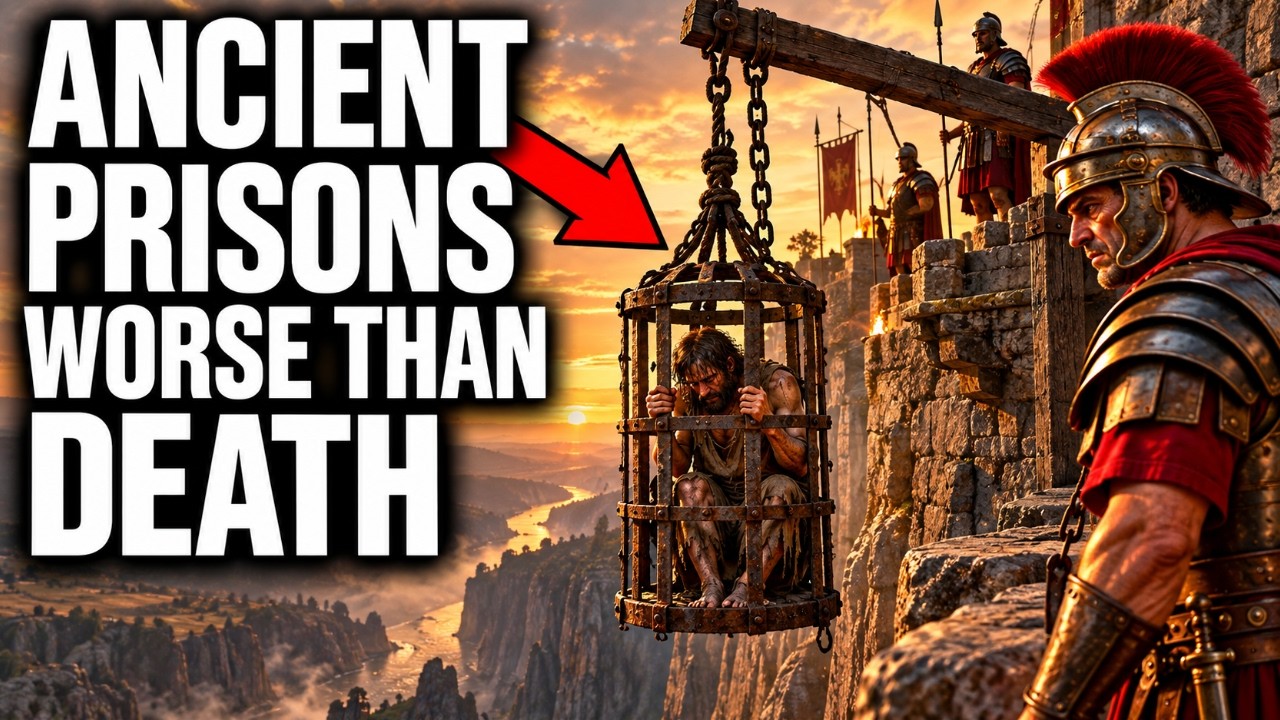
Others lost their lives there completely. What is most striking is that some of these places survived to the present day. At the heart of ancient Rome, only steps from the glory of the Roman Forum, stood a place that functioned like a gateway to the underworld. It was called the Tullianum, though later centuries knew the entire complex as the Mamertine Prison.
It was built on a simple, chilling idea: the worst thing you could do to a person was not to kill him quickly, but to lower him into darkness and let the darkness do the work. Modern images of prison do not apply here. The Romans did not imprison people for years to reform them. Prison was usually a short stop before trial or execution.
The Tullianum was the lower chamber of the complex, a stone cell carved into the earth near the city’s sewers. It had no door. The only way in was a single opening in the roof, through which the condemned man was lowered by rope or simply dropped. Once he landed in the cold, filth, and darkness, the opening was sealed above him and the world moved on without him.
Some prisoners were quietly strangled in the dark. Others were simply left to their fate. When Jugurtha, the defeated king of North Africa who had defied Rome for years, was paraded in chains through the city, he was thrown into the Tullianum. Ancient accounts say that when he was stripped and forced down into the freezing pit, he bitterly mocked how cold the Roman bath was.
There, in that cold, he starved to death within days. The terrible brilliance of the place was its extreme simplicity. The Romans needed no elaborate torture machines. They only had to dig a hole, throw a man in, and wait.
Athens, famed as the cradle of democracy and philosophy, had its own place of horror. It was not a prison in the usual sense at all. It was a pit called the Barathron, a deep chasm outside the city used for a single grim purpose. Condemned criminals, sometimes traitors, and those who had committed crimes against the state were thrown into it.
In the earliest and harshest accounts it was said that the pit was lined with hooks and spikes, so that whoever fell in would be torn apart. Even if those terrible details were later questioned, the essential horror remains. A man was cast alive into a rocky hole that could not be climbed, to die from his wounds or from thirst and exposure at the bottom. There was even a public official whose grim duty was connected to this pit, and being handed over to him meant your fate was sealed.
For a society that produced Socrates and Plato, the response to its worst offenders was to erase them by throwing them beyond the limits of the civilized world and into a hole in the earth. In Syracuse on the island of Sicily, the fate of thousands of men was sealed not in a building but in a wound carved into the heart of the earth. The quarries, known as the Latomiae, were enormous pits cut into the rock to supply stone for the city. Their vertical walls made them a natural prison that was impossible to climb and required few guards.
The most famous prisoners held there were the thousands of Athenian soldiers captured after their disastrous invasion of Sicily in the fifth century BC. The historian Thucydides left a horrifying account of their suffering. Crowded together in deep, exposed pits, they endured the scorching heat of the sun by day and the bitter cold of the night. They received only the smallest amounts of food and water, and the dead were left among the living until the stench and disease became unbearable.
This was not one man in a cell. It was an entire defeated army packed into a rocky valley, dying slowly from heat and sickness under a sky they could not reach. The ordeal lasted about eight months. Many died, and their bodies remained where they fell.
The survivors were eventually sold into slavery, their foreheads branded with the mark of a horse like cattle. One haunting account claims that a handful of Athenians received better treatment or even freedom because they could recite the poetry of Euripides, which their Sicilian captors loved deeply. Not every terrible ancient prison was terrible because of its cruelty. Some earned their place in history because of what happened inside them and because of the quiet dread of waiting for a death you knew was coming.
In 399 BC, the philosopher Socrates was condemned to death by an Athenian court on charges of corrupting the youth and questioning the city’s gods. He was held in a state prison near the edge of the marketplace while awaiting execution. But his execution was not fast. Athenian custom delayed it, and Socrates spent his final days imprisoned, visited by his students and friends, quietly discussing the immortality of the soul while his hour of death drew steadily closer.
What adds to the horror of this particular prison is that Socrates did not have to die there at all. According to Plato, his friends arranged everything for his escape and begged him to flee his cell into exile. He refused, preferring to accept the verdict of his city rather than break its laws. He remained in that room by choice, waiting for the poison.
His end, as described by Plato, is one of the most quietly sorrowful scenes in antiquity. Forced to drink a cup of hemlock, his companions watched as the numbness crept slowly through his body from his feet until it reached his heart. What made this prison worse than a quick death was the waiting, the calm, and the full awareness of what was coming. There was no dark pit and no swarms of insects.
There was a man in a cell who knew exactly how and when he would die. Across the sea from Rome stood its greatest enemy, the great mercantile empire of Carthage. According to the accounts that survive, the Carthaginians kept prisons that matched the ferocity of their long wars with Rome. Their dungeons were described as gloomy underground pits where prisoners of war and the condemned were held in appalling conditions, bound in darkness, starving, and forgotten.
One of the most horrific accounts linked to the Carthaginian world concerns the fate of the Roman commander Regulus. Captured by Carthage, according to Roman tradition he was placed in a brutal confinement, and the legends of his suffering, including sleep deprivation and torture, became a powerful part of Rome’s memory of its enemy. Much of what is known about Carthaginian cruelty comes from Roman sources, and Rome had every reason to paint its defeated rival as monstrous. The victors wrote the history and described Carthage as a dark place.
But even setting propaganda aside, to be a prisoner of a foreign power in the ancient world meant being completely at its mercy, held in darkness, far from home, with no rights and no hope of survival. Whether every terrible detail was true or not, the horror of the enemy dungeon was real enough. Some of the most terrifying forms of confinement in the ancient world were not designed as prisons at all. They were tombs.
There was a special horror reserved in more than one ancient culture for those who violated sacred laws: being buried alive in a place meant for the dead. The most famous example comes from Rome and concerns the Vestal Virgins, the priestesses sworn to preserve their purity in the service of the goddess Vesta. If a Vestal was discovered to have broken her vow of chastity, she could not simply be executed, because it was forbidden to shed her sacred blood. So the Romans devised a colder method.
The condemned priestess was carried through the city in a covered litter in a funeral-like procession while the people watched in silence. She was taken to an underground chamber prepared with a bed, a lamp, and a small amount of food and water. Then she was lowered inside. The entrance was sealed above her and earth piled over it.
The Romans surrounded this grim act with ritual and silence, and ancient writers record that it filled the city with terror whenever it occurred. It was among the most appalling spectacles in Rome. The cruelty was deliberate and carefully calculated. The Romans could convince themselves that they had not killed her.
They had simply left her with a little food and a little air and allowed fate to decide. But everyone understood what it meant. She would die alone in that dark chamber beneath the city, starving and suffocating in a grave she had been placed in while still breathing. Sometimes an entire landscape became a prison.
In the ancient world, remote islands, barren rocks, and distant fortresses were used to hold those whom the powerful wanted removed but, for whatever reason, chose not to kill. Exile to such a place could itself be a slow sentence of death. The Roman emperors made exile into their own art form. Troublesome relatives, rivals, and disgraced nobles were sent to small, wind-battered islands in the Mediterranean, sometimes a barren rock with almost nothing on it.
The emperor Augustus, at the height of his power, exiled his own daughter to a small island and denied her wine and any comfort. She lived there for many years in gloomy isolation. To fall from the center of the greatest empire on earth to a lonely speck of rock in the sea was a descent of unimaginable cruelty. There they lived under guard, cut off from the world, from family, and from the life they had known, often for the rest of their days.
The punishment appeared merciful on the surface. The victim was still alive. But in reality, it was a living erasure, a slow removal from history, where a person simply faded from the world while his heart still beat. There were no bars and sometimes no walls at all, only an endless sea in every direction and the certainty that you would never cross it again.
For a proud Roman noble accustomed to power and company, this quiet annihilation on a lonely island could be a fate that seemed worse than a quick and honorable death. Rome reserved the Tullianum for a unique kind of victim: the captured enemy commander. When Rome defeated a great enemy, it did not always grant him the death of a warrior. Instead, the captured king or general might be kept alive for months or even years for one purpose only: display.
On the day of a Roman triumph, the victorious general paraded through the city, and behind him walked the humiliated enemy leader in chains, stumbling in the dust before a jeering crowd. It was the height of humiliation, reducing a proud king to mere spoils. When the parade ended, the prisoner was often taken aside and led down into the Tullianum, to be strangled there or left to die in the dark. Jugurtha, the king of Numidia, starved to death in that pit.
The rebel leader Vercingetorix, who had united the Gallic tribes against Julius Caesar, was held captive for nearly six years, kept alive only to be led one day through the streets of Rome. When Caesar finally celebrated his triumph, the Gallic leader was paraded before the crowds and then taken down into the Tullianum and executed. His long captivity ended in that silent stone chamber. To be captured by Rome as a king meant being kept alive, not out of mercy, but as property to be displayed and then discarded when its use as a spectacle was over.
The Tullianum was the silent end of that long humiliation, the place where kings were judged and then quietly extinguished. There is a type of prison whose whole purpose is contained in the name later given to it: the oubliette, a word that simply means “the place of forgetting. ” It is the narrow deep pit, and its image haunted both the ancient and medieval worlds. A hole into which a man is thrown and then deliberately forgotten.
Its predecessor appears in the Tullianum, but the idea recurs again and again. A vertical shaft, sometimes bottle-shaped, widening at the bottom below its narrow opening at the top. The prisoner was lowered or dropped through that single upper opening, and once he reached the bottom, climbing the smooth, curving walls was impossible. Food, if it came at all, was thrown from above.
The prisoner lived and died in a stone bottle, in total darkness, in his own filth, unable to stand fully or lie comfortably, while the world continued its life a few feet above his head with no intention of ever letting him out. Perhaps he heard the muffled sounds of ordinary life drifting through the opening, footsteps, voices, the business of a city. None of it was his. The real horror of this kind of prison was psychological.
It was not the pain of the whip or the blade. It was the physical embodiment of abandonment. To be in such a place meant realizing that you had not only been imprisoned but had been erased from the memory of humanity. You were left to rot in a hole while life continued in the sunlight above.
The name itself tells everything. It was a punishment designed to do more than end a life. It was designed to make a person disappear, slowly, in the dark, until even he himself was no longer certain he had ever existed. The final horror comes from ancient Persia and is known by a strange, almost gentle-sounding name: the boats.
In Greek it was called scaphism. If the ancient account is true, it may be the most terrifying method of imprisonment and death ever devised. Nearly everything known about the boats comes from a single ancient source, the Greek writer Plutarch, who relied in turn on an earlier account and was writing about the Persians, the sworn enemies of the Greeks. Many modern historians therefore treat this account with great caution.
It may be exaggerated, or simply propaganda designed to portray the Persians as monsters. According to Plutarch, the condemned man was placed inside a hollowed-out boat, with a second boat fixed over him so that only his head, hands, and feet protruded. He was then forced to consume milk and honey, and his exposed skin was smeared with the same mixture, and he was left floating on stagnant water or sitting under the sun. The sweetness attracted insects that gathered on him and bred in his filth, eating him alive slowly while his captors continued to feed him to keep him alive as long as possible.
Plutarch claims that one victim, a soldier named Mithridates, suffered this way for seventeen days before he finally died. Whether every detail is accurate or not, the boats represents the darkest possibility in this entire list. It was not a quick death, nor even a slow one, but a living body deliberately kept inside a sealed casing to be consumed by the smallest creatures on earth. If there was a prison worse than death, this, at the outermost limit of what the ancient world could imagine, was it.
The ancient prisons that are known today were not really built merely to hold people. Their true purpose was to make every day a little harder for those inside. Perhaps that is why death was, for many, the end. But living that way was the true torture.
What is most striking is this: the people who built these prisons were not barbaric societies. They lived in the most advanced civilizations of their time. History shows that as society develops, the methods of punishment it uses can change just as much.