In the winter of 1991, two children vanished from a remote property in the hills of Harlan County, Kentucky. Iris Mallow, age nine, and her younger brother Caden, age six, had been slowly erased from public view long before anyone officially reported them missing. Their mother, Vera, had married a controlling strip mine operator named Terrance Bodine in the spring of 1989, and within months the household had closed itself off from the outside world. Relatives found visits discouraged, phone calls monitored, and communication tightly controlled.
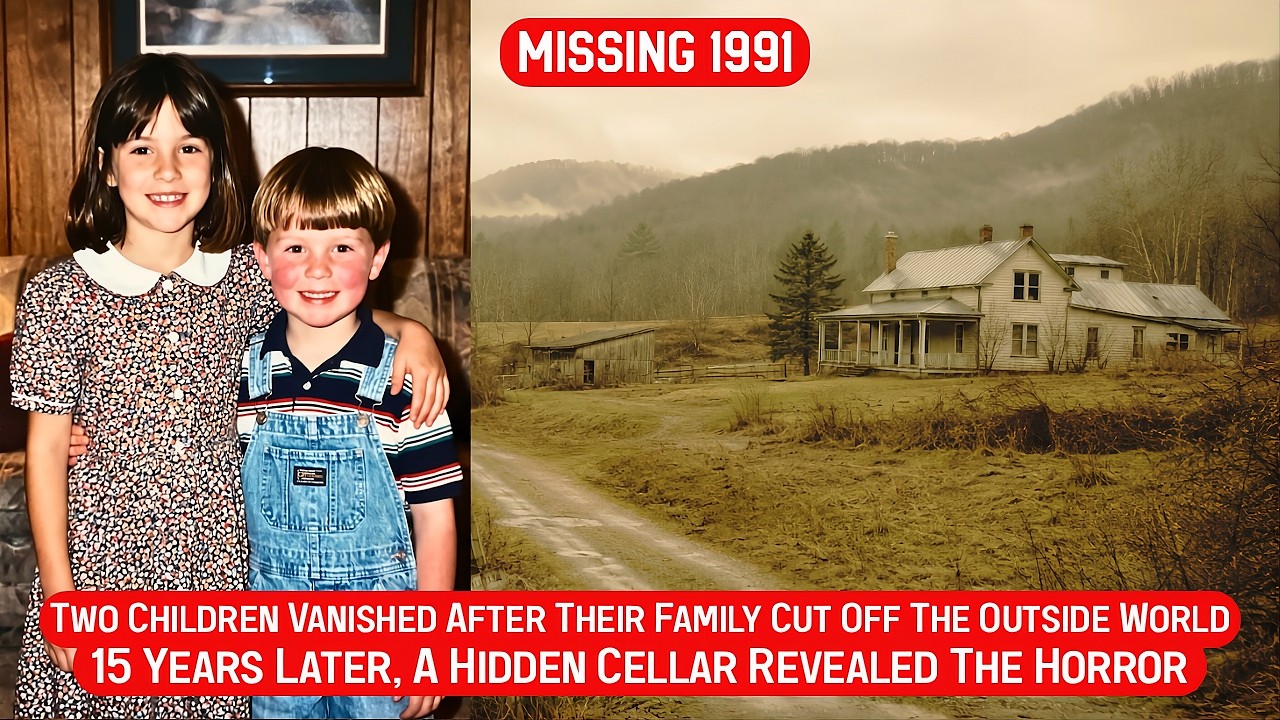
When family members finally began asking where the children were, Terrance and Vera insisted Iris and Caden had been sent to live with their biological father. Investigators contacted that man, who stated he had never seen the children and had no idea where they were. But authorities faced an almost impossible obstacle. There were no witnesses to the disappearance, no official records documenting where the children had gone, and no physical evidence proving a crime had occurred.
For years the investigation stalled, trapped between deep suspicion and the inability to prove what had happened on that isolated property. The story Terrance built was simple, which was part of its effectiveness. Simplicity left fewer details to contradict. The children had gone to live with Dale Mallow.
That was the entire explanation. When pressed for specifics, Terrance deflected with vague references to private family arrangements and divine guidance. He never provided documentation because he understood that providing false documents carried risk, while providing no documents at all simply created ambiguity. And ambiguity was easier to maintain than fabrication.
Vera repeated the story whenever she was asked, which was not often. Her contact with the outside world had been reduced to nearly zero. Terrance handled all interactions with neighbors, delivery drivers, utility workers, and anyone else who came to the property. People who saw Vera during this period described a woman who appeared physically diminished and emotionally absent, thin, pale, with a blank expression.
Several neighbors later admitted they had suspected something was wrong but had not known what to do about it. The culture of the region, with its deep respect for privacy and skepticism of government intervention, created a social environment in which asking too many questions about another family’s business was considered inappropriate. Vera’s younger sister, Paulette, was the first serious challenge to the cover story. When she confirmed through direct contact with Dale that he had not seen or heard from the children, she understood that something was deeply wrong.
Her report to the Harlan County Sheriff’s Office set in motion an investigation that proved both essential and tragically inadequate. Investigators quickly recognized that the story did not hold together. There were no travel records indicating the children had left the area, no school enrollment records in any district where Dale had lived, no medical records, no social service contacts, no paper trail of any kind suggesting the children were alive and living elsewhere. The absence of evidence was comprehensive, but it was not, by the legal standards of the time, sufficient to justify the kind of invasive search that would have been necessary to uncover the truth.
Terrance handled the investigation with a combination of belligerence and cunning that frustrated law enforcement at every turn. He refused to allow investigators onto the property without a warrant. He demanded to know the legal basis for every question. He accused detectives of targeting his family because of their religious beliefs.
He was not a stupid man. He was, in many ways, a brilliant one, brilliant in the narrow, destructive sense of someone who could identify the weaknesses in any system and exploit them without hesitation or remorse. The investigation continued intermittently throughout the 1990s but never gained the momentum necessary to break through the wall Terrance had constructed. Detectives obtained warrants for limited searches of the property on two occasions, but these searches focused on the house’s interior and outbuildings rather than the cellar or the ground beneath the structure.
The cellar itself was inspected during one of these searches, but the packed earth floor appeared undisturbed to investigators who were not specifically looking for burial sites. In 1998, a child welfare case worker named Linda Faye Combs reviewed the entire case file and was alarmed by what she found. She wrote a series of internal reports arguing that the cumulative weight of evidence justified a full excavation of the property under judicial authorization. Her reports were detailed, methodical, and prescient.
They identified the cellar as a location of particular concern. Her recommendations were received with discomfort by her supervisors. She was told that her persistence was creating problems for the office. In 1999, she was transferred to a different county, officially described as a routine reassignment but understood by colleagues as a consequence of her refusal to stop pushing.
By 2004, the case had effectively ceased. No active work was being done. The Bodines continued living on the property in the same pattern of isolation they had maintained since the early 1990s. Vera existed in a state of near total seclusion, living in a house that contained the remains of her children beneath its floor.
She later said there were entire years she could barely remember, periods when she moved through the house like a ghost. The only thing she felt consistently during those years was a low, constant dread that never fully resolved into specific fear but never fully receded either. It was simply the texture of her existence. On a cold morning in November 2005, Vera Bodine collapsed in the kitchen of the house and could not get up.
Terrance stood over her for several minutes, watching her struggle to breathe, before apparently concluding that her condition could not be managed without outside intervention. He called 911. An ambulance transported Vera to the Harlan Appalachian Regional Health Care Facility, where she was diagnosed with a significant cardiac event. For the first time in 14 years, Vera was physically separated from Terrance and from the house.
Terrance visited the hospital once, on the first day of her admission, and did not return. His absence created the opening that would eventually unravel everything. The hospital employed a chaplain named Reverend Thomas Asbury, a Methodist minister who had served in the hospital’s pastoral care program for over a decade. On Vera’s second day in the hospital, he encountered a woman in visible psychological crisis.
Over the course of several visits spanning three days, Vera began to talk. The process was not linear. It emerged in pieces, disconnected statements, long silences followed by sudden bursts of speech. She began by talking about the house.
She said the windows were always covered. Then she began talking about the children. She used their names, Iris and Caden, and when she did, her entire demeanor changed. The flatness that had characterized her speech gave way to raw, unmodulated grief.
She said the children had not gone to live with their father. She said the children had never left the house. The full account took more than three hours, spread across two separate sessions. Vera described the children’s decline, their deaths, the burials in the cellar, and the cover story that had sustained the concealment for 14 years.
She described Terrance’s control over the household, his drug use, his violence, and his systematic isolation of the family from outside contact. Kentucky State Police were notified, and within 24 hours Vera had provided a formal statement to investigators. The excavation of the Bodine property began in early 2006 after investigators obtained a comprehensive search warrant based on Vera’s confession. Terrance Bodine was arrested at his workplace on the morning the warrant was executed.
He showed no visible emotion when told the reason for his arrest. He asked for a lawyer and said nothing further. The excavation team, which included forensic anthropologists from the University of Kentucky, worked slowly over three days. Both sets of remains were recovered and transported to the state forensic laboratory for analysis.
The remains were confirmed as those of Iris Mallow and Caden Mallow. The forensic analysis revealed evidence consistent with severe malnutrition and neglect in both children. And then there was the detail that would become the most enduring image of the entire case. When Dr.
Patricia Hadley’s team uncovered the remains of Iris Mallow, they found that the bones of her right hand were curled inward, as though she had been holding something when she was buried. Nestled within the curve of the finger bones was a small fragment of cobalt blue glass, roughly triangular, smooth on one face and irregular on the other. It was approximately one inch across. It had been in the earth for 15 years, and it was still there, still held.
Dr. Hadley later said that this detail, this small piece of glass still cradled in the hand of a child who had been dead for a decade and a half, broke through every professional defense she had developed. The trial of Terrance Bodine began in October 2006 in the Harlan County Circuit Court. Vera Bodine had entered a separate plea agreement before the trial.
In exchange for her full cooperation and testimony against Terrance, she pleaded guilty to two counts of facilitation of murder, a charge that acknowledged her complicity while recognizing the extent to which she had been under Terrance’s coercive control. She was sentenced to 25 years. Vera’s testimony occupied two full days of the trial. She described the marriage, the escalating control, the isolation, the fabricated documents, and the events of January 1991 in detail that left the courtroom in sustained heavy silence.
When Terrance buried both children beneath the cellar floor, he dug the graves himself over the course of two nights by lantern light, then covered the disturbed earth with packed soil, old boards, and debris. Vera later said she believed Terrance had identified the cellar as a burial site weeks before the children died. The moment that would be most widely reported and most deeply remembered came during Dr. Hadley’s testimony about the blue glass fragment.
She told the court that the positioning of the glass within the hand indicated that Iris had been holding the fragment at the time of her death or burial, and that its preservation over 15 years was remarkable. She said that in her professional experience, the presence of a personal object held in the hand of a deceased child suggested a final act of attachment. A child holding on to something that mattered to her in the last moments of her life. When the prosecution displayed the blue glass fragment to the jury, sealed in a clear evidence container small enough to rest in the palm of a hand, no one in the courtroom looked away.
Several jurors were visibly weeping. Linda Faye Combs testified on the seventh day of the trial. She brought copies of her original reports, which had been preserved in the case file, and read portions of them aloud to the court. Her reports were prescient to a degree that was almost physically painful to hear.
She had identified the cellar as a site of concern. She had identified the fabricated ministry documents as fraudulent. She had argued in writing that the children were likely dead and that their bodies were likely on the property. When asked how she felt about the outcome, she said she had spent six years wondering whether she could have done more, and that finding out the children had been exactly where she said they were had not given her closure.
It had given her confirmation of her worst fears, which was a different thing entirely. Terrance Bodine did not testify on his own behalf. The jury deliberated for less than four hours before returning guilty verdicts on both counts of first-degree murder. Terrance was sentenced to two consecutive life terms without the possibility of parole.
He showed no visible reaction when the verdict was read. The case became a catalyst for systemic reform. Kentucky’s child welfare system underwent a comprehensive review. The fabricated home school documents that Terrance had used to deflect welfare inquiries became a central focus of legislative hearings.
The resulting reforms included strengthened requirements for home school notification and verification, enhanced communication protocols between school systems and child welfare offices, and revised training programs for case workers that emphasized the recognition of isolation as a potential indicator of abuse. Vera Bodine served her sentence at the Kentucky Correctional Institution for Women. She suffered additional cardiac events and was diagnosed with chronic depression that proved resistant to treatment. She died in prison in 2014 at the age of 50.
Her death was attributed to complications from heart disease. Terrance Bodine remained incarcerated. He did not grant interviews. He did not express remorse.
He filed multiple appeals, all of which were denied. In Harlan County, the Bodine property stood empty after the trial. No one bought it. No one moved in.
The cellar entrance was sealed with concrete sometime after the excavation. The fragment of blue glass recovered from Iris Mallow’s hand became the most widely discussed detail of the case. It appeared in newspaper accounts, magazine features, and television specials. A memorial plaque installed in Harlan County includes an etched image of a small triangular piece of glass above the names of Iris and Caden Mallow.
The fragment itself remains in evidence storage, sealed in the same clear container in which it was presented to the jury. It is a small, unremarkable piece of broken glass, cobalt blue, smooth on one side, jagged on the other. It was the kind of thing a child might pick up from a ditch or a roadside and keep because it was pretty, because it caught the light. Iris Mallow held that piece of glass through the worst days of her short life.
She held it as her brother weakened and died beside her. She held it as her own body failed. She held it as welfare inquiries were opened and closed, as her aunt knocked on the door and was turned away, as investigators searched the house and missed the cellar floor, as years turned into decades and her name faded from active files. She held it through all of it.
And when they finally found her, 15 years later, beneath the packed earth of a cellar in a sagging house on a back road in Harlan County, she was still holding it.