Louisiana’s Angola prison sits on 18,000 acres of some of the most fertile farmland in the American South, larger than Manhattan, wrapped on three sides by a bend in the Mississippi River and bordered by the Tunica Hills on the fourth. The geography made the property look like an island, isolated from the rest of the state, and that isolation was deliberate for 150 years. Cotton fields, soybean fields, cattle pastures, and sugarcane stretched to a horizon broken only by a few guard towers and the figures of men working in rows on foot. From a distance, it looked like a slave plantation.
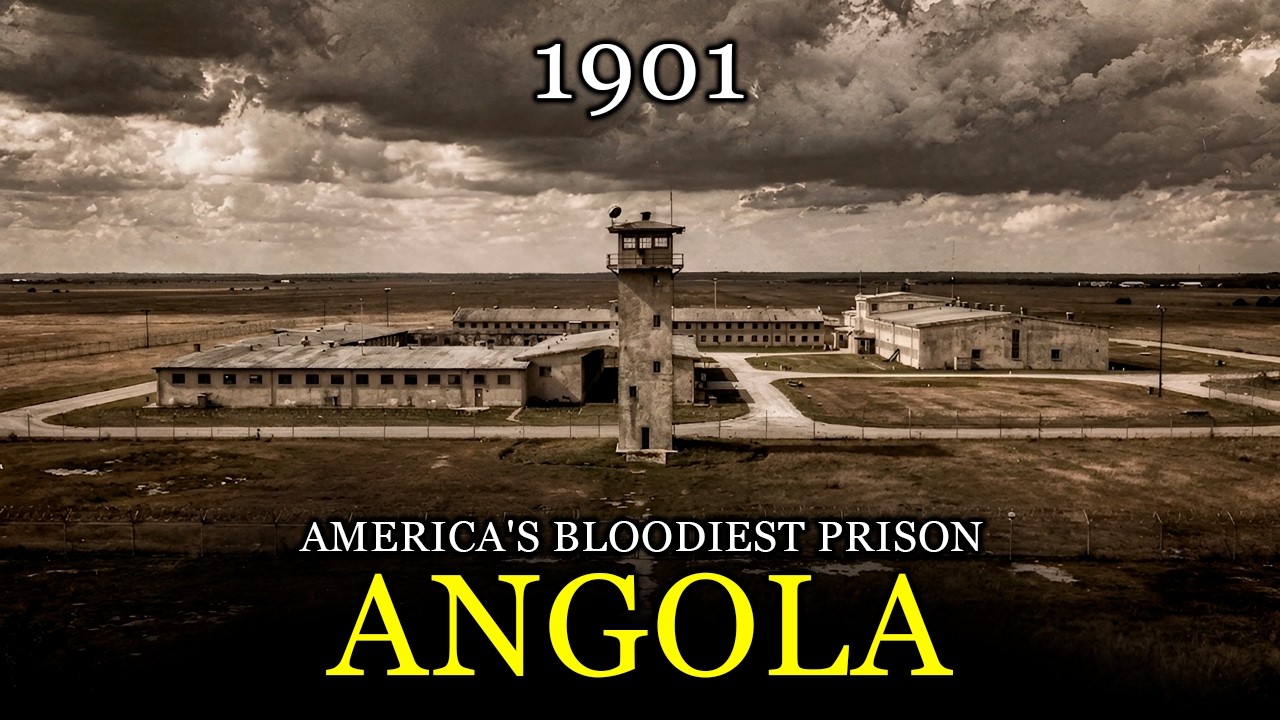
That is because it was one. It always has been. Only the official paperwork changed. Today, the state of Louisiana calls the place the Louisiana State Penitentiary.
Everyone else calls it by the name it carried since before the Civil War, since before it was ever a prison at all: Angola, named after the country on the west coast of southern Africa because that was where many enslaved people were brought from to work this soil. A slave trader bought the land in the 1830s and built a cotton empire on the backs of people he considered property. When slavery ended, Louisiana found a new source of forced labor to work the same fields under the same name, and that has never fully stopped. Today, Angola is the largest maximum-security prison in the United States.
Nearly 5,000 men live here. The vast majority are Black. The vast majority are serving life sentences on the same acres where their great-great-grandparents may have been forced to work in chains under a Louisiana sun that has not changed in 200 years, even as the law has changed what it calls the men beneath it. Three-quarters of the men sent to Angola will die within its borders.
To understand Angola, you have to go back to before there was any prison here at all. Before there was even a single fence, you have to go back to a man named Isaac Franklin, one of the most successful and brutal slave traders in American history, and to the moment he looked at this bend in the Mississippi River and decided it was worth owning. In the 1830s, Franklin was wealthy beyond almost anyone’s imagination. A partner in Franklin and Armfield, a firm based in Alexandria, Virginia, and Natchez, Mississippi, he ran one of the largest domestic slave-trading businesses in the entire country.
Franklin and Armfield did not just buy and sell individuals locally. The company ran what amounted to a cross-country logistics operation in the human trade, buying enslaved people in the Upper South, where the tobacco economy was declining, and moving them overland in chained caravans or by ship around Florida to the booming cotton and sugar markets of the Deep South, where labor demand and prices were much higher. Historians who studied the company’s surviving business records described an operation run with the same cold efficiency as any major commercial enterprise of the era, with standard pricing based on age, sex, and perceived physical condition. A business model that treated human beings as inventory to be moved where the market paid more.
The legal international slave trade had been banned by Congress decades earlier, but the domestic trade, buying and selling human beings within the United States, remained extremely profitable. Franklin built a fortune from it, a fortune large enough that when he turned to buying land along the Mississippi River, he could simply purchase four fully operating plantations and merge them into one unified operation. He bought four adjacent plantations along this bend of the Mississippi from a man named Francis Routh, properties that he and later owners named Panola, Belleview, Killany, and Angola. Franklin named the plantation himself, following the common practice of the era of naming estates after distant places with exotic resonance.
But the choice was not accidental, and it was not empty of meaning. Angola, on the southern Atlantic coast of Africa, was one of the regions from which people were enslaved and shipped to the Americas for more than two centuries. The plantation that would one day become the largest prison in the United States was literally named after the homeland of the people forced to work it. Under Franklin’s ownership and that of his heirs, Angola Plantation became one of the most productive cotton operations in the American South, producing thousands of bales of cotton annually through the labor of enslaved men, women, and children who lived in a cluster of wooden buildings known as the old slave quarters.
When Franklin died in 1846, ownership of the plantations passed to his widow. In 1880, she sold the combined properties, Panola, Belleview, Killany, and Angola, together to a former Confederate cavalry officer named Samuel Lawrence James. Major James did not just want the land to farm it. He wanted it because Louisiana, like every state in the defeated Confederacy, had discovered a loophole in the document that was supposed to end slavery forever.
The Thirteenth Amendment to the United States Constitution, ratified in 1865, abolished slavery and involuntary servitude, with one exception written directly into its text: as a punishment for a crime whereof the party shall have been duly convicted. Slavery ended, except for people convicted of a crime. Across the American South, in the years immediately following the Civil War, state legislatures rushed to make sure that exception would do a lot of work. They issued Black Codes, laws criminalizing vagrancy, unemployment, even simply being outside without a note from an employer, laws that targeted almost exclusively newly freed Black men and women.
Conviction under one of these laws did not send a person to a state-run, state-supervised prison. Instead, it sent them into the convict lease system, a practice in which the state handed its prisoners over to private individuals and companies who paid a fee for the right to work them, feed them as cheaply as they liked, house them as they pleased, and discipline them as they saw fit with almost no government oversight. In 1869, Louisiana leased all of its prisoners to Samuel James. When James bought Angola Plantation eleven years later, he had effectively purchased his own private penal colony.
He moved his leased convicts, the vast majority of them Black men convicted under the Black Codes for offenses a white man would never have been arrested for, into the same fields where their predecessors had been enslaved. He housed them in the same buildings, the very same slave quarters that had stood on the property for decades. He installed himself as the one responsible for their room and board. He had, in the language of the era, near-absolute power over them.
There was no difference for the men forced to live and work on this land between what was happening on it in 1860 and what was happening on it in 1885. A difference the law recognized, and almost nothing else did. The men who ran the fields for James bore a title history has never let go of. They were called free men, armed, mounted on horses, and almost exclusively white.
These free men supervised the convict laborers, most of them Black, from horseback, just as overseers had supervised enslaved laborers in the fields a generation before. The word free itself, applied to the men carrying guns rather than whips, tells you everything about how the state and the law understood this arrangement. There was someone free here. It was not the man in the field.
Conditions under James were deadly by any standard, even by the standards of an era that already tolerated an astonishing amount of cruelty toward its prisoners. Men were malnourished, sleeping without blankets in Louisiana winters, packed into the same wooden barracks that had housed enslaved laborers, sometimes on bare boards, sometimes on straw that was never replaced. Whipping was routine, carried out by those mounted free men at their own discretion, for the most trivial reasons such as working too slowly or looking at a guard the wrong way. There was no requirement for James to report deaths to the state in any meaningful way.
There was no independent inspector with the authority to enter the property without notice. There was no mechanism at all by which the government that had leased its prisoners could find out what was actually happening to them once the lease was signed. Death rates among leased convicts across the American South during this period were catastrophic almost everywhere the system was applied, and Angola was no exception. Some estimates from Southern penal records during the Reconstruction era suggest that death rates for leased convicts were several times higher than those of prisoners in traditional state-run institutions in the same years.
A statistic that becomes less surprising once you realize that a leased convict, unlike an enslaved person before the war, was not a permanent capital investment for the man exploiting him to death. An enslaved person was property to be preserved. A leased convict was a rented asset, and if he died, the state would simply lease you another one. Newspapers finally began reporting on the death toll at James’ plantations, and public outrage, slow to build but undeniable, led to the formation of a prison reform society in New Orleans, one of the first organized efforts in the state’s history to directly challenge the convict lease system.
Pressure built for years without results. Scandal, investigation, outrage, then very little actual change, because the men who profited from the system were the ones with the political influence to protect it. It took until 1898 for Louisiana to insert a ban on convict leasing directly into its state constitution. Even then, the ban did not take effect immediately.
It was written to apply only once James’ existing contract expired, meaning the state that had just declared the practice illegal continued to permit it for years afterward, honoring a contract with a system its own constitution now condemned. Samuel James died in 1894, four years before that constitutional ban was signed. With his contract still in effect, and with no actual legal consequences for what had happened on his plantations, Louisiana waited until 1901, 56 years after it had first begun leasing its prisoners to private hands, to finally take direct control of its penal system. In 1901, Louisiana purchased the entire 8,000-acre Angola plantation, along with an adjacent property known as Hope Farm, ending 56 years of leasing its prisoners to private hands and establishing the Louisiana State Penitentiary directly on the plantation land itself.
On paper, the transition looked enormous. An entire prison system moving from private to state control in one stroke. In practice, for the men actually living on the land, nothing changed at all. Samuel James’ old plantation camps became state prison camps under new names.
The old slave quarters, the same buildings where enslaved people had lived decades earlier, continued to house prisoners well into the new century. One continuous structure of forced confinement stretching across slavery, convict leasing, and state prison, never torn down. State records from the years immediately following the acquisition describe a population that still moved gradually. Hundreds of men who had been living and working under James before his death simply continued to live and work in the same camps, on the same crops, under a different name on the payroll.
The land itself carried its own dangers, regardless of anything guards or the state did. Because the prison sat inside that bend of the Mississippi, surrounded by water on three sides, it was catastrophically vulnerable to flooding. The river rose over its banks and flooded the prison fields in 1902, again in 1912, and a third time in 1922. Each time it destroyed that year’s crop, and each time it strained a facility that depended on its agricultural output to feed itself and generate revenue for the state.
A prison that could not adequately feed its inmates in good years became far worse in flood years, and the men working the fields bore the consequences of a river they had no power over, on top of everything else. By the early twentieth century, the state organized the property into a series of numbered and named camps spread across the farm, each operating as its own self-contained unit with its own dormitories, its own supervising staff, and its own assigned crops. Camp A, the oldest of these camps, was located on the site of the original slave quarters. Men were assigned to camps based on the crops in that part of the property that season, moving between them as the agricultural calendar dictated, following cotton, then corn, then sugarcane through the seasons, just as the enslaved workforce had been moved across the same fields under Isaac Franklin two generations earlier.
Over the following decades, the state continued to purchase and annex additional surrounding land until the property reached its current size of roughly 18,000 acres, larger than Manhattan. The old convict lease system, handing prisoners over to private plantation owners for personal profit, was gone. What replaced it was a state-run farm that continued to produce almost the same crops using the same methods, under mounted overseers who were still called free men for the next 125 years and still are. For much of its early history as a state institution, Angola housed women as well as men, a fact that surprises most people who know the prison only by its modern reputation as a male-only maximum-security facility.
Female inmates at Angola during the early and mid-twentieth century were assigned the same kinds of agricultural labor as the men, weeding and cultivating the fields under the same mounted overseers, wearing the same coarse uniforms, and living in conditions shown in surviving photographs from that period in harsh detail. Rows of women bent over hoes in open fields stretching to the horizon, indistinguishable at first glance from the enslaved workers who had labored on the same ground a century earlier. Louisiana eventually moved its female inmates to a separate facility elsewhere in the state, and Angola settled into the identity most people now associate with it, as a men-only institution. But for decades, women and men worked together in the plantation’s fields.
There was never a golden age at Angola in any sense you might expect from an institution built on optimism and reform. There were no Kirkbride theses, no architects drawing up plans to ensure sunlight and dignity. There was a plantation, and then there was a prison operating on the same principle: land, crops, and forced labor extracted at whatever human cost those in charge were willing to pay. For most of the twentieth century, Angola operated as a production farm, where nearly every able-bodied man was assigned to work in the fields.
The daily reality of that work is documented in painful, specific detail. Men woke before dawn to the sound of whistles and the call to work echoing across the camps. They were marched in long lines, sometimes referred to as the whipping line or the axe gang, depending on the era, to the cotton, corn, sugarcane, and vegetable fields stretching across thousands of acres. They worked with hand tools, sometimes with their bare hands, under the supervision of armed free men on horseback, just as their enslaved predecessors had worked this same ground a generation before.
Photographs surviving from the 1930s and 1940s show exactly what that scene looked like from a distance. Rows of men bent over cotton plants, stretching to a horizon broken only by the silhouette of a mounted guard. A scene that, if cropped and presented without context, would be assumed to be a photograph taken 70 years earlier under a completely different legal system. The heat of a Louisiana summer, then and now, is harsh enough on its own, without adding a day of forced labor to it.
It is humid and merciless, the kind of heat that makes the air itself feel like a physical weight pressing down on you. Authors Charles Wolfe and Kip Lornell, writing about the prison’s history, described Angola in the 1930s as the closest thing to slavery anyone could reach in that decade of the twentieth century. The prison staff, in the very words of history, ran the institution as if it were their own fiefdom. The system relied heavily on trusted inmates who were given authority, and in some cases weapons, to help control the rest of the population.
This trusty system, built on giving some inmates power over others, is a system designed to produce abuse. Angola’s trusty guards, known for decades simply as gunmen because of the weapons some were allowed to carry, were notorious for exactly the kind of brutality you would expect. Whipping continued long after it was officially supposed to end. Malnutrition was common.
Medical care for thousands of prisoners was almost nonexistent, and throughout that period, the state continued to reap the crops from the land while the men working them continued to die. Sometimes from violence, sometimes from disease, sometimes simply from being driven beyond the limits of human endurance. By 1943, a former Angola inmate named William Sadler, who had earned the nickname Wooden Ear after being mutilated in an attack by a prison guard, began publishing a series of articles called Hell in Angola in the inmate prison magazine The Angolite, accurately describing the conditions he had lived through. Sadler’s writing became part of a slow, grinding reform campaign that took nearly a decade to force any real change.
And when change finally came, it came from the only place such authority has ever been forced to yield: the bodies of the men themselves. By the spring of 1951, conditions in the Angola fields had deteriorated to the point that a group of inmates decided the only way to make the state listen was to make sending men to work impossible. In an unforgettable brutal act of protest, 31 inmates took razor blades and cut the tendons of their heels, severing the cords that enable a person to walk, so that they became physically unable to march to the fields. By May of that year, the group, which became known in the prison and later across the country as the Heel String Gang, had grown to 55 men.
It was an act of self-mutilation as protest, a form of desperate, unbearable resistance that had precedents in other brutal labor camps across the American South, but rarely on this scale and with this much attention. The story made national headlines. It forced the state to conduct an official investigation into conditions at Angola, and it worked. In the aftermath of the Heel String Gang movement, corporal punishment and the use of the whip were officially abolished at the prison.
The phrase officially abolished deserves reflection, because the record of what happened at Angola in the decades that followed shows that ending one particular instrument of violence did not end violence itself. It simply changed its form. Five years before the Heel String Gang protest, a 17-year-old boy from the same region of Louisiana had already shown the country what Angola’s machinery of justice looked like when it broke down, in the most literal sense of the word. Willie Francis was convicted in 1945 of killing a pharmacist in the small town of St.
Martinville, based on a confession extracted without a lawyer present and evidence that raised serious questions for generations of legal scholars afterward. He was sentenced to death by electrocution. Louisiana at that time did not keep a permanent electric chair in one place. Instead, it owned a single portable chair nicknamed Gruesome Gertie, loaded onto a truck and driven from district to district to carry out executions, powered by a portable gasoline generator connected to the chair by thick black cables.
On May 3, 1946, that truck arrived in St. Martinville, driven by an Angola prison guard named Captain Evey Foster, to carry out the execution of Willie Francis. Francis was strapped to the chair. The switch was thrown, but he did not die.
Eyewitnesses reported hearing him scream from behind the leather death mask: Take it off. Take it off. Let me breathe, as electricity ran through his body without killing him. It turned out the chair had been improperly wired the night before by a drunk prison guard and an inmate assistant at Angola.
The sheriff at the scene was later quoted as saying: The boy got a real shock when they turned that machine on. Francis was unstrapped, still alive, and returned to his cell while officials tried to figure out what to do with a condemned man who had survived his own execution. The case reached the United States Supreme Court on the question of whether sending Francis back to the same chair a second time constituted cruel and unusual punishment or double jeopardy, punishing a person twice for the same crime. The Court ruled against him.
On May 9, 1947, more than a year after his first attempted execution, Willie Francis was strapped to the same repaired chair and executed. He was 18 years old. There is a persistent piece of folklore attached to the execution history at Angola worth a direct correction, because it is the kind of story repeated so often it hardens into fact. The legend says the Angola electric chair was haunted or cursed, or that supernatural forces intervened to save Francis the first time.
But the documented reality is more mundane, and in its own way, more damning. Francis did not survive because of a curse. He survived because a drunk guard and an untrained inmate had wired the machine incorrectly. And Louisiana’s response to that failure was not to question whether a teenager should have been executed in the first place, but simply to fix the wiring and try again.
The horror here was never supernatural. It was bureaucratic. An administrative error in a killing machine, corrected, and then used as planned. Angola’s death row continued to operate for decades after the Willie Francis case, and produced one of the most famous accounts of capital punishment in American history.
In the early 1980s, a Catholic nun named Sister Helen Prejean began corresponding with men on death row at Angola, including Elmo Patrick Sonnier and Robert Lee Willie, both executed at the prison in the mid-1980s. Prejean’s 1993 memoir describing that experience, Dead Man Walking, became a national bestseller and was made into a 1995 film starring Susan Sarandon as Prejean, with scenes shot in the actual Angola death row and inside the execution chamber. The book and film did more than almost any other American media work to humanize, however uncomfortably, the machinery of modern capital punishment, still operating on the same plantation ground where Willie Francis had been strapped to the gruesome Gertie chair decades earlier. Prejean’s own views evolved through writing the book into firm opposition to the death penalty entirely, a position she has maintained publicly ever since, a direct contrast to the institution she wrote about, which has never stopped carrying out the sentences the state issues.
Executions were only one thread in the larger fabric of violence at Angola for most of the twentieth century. The trusty system, the same system that had allowed inmates to be armed and wield power over other inmates since the earliest days of state control, produced a level of internal violence that alarmed even the officials tasked with running it. Angola’s trusty guards, known for decades simply as gunmen because of the weapons some were allowed to carry, patrolled the camps and fields with authority that rivaled the paid correctional staff. Trusty status within the prison could be gained or lost based on loyalty, brutality, and the ability to control the men under them by whatever means worked.
Sexual violence, extortion, and inmate-on-inmate violence were rampant throughout that era, driven in large part by a rigid informal hierarchy within the camps that guards did little to disrupt, and some trusties actively enforced. Warden C. Murray Henderson, who ran the prison from 1968 to 1975, inherited a system so violent that in 1975 alone, the year he left, 40 men were killed inside Angola’s walls. Forty murders in a single year, inside one institution supervised by armed guards.
Under Henderson, the prison began implementing a formal classification system, sorting new inmates by the level of supervision their histories suggested. An effort records credit with beginning to bring the murder rate down from its horrific 1970 peak of 96 murders in a single year to under 10 annually by the end of the decade. Even accounting for that improvement, a prison recording dozens of murders annually for most of the decade represents a level of institutional violence matched by few American correctional facilities before or since. A federal judge who reviewed prison conditions in that era described what he found as absolutely unacceptable in a civilized society.
Language that echoes almost verbatim the language used to describe Kirkbride asylums and Auburn system prisons in other videos on this channel, because the pattern, once seen enough times, becomes impossible to ignore: overcrowding, understaffing, power given to the wrong people, and violence as the predictable, almost inevitable result. In 1975, a federal judge named Frank Polozola began what would become decades of judicial oversight of Angola prison, following a class-action lawsuit filed by the prisoners themselves. The consent decrees that followed imposed real tangible changes, improved medical care, limits on the authority trusties could exercise over other inmates, and reductions in the use of solitary confinement. It is one of the very few points in this story where the outside world, through the mechanisms of a federal court, actually forced the prison to change rather than merely promise to.
But even as those reforms were being entrenched on paper, the state was simultaneously building one of the most extreme uses of solitary confinement in the history of the American prison system, one that would eventually draw condemnation from human rights organizations around the world. Not every act of resistance at Angola made national headlines, and not every man who suffered here became famous for it later. Richey McGee was 16 years old in the early 1960s when he was convicted in Louisiana of attempted aggravated rape, a charge arising from a relationship with a 23-year-old married white woman. A case his supporters later described in terms that capture the racist machinery of Jim Crow-era Southern courts with a clarity matched by nothing else in this story, as a legal lynching carried out through court papers rather than a mob’s rope.
McGee spent seven years working in the Angola fields before his release at age 23, only to be imprisoned again in California years later, where he participated in the 1970 Marin County Courthouse takeover, an event some in the Black liberation movement of that era described as a slave rebellion. In April 1972, Black Panther Party member and Angola inmate Herman Wallace, along with his party comrade Albert Woodfox, were placed in solitary confinement following the stabbing death of a young Angola correctional officer named Brent Miller inside the prison. Wallace and Woodfox, together with a third man, Robert Hillary King, placed in solitary separately for an unrelated murder, became known collectively as the Angola Three. All three men maintained their innocence in Miller’s death throughout their lives, pointing to what their legal teams argued for decades was a deeply flawed original investigation, lost physical evidence, and a prison informant system that had every incentive to produce convenient rather than accurate testimony.
Their case became one of the most closely watched wrongful conviction and human rights struggles in modern American history, drawing attention from international human rights organizations, documentary filmmakers, and eventually members of the United States Congress. What makes the Angola Three story impossible to ignore is not just the question of guilt or innocence in the original crime. It is the cruel, unreasonable length of time the state kept two of these men in isolation. Robert King was released in 2001 after 29 years spent almost entirely in solitary confinement when his conviction was overturned.
Herman Wallace and Albert Woodfox remained in solitary confinement for decades longer, each spending more than four decades, approximately 41 years for Wallace and 43 years for Woodfox, locked in a cell the size of a small bathroom for 23 hours a day. According to documentation by human rights organizations, including Amnesty International, this is the longest recorded solitary confinement in the history of the United States prison system. Wallace was finally released in October 2013 after his conviction was overturned on the grounds that women had been systematically excluded from the grand jury that indicted him decades earlier. He died of cancer just three days later.
A free man for only 72 hours after more than 40 years locked in isolation. Albert Woodfox was released in February 2016 after entering an Alford plea, a plea that allows a defendant to maintain their innocence while acknowledging the state has enough evidence for conviction. Before their release, Wallace, Woodfox, and King had founded what many historians and activists describe as the first chapter of the Black Panther Party inside an American prison, running informal legal clinics for other inmates and organizing protests against the conditions of their isolation from almost all human contact for longer than most people live entire lifetimes. Not every name that passed through Angola’s gates belongs to a story of unending suffering.
The prison’s cultural footprint also has entirely unexpected directions, though those stories carry a sharpness that popular accounts usually miss. Huddie Ledbetter, the musician known worldwide as Lead Belly and one of the most influential figures in the history of American folk and blues music, served time at Angola in the early 1930s after a conviction for assault. There, folklorists John and Alan Lomax, traveling through the South recording prison work songs, captured his voice on tape for the first time. Popular legend passed down through generations says that Lead Belly sang his way to freedom, that he composed a song addressing Louisiana’s governor directly and was released as a direct result of the music.
It is a wonderful story, but it is not what happened. Documented records show Lead Belly was released through a completely ordinary channel: commutation of sentence for good behavior. It was one of 179 sentence commutations the governor signed that year alone for crimes ranging from manslaughter to murder. His talent was real.
His voice changed American music, but it did not soften the governor’s pen. The routine machinery of the prison system did that on its own. The same machinery that quietly released and quietly re-imprisoned thousands of other men whose names no one remembers and whose voices no one recorded. The Angolite, the inmate-published magazine of Angola, deserves a special place in this story, because it is one of the most remarkable works of journalism ever to come out of an American prison.
And because its very existence depended on a prison warden who allowed inmates the freedom to write honestly about the institution holding them, a freedom almost no other American prison has ever granted the men inside it. Founded decades earlier as a modest inmate newsletter devoted largely to sports results and prison announcements, it was transformed under editor Wilbert Rideau, serving a life sentence for a murder committed in 1961 when he was 19, into a professionally respected national publication investigating conditions inside the prison with a rigor most outside newsrooms would envy. Rideau took over the magazine in the 1970s and rebuilt it from within, training a rotating team of fellow inmates to work as reporters, editors, and photographers, insisting on documented, sourced, fact-checked reporting, something no one expected from a publication produced entirely behind barbed wire by men serving life sentences. Under Rideau’s editorship, The Angolite covered executions from inside the death chamber, investigated corruption among prison staff, and documented living conditions in the camps with a level of detail the state never voluntarily provided.
The work won a Peabody Award, one of the highest honors in American journalism, an accolade usually reserved for television networks and major urban newspapers, not a magazine printed inside a maximum-security prison. Rideau also produced documentaries from inside Angola, collaborating with outside filmmakers to bring cameras into places the prison had never allowed before, work nominated for an Academy Award. His own conviction was ultimately overturned after decades of appeals centered on the racial composition of the juries and grand juries that convicted him at the height of Louisiana’s Jim Crow era. He was released in 2005, after 44 years in custody, becoming one of the very few men in Angola’s history whose voice was heard from inside the prison, unfiltered, by a national audience that had no reason to know his name before his reporting made ignoring him impossible.
Angola’s transformation under Warden Burl Cain, who took charge in 1995, represents the most discussed chapter in the institution’s modern history, a chapter that defies simple summary. Cain built his reputation on what he called moral rehabilitation, an approach heavily focused on Christian faith, education, and structured programs aimed at men serving, due to Louisiana sentencing laws, life sentences without parole, statistically expected to die within the prison’s borders. Under Cain, Angola established a theological program in partnership with a Baptist college, training inmates to become chaplains providing counseling to other inmates within the same walls. An initiative that graduated dozens of people over the following decades, credited by supporters with genuinely reducing violence in the camps where those inmate chaplains worked.
He expanded hospice care so men dying inside the prison, and the vast majority of Angola inmates will die there, received care from fellow inmates specifically trained for the purpose, sitting with the dying around the clock rather than leaving them to expire alone in a hospital bed. Cain also changed the prison’s practices regarding burial of its dead. For decades, deceased inmates with no families to claim their bodies were buried in simple cardboard boxes within the prison grounds, until one of these boxes collapsed during a burial and the body fell through its bottom, according to the prison’s own account. After that, Cain ordered inmates themselves to build proper wooden coffins on site for every man who died at Angola with no other arrangements.
A small, specific, almost unbearably practical response to an indignity that had apparently been standard practice for years before anyone thought to change it. He created the Angola Prison Rodeo, a professional show held within the prison grounds every spring and on one day in October each year, attracting competitors and spectators from across the region, despite the fact that the men competing are without exception serving sentences behind the same fences the audience will pass through on its way home at the end of the day. In events with names like Convict Poker, contestants sit at a card table in the middle of the arena while a raging bull is released among them. The last man to remain seated wins.
Inmates also sell crafts, leather goods, furniture, and artwork to visitors at a market beside the rodeo, keeping a portion of the proceeds. It is one of the very few ways a man serving a life sentence at Angola can earn any money of his own at all. The rodeo draws crowds that can reach 10,000 spectators in a single day. They come from across the state and beyond, paying admission to watch men serving life sentences ride bulls, chase poker chips in a livestock field, and perform for an audience that will go home the same evening while the performers return to their cells.
The rodeo and the broader reforms Cain championed are sincerely credited with reducing the raw daily brutality that characterized Angola for most of the twentieth century. It is also undeniably entertainment built on the spectacle of incarcerated men, most of them Black, most serving sentences that will only end with their deaths, performing for a paying audience, mostly outsiders, on the grounds of a former slave plantation. The tension in that arrangement, between redemption and reform on one side, and spectacle and profit on the other, is something this channel has seen before, in ghost tours built on suffering inside abandoned asylums, in Hollywood film crews who found a decaying Illinois prison more valuable empty than it was full. At Angola, that same tension exists inside a prison still operating at full capacity with the men who are its subject still alive within it.
Cain’s tenure did not end on the terms he might have chosen. In 2015 and 2016, a series of investigative news reports revealed extensive financial deals between Cain, members of his family, and current and former inmates involved in real estate transactions tied to land near the prison. Arrangements that raised serious questions about a prison warden exploiting his position and his access to an incarcerated population for personal financial gain. Questions that echoed, in a more modern and smaller scale, the same conflicts of interest that had characterized Samuel James’ private pilfering over a century earlier.
Cain resigned from Angola at the end of 2015 amid those investigations, ending a 20-year tenure that reshaped daily life inside the prison, leaving behind a controversy the state never fully resolved. Through every one of these chapters, the reforms, the rodeo, the seminary, the periods of judicial oversight, one thing at Angola never stops: the fields. The system now operating at Angola is called the Farm Line, and it is in the most literal and direct sense the direct descendant of everything this story has already described. Almost every man who arrives at Angola, regardless of his future work inside the prison, starts on the Farm Line.
Long rows of crops worked by inmates by hand, weeding and harvesting, under the watch of armed guards on horseback, in the same soil enslaved people worked for Isaac Franklin nearly two centuries earlier. The prison owns modern agricultural machinery. The Farm Line does not use it. Historians who study the origins of Southern prison agriculture, including researchers at Louisiana State University, have described this choice as intentional rather than accidental.
A design inherited directly from the Jim Crow-era beliefs of prison departments that incarcerated Black men were, in their words, uniquely suited to outdoor agricultural labor. A belief that shaped how Southern states built their prison systems on former plantation land in the first place, a belief never formally abandoned, just quietly inherited. In September 2023, a group of inmates and the organization Voice of the Experienced filed a federal lawsuit known as Foote v. LeBlanc, arguing that the Farm Line violates the Eighth Amendment’s protections against cruel and unusual punishment, particularly through prolonged forced labor in extreme heat with utterly inadequate protection, and that it separately violates federal disability law by failing to provide accommodations for men whose medical conditions pose a real risk to life when exposed to heat.
The lawsuit describes conditions that any of the men who lived through the Heel String Gang protests 70 years earlier would immediately recognize. Limited shade, scarce water, men working in fields with heat indices exceeding 100 degrees Fahrenheit, some collapsing, some suffering burns and dizziness severe enough to require emergency treatment. One man who worked the Farm Line described the experience to journalists years later in words that need no elaboration. He said he had to soak a towel in water and put it over his head just to keep working.
His skin was blistering from heat burns, and he became so dizzy in the fields that the heat itself seemed to shimmer and dance before him on the horizon. Another former worker recalled that men on the line were, in his words, forced to work against their will, directly comparing the daily reality of the farm line to slavery. In July 2024, a federal judge named Brian Jackson issued a ruling ordering the Louisiana Department of Public Safety and Corrections to address what he described as stark deficiencies in the prison’s heat policies, concluding that the risk facing detainees working in high-heat conditions on the Farm Line was, in his words, obvious and apparent, and that the state’s handling of the matter reflected a callous disregard for human health and safety. At the time the lawsuit was filed, prison policy allowed work in the fields to continue even when the heat index exceeded 103 degrees, a threshold Judge Jackson found to be a known risk to human health in itself.
The ruling imposed tangible, immediate changes. Installation of shade structures and canopies in the fields for the first time in the prison’s modern history. Expanded access to water, sunscreen, and protective equipment. And a requirement that officials monitor temperature and humidity every 30 minutes during work hours, issuing a formal heat advisory whenever the combined heat index reached 88 degrees.
However, in the wake of that same ruling, once its temporary terms expired in October 2024, the state changed the internal heat advisory threshold, the temperature at which protective measures are triggered, raising it from a heat index of 88 degrees to 91 degrees. A change plaintiff lawyers argued directly increased the danger to the men the court had just ordered protected, a change the court itself later described as approaching bad faith. In a subsequent ruling in 2025, Judge Jackson issued a second temporary restraining order, lowering that threshold back to 88 degrees. He wrote that the men on the farm line must, in his words, be treated with human decency, a phrase that should not have needed to be written into a federal court order in 2025, yet it was.
Lawyers representing the men on the Farm Line described the pattern prevailing through these years of litigation in blunt terms. For the second year in a row, one leading attorney stated: The court has categorically condemned Angola Prison for perpetuating an archaic system of corporal punishment that contradicts fundamental scientific understanding and legal principles, and the state has only found a new way to undermine these protections once the court order expires. The full trial in this case concluded in the winter of 2026, with the judge considering whether the Farm Line as a system is constitutional at all, or whether only its worst excesses are at issue. Plaintiff lawyers demanded the state either end the practice entirely or at least comprehensively reform how forced labor in the fields is assigned and supervised across the prison.
State lawyers defended the Farm Line as a legitimate rehabilitation program, pointing to the shade canopies, sunscreen, and heat alert protocols installed only after successive court orders as evidence that the system had reformed itself from within. At the heart of the arguments presented in that courtroom was a sentence from one of the plaintiff lawyers that captured with painful precision the weight of what Angola represents even today: the Farm Line will always remain a prison farm on the grounds of a former slave plantation, in a region of suffocating heat. What matters now is what the state actually does to limit the harm these unchangeable facts cause. As of the recording of this report, the judge’s final ruling on whether the Farm Line will remain in its current form or must be dismantled entirely remains pending, a decision that will not be filed in a distant archive, but issued in the same news cycle in which this video is being watched.
The prison’s geography, that bend in the Mississippi that made it so easy to fence in during the nineteenth century, continues to create emergencies most American institutions never have to prepare for. Angola sits at the end of a single access road, effectively an island connected to the rest of Louisiana by one road in and out. This means any large-scale evacuation of the prison, whether due to hurricane, flood, or any other disaster, is an immensely difficult logistical task involving thousands of prisoners who cannot simply be told to drive themselves to safety. Unlike nearly all other residents of the state, during Hurricane Ida in 2021, one of the strongest storms to hit Louisiana in decades, Angola inmates and staff were evacuated in conditions former prisoners and rights groups later described as chaotic and unsafe, with some men reporting they were left for extended periods in vehicles or holding areas without adequate food, water, or sanitary facilities.
As the storm swept through the region, it represented in miniature the same vulnerabilities that have marked this land since Isaac Franklin first chose it. A bend in a great river that isolates everyone living here, for better and often for worse, something no amount of modern engineering has ever fully solved. Today, there is a museum in the courtyard of Angola prison, run by the prison administration itself, next to the rodeo arena and the gift shop selling inmate work to visitors. The museum’s exhibits take visitors through the prison’s history in carefully revised language, displaying old shackles and chains, uniforms, and rodeo photographs alongside panels describing the plantation era in the restrained, distant tone institutions tend to use when describing the worst chapters of their history.
There is also, a thousand miles away in Washington, D. C. , an exhibit inside the National Museum of African American History and Culture tracing the same arc this video has traced: from Isaac Franklin’s cotton fields, through the convict lease system, the Heel String Gang, the decades of isolation endured by the Angola Three, to a courtroom in Baton Rouge where lawyers argued, as recently as this year, about whether men can still be sent to work in those same fields when the heat index exceeds 100 degrees. Two museums a thousand miles apart, telling two completely different versions of the same institution, and only one of them still has a working rodeo arena and a gift shop.
Angola Prison is not abandoned ruins like many of the places this channel covers. It is not a decaying asylum turned haunted house or a closed prison turned film set. It is still operating at full capacity and full activity. Nearly 5,000 men still live within its borders today.
Most of them, statistically, will remain there until they die. The land itself has never stopped working. The crops have never stopped being harvested. Only the legal category of the people forced to cultivate them has changed, from enslaved to leased to incarcerated.
Three different words Louisiana has used over nearly two centuries to describe the same stretch of land, the same bend in the same river, and the same requirement that the people on this land work it, whether they agree to that work or not. Consider the journey of a single acre of this property, and what that acre has been called over two centuries. In 1840, an enslaved man picked cotton under the threat of the whip, owned outright as a tool for Isaac Franklin, the man who built his fortune moving human beings from Virginia tobacco fields to Deep South cotton fields like cargo. In 1885, a leased prisoner picked cotton on that same acre, owned by no one on paper, but completely controlled by Samuel James, answerable to almost no one for what happened to him, running his plantation exactly as the private owner had a generation earlier.
In 1955, a prisoner picked cotton on that same acre under the supervision of a gunman within a state institution a federal judge would describe twenty years later as absolutely unacceptable in a civilized society. And in 2024, a man stood working that same acre on a farm in 100-degree-plus heat by order of a judge, the only thing standing between him and a limit the state itself had quietly tried to raise. Four different centuries, four different legal categories for the man doing the work, and the same acre of Louisiana ground beneath all of them, indifferent to whatever the law chooses to call the person working it. The question this story leaves is not really a question about the distant past, because the distant past in this particular case is not actually distant at all.
It is a federal courtroom this year arguing about shade structures and temperature thresholds on the same soil where prisoners cut their heel tendons 75 years ago. On the same soil where enslaved people picked the same cotton a century before that. Isaac Franklin named this plantation after a country he most likely never set foot in, so that everyone who worked it would carry a permanent, small reminder of the homeland of the people forced to build his fortune.
He could not have known the name would outlive slavery, outlive convict leasing, outlive his entire fortune, and still be on the map of Louisiana in 2026, attached to 18,000 acres where men still work in the fields to this day.