In May 2017, the Washington Post printed a number that has come to define a Mississippi landmark: 7,000. That was the estimated number of coffins buried beneath a hill in Jackson, on the grounds of the former Mississippi State Lunatic Asylum. The figure was never a precise count. It was a ceiling, an upper estimate of the dead interred in unmarked ground under what is now the University of Mississippi Medical Center.
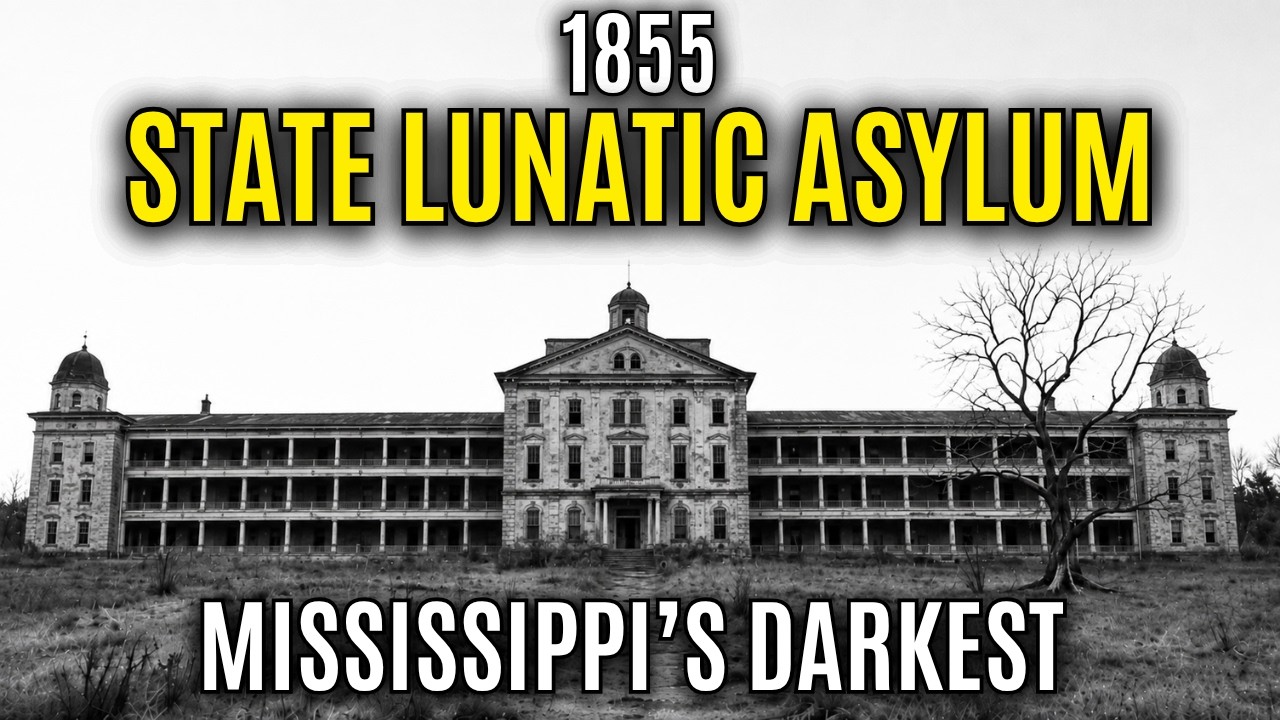
By 2026, the figure most commonly cited by the medical center ranges from 4,000 to 7,000, while only about 1,000 graves have actually been recovered since excavation resumed. Even the lower number represents a documented tragedy. It is, however, a different tragedy than the one popular lore has long described. The hospital opened on January 8, 1855.
Mississippi had built it because, by the 1840s, the state had no place for the people it considered insane. They were kept in attics, basements, pens behind houses, or chained to the floors of county jails. A federal census in 1840 counted 198 insane persons in Mississippi, a number the state’s leaders believed was badly understated. Dorothea Dix, the Massachusetts reformer known for her investigations of jails and almshouses, pushed for the institution.
She visited Mississippi in 1850, and the legislature had already authorized the hospital in 1848, appropriating $10,000 and a donated five-acre lot in Jackson. The commissioners sold that lot and bought 140 acres two miles north of town on ground large enough to farm. Construction took seven years and $175,000. Yellow fever delayed the work in 1853, bricks arrived late from the state penitentiary, and the first foundation had to be torn down and rebuilt.
The building was modeled on the state hospital at Trenton, New Jersey, which Dix had championed. Who designed it is not settled; the state archives name W. M. Gibbons, while a 1955 program credits Joseph Willis.
At capacity, the asylum was meant to hold 250 to 300 people. Instead, admissions rose steadily to 471 patients by 1891, 1,147 by 1907, and roughly 2,000 by 1926. On the day it closed, 2,554 patients were on the rolls, about eight times what the building was designed for. Admission did not always require a medical opinion.
Any citizen could complain to the sheriff, and the sheriff could bring the suspected insane before a county probate court, where a jury of 12 laymen decided by majority whether the person was insane. Mississippi, like Kentucky, placed little faith in medical judgment. One historian wrote that the system allowed counties to exile nuisances who did not fit any criminal category. The admissions register survives in 19 leather volumes.
Alongside name, age, occupation, and education, the books recorded a “predisposing cause” and an “exciting cause,” the institutional language for what set a patient off. Causes on record include childbirth, menopause, grief, financial trouble, a blow to the head, fanatical religion, and masturbation. Two phrases recur: “unlucky in business” and “disappointed in love. ” Diagnoses ran to a short list: chronic mania, melancholia, homicidal mania, hysteria.
Outcomes were recorded as restored, recovered, died, transferred, not insane, or “eloped,” a word penciled in later that meant escaped. The institution rested on a simple doctrine: work restores. Patients ran engine rooms, the post office, the bakery, the carpentry shop, and the farm. By 1890, the payroll listed watchmen, bakers, dairymen, washerwomen, gardeners, engineers, attendants, cooks, nurses, and a chaplain.
The trustees’ first two priorities were to dig a well and to appoint that chaplain. The wards were segregated, and so were the doctors. According to the state’s own biennial report covering 1925 to 1927, buildings for black patients were “jammed against the back doors” of the white wards. Those patients were kept closely confined because the races could not be permitted to mingle, and the grounds and lawn were given to white people.
The black wards themselves were described as dark, dreary, poorly ventilated, and terribly overcrowded, holding twice the number of patients they were built for. That explanation was reprinted word for word in the next report. Between 1855 and 1877, 1,376 people were admitted, and more than one in five died. By 1877, the asylum had also taken in 39 children under 15 and 104 people between 15 and 20.
Between 1925 and 1927, 673 patients died, 480 of them black. That is a body roughly every 26 hours. The superintendent attributed 250 of those black deaths to conditions that a new hospital would have prevented. In the next report, he raised the figure to 300.
Patients who resisted were placed in the “tight pack,” a wrapped restraint that resembled what we would now call a straitjacket, and then left in a “tight room. ” The record describes patients starved and left unwashed for days. According to a 1950 newspaper investigation, the same was done to a patient who had smuggled letters out describing conditions inside. There was also a “hot box,” a diathermy cabinet lined with light bulbs that raised body temperature and burned people, sometimes damaging hearts in ways that did not surface for years.
Mechanical restraint continued here until the early 1930s. One myth deserves correction in the institution’s favor: lobotomies were never performed here. What killed people was more ordinary. The observations columns record epilepsy, tuberculosis, dysentery, exhaustion, suicide by hanging, and pellagra, a disease of niacin deficiency that ran through the asylum from about 1902 to 1945.
Pellagra is a disease of what a person was fed. A resident carpenter named J. M. Moore was paid $120 a fiscal quarter to build the coffins.
The dead were laid in them east to west, hands folded across the chest or at the sides, with a painted wooden marker at the head. The wards were segregated; the cemetery was not. The paint was the only part of that system guaranteed to fail on its own. The asylum did not close because of a scandal, a court order, or the death rate, which the superintendents published themselves in state documents and used to ask for money.
What set the closing in motion was a real estate item in the Jackson Daily News on September 13, 1925. Realtors argued that the 1,400 acres around the asylum, thought worthless apart from the poultry farm, could be sold off gradually and turn a profit. In 1926, the legislature appropriated $2. 5 million for a new hospital on 3,333 acres in Rankin County and dropped the word “insane” from the name.
The new site was a former convict farm, vacated when the prison moved to Parchman. The Removal Commission in 1930 deemed it wise to erect no more buildings until the appropriation was sufficient to take care of all the white patients, and the colored wards were not mentioned again. On March 4, 1935, the asylum was condemned. The 2,554 patients were loaded onto buses.
The move took nine days and cost 15 cents a person. Nobody was charged, and nobody was named. There was no riot, no inquest, no prosecution. The institution ended with an appropriation, a bus schedule, and a bill for 15 cents a head.
The 140 acres had been bought so the place could farm, and by 1926 the grounds ran past 1,300 acres worked by the patients. Patient pay was inconsistent. One census entry reads “carpenter, wage or salary worker”; another reads “unpaid. ” Staff did little better.
In 1949, attendants were paid $60 to $75 a month. In 1936, the daily expenditure per patient was 42 cents, roughly $153 a year to house, feed, clothe, and treat a human being. By 1949, it had reached $1. 07.
A few patients have names. Isham Ernest was born in Georgia in 1787, fought in the War of 1812, was committed in 1857, and died the following year. No admissions record survives before January 1857; the earliest surviving volume opens at patient number 635. Sarah Byrd, a black woman born in Coahoma County in 1873, was admitted in 1908, worked 28 years as an unpaid seamstress, and died in 1936.
Moses Dent, Jr. was admitted in 1907 and died of tuberculosis in 1931 after 21 years. Martha Tillman, a white widow from Lincoln County, was admitted in 1911 and died of a liver abscess in 1934 after 23 years, one month, and 12 days. Dr.
William Compton, appointed superintendent in 1870, was regarded as the best the institution had. He was nationally respected and set out to double capacity, and black patients were admitted for the first time the year he arrived. He asked the legislature for lodging for “the lunatics of color” equal to what white patients had, while also arguing that placing black patients among white patients would excite them and create an untenable situation. In the same document, the trustees assured the legislature that Mississippi viewed its slaves not merely as property but as human beings amply protected by law.
The law allowed a buyer to sue the seller if a purchased slave turned out to be insane. The town did fine when the new hospital was announced. The Clarion Ledger’s special section on February 24, 1935 carried paid congratulations from the plumbing company, the gravel company, the engineering company, and the Rankin County Bank. An institution is an economy.
The University of Mississippi Medical Center now stands on the site. By its own accounting, its annual budget is $2 billion, about a tenth from state appropriations, representing 10% of the Jackson metropolitan economy and 2% of the economy of Mississippi. Forty-two cents a day and $2 billion a year on the same 140 acres. The abuse findings from Whitfield, the hospital that replaced the Jackson asylum, are real and documented: attendants whipping patients with rubber hose, diets under 1,000 calories a day, newspaper series calling conditions subhuman.
No audit and no grand jury finding for the Jackson asylum has been located. Mississippi writers built the older institution into a myth before anything was dug up. In William Faulkner’s 1929 novel, Benjy Compson is threatened with it by place name: “They going to send you to Jackson where you belong. ” Eudora Welty and Tennessee Williams drew on the same shadow, and John Grisham inherited it.
A documentary podcast took the estimate for its title: “7,000 bodies. ”
The biggest false claim is not the one people expect. The popular version says these people were dumped in a pit or thrown away. In August 2023, the lead bioarchaeologist on the excavation, Dr.
Jennifer Mack, said the opposite on the record: “The legend is that they were not cared for, and that is not the case at all. Everyone was given a proper burial in a coffin. ” The ground agrees. Individual pine boxes, bodies squared east to west, hands folded, accompanied by objects: an 18-karat gold wedding band inscribed “Ever true to thee,” an “At Rest” plaque from a coffin lid, work boots, a coin minted in 1895, hair combs, and dentures tucked under an arm in more than one grave.
In 1990, about 20 tombstones were reported dumped in a gully behind the medical center. In 1992, 44 graves were found. In 2012, 66 more. Radar in 2014 suggested 1,000, then more than 2,000.
By May 2017, the figure in print was 7,000, and aggregators pushed it to 11,000. The medical center’s own published figure is now 4,000 to 7,000. Graves actually recovered since digging resumed number about 1,000. Most people put the graves in the wrong place.
Whitfield, 10 miles away in Rankin County, holds another 5,000 graves that almost nobody counts. These graves are under a hospital in Jackson. The end took 43 years and began with soldiers. In 1863, the Union’s 46th Indiana Infantry occupied the grounds ahead of the siege of Jackson and put a signal station in the cupola.
They camped, built fortifications, killed the livestock, and drew seven of the asylum’s 10 employees into the Union Army. The ponds were fouled, and patients died from the water. One soldier wrote that the patients were terribly excited and were seen at the windows shouting to the soldiers. On February 19, 1892, patients were transferred out to East Mississippi.
Later that year, a fire took two-thirds of the central building. After that came coal lamps, bad water, and no wards for tuberculosis. The new hospital at Whitfield opened in 1935, and by 1950 the last building on the Jackson site was gone. The iron gates were sold through an architectural salvage yard on Monroe Street.
For 80 years, one object was carried over: a hand-carved marble sign reading “Established. ” The address is 2500 North State Street, Jackson. The Medical Center opened there in 1955. The cemetery is now the last undeveloped land on a campus of 164 acres with nowhere else to go.
How big the burial ground is depends on who you ask: 10 acres, 20, or 26. Nobody has settled how many died here either. The Medical Center says about 10,000 of more than 30,000 patients. A count presented in 2017 put the known deaths at 6,304.
A searchable database of burials, with 4,380 names, was built by one archives volunteer over four years of Mondays. In 2019, the legislature cleared the way. In 2021, it appropriated $3. 7 million.
Excavation resumed in November 2022, and in the spring of 2026, the team lifted its 1,000th grave. That March, they recovered an intact cast iron casket, probably made between 1860 and 1880, and expensive for its time. Inside was a woman between 30 and 55. Her hair had survived, and so had a simple ring.
The soil is bad for bone, and as of 2023, not one individual had been identified. Dr. Ralph Didlake, the surgeon who founded the research consortium in 2013, has said the medical center inherited these patients and wants to show them care. There is a harder version, from the graduate researcher who first assembled their stories: they were committed involuntarily, died involuntarily, and may now be donating their bodies to science involuntarily.
Thirty headstones still stand on the campus in a fenced plot beside the numbered markers of people who donated their bodies to the medical school. Those stones were moved there and have no relationship to what lies beneath them. One says only “Mary. ”
Other institutions fared differently.
Central State Hospital in Milledgeville, Georgia, opened 13 years earlier, closed in 2010, and is still standing with its chandeliers lit inside the main building. East Mississippi State Hospital in Meridian opened in 1885 and is still operating. Whitfield holds 110 buildings across 3,500 acres, most of them empty, with 1,400 staff for about 600 patients. Jackson got nothing: not a wall, not a wing, not a marker, just the clay.
They were sent to Jackson because a jury said so, because a brother could not keep a house, because a county had a sheriff and a farm, because it was cheaper than the alternative. And Jackson kept them. An asylum, an insane hospital, a state hospital, a condemned property, a vacant lot, a parking problem, a teaching hospital, an archaeological site. Adalie Wynn died of consumption in August 1906.
The state cannot say whether it was the 21st or the 22nd. Her stone is still there. It was moved once.
The rest are being lifted one at a time so that the hospital above them can grow.