On the night of March 24, 1949, Jane Wyman stood on the stage of the Academy Theater in West Hollywood, holding the Oscar for Best Actress. She was thirty-two years old. The prize was for her role as a deaf and mute young woman in Johnny Belinda, a picture that had earned twelve nominations, more than any film of 1948. It won exactly one award, and it went to her.
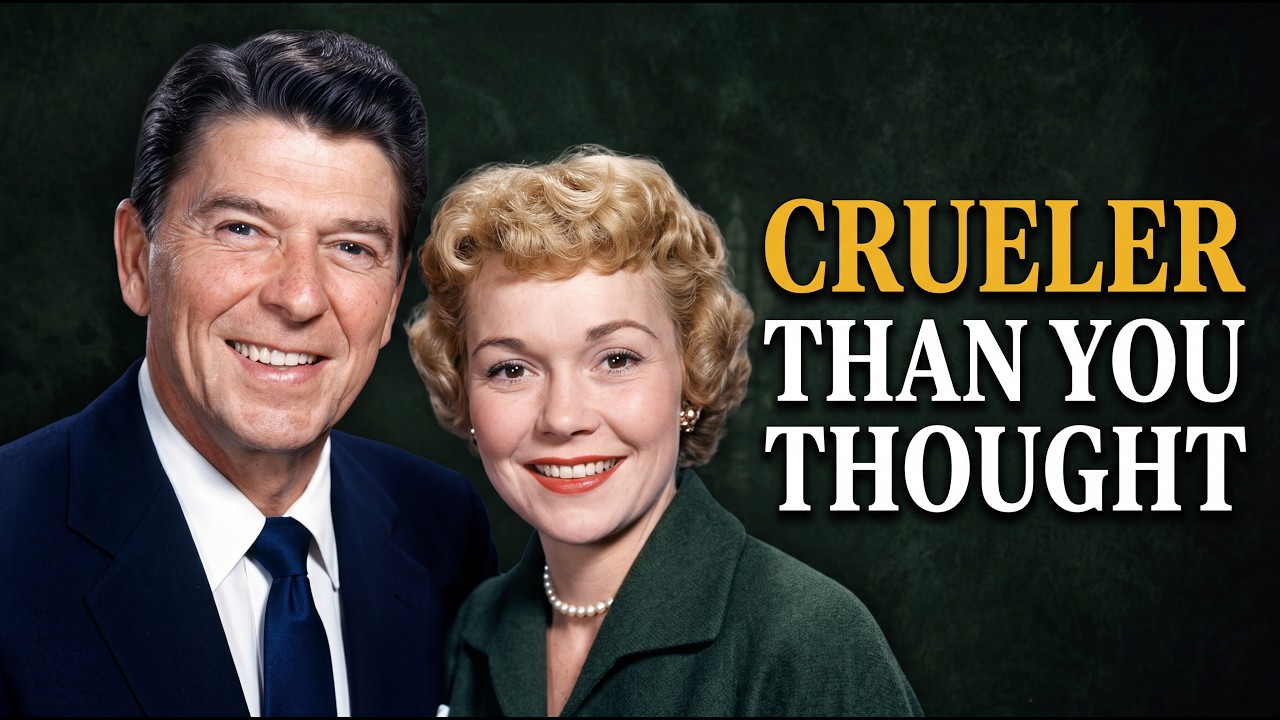
The ceremony that year was held in the Academy’s own theater, a smaller room than usual, because the major studios had withdrawn their financial support over rumors that they had been trying to influence voters. None of that had anything to do with her, but the timing of the night had everything to do with the story people thought they knew about her marriage. At that moment, legally, she was still Mrs. Ronald Reagan.
The divorce she had asked for in a Los Angeles courtroom the previous June would not become final until July of 1949. Those two dates, the award and the final decree, frame the collapse of one of Hollywood’s most publicized marriages. A magazine that reached newsstands early that year had already noted the oddity: her divorce would not be final until May, anything could happen in the meantime, and she might win the Academy Award and find a new love. The marriage had been presented to the public as the industry’s proof that two careers could survive a household.
One magazine called it the perfect marriage, the utopia of matrimony. Jane Wyman and Ronald Reagan had met at Warner Brothers, the studio that put them together in the comedy Brother Rat in 1938. It was the first of five pictures they made together. She had arrived at the studio two years earlier on a contract that paid sixty-five dollars a week with an option to renew every six months, and she had come up from the chorus line.
Asked about it later, she said she had been strictly third from the right in the front row. They married in January 1940 in a chapel called Wee Kirk o’ the Heather, which stands inside Forest Lawn, a cemetery. She called herself Plain Jane, and she called him Dutch. A daughter, Maureen, was born a year later, ahead of schedule.
A son, Michael, was adopted in 1945. For eight years, the industry held them up as proof that marriage and Hollywood could coexist. Then, in June 1947, a third child, a daughter named Christine, was born too soon and died the next day. The separation followed within weeks.
Jane went back to work immediately, into a part that was brutal by any measure. The picture was Johnny Belinda, and the role required her to play a young woman who could neither hear nor speak. Reagan spoke to a reporter during the separation and did not hide behind a statement. He said she had gone back to work too soon after the death of their baby and that the picture had been a terrible strain on her, but he added that he knew they would end their lives together.
He was wrong about the ending and right about the strain. An account of the shoot described her as distraught throughout, partly because the role was brutally hard and partly because her own life was coming apart. Reagan drove up to the Oregon coast location more than once. The coldest line in the record says that none of those reunions were occasions for hectic rejoicing.
When the separation became public, the shock was not about another woman, because there was no other woman to point at. One account from the time said the news shook Hollywood to its very core, and it explained why in a sentence that reads oddly now: in all his years of married life, Reagan had never so much as looked at another woman with desire. There was nothing to sell except the marriage itself coming apart. They tried to stop it.
A magazine reported in the autumn of 1948 that the last attempt had failed, and noted that both had even sought outside help in the hopes of untangling their marital snarl. Her own paperwork shows the hesitation. One account put it in eleven words: she filed her divorce action, redrew it, filed it once more. The hearing came on June 28, 1948, before Judge Thurman Clark of the California Superior Court.
She came in without a hat, her eyes sad, her tawny hair set in a neat pageboy bob, wearing a plain shirtwaist dress of orange gabardine. Before she went in, she told her closest friend what she expected: that she would look like the heavy, divorcing the all-American boy. The judge asked her why she wanted the divorce, and she gave a reason that has been argued about ever since. It was politics, she said, which built the barrier between them.
She said she had tried to follow her husband’s interest in it but lacked his ardor and his intensity, and that finally there was nothing in common between them, nothing to sustain the marriage. Judge Clark leaned over his rostrum and asked a practical question: were Reagan’s political activities connected with his profession? Jane nodded. Reagan was president of the Screen Actors Guild, the union for film actors, and she told the court she liked the organization.
Then came the admission the whole hearing turns on. Most of their discussions were far above me, she wanly admitted. She finished the story of an eight-year marriage in a few minutes. The judge gave her custody of both children.
Maureen was seven and Michael was three. Then he turned to money. Reagan was ordered to pay five hundred dollars a month for the support of the children. He was also ordered to pay Jane five hundred dollars a month for herself, but only under one condition: if illness or injury ever stopped her from working.
Healthy and employed, she was to receive nothing from him for herself. There was to be no alimony. Jane had asked for none. A week after the decree, the two of them were seen having lunch together in the commissary at Warner Brothers, where both were still under contract, at the tables where everyone could see.
They were laughing and joking. One director watched them and said the only sentence anybody remembers from that lunch: unless you knew differently, you’d think those two were newlyweds. That got printed, and reconciliation rumors started. She answered them without drama.
Ronnie and I will always be good friends, she said, adding that they met and took lunch and went out together because they liked to discuss their children’s welfare. The question of what actually ended the marriage produced two theories at the time, and there are still two theories. A retrospective article from 1983 summed it up carefully: the Oscar for Johnny Belinda was said to have put the final blow to the Reagan marriage, but most believed the basic differences came from politics. The facts underneath the theories do not move.
A baby died in June of 1947. The separation followed. He said she went back to work too soon. She told a judge it was politics.
The night of the award, she stood on the stage alone. Two years earlier, when she had been nominated for the first time, for The Yearling, Reagan had spread the newspapers under her nose and said, this is it, baby, and kissed her. She had been sure she would not win, and she was right. This time, she won.
Her acceptance speech was probably the shortest on record. She stood there silent for a moment, the gold statuette held tight in both hands, and then she bent forward and said it shakily: I accept this award very gratefully for keeping my mouth shut once. I think I’ll do it again. In the aftermath, she was seen a great deal with Lew Ayres, her leading man in the picture.
He had driven her down to San Diego to meet his parents. A photographer came at them once, and Ayres clenched his fists and started forward before the man cleared out. Neither would speak to the press. Warner Brothers had not waited for the marriage to finish before selling the award.
A promotional kit for her next picture, A Kiss in the Dark, mailed to theater managers in 1949, carried a line set in capital letters: the star who won the Academy Award will win your heart again. Another line in the same kit called her the recent winner of the 1948 Academy Award for Best Actress. The studio’s own document dated her prize to 1948, the year she filed for divorce, the year she testified about politics, the year Judge Clark signed the first decree. The studio dated the prize to the last full year of the marriage without noticing what it had written down.
She noticed. She just never said so. She married twice more, both times to the same man, the music director Frederick Karger. That was in 1952.
It ended, then started again in 1961, and ended for good in 1965. She converted to Catholicism in 1953 and never married again. In 1955, she moved to television, setting up her own production company. In 1968, after Reagan had become governor of California, a newspaper asked her about him.
She said she had always been a registered Republican, that talking about former husbands and former wives was bad taste, and that she knew nothing at all about politics. She gave the same answer for the rest of her life, through the governorship and through eight years of a presidency. On January 20, 1981, Reagan was sworn in as president, and Jane Wyman became the first living former wife of a sitting American president. That same decade she starred for nine seasons on Falcon Crest as a ruthless family matriarch, probably at the peak of her long career and seen by more people than ever before.
She talked about neither thing. In 2001, her daughter Maureen died of melanoma, and she went to the funeral. Three years later, she went to Reagan’s. Her statement when he died was two sentences long, simple and reported without embellishment: the country had lost a great president and a great, kind, and gentle man.
She died in her sleep at Rancho Mirage, California, on September 10, 2007. She was ninety years old. One national magazine put her age at ninety-three in its obituary headline, the last echo of the birth year she had let stand for seventy years.
Even the people writing her death notices did not know how old she was.