In the mid-1990s, Devon Sawa was one of the most recognizable faces in teen pop culture. He became the romantic ideal of a generation when he played the human form of Casper in the 1995 blockbuster. Five years later, the same face terrified audiences as Stan, the obsessive, unstable fan in Eminem’s landmark music video. The contrast was jarring, but Sawa insists it was no accident.
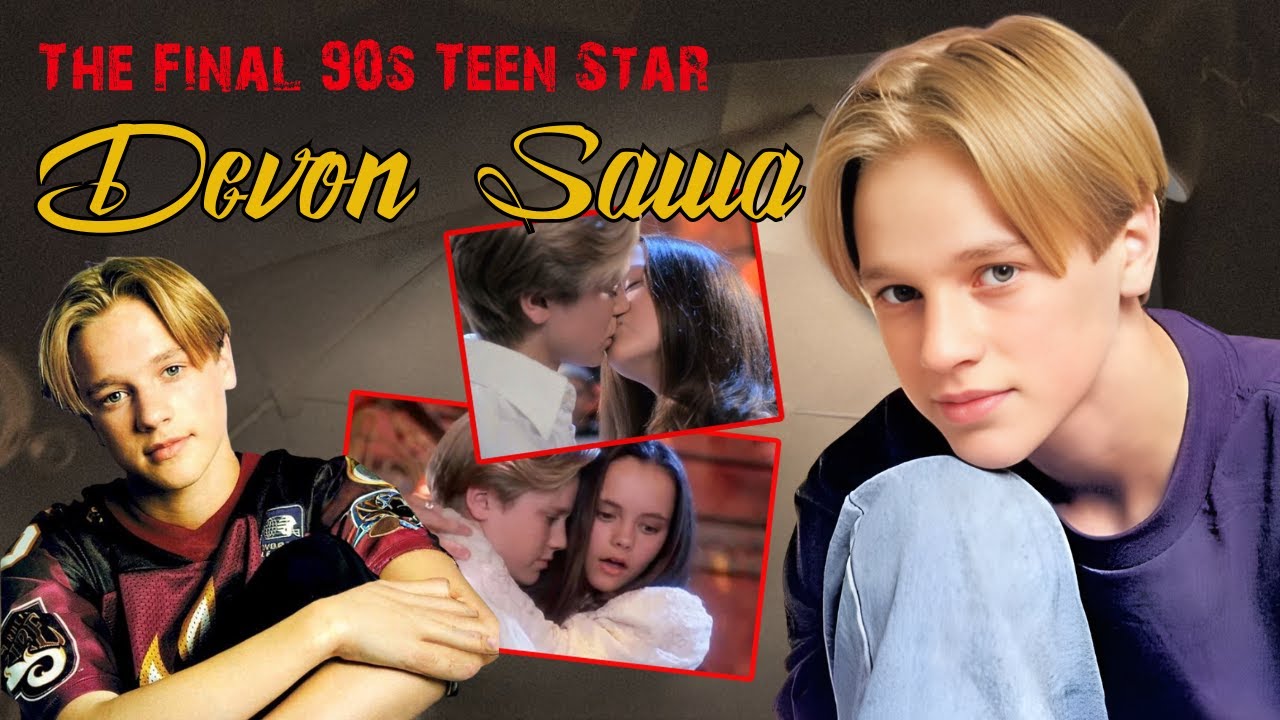
He deliberately dismantled the heartthrob image he had been handed, stepping away from Hollywood at the height of his fame and rebuilding his career on his own terms. Sawa was born on September 7, 1978, in Vancouver, British Columbia. His father was a refrigeration mechanic and his mother a homemaker. He was the youngest of three children.
The family lived a grounded, blue-collar life, far removed from the entertainment industry. In the 1980s and early 1990s, however, Vancouver had earned the nickname Hollywood North, hosting productions like 21 Jump Street, MacGyver, and The X-Files. That proximity made acting a realistic path for a local teenager. After a teacher encouraged him to pursue performing, Sawa began with school theater and local commercials.
His professional start came in 1992 when he appeared in ads for the Starting Lineup line of children’s sports action figures. From there, he moved into small television roles before landing a supporting part in the 1994 family comedy Little Giants. The film was a modest success, but it introduced Sawa to Hollywood casting directors and put his face on movie posters. His breakthrough came in 1995 with Casper.
Universal Pictures and Steven Spielberg’s Amblin Entertainment had invested roughly $55 million in the film, a major technical gamble for its time. Christina Ricci was the film’s lead, and most of the title character was a computer-generated effect voiced by Malachi Pearson. The script called for a single scene in which Casper briefly becomes human, and the actor cast for that moment had to carry the film’s entire emotional payoff. Sawa was chosen, appearing for only a few minutes on screen.
The scene, capped by the line “Can I keep you? ”, turned him into an overnight sensation. Casper grossed more than $287 million worldwide, and Sawa became the face of the 1990s teen idol industry. That same year, he appeared in the coming-of-age film Now and Then, playing the town bully and romantic interest.
In 1997, he co-starred with Jonathan Taylor Thomas in Wild America, a film marketed directly to the teen magazine audience that idolized both actors. By that point, Sawa’s face was on posters and pin-ups everywhere, and he was widely considered one of the most popular young stars of the decade. Sawa was aware that the teen heartthrob label came with a short shelf life. He watched contemporaries like Jonathan Taylor Thomas, Edward Furlong, and Brad Renfro either walk away or crash publicly.
Rather than wait for the industry to discard him, he decided to take control of his own image. His rebellion did not take the form of public meltdowns or scandals. It was strategic. He sought out darker, edgier roles designed to break the Casper persona.
In 1998, at the peak of his teen idol fame, he starred in SLC Punk, an independent film set in the punk scene of 1980s Salt Lake City. He played Shawn, a wealthy suburban kid who embraces punk, takes a massive dose of acid during a party, and eventually appears in a childlike, brain-damaged state. The role was deliberately anti-romantic and anti-Casper. The film became a cult hit on video.
The following year, Sawa led the studio comedy-horror Idle Hands. He played Anton Tobias, a lazy teenager whose hand becomes possessed by a demon and goes on a killing spree. The film was released on April 30, 1999, just ten days after the Columbine High School massacre. It bombed at the box office, but found a loyal cult audience on home video.
In 2000, Sawa starred in Final Destination, a horror film about a group of students who cheat death after one of them has a premonition of a plane crash. Sawa played Alex Browning, the lead whose warnings are ignored by everyone around him. His performance grounded the film’s high-concept premise in believable paranoia. Made for about $23 million, the film grossed over $112 million worldwide and launched a long-running horror franchise.
That same year, Sawa was cast in the music video for Eminem’s “Stan. ” Dr. Dre directed the video, reportedly impressed by Sawa’s performance in Final Destination. The eight-minute film told the story of an obsessed fan who descends into madness and drives his car off a bridge with his pregnant girlfriend locked in the trunk.
Sawa played the title character opposite Eminem himself. The video became a cultural landmark and permanently linked Sawa to the song’s dark narrative. By the end of 2000, Sawa appeared to have accomplished the difficult transition from teen idol to serious leading man. He had a hit franchise, a culture-defining music video, and momentum.
That momentum collapsed quickly. In 2002, he starred in two consecutive flops. The comedy Slackers was widely panned, with Roger Ebert giving it zero stars. Extreme Ops, a big-budget action film meant to establish him as an action star, grossed only about $13 million worldwide against a reported $40 million budget.
Within two years, Sawa had gone from rising star to box office poison. Around 2003 or 2004, at age 25, he left Hollywood entirely. He returned to Vancouver and largely disappeared from public view. For roughly five years, he drifted.
He has acknowledged that he drank heavily during this period. He took low-profile work in independent and direct-to-video films, jobs far removed from his former fame, to keep working and pay bills. It was, by his own account, an identity crisis fought in private. During this period, he met Donnie Sahanovich, a Canadian film producer.
Their relationship helped him find stability. He got sober and began rebuilding his life. He married Sahanovich on May 20, 2013. They had a son, Hudson, in 2014, and a daughter, Scarlett Helénä, in 2016.
His career resurgence began slowly. In 2010, he was cast in the CW series Nikita, where he played a recurring role as Owen Elliot, a former government assassin. The role allowed him to present a mature, physically imposing version of himself, far removed from the boyish image audiences remembered. In 2016, he returned to SLC Punk lore in the sequel Punk’s Dead: SLC Punk 2.
After Nikita, Sawa found steady work in the horror and thriller genres, appearing in a series of independent films. His 2020 role in Hunter Hunter was widely praised. In that film, he played Joseph Muro, a fur trapper living off the grid in the Canadian wilderness with his family. The film builds to one of the most shocking endings in recent horror, and critics singled out Sawa’s performance as transformative.
In 2021, he starred in and executive produced the horror-comedy Black Friday, alongside Bruce Campbell. That same period brought a collaboration with Chucky creator Don Mancini. Sawa joined the television series Chucky in a dual role as twin brothers Logan and Lucas Wheeler. Both characters were killed off during the season, but Mancini invited him back for season two as a different character, Father Bryce.
That character was also killed in spectacularly gory fashion. By season three, the running gag had become part of the show’s appeal: Sawa returned as President James Collins, a new main character whose White House is stalked by the killer doll. He also briefly played the president’s body double. Sawa is scheduled to appear in several upcoming projects, including the television adaptation of Twisted Metal and the series Murder in a Small Town.
He has also worked as a co-producer on several films and directed a short film in 2016. His career now spans both the 1990s icon he remains in pop culture memory and the working actor he has become in his forties. He engages with his past openly, joking with fans on social media about the Casper line “Can I keep you? ” and his rivalry with Jonathan Taylor Thomas.
He won a Saturn Award in 2001 for best performance by a younger actor for Final Destination. His more recent roles have drawn attention for their range and depth. Sawa has said he is at peace with his teen idol past, but no longer defined by it.
Rather than self-destructing publicly or fading into nostalgia, he left the industry when it stopped serving him, rebuilt a private life in Canada, and returned to work gradually, on his own terms.