On a warm July evening in 1954, a Nash Rambler station wagon collided with a family car on a quiet Los Angeles street, killing a nine-year-old boy instantly. The driver, a flame-haired woman, stepped out, looked at the child on the asphalt, then climbed back into her car and sped away into the night. Within 48 hours, police identified the woman as Lynn Bagot, a 31-year-old Hollywood actress whose face was already known to millions. Bagot’s story began far from the Hollywood spotlight.
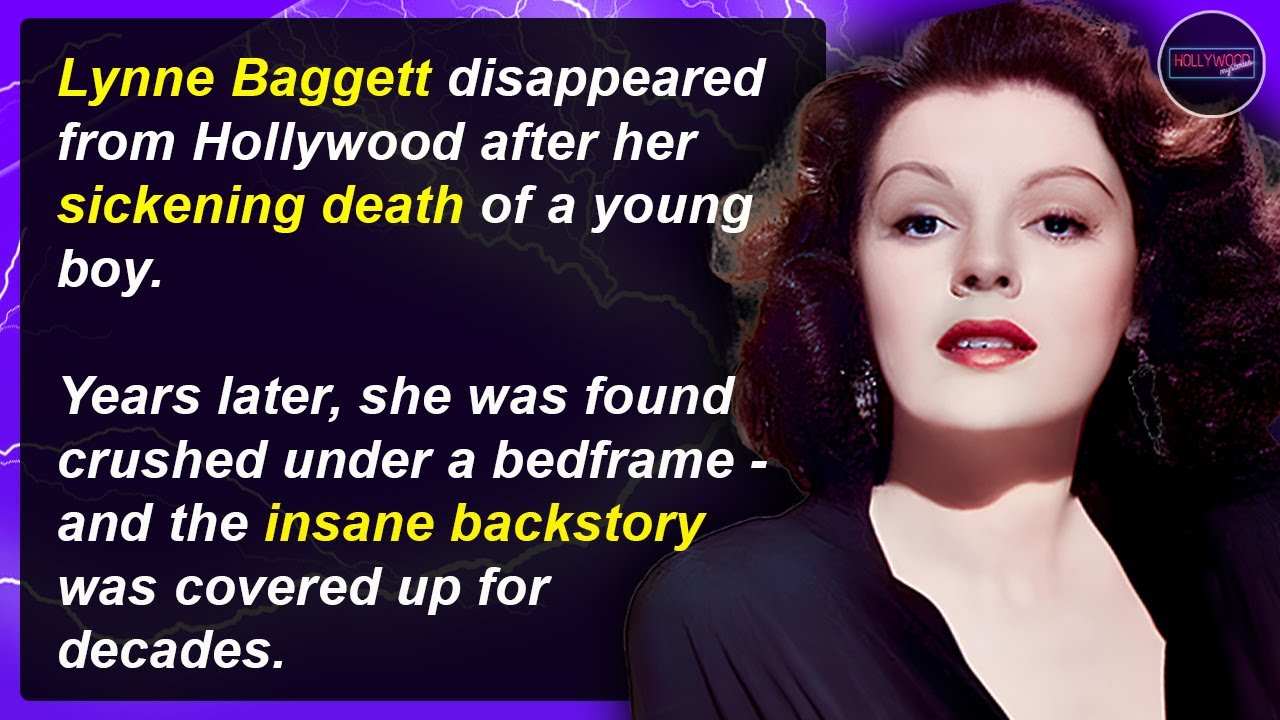
Born Ruth Bagot on May 10, 1923, in Wichita Falls, Texas, she was the daughter of an oil field worker and a stenographer. Family legend held that she suffered a serious head injury as a child, a trauma some later speculated may have contributed to the emotional troubles that haunted her adult life, though the exact circumstances have been lost to time. In 1942, at age 19, she was spotted in a Dallas department store by Warner Brothers talent chief Steven Pallay Bannoff. He scribbled out a contract on hotel stationery, pressed a $25 advance into her hand, and urged her to come to Hollywood by the end of the summer.
With her mother’s consent, she signed a three-year studio contract and became Lynn Bagot, Hollywood starlet. She spent the early 1940s in uncredited roles, appearing as bar girls, nurses, and party guests. Her first visible role came in the 1944 Technicolor biopic “The Adventures of Mark Twain,” and she could be spotted as a waitress in the 1945 noir classic “Mildred Pierce. ” By 1946, she moved to Universal Studios and earned her first screen credit in an Abbott and Costello comedy.
Her breakout came with the 1950 noir thriller “D. O. A. ” Her performance as the duplicitous widow Mrs.
Phillips caught critics’ attention, and the New York Times gave her a polite nod for helping the film. She followed with supporting roles alongside Burt Lancaster and Broderick Crawford, and her career appeared to be steadily ascending. Yet it was her personal life that violently took center stage. During her Warner Brothers years, she was linked romantically with director Jean Negulesco, then moved on to character actor George Tobias.
But it was her relationship with producer Sam Spiegel that changed the trajectory of her life. They met around 1945 when Bagot did a screen test for a film Spiegel was producing. Spiegel, two decades older, was a formidable and brilliant producer who had reinvented himself from a Polish-born immigrant into a maker of prestige pictures. By 1947, he had moved Bagot into his Beverly Hills mansion, and they married in Las Vegas on April 10, 1948, with director John Huston and his wife as witnesses.
Behind closed doors, the marriage was in trouble almost from the start. One acquaintance described the union as unhappy, full of fierceness and dishonesty. The fights were frequent, fueled by Spiegel’s controlling streak and long work absences, and Bagot’s emotional swings and alleged infidelities. In 1951, while Spiegel was abroad scouting locations for “The African Queen,” Bagot allegedly erupted in rage, slashing his expensive suits and destroying half a dozen Picasso paintings he owned.
By early 1952, the couple unofficially separated. Bagot had an affair with writer Irwin Shaw, and later a brief dalliance with John Huston. Rumors circulated through Hollywood, and Spiegel seized on them. Bagot, once a Cinderella story, found herself cast in a new role: the embattled Hollywood wife.
By 1953, her film career had stalled. The phone stopped ringing with casting offers, and some believed Spiegel’s influence ensured her name was no longer welcome at the studios. Her finances were precarious, and in November 1953, she went to court seeking $3,685 per month in temporary alimony, claiming Spiegel had abandoned her two years earlier. The judge awarded her just $500 per month.
As 1954 dawned, Bagot was living in limbo. Friends later recalled she had developed an addiction to sleeping pills, prone to anxiety and depression. In May 1954, a paper spotted her riding a bicycle around Hollywood, a curious sight for a glamour girl, explained by the fact that a court had suspended her driver’s license as part of the pending divorce settlement. The next event in her life proved deadly.
On the night of July 7, 1954, Bagot attended a Hollywood party. Close to midnight, she headed home in a borrowed car, a green Nash Rambler station wagon lent by her old friend George Tobias. As she drove through West Hollywood, her wagon plowed into the back of a family station wagon carrying five young boys returning from a day camp outing. Nine-year-old Joel Watnick, sitting in the back, was ejected from the vehicle and killed instantly upon hitting the pavement.
Other passengers were badly hurt. Bagot stepped out of her car, gasped “Oh my god,” and begged someone to call an ambulance. But as people rushed to help, she climbed back into her car and fled. She later claimed she blacked out in panic.
She recounted driving several miles, parking on a hill, running aimlessly, boarding a city bus, and ending up in a Hollywood movie theater watching a film about auto racing. When she returned home at dawn, she dropped to her knees and prayed that the little boy wasn’t dead. Police investigators soon got a lead when a tow truck driver reported an odd call from a woman asking him to pick up a damaged green station wagon. The car was found stashed at an auto body shop, missing its license plates and registration, but the vehicle identification number pointed to George Tobias.
When contacted, the actor said he had lent the Rambler to his friend Lynn Bagot that day. On July 9, 1954, as Joel Watnick’s family laid the boy to rest, Bagot was arrested and booked on charges of felony hit-and-run and vehicular manslaughter. She was photographed pale and shaken, clutching her attorney’s arm. At the police station, through tears, she confessed her remorse: “I wish I’d been killed instead of the boy.
I wish I was dead. ”
Bailed out by Sam Spiegel, who arranged a $5,000 bond from London, Bagot prepared to face justice. In October 1954, a ten-day trial unfolded in a packed Los Angeles courtroom. She took the stand to describe the crash as an out-of-body episode of terror.
The prosecutor hammered her with the damning facts: she had gone to great lengths to cover her tracks, removing the car’s papers and lying to the tow service. The jury returned a split verdict, acquitting her of manslaughter but finding her guilty of felony hit-and-run. At her sentencing on December 1, 1954, Superior Court Judge Mildred Lillie did not mince words. “I cannot accept her story of a blackout,” the judge declared, noting that Bagot was “extremely rational” soon after the accident and had used every resource to conceal her identity.
The sentence was 60 days in county jail, three years probation, and a one-year suspension of her driver’s license. As the gavel fell, Bagot’s mother, seated in the courtroom, collapsed and had to be carried out. Bagot reported to Los Angeles County Jail in early December 1954. Behind bars, inmate number 87216 scrubbed floors, washed dishes, and sewed patches on fellow inmates’ uniforms.
The rigid routine and forced sobriety brought her a measure of clarity. On New Year’s Eve, she gave a jailhouse interview, saying the past three years of marital problems, anxiety, and shame had felt like another jail of sorts. “Now, I will divorce Sam, try to reestablish my personal life, and try to work again. ”
She was released early for good behavior on January 20, 1955, after 50 days.
“This was sort of my college,” she said of her time behind bars. “I learned so much about life. ” She declared herself eager to resume acting, a plea that Hollywood was in no rush to answer. True to her word, she filed for divorce from Spiegel immediately after her release, while he filed his own suit in California.
The battle was public and bitter. In March 1955, the marriage ended acrimoniously. Bagot received a settlement of $25,000 upfront and $66,000 in installments, but the judge ordered a large chunk go directly to pay her outstanding legal fees. Outside the courthouse, asked what finally broke the marriage, she gave a thin, sad smile.
“He said I made him nervous and he asked me to leave,” she said. Now legally single, Bagot tried to reclaim a semblance of normal life, but the psychological toll weighed heavily. She lived alone in a modest Hollywood apartment, the phone mostly silent. Six separate civil lawsuits were filed by the families of the accident victims, eventually costing Bagot and George Tobias over $40,000 in settlements.
By the late 1950s, Bagot had become a ghost of her former self, drifting through days in a fog of sedatives and regret. The once vibrant actress had grown painfully thin, her red hair now a faded blonde and often unkempt. On June 7, 1959, despair overwhelmed her. She downed a large dose of sleeping pills and attempted suicide.
Moments after swallowing the pills, she picked up the phone, dialed the operator, and gasped, “Please help me,” just before losing consciousness. Police found her barely breathing and rushed her to the hospital, where she survived. When she came to, she was reportedly angry to be alive. The incident received no press coverage.
Just two months later came the strangest episode of her saga. Bagot claimed her Murphy-style fold-away bed collapsed on top of her in the middle of the night, pinning her to the floor for six days without food or water. A worried friend found her on the verge of death, and the fire department had to pry the bed off her. Investigators harbored doubts.
A neighbor told police he had seen Bagot out and about just a day or two before the ordeal supposedly ended, and doctors noted her injuries were not consistent with being crushed under a bed frame for nearly a week. It seemed likely the entire episode was a fabrication, perhaps a cover story for another suicide attempt or drug binge. She emerged from the hospital partially paralyzed from the knees down, with nerve damage doctors attributed to years of pill abuse. A psychiatrist diagnosed her as a chronic depressed neurotic.
She was placed in a private sanitarium, where she spent the last months of her life under 24-hour psychiatric care. By early 1960, there were small glimmers of hope. Some friends later said she had been on the path to recovery, writing letters about feeling better and regaining weight. On the evening of March 22, 1960, Bagot was back in her modest Hollywood apartment, just weeks removed from sanitarium supervision.
She had a part-time nurse, Darlene Jones, the same friend who had found her under the fold-away bed. She told Darlene not to come by until late the next day. “I want to get a lot of rest,” she said, a request that in hindsight bore ominous weight. On the afternoon of March 23, 1960, Darlene returned to find Bagot lying in bed, unresponsive, clad in a pink nightgown.
On the bedside table was an array of pill bottles. There was no note, no sign of struggle. An autopsy determined the cause of death: an acute overdose of barbiturates, the very sleeping pills that had both sustained and tormented her. The coroner recorded it as an accidental overdose, swayed by testimonies from friends who said Bagot had sounded hopeful in recent letters.
But given her history, suicide seemed just as likely. Her ex-husband, Sam Spiegel, initially refused to pay for her funeral, then relented and picked up the tab for a basic service, though he pointedly did not attend. On March 25, 1960, a sparse gathering of mourners assembled at Forest Lawn Memorial Park in Glendale. Bagot was laid to rest beneath a simple marker in the Graceland section of the cemetery.
In the decades since, Bagot’s name has largely slipped into the margins of Hollywood history, a trivia question for noir film buffs or a footnote in biographies of Sam Spiegel. Her case even found its way into legal discussions, with observers feeling that a mere 60 days in jail for a child’s death was a gross miscarriage of justice. But if the courts showed mercy, life itself did not.
Her life became a cautionary tale of ambition, tragedy, and the unforgiving nature of fame, a reminder of how a young woman chewed up by personal demons and public scandal could be cast aside and forgotten.