Margarita Cansino was born on October 17, 1918, in Brooklyn, the daughter of Eduardo Cansino, a flamenco dancer from Seville, and Volga Hayworth, a former Ziegfeld Follies showgirl. Her father saw her future before she could walk. While her mother hoped she would act, Eduardo decided she would dance, and she was drilled in lessons almost as soon as she could stand. She was a shy, quiet girl who barely spoke, and the only place she ever felt sure of herself was in motion, performing the steps her father demanded.
When the Depression destroyed his dance studio in Los Angeles, Eduardo needed a new act and a new partner. His wife was past her dancing years. His daughter was twelve. He chose his daughter.
Because she was too young to perform legally in California, father and daughter worked the casinos across the border in Tijuana at the Foreign Club and the Agua Caliente Resort, a playground where Hollywood money went to drink and gamble beyond American law. A girl of twelve, thirteen, and fourteen did show after show for rooms full of strangers, by some accounts up to twenty performances a week. Her schooling stopped around the ninth grade, and between shows her father kept her isolated. On stage she was costumed and presented as a grown woman, his partner, so convincingly that strangers sometimes assumed the teenager was his wife.
In February 1935, Winfield Sheehan, head of production at Fox, saw the sixteen-year-old dancing at the Caliente Club and signed her for six months at two hundred dollars a week. Fox billed her as Rita Cansino and filed her under the industry type called exotic. She played Latin dancers, Argentine girls, Egyptian servants, anything dark and foreign. In the racial geography of 1930s Hollywood, a Latin name on the credits was a ceiling.
When Fox merged with Darryl Zanuck’s 20th Century Pictures, Zanuck dropped Sheehan’s projects and his discoveries, and the studio declined to renew her option. A year and a half of B pictures followed, the same exotic shelf for whoever was buying. In 1936 she met Edward Judson, an oil promoter and salesman more than twice her age. He did not see a girl pressed against a ceiling.
He saw an asset that needed remodeling. He married her in 1937 when she was eighteen, and he approached his young wife as inventory to be reconditioned and sold upmarket. He chose her clothes, arranged her publicity, and drove her to her appointments. Under his direction, she began weekly electrolysis sessions, a burning needle at the hairline applied hair by hair at the top and the sides for roughly three years, until close to an inch of new forehead had been carved out of her scalp.
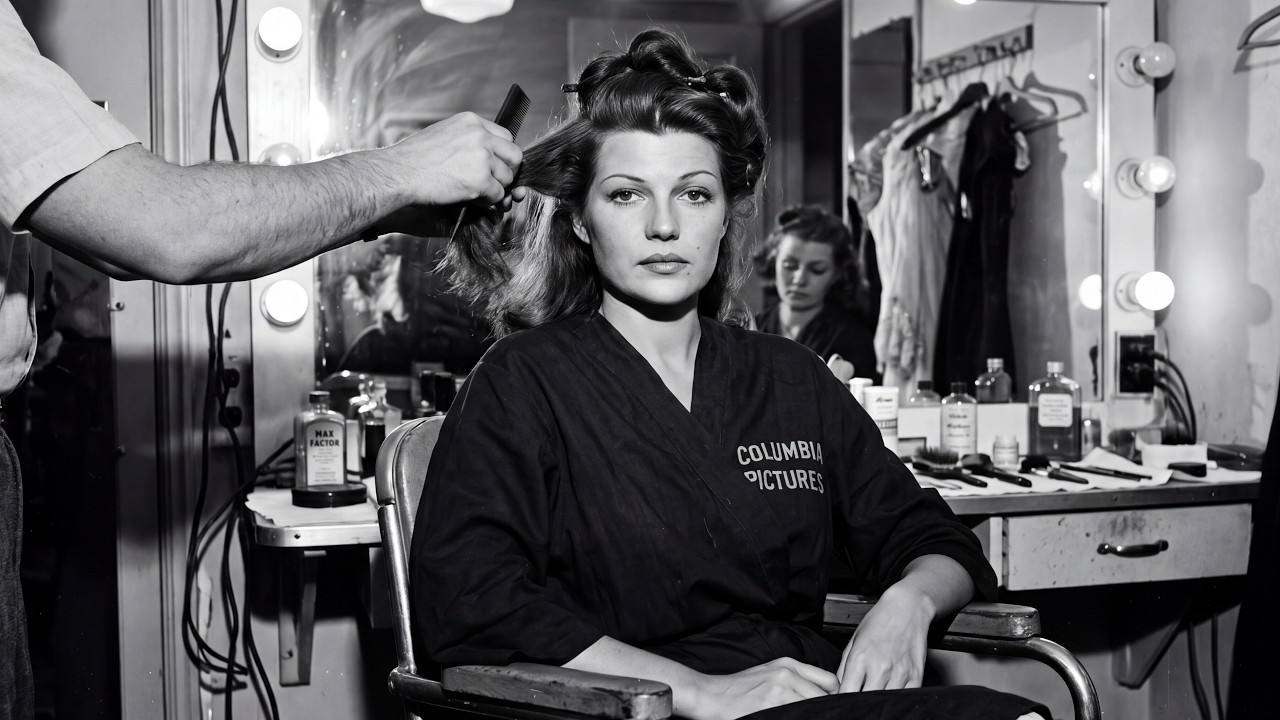
The hairline read as Latin, and the men appraising her considered it the problem. That same year, Columbia Pictures signed her to a seven-year contract at about 250 dollars a week. Columbia was the runt of the major studios, run by Harry Cohn, the most brutal executive in Hollywood. Cohn rendered the same verdict the industry had been making since she was sixteen, but he said it out loud.
Her look was too Mediterranean, and the name Cansino sounded too Spanish. The studio finished what the needle had begun. Her dark brown hair was dyed, first toward auburn and eventually to the flaming red that would become one of the most famous heads of hair in the history of photography. Her eyebrows were reshaped, makeup and lighting were calibrated to make her skin fair on film, and the name was taken last.
They adopted her mother’s maiden name, Hayworth, Irish and English, adding a Y so the public would pronounce it properly. Rita Cansino went into the machine. Rita Hayworth came out. It worked completely.
In 1939, Howard Hawks put her in Only Angels Have Wings beside Cary Grant and Jean Arthur, and audiences leaned forward. In August 1941, Life magazine published a photograph of her kneeling on a bed in a black negligee, taken almost casually during the publicity push for a picture with Fred Astaire. That single image became one of the two defining pin-up photographs of the Second World War. By the end of the conflict, more than five million copies had been printed and sold, carried into footlockers, cockpits, barracks, and warships across the world.
The hairline in the photograph had been burned into place over three years of needle sessions. The red hair was dye over a Spanish girl’s dark brown. The name printed in the caption had existed for about four years. The most desired woman of the 1940s was, in the most literal sense, a manufactured woman, and not one of the millions of men who carried her into war knew it.
The years around that photograph were the detonation of her career. Warner Brothers borrowed her to play the flirt in The Strawberry Blonde, and 20th Century Fox, the same studio that had dropped Rita Cansino without a phone call, paid Columbia handsomely to rent Rita Hayworth for Blood and Sand, casting her as a Spanish aristocrat. By late 1941 she was dancing with Fred Astaire in You’ll Never Get Rich, a pairing so successful that Astaire would later call her his favorite dancing partner. The picture put her on the cover of Time.
After Pearl Harbor, Hollywood and Washington fused into a single morale industry, and the pin-up was its ammunition. She toured for war bonds, danced with soldiers at the Hollywood Canteen, and received fan mail by the thousands of letters a week, which the studio answered on her behalf, in her voice, with her stamped signature. Men proposed marriage to a woman who would never read the letters. In 1942 she finally moved to leave Edward Judson.
In her divorce complaint she alleged cruelty and stated that she had promised him twelve thousand dollars under threats that he would do her great bodily harm. She was twenty-three years old. The image floated on, untouched, smiling from five million walls. The image and the woman could now lead entirely separate lives.
The image was bulletproof and on duty around the clock. The woman was alone, newly free of one owner, and reporting daily to another. Harry Cohn had her dressing room bugged, according to her own belief and the account of biographer Barbara Leaming. He demanded that she sleep with him, and she refused.
What followed was a campaign of surveillance, interference, and punishment, what the Hollywood Reporter would eventually describe as sexual harassment sustained for the better part of two decades. The seven-year contract bound her exclusively to Columbia while the options belonged only to the studio. If she refused a role she was suspended, her pay stopped, and the suspended weeks were added to the end of the contract. The most famous woman in America needed written permission to change her own hair.
When Orson Welles, then her fiancé, wanted her to appear in his wartime variety show for servicemen, Cohn said no. She married Welles on September 7, 1943, in a lunch break wedding, and returned to the lot that afternoon to finish the day’s shooting. In 1946 she made Gilda, the role that swallowed the rest of her life. The scene everyone remembers arrives near the end, when Gilda, in a strapless black satin gown, sings Put the Blame on Mame and removes one long glove slowly to the music.
The voice was not hers. A singer named Anita Ellis recorded it, and Rita mimed. The film was a sensation, one of the biggest successes of the year, and it lifted Columbia decisively out of the second tier. Life crowned her the Love Goddess the following year.
The woman playing the most confident seductress on Earth was painfully shy, drank to get through parties, and believed no man had ever loved her without an invoice attached. She said it herself in the saddest sentence any star of her era ever spoke: Men fell in love with Gilda, but they wakened with me. Five months after the premiere, the image left Earth’s atmosphere. On July 1, 1946, at Bikini Atoll, the United States conducted Operation Crossroads, the first postwar atomic test.
The crew had stenciled the name Gilda on the bomb casing in black letters and taped to the steel a photograph of Rita Hayworth cut from the June issue of Esquire. According to Orson Welles, she was the angriest he ever saw her, wanting to fly to Washington and protest that her face had been bolted to an instrument of mass death. Nothing came of her anger. She did not own the photograph.
She did not own the name Gilda. She did not own the name Hayworth. In 1948, she walked off the lot. At a party on the French Riviera, she had been seated next to Prince Aly Khan, the son of the Aga Khan, a charming, wealthy man who pursued her with the full apparatus of his world.
She took her daughter Rebecca and sailed to Europe, and Columbia’s biggest star simply did not come back. In the entire history of Harry Cohn’s Columbia, nothing so valuable had ever simply stood up and left the building. On May 27, 1949, the mayor of Vallauris in the south of France married Margarita Carmen Cansino of Brooklyn to Prince Aly Khan. The American press treated it as something between a fairy tale and a felony.
On December 28, 1949, she gave birth to a daughter, Princess Yasmin. But Aly’s life was a permanent circus of racetracks, casinos, and house parties in languages she did not speak, surrounded by aristocrats who regarded the movie star as a decoration, and he did not stop seeing other women. She put it plainly to friends. She had not signed on to be one of the harem.
In 1951 she left, and in January 1953 a judge in Reno granted her a divorce on grounds of extreme cruelty. The fairy tale had lasted barely two years. She came home to the only employer she had ever had. Columbia welcomed her back in 1952 by reissuing the product in Affair in Trinidad, Gilda with the serial numbers barely filed off, with Glenn Ford again, a nightclub again, a sultry dance number again.
The public bought it. The studio fed the appetite with costume spectacles, Salome in 1953 and then Sadie Thompson, roles built backward from her body as she approached her late thirties. Into this came the fourth husband, Dick Haymes, a crooner wrecked by debts, back taxes, unpaid alimony, and a drinking problem, facing deportation proceedings. The press called him Mr.
Evil. They married in Las Vegas in September 1953, and the wedding procession was routed through the casino floor. Her money went into his debts. In 1955, in public at the Coconut Grove nightclub, Haymes struck her in the face in front of witnesses, and the blow made the papers coast to coast.
She divorced him that December. In 1954, while she was at his side in Florida, her daughters were found to have been left for an extended stretch in the care of a hired caretaker, and the scandal magazines, Confidential first among them, ran the pinup queen as a negligent mother. By 1954, drained by the Khan years without income and by Haymes’ debts, she dissolved her own production company, surrendering her profit participation in her own pictures. Twenty years at the absolute top of her profession, and she did not securely own the results of any of it.
Her last picture for Columbia was Pal Joey in 1957, with Frank Sinatra. Rita played the wealthy older woman, the former star with money and a past. The fresh love interest was Kim Novak, Columbia’s new manufactured blonde, a Chicago girl whom Cohn had renamed, reshaped, dieted, and drilled exactly as his machine had once remade a Brooklyn girl called Cansino. Rita was thirty-eight years old, and the system that measured women in model years had moved her formally to the older woman shelf.
Harry Cohn died of a heart attack in February 1958, still running Columbia, with a riding crop still by the desk. With Cohn dead and the contract done, she was at last free, and at last alone with whatever was left of Margarita Cansino. There was one more marriage, the fifth, to producer James Hill, in February 1958. That same year he produced Separate Tables, in which Rita, playing a fading beauty terrified of age, gave one of the finest dramatic performances of her life.
By Hill’s own remorseful account, he kept pushing her to make pictures when what she wanted was to stop, to paint, to live like a private person. She filed for divorce in September 1961. Five marriages, five divorces. She later said she had been attracted to mean personalities, and that the one thing every man in her life had in common was that they fell in love with Gilda and woke up with her.
On sets in the late 1950s and into the 1960s, the woman who had once absorbed entire dance routines overnight began losing lines completely, repeatedly, with fear in her eyes. Her temper, always quick after a drink, began detonating without warning. The industry reached for the explanation it kept on the shelf for difficult aging actresses. She drinks.
And she did drink, which made the explanation airtight. Nobody could see that two separate fires were burning in the same house. In 1971 she could not retain the script for the Broadway musical Applause, and the plan collapsed. On her final film, The Wrath of God in 1972, she could no longer memorize dialogue at all, and her scenes were assembled line by line with the words held up off camera.
The bottom of the public record came in January 1976 at Heathrow Airport in London, when she was taken off a transatlantic flight after an outburst on board. The photographs went around the world, captions inviting the planet to inspect the ruin of the love goddess. She was not drunk that day in the way the captions implied. She was sick, suffering from a degenerative brain disease.
The world looked at a medical emergency and saw a bender, because the bender fit the story it already owned. It took a daughter to do the looking. Yasmine Aga Khan assumed, like everyone, that it was alcohol, and for years the doctors agreed. The answer finally came in 1980 at Columbia Presbyterian Medical Center in New York, where the psychiatrist Dr.
Ronald Fieve and his colleagues found the disease. Alzheimer’s, early onset, by then far advanced, probably working in her silently for years and decades, through the lost lines of the 1950s, the rages of the 1960s, the cue cards, the airport. In 1981 the diagnosis was made public, and that disclosure changed medical history because almost nobody in America had heard the word. Now it had a face, and the face was the most famous pinup of the Second World War.
In June 1981, a court in Los Angeles appointed Princess Yasmine Aga Khan her conservator. Yasmin moved her mother into an apartment beside her own and organized the rest of her life around her care. Even very late, music could still reach her for a moment, the last open channel in a dancer’s brain. She died on May 14, 1987, at sixty-eight years old.
She was buried at Holy Cross Cemetery in Culver City, a few miles from the lot where she had punched the time clock. The grave says Rita Hayworth. It does not say Margarita Carmen Cansino. In 1985, while her mother could still occasionally smile at music, Yasmine founded an annual benefit in New York called the Rita Hayworth Gala in support of the Alzheimer’s Association.
It has run for four decades and raised tens of millions of dollars for research. Doctors credit her case with transforming public awareness and helping unlock federal research money. Ronald Reagan, the studio era contract player who as president had mourned her, announced in 1994 that he too had Alzheimer’s disease, in an open letter that doctors credit, alongside her case, with finishing the work of dragging the illness out of the shadows. Gilda sits in the National Film Registry, preserved as a permanent piece of American culture.
In 1982, Stephen King titled a prison novella Rita Hayworth and Shawshank Redemption, and in the film her Gilda poster hangs on a cell wall hiding the tunnel a man digs to freedom. The culture took the most manufactured image of the studio age and made it literally the cover for an escape. Film historians now teach the Cansino to Hayworth conversion as the most extreme documented case of ethnic erasure in Hollywood history, the place where the industry’s racial gatekeeping stopped being metaphor and became a needle, a dye bottle, and a legal name change. The system that made her did not operate in secret.
It operated in plain sight, and its customers were everyone who bought the five million photographs and the Heathrow front pages, who loved her at twenty-three on a bedspread in Life and mocked her at fifty-seven lost in an airport dying of a disease no one had bothered to name. She told the truth in her own words, and it was written down and ignored. Men fell in love with Gilda, but they wakened with me. There never was a woman like Gilda.
There never was. There was only Margarita Cansino of Brooklyn, who danced because her father required it, who sat under the needle because her husband and her studio required it, who smiled because the contract required it, and who waited sixty-eight years for someone to require nothing and simply see her. Her daughter managed it at the end.