In the summer of 1924, a federal revenue agent named Amos Codray stepped off a train in Houma, Louisiana, carrying a file that four other men had already failed to close. He was forty-one years old, a former carpenter with the calloused hands of a working man, and for six years he had served in the New Orleans office as the man they sent when local law hesitated. His assignment was the disappearance of a bootlegger named Cornelius Bellefontaine, a thirty-six-year-old runner who had moved cane spirits north to Baton Rouge for years without losing a single shipment. In March of that year, Bellefontaine had taken his boat into Gallows Marsh at dusk, carrying two barrels of high-proof liquor.
Two mornings later, his brother found the boat floating empty on the outer edge of the swamp, the barrels still sealed and untouched. A man who knew him said Bellefontaine would have drowned before abandoning his cargo. The file Amos carried listed other names. Four men had entered Gallows Marsh in the past seven years and never come out.
A hunter named Absalom Ferlin in 1917. A land surveyor named Tibo Gilory in 1919. A Baptist preacher who went in twice and returned, then went in a third time in 1922 and did not return. And a mussel fisherman named Enoch Brideau, who entered the previous autumn on a bet and was found floating at the edge of Bayou Petit Caillou six weeks later, four miles upstream from where he was last seen.
The coroner noted in the margin of that report, in different handwriting, three words: do not release to family. The family never received the body. Amos reached the small settlement of Petit Bois on June 18, 1924. It was a scatter of twenty-two households at the end of a raised road that simply stopped at the edge of the swamp.
There was a general store, a small church, and the home of an old swamp guide named Winslow Tremain. Three separate people in New Orleans had given Amos the same advice: Tremain would take him in, but no one would take him the last mile. Tremain was sixty-four, short and heavily built, with a face so deeply lined it looked cut. Both of his hands were missing the tip of the little finger.
He agreed to take Amos into the marsh for ten dollars a day, but he made one thing clear. He would take him to the Mercer landing and not one foot beyond. When Amos asked why, Tremain looked at him for a long time and said that the place was not what it seemed, and the family that lived there was not what it seemed. He had known men who went in smiling and came out weeping, and he had known more who went in smiling and never came out at all.
They set out at first light on June 20 in a fourteen-foot cypress pirogue. Within an hour, the cypress trees closed overhead so completely that sunlight slipped through only in green fragments. The water, which had been moving near the settlement, slowed and then stopped entirely, so still it looked like a mirror. Amos could see the entire cathedral of moss and branches reflected below him, sharper than it was above.
They seemed to be rowing through the middle of two forests, one hanging and one drowned. After about two hours, they passed a cypress tree marked with three deep parallel cuts at the height of a tall man’s shoulder, old enough that the bark had grown over them in thick lips. Tremain said the marks had been made when his father was a boy, marking the far edge of where a Christian man was supposed to go and still come back. Farther on, they passed the ribs of an old dock sinking into black mud.
Tremain said it belonged to the Guidry family in the 1860s, a family that moved out during a single winter, and no one had ever lived on that land again. The road to it had disappeared. The house had disappeared. Only the wet ribs of the dock remained.
The deeper they went, the fewer birds they saw. Then the birds stopped appearing altogether. They were not frightened away. They simply did not enter that far.
Twice in the first hour after the old dock, Tremain stopped rowing and let the boat drift, listening. When Amos asked what he was listening for, Tremain said only: the birds. They stopped on a bank of black mud to eat. Tremain spoke more than he had since they met.
He told Amos that the Mercer family had been on that land longer than the parish had existed, longer than Louisiana had been Louisiana. His grandfather, born in the 1820s, had said that when he was a young man, the Mercers were already old on that land and looked exactly as they looked now. A photograph taken in 1872 by a Yankee with a wet-plate camera showed Osias Mercer standing on his porch in a black wool suit. Tremain’s uncle Alcide had seen that photograph on a wall in Baton Rouge and recognized the man in it.
It was the same face he had seen thirty years later, down to the trimmed beard. Tremain gave Amos instructions. The family would receive him politely. The old man would say his name was Osias and invite him inside.
The woman would not speak but would look at him for a long time. There was a brother named Barnabas who did most of the talking, and a son named Delmar who did not speak at all. An old woman called Lorenza would sit in a chair by the window and smile, and Tremain told him not to smile back. When Amos asked why, Tremain said he did not know what it meant, only that his uncle had told him before he died that she counted smiles.
They would offer him food, Tremain said, and they always offered food. He did not have to eat what they set before him, but he had to touch the bread. It was an old custom in that country. If he touched the bread, they could not claim him after sunset.
If he did not touch it, they could. Tremain told him that Bellefontaine had been to the house twice before his final trip, and each time he came out again and spoke of the family with strange care, as if he owed them something. The third time he did not come out. And then Tremain said the last thing he would say for the rest of the journey.
If Amos heard drums in the night, and he would hear drums, he was not to go out and look. He was not to open the door. He was not to open the window. Whatever came to the door in the night, it was not the people who had invited him in.
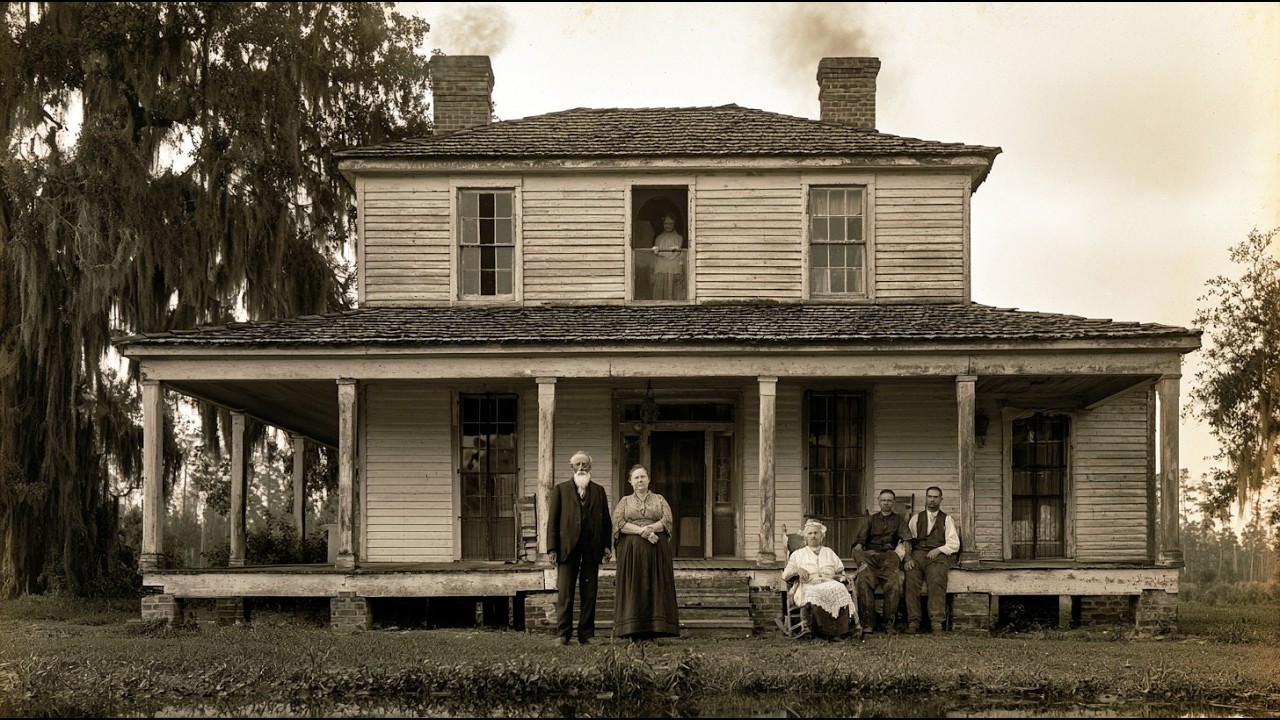
They rowed for two more hours. The channel narrowed until cypress branches scraped the sides of the boat, then suddenly opened into a wide, still pond. On the far side, on high ground, stood a dock and behind it the Mercer house. It was two stories, painted white long ago and gray for a long time since.
It had a wide covered porch, a brick chimney at each end, and both chimneys were smoking even though it was the middle of summer. From the boat, Amos could see that some of the cypress roof shingles had been replaced recently, and the new ones were the same faded gray as the old ones. That was the first thing that struck him as wrong. The house was old, but nothing in it showed decay.
Everything was intact. There was no loose window, no rotting fence, and the dirt path from the dock to the porch was smooth and packed, as if someone had walked it a thousand times that year. The light on the house was different from the light on the water. It was dim, like a lamp that had burned too long and was running out of oil.
Tremain tied the boat at the dock but did not get out. He told Amos he would be there at first light the next morning, and if Amos was not there, he would wait one hour and then leave. He took a small object from his coat and handed it over. It was a plain iron nail, cold-wrought, about four inches long.
He told Amos to keep it in his left pocket, to show it to no one, and to say it was tobacco if asked. Then he untied the boat, pushed off, and disappeared into the green tunnel of the swamp. Amos walked up the path. The air was colder than it should have been, a full ten degrees colder between the dock and the porch, and the smell changed from wet plants and mud to something dry and cold, like a stone church that had been shut for a long time.
There was not a single stone within twenty miles. He climbed the steps. The porch boards made no sound. He had never stepped on a porch that did not creak.
The front door opened before he could knock. A man stood there, about seventy, tall and thin, wearing a black wool suit far too heavy for the weather, and he was not sweating at all. His hair was thick and white, combed back, his beard trimmed, his skin so pale and smooth it was almost without wrinkles. He smiled a small, closed smile and said, in a voice touched by old French: welcome, Mr.
Codray. We have been expecting you. Amos had told no one where he was going. He put his hand in his coat pocket and held it there for a moment.
Then he said thank you, Mr. Mercer. The man said his name was Osias, and invited him inside. The main room was long, low-ceilinged, and dark.
A fire burned in the hearth at the far end, though the room was several degrees colder than the porch. A long dining table was set for six. On the left wall hung an old clock, stopped, its pendulum motionless, and beside it a small round window that let in a shaft of green light. In a rocking chair by that window sat an old woman, motionless.
She was not rocking. She held something like lace in her lap, but her hands were not moving. She looked up when Amos entered and smiled exactly as Tremain had said she would. Amos remembered the warning.
He did not smile back. He nodded once and looked away. The old woman, whose name was Lorenza, stared at him for the entire time he was in that room, and she did not blink. Osias introduced the others.
Vasti, the woman of the house, was a large woman in a long black dress who stood by the kitchen door with her hands clasped in front of her. She did not smile. She did not speak. She tilted her head slightly and looked at Amos as if she could see through him rather than at him.
Barnabas, Osias’s brother, was younger and heavier, wearing a brown suit and red vest. He shook Amos’s hand warmly and asked about the journey, and his grip was cold but strong, and the skin of his palm was so smooth it felt like the inside of a glove. Delmar, the son, was broad-shouldered, in work clothes, his hair cut brutally short. He never looked at Amos.
He looked at the floor. When his name was mentioned, he nodded once and that was all. Osias invited Amos to the table. Vasti brought a covered iron pot and set it in the middle.
There was a loaf of dark bread already sliced, a small pitcher of milk, and a jar of something dark that looked like preserves. The pot, when uncovered, held a thick brown soup that smelled of onion and pepper and something Amos could not name. He remembered Tremain’s rule. He reached out, laid his hand flat on the bread for one second, and drew it back.
Barnabas saw it. His smile widened slightly, and his eyes moved toward Osias, whose face did not change. They ate. Amos took soup because it would have been rude not to, and it tasted better than good.
It was one of the best things he had eaten in a long time, and that fact alone rang like a warning bell at the back of his head. Nothing that far from a spice merchant should taste that good. Delmar did not eat. He sat staring at his empty plate and did not move.
Lorenza watched from her corner and did not blink. Barnabas made pleasant conversation. He asked about the weather in New Orleans, about Amos’s wife, about the road from Petit Bois. He did not ask why Amos was there.
He asked if Amos’s mother was still alive, and when Amos said she was not, Barnabas nodded and said: of course. He asked if Amos attended a certain church, and when Amos named it, Barnabas smiled and said: ah, the one by the river, as if he had been there. He asked if Amos had brothers or sisters, and when Amos said one brother, dead of the influenza in 1918, Barnabas said only that it had been a bad year for many families. When Amos raised the subject he had come for, after the second bowl, Barnabas’s face did not change at all.
Amos said he was there about a man named Cornelius Bellefontaine. Osias set down his spoon and said they knew the name. Amos asked what had happened. Osias said he had come, eaten dinner with them, and left in the morning.
When Amos asked which direction he took, Osias said he returned the way he came. A long silence followed. Amos could hear the fire crackling, and outside, from far off, the sound of a single frog. Amos asked if Bellefontaine had come alone.
Barnabas answered cheerfully. Oh yes, he said, he always came alone when he visited. Amos noted the past tense. He asked how many times he had been there.
Barnabas thought for a moment and said three times, he believed, and the last time, in March, he stayed one night, ate his dinner, slept in the small room at the top of the stairs, and was gone with first light. Amos asked if anyone heard him leave. Osias said no, and when Amos pressed, asked if that did not seem strange. Osias said no, not in this house.
Nothing was heard in this house except what was meant to be heard. Amos asked if he could see the small room at the top of the stairs. Osias smiled his small, closed smile and said that was the room Amos would stay in that night. After dinner, Barnabas escorted Amos upstairs.
The stairs were steep with shallow old treads, and the wood made no sound under either of them. The upper hall was short, with only three doors. Barnabas opened the last one and stood aside. The room was small.
A single bed covered with a plain gray blanket, a washstand with a pitcher and basin, one window facing the back of the house where the swamp resumed, black in the last light, a rag rug, and a candlestick with a fresh candle on the washstand. On the small table beside the bed lay an open Bible, turned face down, as if someone had been reading it and set it aside. It was open to the Book of Ezekiel, chapter 37, the valley of dry bones. Amos set it back exactly as he found it.
Because he was a cautious man, he searched the room. Under the bed was a small trunk, unlocked. Inside was a man’s summer suit of cream linen, neatly folded. A straw hat with a black band.
A pair of good leather shoes. In the inside chest pocket of the folded jacket was a small leather wallet. It held seventeen dollars in cash, a Louisiana driver’s license, and a small photograph of a man and woman on their wedding day. The name on the license was Cornelius Bellefontaine.
Amos sat with the wallet in his hands for a long moment. He turned the license over. On the back were two words written in pencil, in a hand he did not recognize: he stayed. He put the license back, closed the wallet, returned it to the jacket, folded the jacket as it had been folded, closed the trunk, and slid it back under the bed.
He blew out the candle, lay down on the bed fully dressed, his back against the wall, and waited. The drums began about an hour after full dark. They started very softly, soft enough that Amos first thought he was imagining them. He held himself perfectly still to be sure.
They were real. Low and slow. Four beats, a pause, four beats, a pause. Not fast.
No frenzy. Just a steady rhythm, coming from behind the house, from inside the swamp. He went to the window but did not open it. He did not stand directly in front of it.
There was a moon, in its second quarter, enough light to see the black wall of cypress on the far side of the pond. He saw nothing on the water. He saw nothing between the trees. But the drums were there, and now he could hear voices too, singing faintly in a language he did not know.
It was not English. It was not French. For one strange moment it sounded like the sound the swamp itself might make if it tried to speak. And through the floorboards of the house, he heard singing.
Someone in the house was singing softly along with them. He lowered himself to the floor and put his ear to the boards. It was Vasti. He was almost certain it was Vasti.
Her voice was low and heavy, and it kept time with the singing outside as if she had practiced it for a hundred years. He listened for a long time. He did not understand a single word, but twice he heard his own name woven into the song. Then, after an interval he could not measure, someone knocked on the door of his room.
Three soft taps. He did not answer. He did not move. The knock came again, three taps, and then a voice from the other side said, very softly: Mr.
Codray, come and look. It is a lovely night. He did not answer. He put his hand into his left pocket and closed it around the iron nail.
The voice was a woman’s. It was not Vasti’s voice. It was not Lorenza’s either. It was the voice of a young woman.
There was no young woman in that house. There was no young woman anywhere in that swamp. Yet the voice knew his name. He heard the doorknob turn slowly, a full turn, but the door did not open.
Whatever stood on the other side could turn the knob but could not push the door inward. The knob turned again. Then it stopped. Then the voice said one last thing, softly, like a breath: if you will not open the door, come to the window.
There is something you must see. Amos did not go to the window. He kept the nail in his hand. But he watched the strip of yellow light beneath his door from the hall.
A shadow passed over it. Slowly. The shadow of two feet standing directly before the wood. Then the shadow moved away without a sound, and the strip of light was empty again.
He did not know how long he lay there. He thought it was hours. He heard the doorknob turn twice more that night. Once, from somewhere downstairs, he heard a long, faint sound that was not human and not animal and not wind.
And once, directly at the window from outside, a slow scratching, like a nail drawn across the glass. He did not turn his head. He kept his eyes on the door. At some point the drums slowed and stopped.
The singing from the room below stopped. The scratching stopped. The house went very quiet. Amos must have slept, because the first thing he knew was that the sky beyond the window had gone gray with dawn.
There was a smell in the room he did not recognize, a damp metallic smell, like a well when you first open it in summer. The iron nail was still in his left hand. He put it back in his pocket, splashed water on his face from the basin, straightened his coat, picked up his bag, and went out into the hall. The house was silent.
He came down the stairs without a sound and reached the long room where they had eaten. The table was empty. The fire had gone out. The clock was still stopped.
Osias sat at the head of the table in the same chair, in the same suit. He looked as if he had not moved all night. He raised his head when Amos entered, smiled his small, closed smile, and said good morning, Mr. Codray.
You slept well. Amos said yes, he had. It was a lie, but a polite one. He asked for the shortest way back to the landing.
Osias said straight down the path, but Amos had not eaten. Amos said he was not hungry. Osias said: of course. He rose and walked Amos to the door.
At the door he placed his hand very lightly on Amos’s shoulder and said: please visit us again, Mr. Codray. We enjoyed having you. Amos said he would.
That was also a lie. He stepped out onto the porch. The morning was cold and gray, with a light mist on the water. He walked down the path.
He looked back only once. Halfway to the landing, Lorenza was sitting on the porch in her chair, in the same place she had sat inside the day before, smiling at him without blinking. Vasti stood at the doorway. Osias stood beside her.
Delmar stood at one corner of the porch, Barnabas at the other. All five were watching him with still faces. No one raised a hand to wave. And in the small round window above them, on the upper floor, was a sixth face.
A pale, smiling face. A face Amos had not seen at dinner, a face he could not put a name to, a face he would never be able to describe to anyone for the rest of his life. He turned away and did not look again. Winslow Tremain was at the landing in his pirogue, exactly where he had said he would be, the paddle already in the water.
He said one word when Amos climbed in: hurry. Amos sat. Tremain pushed off, and within a minute the boat was back in the green tunnel of the swamp, and the Mercer house was gone behind them. They did not speak for the first hour.
Then, when they were far enough out that the white light came through the trees again and the birds had returned, Tremain eased his stroke and said: tell me. Amos told him everything. He told him about the room, the trunk, the wallet, the two words in pencil on the back of the license, the drums, the voice at the door, the language he did not know, his name in the song, the shadow under the door, the sixth face in the round window, and the way Lorenza had not blinked once in the whole evening. When he finished, Tremain was silent for a long time.
Then he said: you touched the bread. Amos said he had. Tremain said it had saved him. He was a guest, and a guest was allowed to leave.
The others stopped being guests once they reached the trunk stage. Amos asked what he meant by the trunk stage. Tremain said the room at the top of the stairs was where they put those they kept. They put a man’s things in the trunk because he would not need them again.
And at some point, the person in the room and the person outside the door changed places. Amos asked how they changed places. Tremain looked at the water for a long time and said he did not know how. He only knew what he had seen.
In 1889, his father Alcide had gone to that house on business, surveying timber, with a paper from a company in New Orleans that was thinking of buying the land. He stayed one night, exactly as Amos had, and came back looking twenty years older. He told Tremain’s mother, once and only once, that he had heard a voice at the door in the night, and the voice was his sister’s. His aunt Elodie had gone into that swamp in 1861 and never returned.
She was supposed to be twenty-eight then, but when his father heard her voice at that door in 1889, twenty-eight years after she had entered, it sounded exactly as it had on the last day he ever heard her. She called him by a name no one else had ever called him. As if she had been there all those years, still herself, still waiting on the other side of the door. Tremain said he had not told Amos before because he wanted him to go in without the extra weight.
But that was what the house did. It took them, and later it let them come back to the door and knock. And what came to the door was no longer them. It only knew their names and their voices and the way they used to call.
Amos asked what the sixth face in the window was. Tremain looked at the water again, then said: the sixth face is the one they are working on now. It is never the same face twice. And if you see it clearly enough to remember it, you are already lost.
Do not try to remember it. Do not draw it. Do not speak it aloud. If you feel yourself beginning to picture it, think of a room in your home, a room you know well, and count the corners of that room until the image goes away.
Amos did that for the rest of the journey back. He counted the corners of his kitchen on Chartres Street over and over, and did not let his mind wander. They reached Petit Bois by mid-afternoon. Amos paid Tremain five dollars on top of the ten.
Tremain took it without argument this time. They shook hands. Amos asked if Tremain would go back into the swamp again. Tremain said no, not for money, not for anything.
Amos asked if the state should send a team with dogs and lamps to look into Bellefontaine. Tremain said the state would not find anything they could name. Amos asked what he should write in his report. Tremain thought about it and told him to write what he had seen.
Say the family denied it. Say the terrain was difficult. Say he did not recommend further action. Because no further action was what would happen anyway.
If he wrote that the government should send men into Gallows Marsh with guns and lamps, some of those men would not come back, and their families would hate him for the rest of his life. It was better to write the truth quietly and let the swamp keep what it had kept for two hundred years. Amos returned to New Orleans that night by train. He wrote the report the next morning, the way Tremain had instructed.
He wrote that he had visited the Mercer family, that they denied any knowledge of Cornelius Bellefontaine’s disappearance beyond his single visit in March, that he had personally examined the surrounding area and found nothing to justify a search warrant or a search party, and that the terrain was such that any man lost in the deep swamp would most likely never be found. He did not mention the linen suit. He did not mention the wallet. He did not mention the two words on the back of the license.
He did not mention the voice at the door. He signed the report, handed it to his superior, and the file went into a cabinet in the New Orleans office, where it sat untouched for the next thirty-one years. But that was not the end of it for Amos Codray. He went home to his wife Odalie in their small house on Chartres Street.
He kissed her. He sat with her at the kitchen table and drank a cup of coffee. He told her only that the case had come to nothing and no further action would be taken. She could see that something had happened to him in there.
She did not press him. He slept badly that first week. He kept the iron nail in his pocket, then put it in a small tin on a kitchen shelf and closed the lid. Odalie asked what was in the tin.
He said an old nail. She did not ask again. On Tuesday of the second week, he came back from the office in the evening and Odalie met him at the door. She said someone had been looking for him that day.
A young woman. She had not given her name. She had stood at the front door for a long minute, smiling, and asked when he would be coming home. She had not wanted to come in.
She had not left a message. When Odalie closed the door, the young woman was still standing in the hallway, and when she looked out a minute later, the hallway was empty. Amos said he did not know who she was. But he knew.
He knew at that moment. That night he took the iron nail out of the tin and put it back in his left pocket. He carried it with him every day for the next twenty-nine years. The young woman never came back to the house on Chartres Street.
In the years that followed, Odalie sometimes felt that someone was standing in the hallway in the early hours of the morning. She would go to the front window and look out and see no one, then go back to bed and lie awake until dawn. She never told her husband about those nights. He never told her why he kept a nail in his pocket.
That autumn, Amos requested a transfer away from any file concerning the deep swamp country. He was moved to desk work in the New Orleans office and never worked on another case south of Houma. He never went hunting again after that summer. On the two occasions his work required him to cross a swamp by boat, he had someone else pole him while he sat facing forward, not looking at the water on either side.
Odalie noticed. She noticed everything. But she never asked. When he died in 1953 of a heart attack in his kitchen at the age of seventy, Odalie, then seventy-one, found the nail in his pocket when she sent his suit to the undertaker.
She did not know what it was. She put it back in the tin on the shelf, and it stayed there until her own death five years later. The Mercer family remained in Gallows Marsh. No further inquiry ever came from New Orleans.
The parish left them alone. Amos’s report, recommending no further action, was believed by everyone who read it, and by many who did not, because Gallows Marsh was, and still is, easier to leave alone than to enter. The bootleggers who worked that country during Prohibition never ran a single shipment through the swamp. The story of Cornelius Bellefontaine spread among them as a small dark charm, and from then on no one dared enter.
Old-timers say that in the 1930s, when the rural electrification project began, a survey crew looked at Gallows Marsh, went in three miles, came back the same day, and marked the map to extend no services there. The map was signed and filed, and no reason was ever given. In 1941, a young Coast Guardsman from the New Orleans station named Marlon Fontenot went in alone on foot from the north on his day off, out of curiosity. He was gone six days.
He came back on the seventh with a thick beard, though he had been clean-shaven on the morning he left, and refused to tell anyone where he had been. He resigned from the Coast Guard within a month and moved to Baton Rouge. Twenty years later, a friend asked him about it in a bar, and Fontenot said only one thing about the Mercer house. He said they were still there, all five of them, and none of them looked a day older than in the photographs he had seen before he went in.
Then he said never to ask him about it again. The house is still there. No one in the century since could confirm whether the Mercers still occupy it. There are photographs from the 1920s taken by a Baton Rouge geologist named Alden Mouton during a survey of Louisiana wetlands, showing the porch and part of the front of the house.
They remain in a collection at the state archives in Baton Rouge, in a file no one has requested in forty years. In one of those photographs, in the small round window upstairs, if you look carefully, there is a face. A pale, smiling face. Mouton’s field notes in the same file say that when he took the picture, he saw no face in that window.
He only saw it later, when he developed the plate. Mouton lived another thirty-one years after taking it. He never returned to the deep swamp. His widow wrote in her own memoir a single line about that trip.
She wrote that he came back from Gallows Marsh a different man, and for the rest of his life he refused to sleep with the light off or the bedroom door fully closed. That is the story of the Mercer family in Gallows Marsh. The bayou families, and even the bootleggers, refused to cross. Amos Codray never returned.
Winslow Tremain died in 1938 of natural causes in his bed in Petit Bois and never went back there. As for Cornelius Bellefontaine, or whatever he became after March 1924, no trace of him was ever found.