A mule with one leg hauled a cart through the red mud of Georgia, and inside that cart lay the reason the Confederacy lost the war. It was not a general, not a cannon, not salt pork or cornmeal or horseshoes. James Longstreet mocked William Sherman’s plan as reckless, the fantasy of a gambler who would starve within a month. He was wrong, and he paid for that error as Georgia’s farms burned to their chimneys, as railroads were twisted into scrap that soldiers called Sherman’s neckties, and as a state was so thoroughly exhausted that the war’s outcome no longer stood in doubt.
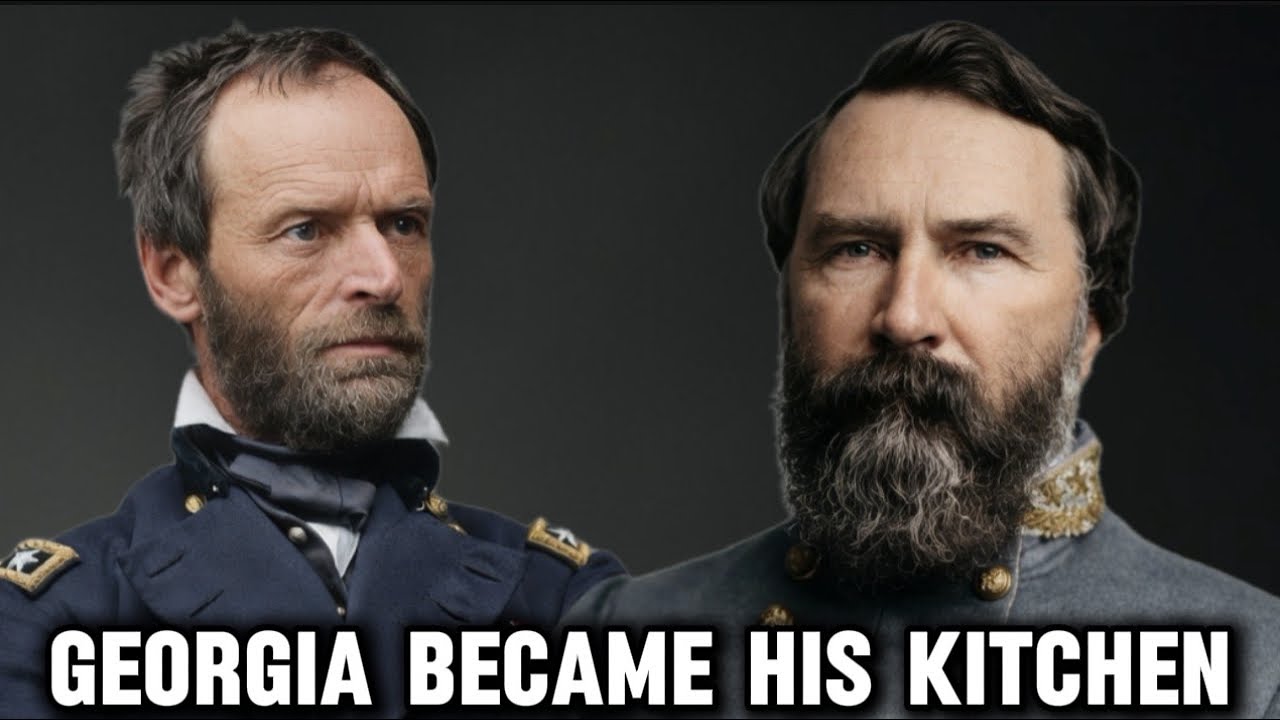
This is the story of how a Confederate general’s laughter turned to silence, and how the Union’s ability to feed its own army became the deadliest weapon of the entire conflict. Longstreet knew armies. He had watched them starve before. Every man who wore the gray understood the iron law that had governed warfare for centuries: no force could hold out for long beyond its rail lines and its rivers.
Cut the supply line, and the army died, not by bullets but by hunger and the weakness that halts a march. So when word arrived that Sherman intended to abandon Atlanta, cut his own telegraph wires, burn the rail line leading to Tennessee, and march sixty thousand men through the heart of Georgia with no supply line at all, the reaction among Southern officers was not fear but disbelief. In Longstreet’s case, it was closer to contempt. He had reason for that feeling.
His entire career had been built on respect for the arithmetic of war, the precise calculation of supplies and provisions that decided battles before the first shot was fired. He had seen Lee’s army bleed from hunger. He had watched Confederate battalions strip the fields bare and still go hungry. The idea that any general, even a Union general backed by all the industrial power of the North, could simply abandon his supply base and expect to survive seemed to him a fatal error that would annihilate the army.
He said as much to those around him. He believed Sherman was handing the Confederacy a gift: an army that would collapse under its own weight somewhere in the pine woods of Georgia, hungry, scattered, ready for destruction. What Longstreet did not know, and what almost no one in gray understood in the autumn of 1864, was that Sherman had already solved the puzzle that had confounded armies since Alexander marched into Persia. He would not carry his supplies with him.
He would take them from the land he intended to invade, and he had built a machine of men and wagons precise enough to do it without starving. The march began on November 15, the day Atlanta burned behind them, columns of smoke rising into a sky that Georgia would remember for a generation. Sixty-two thousand men moved out in four columns, spread across a front that sometimes stretched sixty miles wide. Behind that vast human tide came something almost no one noticed: twenty-five hundred wagons, six hundred ambulances, and herds of cattle driven alongside the marching soldiers like a slow-moving supply of meat.
This was not an army abandoning its supply line. It was an army turning the entire state of Georgia into its supply line. The wagons were not there to carry food from Atlanta. They were there to carry what the soldiers had not yet stolen.
Each morning, foraging parties fanned out from the main columns, sometimes a hundred men at a time, moving ahead of the army toward its flanks with a single order: live off the land and leave it barren behind you. The soldiers called them bummers, and the word would outlive the war itself, becoming in Southern memory a shorthand for a kind of organized plunder that seemed as precise as surgery. They took corn from the cribs. They took hogs from their pens and chickens from their coops.
They took salt pork from the smokehouses where families had spent a year curing it. They emptied root cellars of sweet potatoes, drained the molasses barrels, and loaded it all onto wagons that advanced each day exactly as far as the infantry had marched, never one mile beyond. These were the details that shook Longstreet’s confidence in himself, even if he did not fully realize it until weeks later, when reports began reaching Confederate command. Sherman was not gambling.
He was executing a plan with the discipline of a quartermaster and the ruthlessness of a man who understood that the war was no longer being decided only on battlefields. Estimates compiled after the march put the losses at over one hundred million dollars, a figure almost impossible to believe in that era. Sherman himself later assigned only twenty million of that to any military purpose. The rest, in his cold calculation, was waste and destruction, a message carved into Georgia’s earth with ash.
Numbers alone cannot convey what actually happened, because a campaign like this is not a statistic. It is ten thousand individual mornings when a farmer’s wife walked to the corn crib and found it empty. It is when a widow with three children watched Union soldiers drive off the family’s last milk cow. It is when an old farmer stood on his porch and watched black smoke rise from his barn.
Sherman’s men were under strict orders not to enter occupied homes or directly threaten families, and by the standards of that era, they largely obeyed. But restraint toward people was not restraint toward property, and property was the engine of the Confederate war effort. Every bushel of corn Sherman’s men loaded onto a wagon was a bushel that would never reach Lee’s starving army in Virginia. Every rail line his men wrapped around tree trunks, forming shapes the soldiers named after the general himself, was a line that could no longer move troops or ammunition or hope.
And here Longstreet’s earlier laughter turned to something like horror, because the general who had dismissed Sherman’s march as a fantasy doomed to collapse from hunger was at that very moment watching his own army’s supply system fail for entirely different reasons. The Confederacy did not lack farmland. It lacked the ability to move what it produced. Railroads built on different gauges could not connect to each other.
Currency was collapsing so fast that farmers preferred hoarding crops to selling them for worthless paper. A government in Richmond could print supply orders faster than it could deliver a single wagonload of bacon to the men in the trenches. While Sherman’s army marched through Georgia, eating well, gathering supplies with organized efficiency, growing stronger with every barn it seized, the army Longstreet had served his whole life was slowly starving in place. Not because the South lacked food, but because it no longer had any way to transport it.
By the time Sherman’s forces reached Savannah in late December, it was nearly impossible for Confederate command to ignore the contradiction. Sherman presented Savannah to Lincoln as a Christmas gift, a coastal city whose warehouses still held twenty-five thousand bales of cotton. Savannah fell without the massive bloodshed everyone had expected from a march through enemy territory. The army Longstreet believed would collapse from its own recklessness had instead completed a campaign of 250 miles through the heart of enemy land, arriving stronger and better fed than when it started, leaving behind a swath of destruction sixty miles wide that made continued Confederate resistance in the Deep South almost arithmetically impossible.
What makes this reversal striking is not simply that Longstreet misjudged Sherman. Soldiers misjudge each other constantly, and hindsight reveals the folly of even the brightest generals. What makes it striking is what Longstreet misjudged about him. He thought the war would be decided by courage and tactics, by the traditional rules of combat and cavalry charges that had marked the first three years of the conflict.
But Sherman understood something deeper and harsher. He understood that the civilian population’s ability to feed, clothe, and supply their soldiers was itself the target, and that breaking a state’s ability to produce and transport food might do more to end the rebellion than any battlefield victory. This was not the war Longstreet had trained for. It was the next war, the total war of the coming century arriving early and sweeping across Georgia’s farmland in five brutal weeks.
The psychological losses mattered as much as the physical ones. Soldiers in Lee’s army, men from Georgia and the neighboring states, began receiving letters from home describing burned barns and stolen livestock, and desertion rates climbed as those letters spread through the camps. A man could stand under artillery fire more easily than he could stand knowing his family had nothing left to eat that winter. Sherman had not only crippled Confederate supply.
He had shaken the moral foundation that kept its soldiers in the field. That crack spread through the ranks faster than any single battlefield defeat could have achieved. Longstreet continued fighting through the final months of the war, already wounded from the Battle of the Wilderness, and watched the Confederacy he had served with skill and firm faith disintegrate, not in one dramatic collapse but in hundreds of small failures of supply, transport, and will. When Lee’s army finally surrendered at Appomattox in April 1865, the men who laid down their arms had not been beaten primarily by Union numerical superiority on any single battlefield.
They had been beaten by an army that learned to starve its enemy’s homeland into submission while feeding itself at the same time. A lesson written first and harshly across Georgia’s burned earth. To understand how badly Longstreet and his peers misjudged the situation, consider what the Confederacy still believed possible in the autumn of 1864. Atlanta had fallen, yes, but Richmond still stood.
Lee still held his lines around Petersburg. Confederate officers still held firm faith that the war would be decided the way wars had been decided in their lifetimes, by a decisive battle somewhere that would break the North’s will and force a negotiated peace. Sherman’s march offered no such battle. There was no climactic clash of armies in Georgia, no field where thousands fell in a single afternoon and victory was declared by nightfall.
That absence of battle was what confused Confederate command, and it was what made the march so devastating. They kept waiting for Sherman to make the mistake that would let them destroy him. Instead he kept marching, kept foraging, kept burning, and never gave them the battle they were ready to win. Confederate cavalry under Joseph Wheeler shadowed the march the whole way, harassing the foraging parties and picking off stragglers wherever they could.
But Wheeler led perhaps eight thousand horsemen against tens of thousands of Sherman’s infantry, and harassment was never enough. Georgia’s home guard, made up mostly of old men and boys too young for the regular army, offered what resistance they could at places like Griswoldville, where a poorly armed militia charged entrenched Union veterans and was cut down within minutes. It was not so much a battle as a warning to the rest of the state that resistance would be short and costly. After Griswoldville, organized opposition to the march largely dissolved into scattered, desperate skirmishes that could slow Sherman’s advance for hours but not for days.
What Longstreet came to realize in the months after the march to the sea was that Sherman had rewritten the terms of the war while everyone else was still arguing over the old ones. The Confederacy’s entire strategic hope rested on the assumption that the North would tire of the war’s cost and vote against Lincoln in favor of a peace candidate. Sherman’s capture of Atlanta in September had dealt that hope a heavy blow, coming just weeks before the 1864 election and restoring Northern morale at the moment it began to falter. The march to the sea in November and December completed what Atlanta had begun, giving Lincoln’s supporters a second, conclusive demonstration of Union victory, measured not in promises but in captured cities and severed rail lines.
The soldiers themselves left their own accounts of what the march felt like, and they rarely matched the picture of desperate pursuit Confederate officers had expected. Union diaries from the campaign describe men eating better than they had in months, turkey and pork and fresh vegetables replacing the salt pork and hardtack that had fed them through the Atlanta campaign. There was an unmistakable, almost unsettling cheerfulness. Soldiers singing as they marched, officers noting with surprise how little resistance they met compared to what they had expected.
This was not the exhausted, hungry column Longstreet had imagined when he dismissed the plan as reckless. It was, by the accounts of the men who lived through it, one of the easiest phases of the war for the Union soldiers who took part. And one of the harshest for the Georgia families whose stores were plundered. That gap between the two experiences, an army growing fat on spoils while the civilian population starved through the winter that followed, became the decisive truth of how the march was remembered on both sides of the old Confederacy for generations.
Southern memory fixed on the image of burned barns and empty smokehouses, and on Sherman as a figure of almost mythic cruelty, a general who waged war on women and children rather than soldiers. That memory was not baseless, even if it simplified a campaign built on the deliberate destruction of military resources more than random terror. But it captured a real truth about how thoroughly the march broke the assumption that civilians could remain untouched by a war fought between armies. Sherman himself never denied the intention behind it.
He wrote after the campaign that he meant to make Georgia howl, and by every available measure, Georgia did. The irony history remembers is simple and cruel. The general who mocked Sherman’s march for failing from lack of supplies lived to see his own army collapse for that very reason. The man he mocked led an army of sixty thousand through the Confederate heartland and emerged on the other side stronger, heavier, and closer to victory than when he started.
Longstreet had judged Sherman by the rules of a war that was about to end, a war of fixed battles and defined supply lines. Sherman simply refused to play by those rules. The war had become a question not of who could win a battle, but of who could feed his army while starving the enemy’s capacity to resist. And in the winter of 1864, Georgia paid the price for teaching that lesson to the world.
A lesson so decisive that within four months of Sherman reaching Savannah, the Confederacy itself would cease to exist.