Deadwood, South Dakota, was a town that should never have existed. It sat in the Black Hills, land that belonged to the Sioux under the 1868 Treaty of Fort Laramie, which explicitly barred non-native settlement. For years, that legal protection kept prospectors away. Then, in 1874, General George Armstrong Custer led an expedition through the region and proclaimed that gold was abundant.
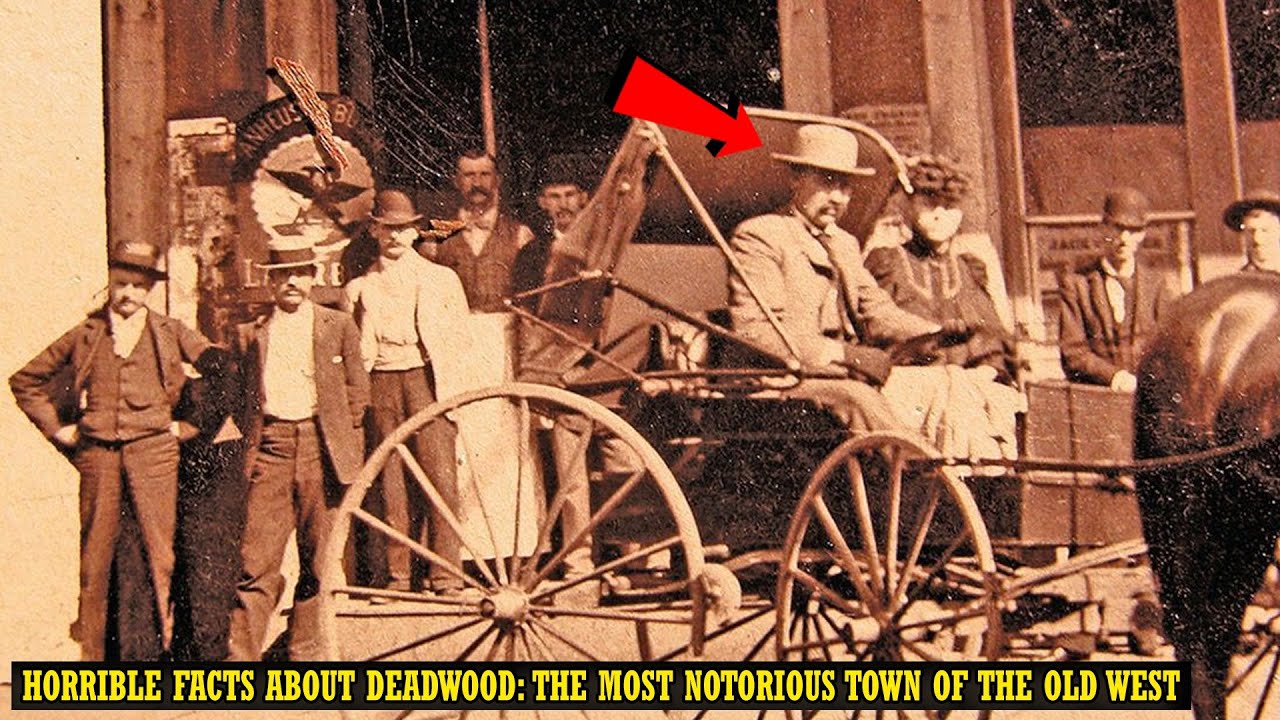
The discovery set off a rush that no treaty could contain. Prospectors, many of them called trespassers by the Sioux, flooded in anyway. The federal government, unwilling to enforce a ban on a region it itself coveted, looked the other way. Deadwood grew without legal recognition, without governance, and without oversight.
It was a settlement born of defiance, shaped by a legal and political vacuum as much as by the ambition of its first residents. By 1876, Deadwood had a population of roughly 3,000 permanent residents and nearly 200 businesses. Transient miners, always coming and going, swelled those numbers further. The town was larger and more developed than later television portrayals suggest, with brick-and-mortar structures already rising alongside the rough-hewn camps.
The first lawman to bring order to this chaos was Seth Bullock, who had originally arrived with his business partner Saul Starr to open a hardware store. Bullock had served as a county sheriff in Montana, and that experience made him the obvious choice when the community, shaken by the murder of Wild Bill Hickok, needed a man of authority. His tenure was marked by tension with Al Swearengen, the owner of the Gem Theater, but both men understood they needed a working relationship to keep the town from collapsing into outright anarchy. Bullock’s wife and daughter eventually joined him, a sign that Deadwood had become a place where a family could envision a future.
He later built a ranch near the town and became a friend of Theodore Roosevelt, who appointed him a U. S. Marshal when he became vice president. The man who gave Deadwood its most infamous legend was Wild Bill Hickok, a figure whose own storytelling blurred the line between fact and fiction.
He was fond of dark jokes about his own mortality, once responding to a man marveling at his survival in a perilous encounter by saying, “I didn’t. ” His reputation as a gunfighter was exaggerated. He had shot and killed hundreds of men in duels, or so the stories went. In reality, his career as a shooter was far shorter and more complicated.
While serving as town marshal in Abilene, Kansas, he accidentally killed his own deputy during a confrontation with a local outlaw. The incident unsettled him deeply. He set aside his badge and firearms and took up gambling, seeking a quieter life. It was in that phase of his life that he met Jack McCall in Deadwood.
Hickok soundly defeated McCall at cards, then, in an uncharacteristic gesture of kindness, offered him money to buy a meal. McCall was humiliated rather than grateful. The next day, he returned to the saloon. Hickok, who had a well-known rule of never sitting with his back to a door, found no other seat available and reluctantly took the one facing away from the entrance.
McCall walked in and shot him once. He later claimed he was avenging a brother killed by Hickok years earlier in Abilene, but no records supported that story. It was likely a convenient excuse for a rash act of violence. Hickok’s death sealed his legend.
McCall was quickly apprehended and tried in Deadwood, not in a saloon as later dramatized, but at McDaniel’s Theater. He claimed again that Hickok had killed his brother. The ad hoc jury acquitted him, citing a lack of solid evidence. McCall left town immediately, but he could not stop boasting about what he had done.
Colonel May, not the more famous Seth Bullock, tracked him to Wyoming and alerted the local authorities. In a second, more formal trial, McCall’s defense collapsed. He claimed his brother had been killed, then claimed he had been paid for the murder, then claimed he had been too drunk to remember anything, and finally claimed he was not Jack McCall at all. In March 1877, he was sentenced to death and executed.
The episode highlighted how tenuous justice was on the frontier, and it remains so compelling that actors in Deadwood have reenacted the shooting and trial every summer since the 1920s, one of the longest-running theatrical productions in American history. Al Swearengen, the man who ran the Gem Theater, was a far starker figure than any fictionalized version of him. He opened the saloon in 1876 and used it to entice vulnerable working-class women into sex work, trapping them in cycles of debt. Life there was harsh, marked by poor living conditions, limited medical care, and the stigma of the profession.
Many of the women suffered from illness, struggled with substance dependency, or met tragic ends. Swearengen was fixated on power and profit, and historical accounts show few redeeming qualities. The Gem Theater itself seemed cursed. Fire ravaged much of Deadwood in 1879 and destroyed his establishment.
He rebuilt it in the same location. Another fire struck the town in 1894 and again destroyed the Gem. He rebuilt once more. Then, in 1899, a third fire consumed the building.
The firefighters who responded found their equipment deliberately sabotaged. The Gem was reduced to ashes, and Swearengen’s efforts to resurrect his empire were thwarted. The town was also home to a thriving Chinatown. Chinese immigrants were integral to the development of the American frontier.
They worked in mining, helped build the railroads that connected isolated settlements, and were often among the first to open shops and supply vital goods. In Deadwood, the Chinese community expanded alongside the gold boom. Relations between Chinese residents and other settlers were more cooperative than adversarial. Racism was real, but the historical record suggests that Deadwood’s interactions were more nuanced than the exaggerated conflicts often depicted in fiction.
Claims of gruesome acts in the district, such as bodies being fed to pigs, are not supported by evidence. The Chinese pioneers and their neighbors contributed together to the growth and sustainability of the town. Among the notable figures who passed through Deadwood was George Hearst, the father of the newspaper magnate William Randolph Hearst. He arrived in 1877 and quickly began acquiring mining claims, notably the Homestake Mine, which became one of the richest gold deposits in American history.
Hearst’s ambitions extended beyond mining. He eventually became a United States senator and, in 1880, purchased the San Francisco Examiner, bringing his son into the family business. Under William Randolph Hearst, the paper grew rapidly in influence and circulation, and his sensationalist approach to journalism became the hallmark of a vast media empire. Deadwood’s transformation accelerated after the catastrophic fire of 1879, which started in a bakery on Sherman Street and destroyed much of the business district.
Residents rebuilt using brick rather than lumber, and the local government passed laws banning combustible materials in new construction. The shift marked the beginning of a more permanent and resilient settlement, one that was slowly evolving from a chaotic mining camp into an organized community. There remains debate about how the people of Deadwood actually spoke. The colorful profanity that defines modern portrayals of the town may not reflect 1870s linguistic reality.
The Oxford English Dictionary editor Jesse Sheidlower has suggested that many of the specific insults were not in common use at the time. David Milch, the creator of the television series Deadwood, argued that dictionaries are not reliable guides to what was actually spoken, and that many profanities in common use during the nineteenth century were simply never recorded. “I’m not publishing a dictionary,” he said.
The debate highlights just how difficult it is to reconstruct the raw, gritty texture of life in a place where social norms were pushed to their limits, a town that thrived on chaos, where fortunes were made and lives were lost just as fast.