In 1895, in the small community of Hays in Martin County, Kentucky, a boy named Nimrod was born. The remote mountain village sat at the eastern edge of the state, where the hills pressed tightly against the West Virginia border and narrow strips of fertile land followed the creeks. Nimrod was named after his Scottish grandfather, one of the first white settlers to tame those wild mountains. Like most mountain families, his people struggled to scratch a living from land that did not give easily.
They planted corn on slopes so steep locals joked a man could fall out of his own field. Hogs roamed free in the woods, fattening on chestnuts and acorns, and the family raised a garden large enough to carry them from one summer to the next. It was a life of constant labor, with very little money passing through their hands. Schooling was never considered important.
There was always work waiting on the farm, and no one saw much value in books or classroom lessons. The corn had to be planted, weeded, and harvested. Firewood had to be cut and stacked before winter. The livestock needed feeding, and countless other chores demanded every able hand.
On a steep mountain farm, even a small boy was expected to earn his keep. For that reason, Nimrod only reached the second grade before his father pulled him out of school for good. The old man told him to stop wasting his time on such foolishness and put his hands to useful work. After all, no man could plow a field with a multiplication table, and as his father liked to say, a hungry family could not eat paper pages the way they could eat corn grown on a mountainside.
From an early age, Nimrod had a natural gift for carving things by hand. Using his grandfather’s little knife, he shaped elaborate totem poles and lifelike figures from fallen branches of walnut and oak that surrounded the family home. What began as a boy’s pastime soon became something close to an obsession. He became so skilled that he set his sights on building a guitar for himself.
It was a crude instrument by any measure, made entirely from whatever materials the boy could find. He carved the neck by hand, built the body with a thin spruce top, and made the sides and back from yellow birch. For strings, he pulled them from his mother’s screen door, an act that earned him one of the worst whippings of his childhood. But he had built himself a guitar.
It may not have produced the sweetest melodies, and it certainly would not have impressed a professional musician, but to Nimrod it was worth more than any store-bought instrument. That handmade guitar became the most prized possession of his formative years. He carried it everywhere, spent much of his childhood writing poetry, and worked hard at the words until he could set them to music. Music ran in his family.
His mother had an angelic voice, so clear and sweet it echoed across the valley on quiet summer evenings. His sister played guitar and banjo. When their chores were done, the three of them would gather on the porch and fill the darkness with song. Much of what they sang had been handed down through generations: old Scottish and British songs that their ancestors had carried across the Atlantic and preserved in the mountains through memory and repetition.
These were songs about homelands left behind, lovers parted by war, wandering soldiers, cruel kings, and restless spirits roaming the wilderness. Though Nimrod had never seen England or Scotland, those old melodies stirred something deep in him. They belonged to the Appalachian hills as much as they belonged to the distant lands they came from. As the century turned, winds of change began blowing through eastern Kentucky.
Across the river in West Virginia, railroads were pushing their way through the mountains, and the coal companies came right behind them. Steel rails were laid along the creek beds, and mountainsides were blasted open, opening a region that had been isolated from the outside world for generations. Places that had once required a full day of travel on horseback suddenly became reachable by train. The sound of the locomotive whistle began echoing through valleys where silence had previously been broken only by a dog’s bark or a Sunday morning church bell.
Almost overnight, huge wooden tipples rose above the hollows. Mine entrances were carved into the hills, and company houses went up in long, orderly rows. Entire coal camps appeared in valleys that had once held only three families. With the workers came railroad men, timber cutters, merchants, doctors, preachers, and every kind of person hoping to make a living from the wealth pulled out of the earth.
For the mountain families watching from across the Tug River, it looked like a whole new world had appeared before their eyes. For generations, the people of Martin County had grown what they ate and made almost everything they owned. Money was something most of them had never seen. Most business was done through barter, trading labor and goods as needed.
But those coal fields offered something almost unheard of in the mountains: a steady wage. Before long, the men of Martin County began crossing the river, searching for the first regular paychecks their families had ever known. Some went alone at first, carrying only a few clothes and a dinner pail. Others brought their wives and children, abandoning farms that had belonged to their families for generations.
Whole families followed in the footsteps of brothers, relatives, and neighbors who had already found work in the mines. The promise was simple enough. A man willing to enter the mountain before daylight and stay there until the evening whistle could earn real money. He could buy flour instead of grinding cornmeal, even buy ready-made shoes for his children.
For people accustomed to measuring wealth by the salted meat in the smokehouse, the prospect of wages every two weeks was hard to resist. But the coal barons were not doing charity work. The work was dark, dangerous, and merciless. Cave-ins, explosions, runaway mine cars, and pockets of poisonous gas could end a man’s life without warning.
Coal dust settled in his lungs and followed him home. And those wages were not even paid in real money. The miners were forced to buy their supplies at the company store at prices set by the very men who signed their paychecks. The company owned the house a man slept in, charged him rent, and billed him for his tools and blasting powder.
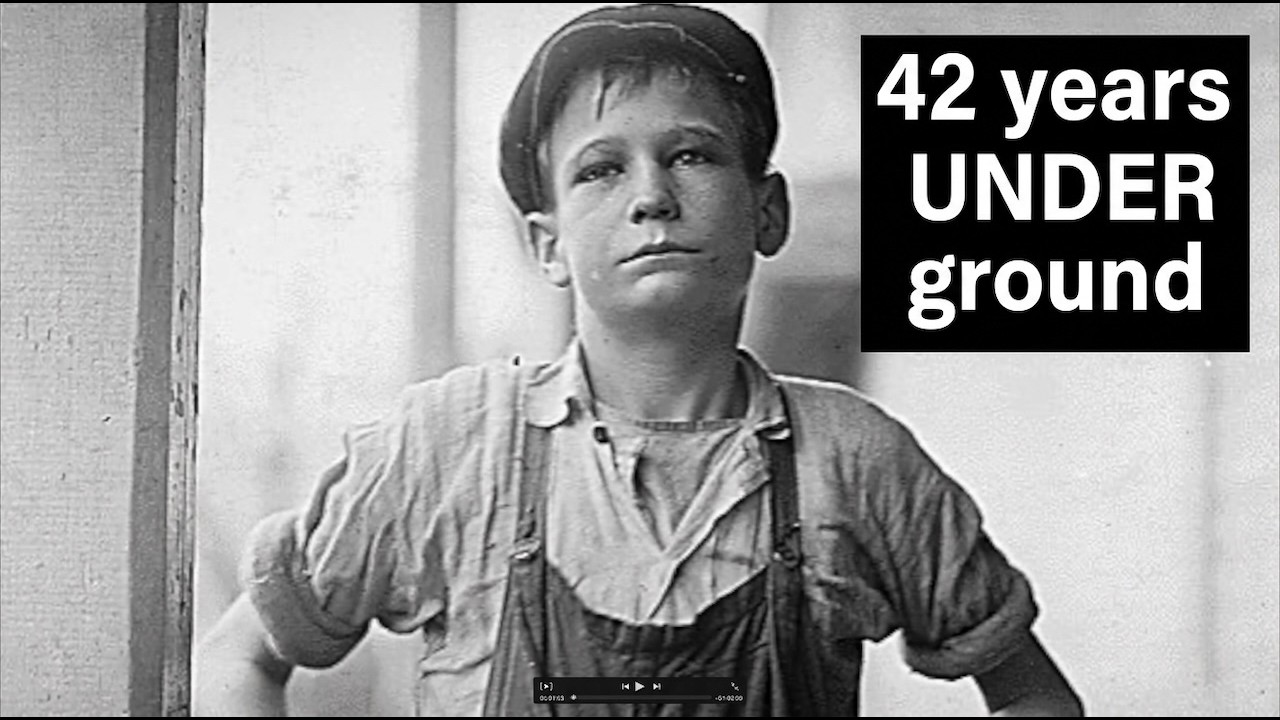
Whenever his wages ran short, he sank deeper into debt. It was a vicious cycle that many men spent their whole lives trying to escape. By 1910, Nimrod was fourteen years old. In his father’s eyes, the boy was old enough to do a man’s work, and if he was old enough to work, he was old enough to feed himself.
So Nimrod packed his few belongings, said goodbye to his mother, and crossed the Tug River into the unknown of West Virginia. He found work immediately in the coal mines as a loader. A loader had to be small enough to crawl into tight spaces and work in a seam that might be barely a foot from roof to floor. There, Nimrod spent his entire shift lying on his side in pitch darkness, his face only inches from the coal.
He worked a short-handled pick, digging under the seam with a sideways motion, striking the black wall again and again until his arms trembled from exhaustion. Then he drilled deep holes into the face and packed them with dynamite, lit the fuse, and scrambled out as fast as he could. The blast rolled through the mountain like distant thunder, shaking loose a cloud of coal dust and shattered rock. When the smoke cleared, Nimrod crawled back in and began loading the fallen coal into the mine car by hand.
Shovel after shovel, ton after ton. When one car was full, another took its place. The work never ended. His fingers grew raw, and the muscles in his back felt torn from the bone.
For this work, Nimrod earned up to fifty cents for a ten-hour shift. The company controlled him completely. They owned the house he slept in, charged him rent, and billed him for his tools and powder. Every time his wages fell short, he sank deeper into debt.
It was that same vicious cycle that trapped so many men for life. The only thing that carried Nimrod through those terrible years beneath the mountain was his love of music. While other men cursed the darkness or saved their breath for the hard work, Nimrod sang. He spent countless hours singing songs he had composed himself while striking the coal with his pick.
Each blow followed a rhythm, and the ring of steel on stone became a kind of musical accompaniment as his voice echoed through the narrow passages. Using the melodies handed down from his Scottish ancestors, he sang the old ballads to himself a thousand feet inside that mountain. Songs once sung beside hearth fires in the Scottish borderlands now echoed through the coal seams of West Virginia. By 1920, Nimrod had spent ten years in the earth of Mingo County, West Virginia, a place known as one of the most dangerous spots in the United States.
The newspapers called it Bloody Mingo, with good reason. The United Mine Workers had begun organizing the southern coal fields, and the coal barons were determined to stop them at any cost. Any miner who signed a union card was fired before sundown and thrown out of his company house, with his furniture set on the road and his family standing beside it. Nimrod’s mine soon became the scene of a full-scale battle.
Paid detectives came to evict union miners’ families from their homes. The town constable sided against them, while Nimrod and hundreds of other miners demanded more workers’ rights. The wealthy owners would not submit to these mountain people. What followed was the Battle of Blair Mountain, where thousands of workers clashed with the coal companies’ hired gunmen.
Thanks to their vast fortunes, the coal barons persuaded the government to send the United States Army to fight on their side. The two sides faced each other in the largest armed uprising in America since the Civil War. That event changed Nimrod forever. He became a strong advocate for better wages and working conditions for miners, and he wrote political protest songs that the outside world never knew existed, songs heard only by his fellow miners in the evenings after their shifts.
Nimrod worked in those mines for forty-two years in total, until he was fifty-seven years old, when his back finally gave out after a lifetime of loading coal on his knees. Even on his last day, as he descended into the darkness as he had done since he was fourteen, he could not come back up on his own. They had to carry him out, and that was the end. His body was broken, and his lungs were failing from black lung disease.
But the coal companies and their hired doctors claimed black lung disease did not exist. Instead, they called it miners’ asthma and said it was harmless. So after forty-two years underground, Nimrod was sent home with blackened lungs and a broken body, without a penny. The years passed.
In 1974, Nimrod was an eighty-year-old man who still possessed a genuine voice and a vast repertoire of songs reflecting the struggles of his life in those mountains. Someone recorded his voice and put those songs on a record, and his story became known across America. His singing was so honest, so much a living window into the past, that his voice captivated the music world. A critically acclaimed album of his songs was soon released, and for the first time in his life, Nimrod earned a decent living.
By 1980, he appeared alongside Loretta Lynn in the film Coal Miner’s Daughter. In 1982, he was a featured performer at the World’s Fair in Knoxville, Tennessee, and a few years later, the National Endowment for the Arts awarded him the title of National Heritage Fellow, the highest honor the United States bestows on a traditional artist. His music catalog was added to the Library of Congress. Nimrod died in 1994, just weeks after his ninety-ninth birthday, and was buried in Knox County, Tennessee.
Throughout his life, he never left the mountains he loved so much. Somehow, that poor boy from eastern Kentucky, sold to work in the coal mines at fourteen, emerged triumphant as one of the greatest figures in American history. He was Nimrod Workman, one of the finest ballad singers and storytellers Appalachia ever produced.