On June 27, 1876, two days after the fighting ended, the first rescue party climbed a hill in Montana Territory and found a scene the June sun had been working on for nearly forty-eight hours. The bodies had swollen in the heat. The grass had blackened with dried blood. Hundreds of empty cartridge casings lay scattered across the ground like a metal carpet.
Soldiers turned the bodies over one by one, but most were unrecognizable. Only tattoos, rings, and pieces of clothing offered any clue to identity. One officer’s pocket watch had stopped at 3:25. That officer was Captain and Brevet Major General George Armstrong Custer.
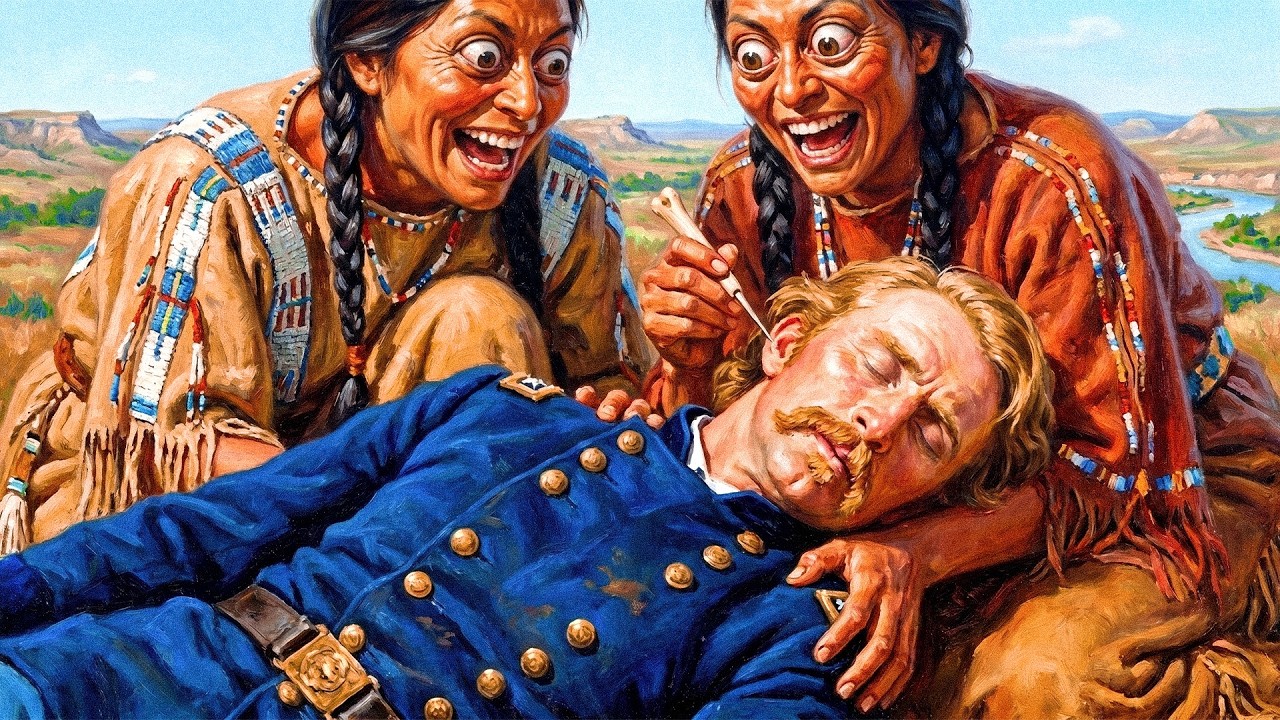
His fair hair had been cut short and the Cheyenne women who knelt over his body had pierced both of his eardrums with an awl. “Let him hear better from now on,” they said, “because he once heard a promise and did not keep it. ” His body carried only two bullet wounds, one in the chest and one at the left temple. Around him lay more than forty soldiers, their bodies far more heavily mutilated.
The difference was deliberate. It was a message, not a mark of torture. What came to be known as Custer’s Last Stand was not a stand at all. It was a collapse.
And thanks to archaeological excavations in the 1980s, forensic analysis, and the mapping of cartridge case trails, the battlefield can now be reconstructed almost minute by minute. The roots of the disaster reached back to 1874, when Custer led a thousand-man expedition into the Black Hills, land the Lakota considered sacred and which the 1868 Fort Laramie Treaty had recognized as theirs. The stated purpose was to scout a site for a military post, but civilian geologists accompanied the column. Traces of gold found near French Creek reached the eastern press through Custer’s own reports, and the phrase “gold from the grassroots” appeared in newspaper headlines.
Within months, tens of thousands of prospectors poured into treaty-protected land. When Sitting Bull and other leaders rejected the government’s offer to buy the region, the government issued an impossible ultimatum: all non-reservation bands must return to their agencies by January 1876. It was, in effect, a declaration of war. The army’s plan called for three columns to squeeze the Lakota and Cheyenne villages from different directions.
Custer’s Seventh Cavalry rode out from Fort Abraham Lincoln on May 17, 1876, as part of a larger operation under General Alfred Terry. With Custer went his brothers Tom and Boston, his nephew Autie Reed, and his brother-in-law James Calhoun. It was not just a military unit; it was a family expedition. On the night of June 24, Custer’s scouts warned him that the village ahead was enormous.
One Crow scout reported it was the largest camp he had ever seen. Custer was urged to wait for reinforcements, but he refused. He feared the village would scatter if it detected his approach. In reality, the village was neither aware of the impending attack nor preparing to flee.
On the morning of June 25, Custer split his regiment into three. Major Marcus Reno received three companies, Captain Frederick Benteen received three, and Custer kept five for himself. One company was left behind to guard the pack train. The plan was for Reno to attack the near end of the village from the south while Custer circled around from the north and struck the middle or far end.
But the plan was made without accounting for the village’s true size. The settlement stretched more than three kilometers along the Little Bighorn River in six separate circles, holding more than seven thousand people and over eighteen hundred warriors, three times the army’s estimate. At 2:30 p. m.
, Custer’s column of roughly 210 men advanced toward the river, completely cut off from the rest of the regiment. His intention was to seize the village’s defenseless women and children as hostages to force the warriors to surrender. But at the shallow ford called Medicine Tail Coulee, a Hunkpapa Lakota warrior named Gaul closed the crossing. Gaul had just learned that his two wives and three children had been killed minutes earlier in Reno’s attack, and his rage turned into tactics.
The riders were pushed back before they could enter the water. The plan collapsed almost immediately. Custer pulled back toward the hills to the east, but the retreat was not orderly. Cartridge trails show the horses driven in different directions in panic.
The five companies lost cohesion. Company C broke off toward the south. Company I remained in the middle. Company L under Captain Calhoun tried to hold the southern ridge.
Company E, known as the Grey Horse Troop, was pushed toward a ravine to the north. Company F and the headquarters detachment gathered with Custer on the hill to the north. At about 3:00 p. m.
, the first collapse began on what came to be called Calhoun Hill. Company L had established a disciplined firing line, with soldiers spaced roughly five meters apart in standard defensive formation. The cartridge casings confirm they fired in orderly volleys for the first minutes. But a group of Oglala Lakota warriors under Crazy Horse drove their horses at full gallop straight through the middle of the line, a classic tactic designed to split the enemy in two.
The line shattered within seconds. Calhoun and the twenty-eight soldiers beside him fell one by one, shot where they stood in open ground. The stand was the most disciplined of the battle, and the shortest lived. Within minutes, the Keogh sector collapsed.
Company I, positioned about two hundred meters north of Calhoun’s line, was surrounded from both sides. Bone analysis shows most of the soldiers who died there were shot from the back or the side, killed while fleeing or turning. Keogh was found dead beneath his horse, a Catholic medal on his body. Tom Custer, the general’s brother and a two-time Medal of Honor recipient, also died in this sector.
One of the darkest legends to emerge after the battle claimed that the Hunkpapa warrior Rain-in-the-Face had taken revenge for his earlier arrest on a murder charge by specifically targeting Tom Custer’s body, but Rain-in-the-Face denied the story years later, and the bone record offers no evidence that Tom’s body was singled out. It remains one of many legends born after the fight. At about 3:10 p. m.
, the end came for Company E in the deep ravine to the north. Rising banks on both sides left the cavalrymen with no room to maneuver, and Cheyenne warriors poured fire down from the edges. The entire twenty-eight-man company was wiped out in an estimated three to four minutes. It was the most intense and shortest-lived slaughter of the battle.
By 3:15 p. m. , only Custer Hill remained. The remnants of Company F, the headquarters guard, and Custer himself gathered there, roughly forty to fifty soldiers, surrounded by more than a thousand warriors.
Cartridge trails from the 1984 metal detector survey proved there was no organized circular defense. There was no single ring. The soldiers were shot in small, scattered clusters while trying to use their horses as cover. Some groups were separated by five to ten meters.
The weapons made matters worse. The soldiers carried Model 1873 Springfield carbines, single-shot breach-loading weapons that required manual ejection of each spent casing. The copper casings expanded inside the heated barrel after successive shots, and the extractor claw would tear the rim and jam the weapon. A significant portion of the casings collected by archaeologists bear exactly that tearing mark.
Soldiers often had to use a knife to clear the jammed casing in a fight where seconds were vital. By contrast, many Lakota and Cheyenne warriors carried Winchester and Henry repeating rifles, which allowed fourteen rounds to be fired from a single magazine. Artillery analysis shows that at some points a single warrior could fire at three times the rate of an American soldier. The army’s equipment decisions translated directly into battlefield casualties.
At 3:20 p. m. , Custer was still standing. According to witness accounts later relayed by the Cheyenne woman Kate Bighead, he was accompanied in his final minutes by his brother Tom, his nephew Autie Reed, and his journalist brother Boston.
Four family members died within the same five-hundred-square-meter area. At 3:25 p. m. , the final shots were fired.
The two wounds on Custer’s body, one in the chest and one at the left temple, have sparked lasting debate. Ballistic angle analysis shows the temple wound came from close range, but who fired the shot remains unclear. The only certainty is that death was nearly instantaneous. By 3:30 p.
m. , the hill was silent. Of the 210 soldiers in Custer’s column, not one survived. The only living creature found on the battlefield was Keogh’s horse, Comanche, gravely wounded but still breathing.
He was treated standing for three months, became the regiment’s ceremonial mascot, and after his death in 1891 was embalmed and remains on display at the University of Kansas. The breakdown of the casualty list makes the scale clear. Of Company C’s thirty-eight soldiers, none survived. Company E was wiped out to the last man.
Thirty-nine men under Keogh, thirty-nine under Yates in Company F, and thirty-nine under Calhoun in Company L were erased that afternoon. The headquarters detachment lost thirteen men, including Custer, his brothers, his nephew, and a journalist. In total, a single family lost five members on the same hill. Major Reno’s three companies, meanwhile, had attacked the village’s near end, found hundreds of warriors facing them, and retreated within minutes before falling into a panicked rout across the river to the bluffs beyond.
Benteen received Custer’s final written order, “Come on. Be quick,” around 3:30 p. m. , but the order directed him first to Reno’s beleaguered troops.
The soldiers on Reno’s Hill were under siege, and Benteen decided to keep his companies there. This decision would be debated for years. The official 1879 inquiry cleared both Reno and Benteen of misconduct, but in the court of public opinion the question was never fully closed. The siege lasted thirty-six hours, and four soldiers who risked running water down the steep slope to the river were later awarded the Medal of Honor.
On June 27, General Terry’s relief force reached the hill where Reno and Benteen had taken shelter. Terry’s scouts, climbing the hill to the north, found the horrifying scene that would define the battle in the public mind. The bodies were buried hastily and in shallow graves, some covered only with brush and scattered dirt. Rain, freeze-thaw cycles, and scavengers exposed remains again the following year, provoking public outrage, and the army mounted an official second burial expedition in the summer of 1877.
The white marble markers seen on the site today date from 1890, and in 1991 the battlefield’s official name was changed from Custer Battlefield to Little Bighorn Battlefield. Custer’s body was removed and transported to the military cemetery at West Point, thanks to the intense efforts of his widow, Elizabeth. For fifty-seven years, she ran a campaign to protect her husband’s image. She wrote three books, went on nationwide lecture tours, and carefully edited his campaign diaries, letters, and the testimony of his officers, stripping out every detail that might reflect badly on him.
Former officers who attempted to publish unfavorable accounts found themselves censored or ignored. The army did not reject this narrative, either. Turning a fiasco into a heroic epic protected the institution’s reputation and legitimized the ongoing seizure of native lands. The real story only emerged more than a century later, in 1983, after a grass fire swept across the battlefield.
Archaeologists Richard Fox and Douglas Scott carried out the first comprehensive metal detector survey, dividing the site into a grid and recording the location of every object to within a centimeter. Thousands of cartridge casings, bullets, and bone fragments were cataloged. Forensic ballistics allowed researchers to match casings fired from the same weapon and map exactly where a single weapon moved across the battlefield. The results shattered the accepted narrative.
There was no organized circular defense, no disciplined last stand, only a unit that collapsed within minutes, fell into panic, and was destroyed in scattered disarray. The victory at Little Bighorn did not become a turning point for the Lakota and Cheyenne. It became a pretext that accelerated the army’s complete seizure of their lands. In the fall of 1876, Congress tied food and supply aid to the surrender of the Black Hills.
Sitting Bull took refuge in Canada for four years before hunger and pursuit forced his return and surrender in 1881. He was killed on his own reservation in 1890 by native police officers sent to arrest him. That same year, the massacre at Wounded Knee marked the final act of the long collapse. The single afternoon at Little Bighorn was a brief pause on the road to a far more brutal ending.
The data gathered from the battlefield is more reliable than any report written in 1876, because metal, unlike people, does not lie. It simply keeps what happened that day exactly as it happened, buried in the earth.