The Victorian era was a golden age for dark stories and supernatural phenomena, from monster sightings and ghost tales to accounts of people being imprisoned and murdered. Among the strangest of these stories were the fasting girls, young women who claimed to survive for weeks or even years without food. Fasting had long been practiced for religious reasons, and medieval figures like Catherine of Siena had gained reputations for sanctity through extreme abstinence. But in the second half of the nineteenth century, reports of mysterious girls who could live without nourishment spread across Britain, the United States, and Canada.
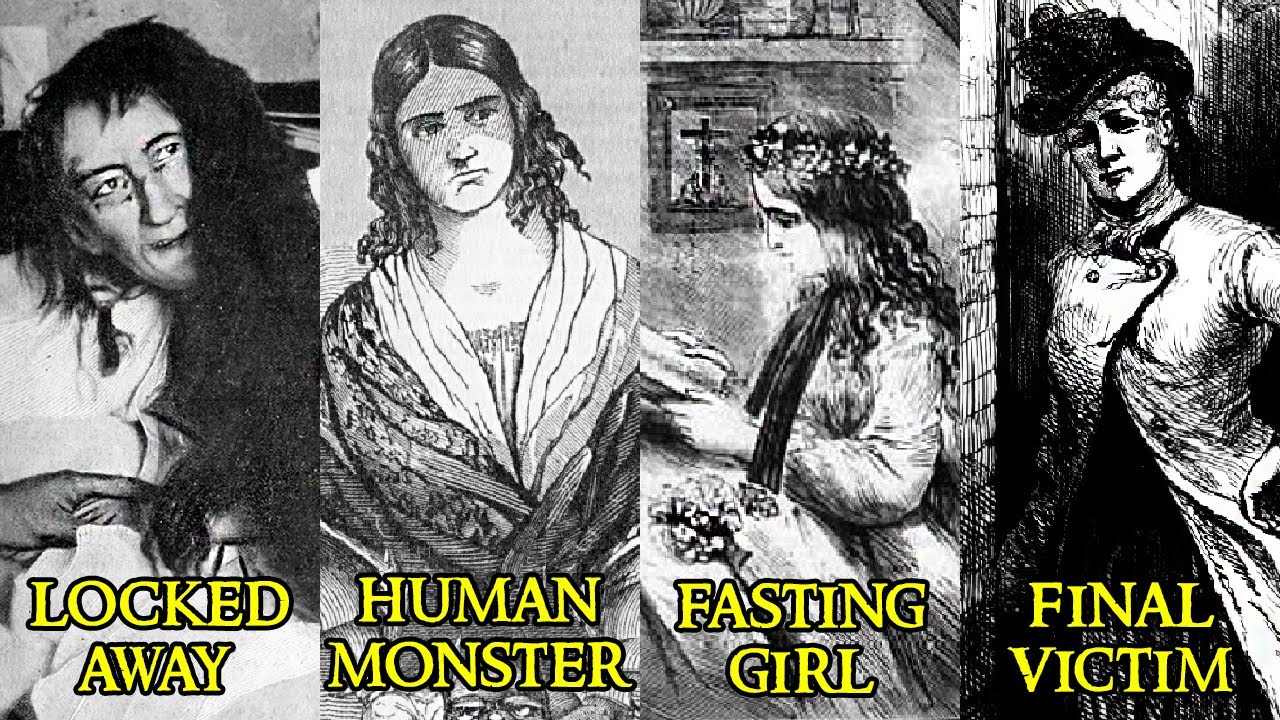
They became local celebrities, attracting journalists, writers, and paying visitors who wondered whether they possessed divine or magical powers. One of the most famous American fasting girls was Mary Fenn, known as Molly Fancher, born in Brooklyn in 1848. In her teenage years, she suffered a series of misfortunes: she fell from a horse, then was dragged under a streetcar, injuring her spine. On February 3, 1866, she experienced a strange seizure and collapsed on the kitchen floor, seemingly possessed by an evil spirit.
Confined to her bed for the next fifty years, Fancher gained a reputation for extraordinary abilities, including long periods without food and apparent clairvoyance. Newspapers dubbed her the Brooklyn Mystery. Showman P. T.
Barnum tried to recruit her for his exhibition, but she refused. Over the years, she reportedly developed five distinct personalities. By the 1880s and 1890s, public interest faded, and she disappeared from memory. Whether her behavior was fraud, mental illness, or anorexia nervosa remains unclear.
Not all fasting celebrities were young girls. Ann Moore, a woman in her forties from Tutbury, Staffordshire, attracted attention in 1808 when she reportedly went sixteen days without eating. Her fame spread across Britain and even to the United States, with claims that she had once lived five years without food. She was widely believed to possess a religious gift, but she was later exposed as a fraud.
She had devised elaborate ways to smuggle food into her room, reportedly with the help of her daughter, who transferred broth-soaked cloths and food from her own mouth to her mother’s during kisses. Despite the deception, Moore earned considerable income from her fame before dying in 1813. Over the course of the nineteenth century, many fasting girls died. Lenora Eaton, from New Jersey, died just a month after observers began testing her claims in 1881.
Josephine Marie Bedard of Quebec was exposed when witnesses saw food smuggled to her and even watched her steal food from their plates. Therese Neumann of Bavaria, born in 1898, claimed to have abstained from all food and drink after 1927. During a two-week medical observation, she appeared to eat and drink nothing, yet strangely gained weight. She died in 1962 of a heart attack.
The most tragic case was that of Sarah Jacob, a Welsh girl born in Camarthen in 1857. Her family was poor, her father a simple farmer. When Sarah stopped eating and drinking, news spread across Wales. A medical team of nurses was sent to observe her, but unlike other cases where food was secretly provided, her parents, Evan and Hannah Jacob, decided to genuinely starve her during the observation period.
Sarah died after going without food and drink for more than a week; the lack of water proved fatal. She was only twelve years old and was said to have fasted for 113 weeks. During the autopsy, an unopened water bottle was found in her bed. Her parents were tried and convicted of manslaughter for their role in the deception.
Historians now largely agree that the fasting girl phenomenon was at least partly a manifestation of anorexia nervosa. The term anorexia nervosa was first used in 1873 by the English physician Sir William Gull, who studied the condition systematically. At the very time fasting girls were attracting public attention, doctors in Britain were beginning to recognize the disorder. Cases like Sarah Jacob and Lenora Eaton likely represented early instances of this condition, later romanticized as stories of religious or supernatural communication.
The Victorian era also produced one of its most horrifying domestic crimes in the case of Blanche Monnier. Born in 1849 in Poitiers, France, Blanche was the daughter of a respected bourgeois family. Her father, Emile Monnier, was head of the faculty of letters at the local university, and her mother, Louise, was a prominent social figure. In the mid-1870s, Blanche fell in love with a lawyer who, while respectable, came from a modest background, was much older, and had few clients.
Her parents disapproved entirely. When Blanche refused to end the relationship, her parents and brother Marcel imprisoned her in a small attic room in their large home on her twenty-sixth birthday, March 1, 1875. At first, the confinement was meant to force her to give up the match. But it became permanent.
After her father died in 1879, her mother and brother continued keeping her locked away. The room had a small window covered with a black layer, letting in no natural light. The door was locked from the outside, and Blanche depended entirely on what her captors provided. The lawyer she had loved died in 1885, yet her imprisonment continued year after year.
Neighbors and friends inquired after her disappearance at first, but eventually stopped. Some noticed strange things over the years, including a woman heard screaming from the Monnier house in 1892, but no one understood what was happening. Blanche was finally rescued after 26 years. On May 23, 1901, an anonymous letter reached the public prosecutor of Paris, detailing the ordeal: a woman was being held in the Monnier house, starving on a rotting bed for 25 years.
Police raided the home and found nothing at first, then reached a door locked from the outside. They broke it down. The smell was overwhelming. Behind thick, dust-laden curtains and heavy wooden bars, they found Blanche lying completely naked on a bed of rotting straw, surrounded by filth, decomposing food, and insects.
She weighed barely 25 kilograms. The air was so foul that officers could not remain inside for long. Blanche was taken to a hospital, and her mother and brother were arrested. A crowd gathered outside the house demanding justice.
But her elderly mother died of a heart attack days later, escaping punishment. Marcel Monnier, found to be psychologically impaired, was initially sentenced to fifteen months but was acquitted on appeal. Blanche spent the remaining twelve years of her life in a psychiatric hospital, suffering from anorexia and schizophrenia, and developed an intense fear of bright light after decades of darkness. She died on October 13, 1913, at age 64.
Her story became widely known in France and inspired the Nobel Prize-winning author Andre Gide’s 1930 novel based on her case, which in turn influenced later French literature. The Victorian obsession with the supernatural also produced the legend of Spring-Heeled Jack. In late 1837, a young woman named Mary Stevens was walking across Clapham Common when a strange, almost demonic creature leaped from an alley and attacked her, tearing at her flesh with claws instead of hands. The thing’s touch was cold as stone, and it fled when she screamed.
Throughout November 1837, more sightings were reported across London. Witnesses described a figure appearing suddenly, leaping great distances, and disappearing quickly. By early 1838, panic had grown enough that the Lord Mayor published a letter in The Times, suggesting it was a hoax perpetrated by someone in disguise. He claimed it was likely a prank by an aristocrat who had the money to stage such an elaborate trick.
On the night of February 19, 1838, eighteen-year-old Jane Alsop answered her father’s door and found a figure dressed as a policeman in a large cloak. When she held up a candle, the figure spat blue and white flame from its mouth and attacked her with claw-like hands before fleeing. Police investigations found nothing conclusive. Dozens of similar attacks were reported over the following weeks.
Witnesses described a creature capable of leaping ten to twenty feet, leading some to believe it used springs in its boots, which gave rise to the name Spring-Heeled Jack. By late spring 1838, he was the talk of London, appearing in newspapers, magazines, and even on stage. Then reports began to fade. By 1839, the hysteria had largely passed, and Jack became more of a literary figure than a real threat, with occasional reported sightings over the following decades, including in 1872 in Beckenham and Sussex, and finally in Liverpool in 1904.
Explanations for Spring-Heeled Jack ranged from the supernatural to the mundane. Some believed he was an alien or a half-human beast, others that he was a demon summoned by black magic. Skeptics pointed to drug use, drunkenness, or mental illness among the first supposed victims, followed by mass hysteria and copycats. The most popular theory at the time was that a nobleman had lost a bet and hired someone to stage the apparitions.
Many suspected Henry de la Poer Beresford, the young and unruly Marquis of Waterford, who was notorious for public drunkenness and violence. This was plausible but never proven. The simplest explanation, however, may be that a society already steeped in gothic horror stories and penny dreadfuls was prepared to inflate a strange, inexplicable event into a supernatural legend. The era also produced one of America’s most notorious figures in Madame Restell, born Ann Trow in Gloucestershire, England, in 1812.
She married young, emigrated to New York, and was widowed by 1833. Her second husband, Charles Lohman, was a printer with radical intellectual connections who introduced her to the growing debate over population control. In the late 1830s, Ann began selling contraceptive and abortion pills under the name Madame Restell, claiming the recipes came from a French grandmother. Abortion and contraception were legal in most American states at the time, and she advertised openly in New York newspapers.
Her business expanded rapidly, and by 1840 she was running a boarding house where abortions were also performed. In 1841, a woman named Maria Purdy died shortly after an abortion, leading to charges against Restell, though she defended herself successfully. The case made her infamous, and public outrage grew as anti-abortion movements emerged. By 1845, New York had largely criminalized abortion, and Restell’s practice moved underground.
In 1847, Restell was convicted for her involvement in an abortion for a woman named Maria Bodine, who had sued after falling ill. The abortion had been performed only after her employer, who had impregnated her, offered Restell an unusually large payment. Restell was sentenced to a year in prison, but she continued her work upon release. Over the following decades, she grew enormously wealthy, building a mansion and flaunting her fortune while performing abortions for clients who sometimes paid over a thousand dollars.
The anti-vice crusader Anthony Comstock finally brought her down. In 1873, he secured federal legislation criminalizing the mailing of obscene or immoral materials, including information about contraception and abortion. In 1878, Comstock visited Restell’s office posing as a husband seeking contraceptives for his wife, then took the products to police. Raided and arrested, Restell faced a trial that might have become a national sensation.
Instead, on April 1, 1878, she committed suicide by cutting her throat in her bathtub, at the age of 65. The most famous killer of Victorian England left his final victim in a small room in Whitechapel. Mary Jane Kelly was born around 1863 in Limerick, Ireland, and moved to Wales as a child. Her father was a blacksmith, and the family was poor.
At sixteen, she was illiterate. In 1879, she married a coal miner named Davies, but he was killed in a mine explosion three years later. Widowed and without skills, she moved to Cardiff, then to London in 1884. Unable to find work, she turned to prostitution in a high-class brothel in the West End.
A wealthy client took her to France, where she was sold into the sex trade and trafficked before escaping back to London. She settled in the East End, living with several men before meeting Joseph Barnett in April 1887. They moved into a small room in Miller’s Court, Spitalfields, in a squalid area known for poverty and crime. Barnett worked as a porter but lost his job, and Mary Jane returned to prostitution to support them.
She was known locally as Dark Mary, and sang Irish songs when drunk. Barnett left on October 30, 1888, but they agreed to keep meeting. On the evening of November 8, he visited her, and they parted around 8 p. m.
That night, Mary Jane was seen returning home drunk, accompanied by a stout man with red hair wearing a bower hat. On the morning of November 9, the landlord’s agent, Thomas Bowyer, came to collect six weeks of overdue rent. Receiving no answer, he looked through the window and saw a mutilated body on the bed. Police arrived and broke into the room at 1:30 p.
m. The victim’s clothes had been burned, likely to provide light. The body had been extensively mutilated, and doctors estimated the murder occurred between 2 and 8 a. m.
, with the mutilation taking about two hours. The cause of death was a cut throat, and the killer appeared to lack any medical or butcher’s knowledge. Witnesses reported hearing a faint cry of murder around 4 a. m.
, but cries of murder were common in the East End. Identification was difficult due to the condition of the body, but Barnett recognized her by her ear and eyes, and her landlord confirmed it was Mary Jane Kelly, aged 25. The government offered a pardon to any accomplice who provided information leading to the killer, but no one came forward. One witness, George Hutchinson, gave a detailed description of a suspicious man seen with Kelly, but police believed his account may have been from a different night.
No one was ever charged with her murder. Theories have since suggested everything from Joseph Barnett killing her out of jealousy to Hutchinson himself being the killer, even to Mary Jane not being a Ripper victim at all, partly because she was so much younger than the other victims and her mutilations were far more extensive. No such murders were recorded for another six months afterward. Most believe she was Jack the Ripper’s final victim, his crimes ending through death, imprisonment, or departure.
Yet the true identity of her killer remains as mysterious as the Ripper himself.