By mid-December 1862, Ambrose Burnside’s Army of the Potomac had been sitting on the northern bank of the Rappahannock River for nearly three weeks. The plan had been a lightning strike: cross the river before Robert E. Lee could concentrate his forces and smash the Confederate army before it could fortify. But the pontoon bridges needed for the crossing never arrived on time, and by the time they finally reached Falmouth, the element of surprise was gone.
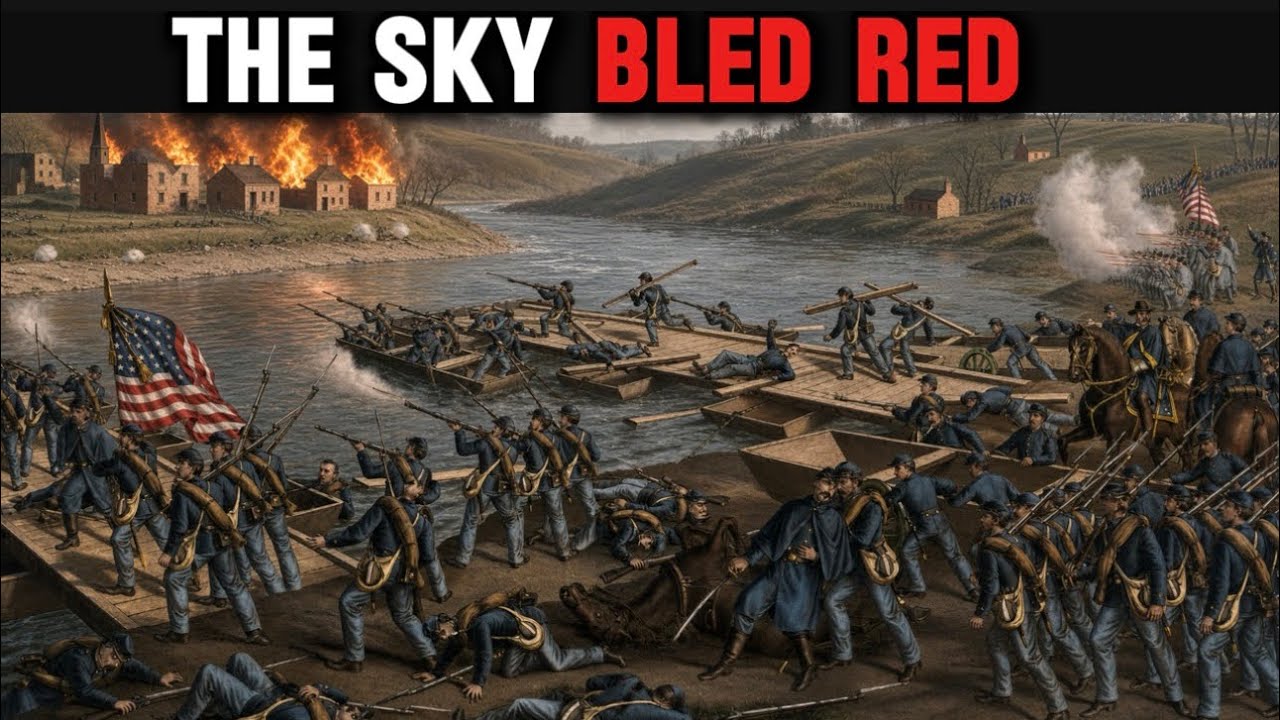
Through their telescopes, Union officers watched helplessly as Lee’s men turned the heights west of Fredericksburg into an impenetrable fortress of earthworks and artillery. The river crossing finally began before dawn on December 11th. A cold fog hung over the water as Union engineers stepped onto the bank to lay the first bridge sections, and the hidden city across the river exploded with rifle fire. William Barksdale’s brigade of Mississippi sharpshooters had turned the abandoned homes, cellars, and warehouses of Fredericksburg into a chain of sniper nests.
Every window held a rifle barrel, every wall was sandbagged. The engineers working on the open bridges had nowhere to hide. Men carrying wooden beams were shot through the head and pitched into the freezing current. The Union command rotated three full crews of bridge builders through the fire in less than an hour, and every man who stepped onto the unfinished spans was either killed or driven off.
Burnside, watching from a mansion on the opposite shore, finally lost patience and ordered a bombardment unprecedented in American military history. More than 140 heavy siege guns and field pieces lined the heights behind him and opened fire directly on the town of Fredericksburg. For two hours, solid shot, explosive shells, and incendiary rounds tore through the colonial streets. Brick houses collapsed into the roadways, timber frames burst into towering flames, and black smoke turned midday into pitch darkness.
Civilians who had refused to leave huddled in cellars as masonry fell around them. Yet when the smoke cleared, Barksdale’s Mississippians crawled out of their reinforced basements, wiped the brick dust from their rifles, and resumed their positions on the riverbank. To break the deadlock, Union commanders ordered an amphibious assault. Infantrymen from Massachusetts and Michigan piled into open pontoon boats and shoved out across the exposed river under a murderous fire.
Dozens were hit before midstream, their blood staining the boats as their comrades paddled past floating corpses. Those who reached the southern bank charged up the steep bluff with bayonets fixed and stormed into the city. The fight became a brutal room-by-room clearance. Union soldiers kicked in doors, fired into dark interiors, and stabbed blindly down cellar stairs.
By late afternoon, the Mississippians had been forced to withdraw, and the streets lay littered with smashed furniture, fallen chimneys, and hundreds of frozen corpses. That night, the victorious federal troops completely lost control. What followed was one of the most disgraceful incidents of the war. Regiments rampaged through the abandoned city, dragging velvet couches into alleys, smashing grandfather clocks with rifle butts, and cutting oil portraits from their frames.
Drunken soldiers paraded through the smoke in stolen silk dresses and hoop skirts. Rare books were pulled from library shelves and thrown into the mud to serve as stepping stones. By the time the sun rose on December 12th, Fredericksburg was a gutted, glowing shell. The next morning, Burnside ordered his army west toward the gentle slope of Marye’s Heights.
There, behind a sunken road shielded by a four-foot-high stone wall, stood Lee’s army. Four dense ranks of Confederate infantry lined the wall, and dozens of artillery pieces on the crest above commanded every square inch of the open plain below. James Longstreet, surveying the field, delivered a chilling assessment: once his guns opened fire, not even a chicken could live on that ground. Burnside, clinging to an outdated belief that determination and cold bayonets could shatter any line, ordered a full frontal assault.
On the morning of December 13th, thousands of Union soldiers stepped out of the town onto an open, muddy slope crossed by freezing drainage ditches. There was no cover anywhere. The moment the blue lines emerged, Confederate artillery opened a devastating crossfire. Solid iron shot bounded through the mud, tearing off limbs and ripping men apart.
Explosive shells burst overhead, showering the ranks with red-hot fragments. Entire files disappeared in single flashes. Yet the survivors closed the gaps, stepped over the screaming remains of their comrades, and kept advancing. When the infantry reached rifle range, the stone wall seemed to erupt in a continuous sheet of fire.
The defenders had organized a rotation system: the front rank fired, then stepped back to hand their empty muskets to the men behind them, who reloaded and passed them forward again. The storm of lead was unending. Wave after wave of federal regiments stepped into the killing zone and was sheared down within seconds. The impact was so concentrated that front-rank men were often knocked backward into the men behind them.
Among those ordered into the storm was the Irish Brigade, a hard-fighting unit of mostly poor Irish immigrants who wore sprigs of green boxwood in their caps. Shouting Gaelic war cries, they charged farther up the slope than almost any unit before them. Across the field, behind the stone wall, sat the 24th Georgia, a Confederate regiment made up almost entirely of fellow Irishmen. They recognized the green boxwood in their enemies’ caps, and tears reportedly ran down their faces as they loaded and fired volley after volley into the men who had once been their countrymen.
The boxwood sprigs soon lay scattered across the mud, stained dark red. Of the 1,200 Irishmen who had stepped onto the plain, more than five hundred fell in fifteen minutes. Burnside, desperate to rescue his pinned-down army, sent division after division against the same position. Fourteen separate waves advanced into the same fire.
Officers who understood that the attacks were nothing short of organized murder nonetheless drew their swords and led their men forward. Whole brigades were wiped out in the time it took to read a single page. As the short winter afternoon faded, the field below Marye’s Heights had become a sea of torn flesh, broken weapons, and muddy uniforms. Thousands of wounded men lay in no-man’s-land, too badly injured to crawl back.
Their wet clothes froze solid around them, encasing their limbs in ice. Blood crystallized into crimson icicles on their skin. Survivors later described the sensation of open wounds freezing as if hot liquid fire were being poured over torn muscle. As darkness fell, a sound rose from the field that haunted every survivor for the rest of his life.
It was not scattered cries but a single, continuous wall of agonized moaning, thousands of dying men weeping, praying, and begging for help. Some called for their mothers, some begged their comrades to shoot them, and others pleaded for water they would never receive. In Washington, the full scale of the disaster threw Abraham Lincoln into a profound darkness. He paced the halls of the Executive Mansion late into the night, reportedly muttering that if there was a worse place than hell, he was living in it.
The loss of more than twelve thousand Union soldiers for zero strategic gain brought the administration to the brink of political collapse. Across the river, Burnside collapsed completely. Overwhelmed by guilt, he wept openly in front of his staff. In a desperate fit, he announced he would personally lead his old division in one final suicidal assault against the stone wall.
His horrified generals physically restrained him and refused to obey the order. Facing mutiny and destruction, Burnside ordered a secret retreat. On the night of December 15th, tens of thousands of exhausted soldiers packed mud around their artillery wheels and wrapped cloth around their horses’ hooves to muffle the sound. They slipped silently back across the Rappahannock on pontoon bridges, abandoning the ruined town and the bloody field.
When the Confederate army cautiously advanced the next morning, they found a scarred, blackened wasteland. Fredericksburg was a hollowed-out ghost city of standing chimneys, shattered brick, and burned rubble, stripped of life and beauty. The battle had gained the Union nothing.
More than twelve thousand men had fallen, and the army limped back north into winter quarters, leaving behind a field where ice sealed the dead to the frozen mud.