The case that would become one of Europe’s most disturbing crime sprees began to break open in April 1929, when three anonymous letters landed on the desk of the royal prosecutor in Szolnok, a town along the Tisza River in southeastern Hungary. Each letter accused a woman from the tiny farming village of Nagyrév of poisoning a relative. One named a wife accused of killing her husband. Another pointed to a mother who poisoned both her husband and her son.
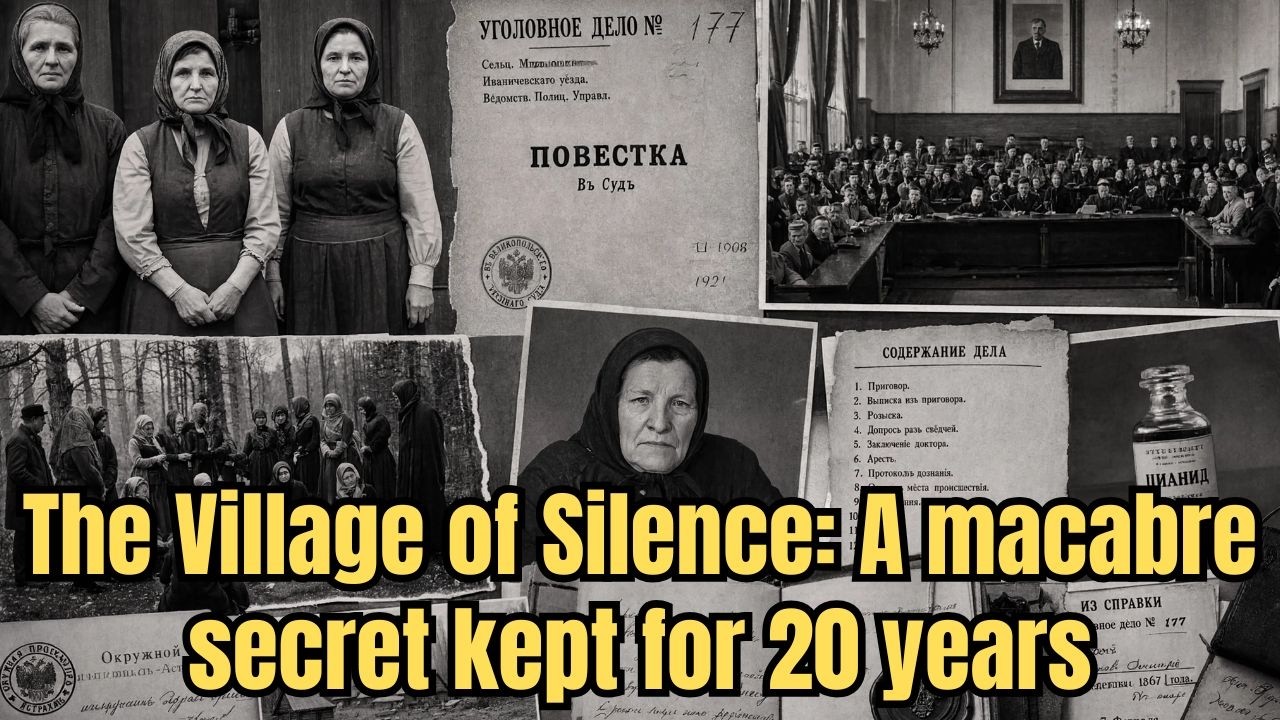
The third claimed a woman had poisoned her own child. The investigation stalled almost immediately. Authorities traced the letters to a local woman, but she produced no evidence, no witnesses, and no proof. Instead of pursuing the accused poisoners, prosecutors charged the letter writer with slander.
The case was dismissed, and the women named in the letters returned to their homes as the complaints were buried in a filing cabinet. Warnings had been piling up for years. In 1924, a local doctor became suspicious when a healthy patient died suddenly and requested an exhumation. The request was denied for lack of evidence.
In June 1929, a resident published an article saying the region was buzzing with rumors of mass poisonings and that authorities were turning a blind eye. He was sued for defamation. Anonymous letters detailing suspicious deaths had been reaching provincial offices for years, but they were ignored. In June 1929, one of those letters finally reached officials who acted on it.
The letter accused a couple of poisoning the husband’s father years earlier, and it provided specific names, dates, and the method used. Police traced the accusation to a woman who had heard the story directly from the dead man’s daughter-in-law. When the accused couple was arrested, they confessed on the spot. A second couple followed, and all four prisoners pointed to the same source of the poison.
Police moved into Nagyrév and began questioning women, summoning 17 in the first wave. Between July and October 1929, authorities filed 77 murder charges across Nagyrév and the neighboring village of Tiszakürt. Nagyrév had about 1,000 residents at the time, meaning roughly one in every 13 villagers stood accused of murder. Different accounts exist of how the case first broke, and historian Béla Bödő, author of the first academic book on the case, points to an anonymous letter sent to a small newspaper.
On July 22, 1929, authorities exhumed graves in Nagyrév with examining magistrates, forensic experts, and defense attorneys present. The entire village gathered in silence to watch. The bodies were sent to the capital for analysis, and the results showed arsenic in large quantities. Police reported that the exhumed bodies contained, on average, enough arsenic to kill eight to 10 adults.
Of the first 50 bodies exhumed, arsenic was found in 46. The roots of the case stretched back nearly 20 years. Nagyrév stood isolated on the Hungarian plain, a farming community where everyone knew everyone and the nearest doctor lived about five miles away. In that void, a midwife born in the village in 1861 became the local healer, delivering babies there since 1893.
She was the person villagers turned to when sick, when dying, and when they had nowhere else to go. Women brought her their secrets, including the ones they would not tell anyone else. Marriage in that community offered women little escape. Families chose husbands for their daughters, usually while they were teenagers, and divorce was never a real option for poor peasant women.
A woman who entered marriage knew that only death would set her free. During World War I, the Austro-Hungarian Empire called up millions of men to the front, and the husbands of Nagyrév went to war. The village also became a detention center for prisoners of war, who worked on farms, mingled with locals, and started relationships with the women whose husbands were gone. For the first time, those women ran their own lives and made their own decisions.
When the war ended and the husbands came back, the men who returned were often broken, wounded, sick, and determined to restore the old order. Historians describe the situation as explosive. The midwife’s house became the place where women brought their complaints about unbearable husbands. The standard response, recorded by researchers, was a question: “Why are you suffering for him?
” The answer was arsenic, and the midwife did not buy it. She manufactured it in her own kitchen by boiling flypaper, which anyone could buy at a general store, in water. The arsenic leached out and formed a film on the surface, which could be skimmed off, concentrated, and bottled. The instructions were simple: mix it into his food or drink, often little by little, dose by dose.
Arsenic was the perfect poison for the setting. It is colorless, odorless, and dissolves into soup, coffee, brandy, or cake batter. The symptoms—vomiting, diarrhea, stomach pain—were indistinguishable from cholera or the infections that killed country people every day. A poisoned man died in a way that looked like any other death.
The system was protected from scrutiny. In a village without a doctor, the midwife determined the cause of death in practice, and the official who signed death certificates was her cousin. The entire business of death was controlled by her family. On paper, there was nothing to see.
The first confirmed arsenic death in Nagyrév dates to 1911, three years before the war. The war did not create the practice; it gave it scale. When the husbands returned from the front, healthy men began falling ill and dying. Officially, each death was recorded as cholera, infection, or common illness, but within the village, everyone knew.
The accused women themselves later told the press: “It was an old custom here. They did it before us and they’ll do it after us. ”
Over time, the poison was used beyond husbands. Women sought out the midwife to solve other problems: elderly parents who had become burdens, inconvenient lovers, even sick babies and small children.
Poisoning became a domestic solution passed from kitchen to kitchen. In July 1929, confessions were coming in quickly. On July 18, one of the accused women, a midwife herself, hanged herself in her cell. Police moved to arrest the main midwife, but she had been watching the street for days and had prepared caustic soda.
When police appeared, she drank the poison and died beside a well. The village death record lists it as suicide by caustic soda poisoning. The central figure of the case was Anna Varga, 68 years old, born in Nagyrév in 1861, and known to neighbors as Aunt Anna. A good portion of the village had literally passed through her hands at birth and at death.
She died without answering a single question in court. Altogether, four women under investigation took their own lives. The trials ran from December 1929 to November 1931. Twelve main trials were held, and in the dock stood 28 people: 26 women and two men.
Authorities tried to split the case into separate proceedings to avoid publicity, but Hungarian newspapers put the case on the front page, and The New York Times called it the biggest poisoning case of the century. Nagyrév earned the nickname “the village of death. ”
A report by one of Hungary’s greatest writers described a packed courtroom with 20 journalists, photographers, and sketch artists. The defendants were described in shocking terms.
One, accused of killing her own mother, then her husband, then her lover, looked like a sweet little grandmother, neatly dressed in black, hands clasped as if in church. The defendants spoke of poison in terms of medicine, viewing arsenic as a remedy for life’s troubles. One woman told the court: “My husband was a very bad man who beat me and tortured me. And since he died, I’ve found peace.
”
Motives covered a broad spectrum: violent husbands, husbands who returned from war broken, inheritance disputes, wartime lovers, sick relatives who had become burdens. Confessions began to unravel, and one by one they were retracted. Without confessions, the evidence had limits. Arsenic in the body does not point to the hand that served the plate, and in several cases even careful analysis failed to produce a conclusive result.
Far more cases were opened than sentences handed down. The vast majority ended without punishment for lack of evidence. Six death sentences were handed down, and three women were executed by hanging, including the neighboring village midwife who had resold the poison. The other capital sentences were overturned on appeal, with one defendant acquitted in a second trial and the others receiving life imprisonment.
Alongside the death sentences, there were eight life sentences and other fixed prison terms ranging from five to 15 years. Anna Varga was officially cast as the architect of it all, but researchers later found that other women also distributed the poison, and some murders had no connection to the main midwife. Since she died before giving testimony, the exact extent of her role cannot be measured. The press called the group the Legion of Jäger Matyi, a reference to a poisoning midwife from an earlier famous case.
The number of victims remains disputed. Police records put the number of exhumations at 162, while historian Béla Bödő told the BBC he considers between 45 and 50 deaths confirmed. Estimates for the entire region reach 300, a number never confirmed. The exhumations were not continued in other villages once the case became a national and international scandal, so the graves that could have answered the final question remain closed.
In 1937, a Hungarian sociologist gave the region the name “the arsenic zone. ” The case entered Hungarian criminology as the Tiszazug poison mixers, named for that bend in the river, but the rest of the world knew it by another name: the Angel Makers of Nagyrév. The term “angel maker” was an old European euphemism for a woman who performed illegal abortions or let unwanted babies die, based on the logic that a child who dies becomes an angel and goes straight to heaven. In that village, the women had started making angels out of grown people—husbands, fathers, relatives—sending the problem to heaven or hell.
Two records preserve what the case meant. In the 1950s, a historian imprisoned by the communist regime met an elderly man from that region in prison, who told him that around there, women had been killing their men since time immemorial. And in 2004, a resident of Nagyrév who had been a child during the trials told the BBC that after the poisonings, the behavior of husbands toward their wives improved considerably. Nearly a century later, the questions remain.
Were these women victims trapped in a world where marriage was imprisonment and domestic violence was legal? Or were they calculating killers who murdered anyone who became inconvenient? The truth may lie somewhere in between. The village kept its secret for 20 years, and when the secret came out, the world looked on in horror.
For the villagers themselves, poison was not a crime. It was a custom.