In January 2024, Marcus Chen, the chief conservator at the Atlanta History Center, received a photograph from the estate of Helen Morrison, a 93-year-old Atlanta schoolteacher who had spent decades collecting artifacts of African-American history in Georgia. About six by eight inches, mounted on thick cardboard, and preserved in an acid-free envelope, it was a wedding portrait from a photographer’s studio. The backdrop showed a painted parlor with columns and draped curtains. A Black couple stood at the center, formally dressed, staring at the camera with expressions of solemn pride.
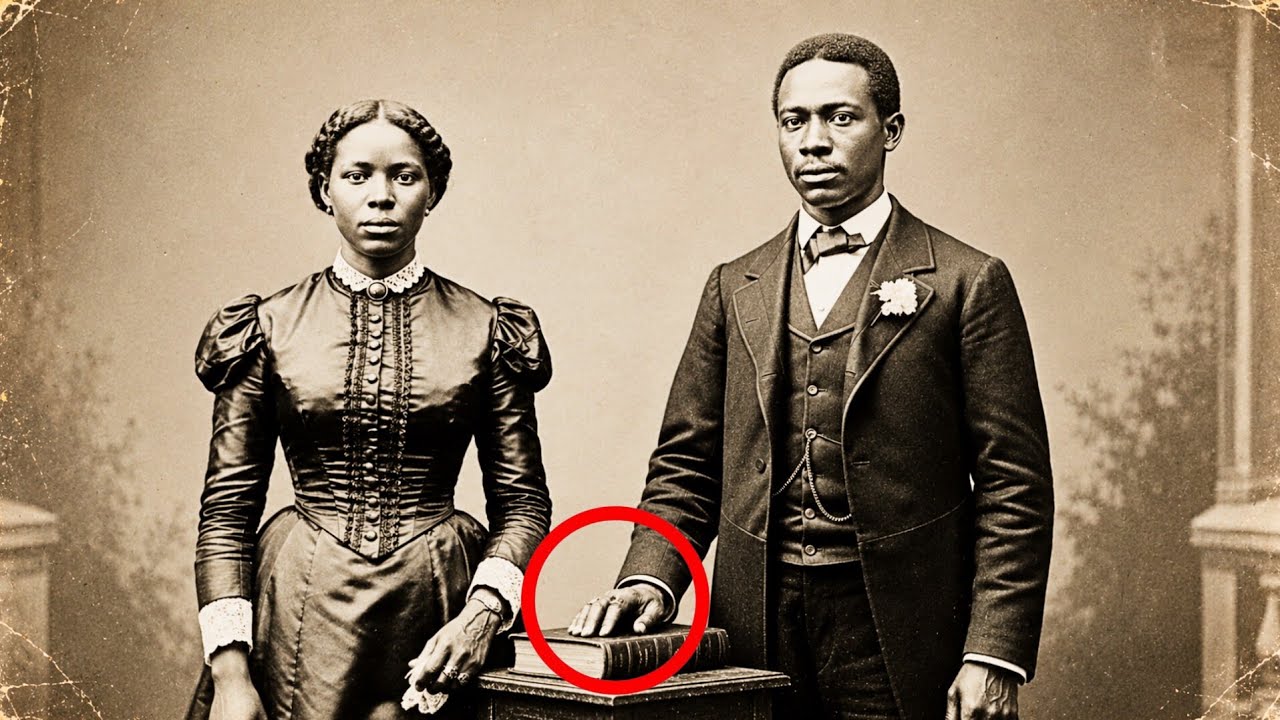
The photographer’s stamp read Sterling and Associates, Atlanta, Georgia, 1871, just six years after the end of the Civil War and in the midst of Reconstruction. Chen began his standard assessment, noting slight fading around the edges. Then he looked closer at the groom’s hand resting on a Bible. Under magnification he saw irregular patches of lighter tissue on the skin, scarring consistent with injuries from shackles or chains.
And on the groom’s finger was a ring with a rough, hammered surface and a dark, almost matte finish, nothing like the bright gleam of gold or silver. Using high-resolution photography and enhancement software, Chen found small marks around the band forming a chain-like pattern. The ring appeared to be iron, and it had apparently been forged from the chains of slavery. The practice was documented in historical journals.
Formerly enslaved people were known to take the physical instruments of their bondage and transform them into wedding bands, turning symbols of oppression into symbols of love and commitment. Chen wanted to know who the couple was, and whether the ring itself had survived. Faded pencil on the backing read, David and Clara married November 18th, 1871. Genealogical records identified David Freeman, about 28, a blacksmith, and Clara Washington, about 24, a domestic worker, married at Friendship Baptist Church and recorded in the Fulton County Marriage Register.
The 1870 census listed both as literate. A Freedman’s Bureau record from 1865 described David, then about 22, as formerly enslaved by Robert Freeman of Clark County, Georgia, with scars on his wrists and ankles from extended periods in chains. Clara’s record noted she had been separated from her mother, Sarah, and brothers, Thomas and James, when they were sold to a trader bound for Mississippi in 1859. She had learned to read from the Washington family children, against the will of the enslaver, who beat her severely when he discovered her literacy.
She had also been married before, under slave custom, to a man named Joseph, who was conscripted to work on Confederate fortifications in 1864 and never returned. Her marriage to David was a second chance after loss and trauma. Chen found references to David’s blacksmith shop on Decatur Street near the railroad depot. An 1872 article in the Atlanta Advocate reported that Mr.
Freeman had become known for creating wedding bands from iron that once bound us, transforming symbols of oppression into symbols of love and freedom. An 1873 article described his forge as a center for this practice, noting that couples often brought him pieces of chains or shackles from their time in bondage, and that he had performed the service for more than fifty couples. In a letter from 1874 to a Savannah minister, David explained his philosophy: each ring required four to six hours of work, he charged no money, and the work was not business but ministry. The iron from chains was often poor quality, requiring repeated heating, folding, and hammering to remove impurities and strengthen it.
Some couples wanted the hammered texture visible, showing the work of transformation. Others wanted it smooth and polished, showing that a painful past could be refined into beauty. People often stayed to watch and tell their stories about being chained, about seeing loved ones sold away. As David wrote, the ring must contain not just the iron, but also the witness to what was endured.
Marriage registers from several Atlanta churches throughout the 1870s and 1880s noted rings made by David Freeman next to couples’ names. One entry moved Chen deeply: in the Wheat Street Baptist Church register from 1872, Samuel Jenkins and Elizabeth Porter were married with rings made from chains that had bound both of them when enslaved on the same plantation, separated by sale in 1858, reunited after emancipation. Chen also found that David’s practice had inspired other blacksmiths in Savannah, Charleston, New Orleans, and Richmond. Chen uncovered the day of the wedding through the diary of Reverend Isaiah Grant, whose papers had been digitized by the Atlanta University Center Archives.
On November 18th, 1871, Reverend Grant presided at Friendship Baptist Church. More than one hundred people attended. In his diary he described how Brother David stood at the altar in a fine suit he had saved months to purchase, and Sister Clara wore a dress of dark blue silk she had sewn herself. When the time came for the exchange of rings, David presented a ring he had forged himself from chains that had once bound him.
Clara wept as he placed it on her finger. Reverend Grant spoke to the congregation about the meaning of the ring and the marriage: just as David had taken chains and transformed them into a ring, so were the people transforming their bondage into a foundation for freedom. After the ceremony, the couple and their guests walked through downtown Atlanta to the photography studio, a public statement in streets where they would have been enslaved only six years earlier. At the studio, David insisted that his hand rest on the Bible and that his wedding ring be clearly visible, wanting future generations to see the ring and understand what it represented.
Clara’s life was harder to trace, but Chen found she had joined Friendship Baptist Church in 1866 and quickly became active, organizing literacy classes for formerly enslaved adults, collecting funds for families whose homes had been burned, and testifying about violence she had witnessed. In 1870 she testified before a congressional committee investigating violence against African Americans in Georgia, describing how Black people were told they were free but could not live without fear, how they built and their work was burned down, how they tried to vote and were beaten, but declaring they would not give up. Census records showed the Freemans still living in Atlanta on Decatur Street in 1880, with two children, Robert and Sarah. By 1900 they were still together, in their fifties.
Robert had graduated from Atlanta University in 1895 and become a teacher of mathematics. Sarah became a dressmaker and later owned a small shop on Auburn Avenue. David’s obituary in 1906 described him as a respected blacksmith and community leader who, for forty years, had crafted wedding rings from the chains of slavery and never charged for the service, considering it his ministry. He was survived by his wife, his children, six grandchildren, and the hundreds of couples whose marriages were blessed by his work.
Clara lived until 1921, remembered as a pioneer and pillar of the community who was born into slavery and lived to see her grandchildren educated and successful. Chen also found a 1920 letter from Sarah Freeman to a museum offering to donate her parents’ wedding photograph and Clara’s ring. She wrote that her father had told her every ring was an act of defiance, taking what was meant to enslave them and transforming it into something that celebrated their humanity. As long as people remembered what these rings meant, he said, slavery would never truly win.
Chen began contacting museums across the South and received a response from Dr. Angela Price, a curator in Savannah, who held three rings matching the description, donated by different families with similar stories. The rings were dark iron with hammered texture. A metallurgist, Dr.
James Wu, examined them with X-ray fluorescence spectroscopy and confirmed they were wrought iron consistent with mid-nineteenth-century American iron, showing repeated folding and hammering. Each ring had likely started as three or four separate pieces, links from chains or pieces of shackles, heated and hammered until they fused. The craftsmanship, Wu said, showed skilled work. Three months into his research, Chen received an unexpected package.
It contained a letter from Dorothy Freeman Watson, the great-great-granddaughter of David and Clara, who, after seeing news coverage of the research, had decided to donate Clara’s ring. Wrapped in tissue paper was the iron ring, dark, hammered, irregular, preserved through five generations. On the inner surface Chen found tiny stamped letters: D. F.
1871, David Freeman’s signature and the year he created it. Dorothy explained that David had made Clara’s ring from pieces of the chains that had held him on the Freeman plantation, pieces he had saved after emancipation and kept for years until he felt ready to transform them. In 1871, using those chains for Clara’s ring was both a personal memorial and a promise that their love would be stronger than anything that had tried to break them. Clara wore the ring every day of her married life and continued wearing it until her death in 1921.
Five generations of women in the family had been its guardians, but Dorothy decided the story belonged to more than just the family. Eight months after Chen first examined the photograph, the Atlanta History Center opened an exhibition titled Forged in Freedom: Wedding Rings from Slave Chains, on November 18th, 2024, exactly 153 years after David and Clara’s wedding. The centerpiece was the wedding photograph enlarged to five feet tall, with Clara’s ring in a climate-controlled case nearby. Text panels explained that David Freeman was a blacksmith who transformed instruments of oppression into symbols of love, creating rings for hundreds of couples during Reconstruction.
The exhibition included the three rings from Savannah, interactive displays of the ring-making process, and audio recordings of a descendant sharing family stories. It also explained how marriages between enslaved people had no legal recognition, how families were deliberately separated, and how the right to legal marriage was one of the first freedoms formerly enslaved people exercised. On opening day, visitors stood before the photograph. An elderly Black woman told Chen that her grandmother had told her stories about rings like this, and she had thought it was just a story, but it was real.
Looking at David and Clara, she said they seemed so dignified, so proud, and after everything they had gone through, they stood there and said: we are worthy of love, worthy of being remembered. An exhibition that had begun with the discovery of a wedding photograph became one of the museum’s most popular displays. David Freeman’s rings, hundreds of them, each transforming pain into beauty, bondage into freedom, and chains into circles of love, endured to teach future generations about survival, resistance, and hope.