The old west produced few figures whose deaths matched the drama of their lives. For some, the end came suddenly and violently. For others, it arrived quietly, sometimes far from the frontier that made them famous. Buffalo Bill Cody’s body waited six months for its final burial.
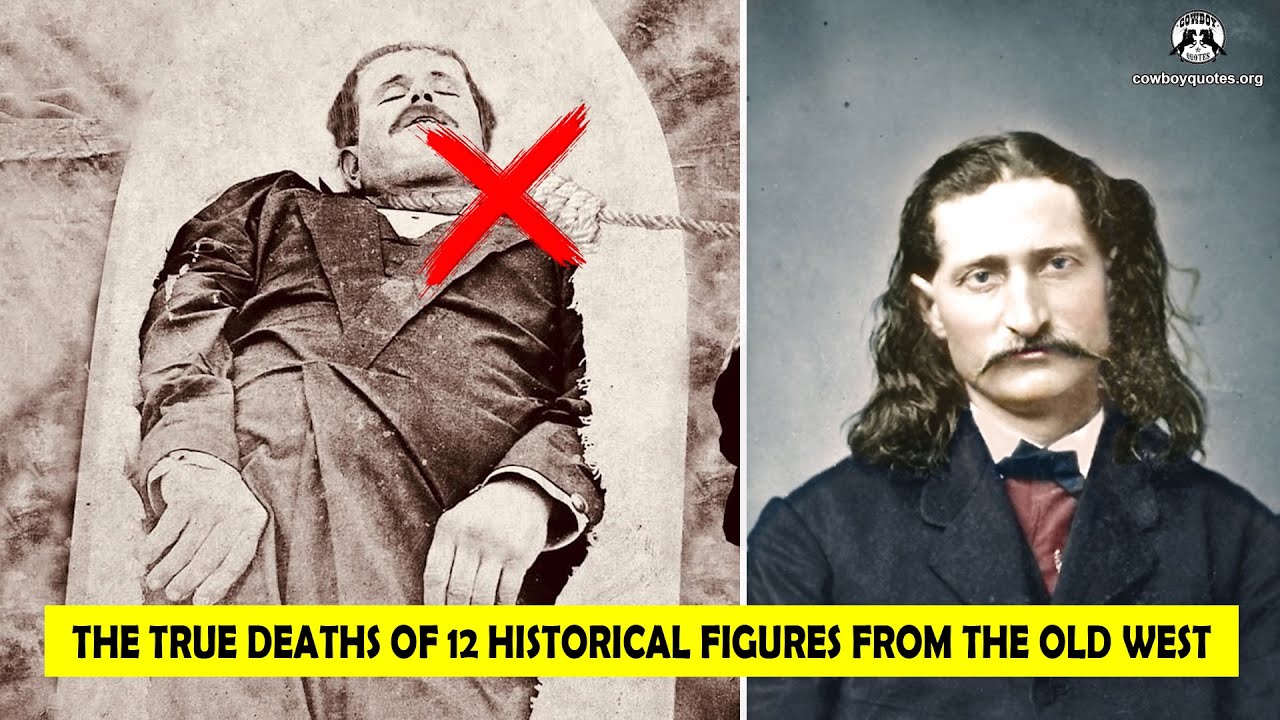
Cody had become a household name in the late 1800s through his traveling Wild West show, which brought the romance of the frontier to audiences across the country. On January 10, 1917, while visiting his sister in Denver, he died of kidney failure. His most recent will requested burial atop Lookout Mountain in Colorado, a site with remarkable views, but heavy snow that January made the road to the mountain impassable. To honor his request, the mortuary extended the preservation period for six months, requiring six separate embalmings.
During that time, many argued he should be buried in Cody, Wyoming, the town he had founded and where an earlier will had placed him. It is widely agreed that Cody was ultimately buried on Lookout Mountain, though conspiracy theories have long suggested his body was secretly moved to Wyoming. Bat Masterson followed a similar path from gunslinger to respected citizen. His early years were marked by his skill with a firearm, and he eventually became a sheriff.
After meeting Wyatt Earp, who helped convince him he could bring order to the chaos of Dodge City, Kansas, Masterson took up the task. His brothers were already involved in law enforcement near Dodge City, and Masterson committed himself to the work. His tenure saw both triumphs and tragedy, including the killing of his brother Ed. By age forty-nine, Masterson had grown tired of the violence of the West and longed for a quieter life in the East.
He and his wife moved to New York, where he worked as a newspaper journalist and as a U. S. marshal for several years. On October 25, 1921, at the age of sixty-seven, Masterson died at his desk of a massive heart attack after writing his final column for the Morning Telegraph.
Wyatt Earp’s fame came mostly after his death. During the 1800s, his name did not resonate widely. Only after a biography detailing his daring escapades, including the shootout at the O. K.
Corral, was published did his reputation surge. Near the end of his life, with his gunfighting days behind him, Earp moved to Los Angeles. There he became an unpaid adviser in the growing world of western films, growing close to stars such as Tom Mix and William S. Hart.
So strong were those connections that both Hart and Mix served as pallbearers at his funeral in 1929, with reports suggesting Mix was visibly moved during the ceremony. Doc Holliday died young, worn down by the very habits that made him a legend. Originally a dentist in Texas, John Henry Holliday’s passion for card games pulled him toward a different life. He became close with figures like Wyatt Earp and took part in his share of shootouts, gambling, and heavy drinking.
The drinking aggravated his pre-existing tuberculosis, and his health steadily declined. In 1887, Holliday checked himself into a sanitarium in Glenwood Springs, Colorado, to seek treatment. At the age of thirty-six, he drew his final breath in that sanitarium bed. Annie Oakley’s death was followed almost immediately by her husband’s.
Before she became a legendary sharpshooter and a role model for young girls around the world, she was Annie Moses, a sixteen-year-old with an exceptional talent for shooting. During a visit to her sister’s home, a local innkeeper arranged a trap-shooting competition between her and Frank Butler, a professional exhibition shooter. The challenge was to hit the most targets out of twenty-five. Frank hit twenty-four.
Annie hit all twenty-five. The feat captivated Frank, and the two married shortly after. They spent nearly fifty years together until Oakley’s life was claimed by anemia. The circumstances of Butler’s death remain undisclosed, but his passing just eighteen days after Oakley’s suggests the toll of a broken heart.
The couple was buried side by side in Oakley’s family burial site. Billy the Kid was barely an adult when he became one of the West’s most wanted outlaws. By the age of eighteen, he had allegedly committed as many as seventeen killings and was still on the run. Sheriff Pat Garrett eventually captured him, and Billy stood trial, was found guilty, and was sentenced to hang.
Only days before his scheduled execution in 1881, he made a daring escape, leaving two guards dead. Garrett pursued him for three months and finally received a tip about Billy’s location. Garrett entered the dimly lit bedroom at the Maxwell ranch in New Mexico, waited in the dark, and shot Billy as he entered the room. In the aftermath, doubts emerged about whether the man killed was truly Billy or another young man who resembled him.
In later years, two different individuals came forward claiming to be Billy the Kid, but neither claim could be proven. Davy Crockett’s death at the Alamo remains one of the most debated endings in American history. Crockett was a frontiersman, a U. S.
congressman, and a storyteller, but he is most remembered for his final stand in 1836. What is certain is that he died at the Alamo on the morning of March 6, 1836, at the age of forty-nine. The prevailing narrative holds that Crockett, alongside a contingent of about two hundred men, resisted thousands of Mexican soldiers for thirteen days before being overwhelmed, and that he perished while defending the fort. Some historians, however, have argued that Crockett may have been among a group of six soldiers who surrendered under a promise that their lives would be spared, only to be executed anyway.
Jesse James was killed not by a lawman, but by a member of his own gang. He was such an effective outlaw that the governor of Missouri, Thomas Crittenden, personally pursued his capture. After a botched bank robbery, Jesse and his brother Frank were lying low. Frank, moving toward an honest life, left the gang, forcing Jesse to recruit new members who had no loyalty to him.
Among them was Bob Ford, whose brother Charlie had recently joined Jesse’s operation. Learning of Crittenden’s ten-thousand-dollar reward for Jesse James, Bob persuaded his brother to help him turn against their leader. The Fords struck an agreement with Crittenden, securing both the bounty and a pardon. A few months later, the Ford brothers were with Jesse in one of his houses in St.
Joseph, Missouri. As Jesse removed his coat and holsters because of the heat, he noticed a dusty picture above the mantel and stood on a chair to clean it. Bob Ford seized the moment and fired a fatal shot into the back of Jesse’s head. The death became a national sensation.
The Fords made no attempt to hide their role, and Bob wired the governor to claim his reward. Crowds pressed into the small house to see the dead bandit for themselves. Butch Cassidy and the Sundance Kid ended their run in South America, though the exact circumstances remain clouded. With an average take of thirty-five thousand dollars per robbery, the Wild Bunch, led by Cassidy, was an elusive target for law enforcement, thanks to his careful preparation before each job.
After years of crime, Butch and Sundance decided to give it up and move to South America to start new lives. They kept a low profile until they allegedly took a payroll in Bolivia. Pursued by Bolivian troops, they were cornered, and a shootout left one of them injured, reportedly Sundance. That night, two gunshots rang out, and the men’s bodies were recovered with bullet wounds to their heads, one directly between Sundance’s eyes and one in Cassidy’s temple, apparently self-inflicted.
Still, vigorous debate persists over whether the men really died there. Some have claimed one or both survived and returned to the United States. One such claim held that Cassidy lived under the name William Henry Long in the small town of Duchesne, Utah. Long died in 1936, and his remains were exhumed in December 2008 and subjected to DNA testing.
Anthropologists stated that Long’s remains did not match DNA obtained from a distant relative of the Sundance Kid. Belle Starr was likely more an associate of criminals than a hardened criminal herself. She faced a conviction for horse theft that led to a nine-month imprisonment, but she never again encountered legal trouble. She maintained close ties with outlaws and people of dubious reputation, including two husbands who died in gunfights, and she was associated with the James-Younger gang.
On February 3, 1889, two days before her forty-first birthday, Belle was killed. She was riding home from a neighbor’s house when she was ambushed. After she fell from her horse, she was shot again to make sure she was dead. She died from shotgun wounds to the back, neck, shoulder, and face.
Her killer was never found. Rumors surrounded her death, and in at least one version of events, her own son Ed had a hand in the incident. Wild Bill Hickok was shot from behind while holding the dead man’s hand. His reputation began after a magazine published his story of killing three men, launching his renown as a sharpshooter.
He engaged in a series of gun battles before eventually ceasing such encounters after accidentally causing the death of his own deputy. As time went on, his popularity waned, and he fell into hard times, barely scraping by as a card player in Deadwood, South Dakota. One August day, positioned with his back to the saloon entrance, he was confronted by a young gunslinger named Jack McCall, who fired a fatal shot into the back of Hickok’s head. In his final moments, Hickok was holding a pair of aces and eights, a combination now forever known as the dead man’s hand.
Calamity Jane’s name captures her life. To make a living, she sometimes adopted male attire, worked with the Pony Express, and some records suggest she engaged in prostitution. She later became a member of Buffalo Bill’s Wild West show and was renowned for her marksmanship while riding a horse. Her popularity grew alongside a reputation for heavy drinking and enjoying life’s pleasures.
Eventually, the whiskey caught up with her, leading to severe alcoholism that plagued her for years until her death at fifty-one. She was buried at Mount Moriah Cemetery in South Dakota, next to Bill Hickok. Four of the men who planned her funeral later said Hickok had no use for Jane while she was alive, so they decided to play a posthumous joke on him by burying her by his side.