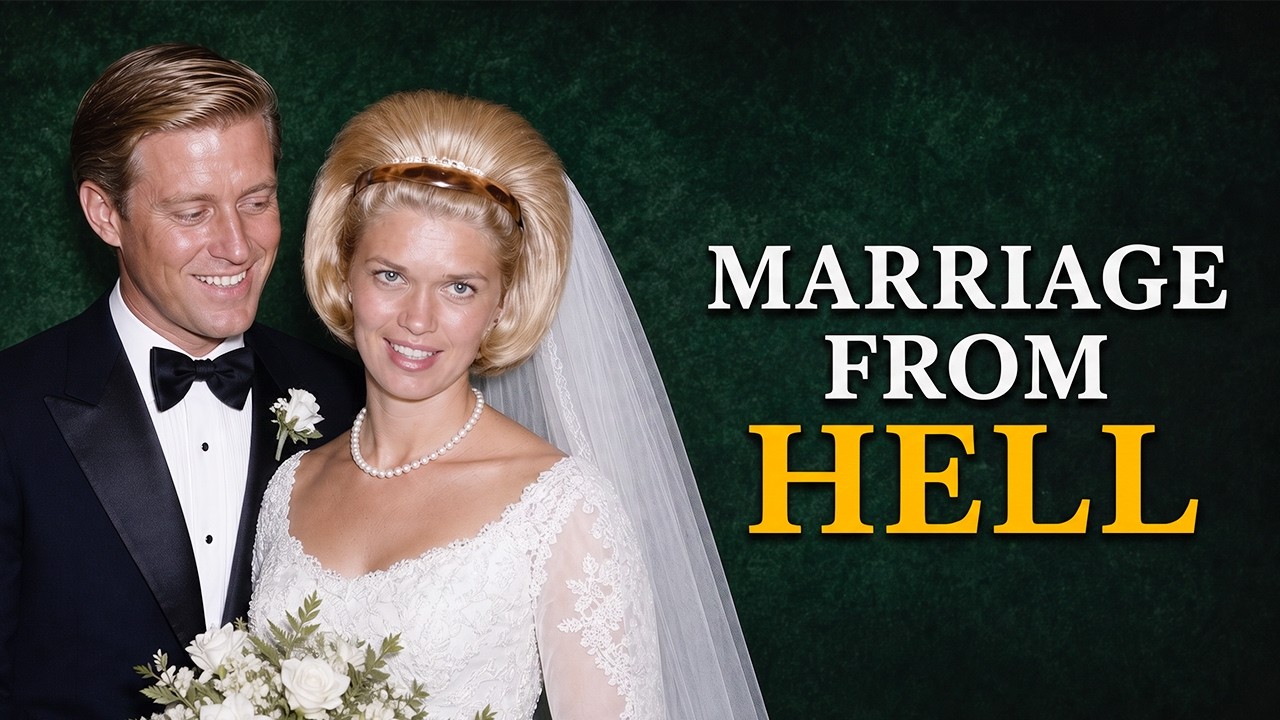
In January 1962, as Linda Clapp prepared to marry the heir to the Trump real estate fortune, her future sister-in-law reviewed the wedding announcement and suggested she claim classes at Columbia she had never taken. Thirty years later, when Fred Trump Sr. rewrote his will, testimony indicated he still feared money reaching her, two decades after her divorce. The family that edited her out of one sentence in 1962 did not control the last version.
Her two children opened the books, the courtrooms, and the archive. The meeting was August 1958 in Nassau. She was nineteen, a stewardess escaping a hardscrabble life in Kalamazoo, Michigan. He was twenty, a Lehigh student home for the summer.
Freddy Trump was the most charming person in any room he walked into, by every account from that period of his life. He talked about the new Corvette he had bought with money earned working at a Chevy dealership near campus. Then he vanished on her. No calls, nothing.
For a young woman in 1958, that was an answer. She took it and went on with her life for three years. What brought them back together was an apartment. In 1961, she moved to New York for the airline job and needed somewhere to live near Idlewild, the airport now called JFK.
She got in touch with Freddy because his family owned buildings in Queens and finding an apartment was the one thing he could absolutely do. He found her one. They started seeing each other. He proposed that same year.
Linda was twenty-two, a thousand miles from home, in a job that could be terminated by marriage or age, with no family money behind her and no degree. Freddy offered stability, affection, and a name that opened doors. Freddy, for his part, was getting a witness who was not from the family. He was the namesake, the eldest son, sent to St.
Paul’s and then Lehigh, where he joined a historically Jewish fraternity despite not being Jewish and ended up running it. He did ROTC, took a commission in the Air National Guard, graduated in 1960, and stepped straight into the job assigned to him at birth, working for his father. Linda was the first significant thing in his life that Fred Trump Sr. had not picked out.
That was precisely why the family disliked her before they had properly met her. The assumption was immediate and fixed: she was a gold digger who had latched onto the first rich man she found. Decades later, in sworn testimony fought over his will, Fred Trump Sr. explained that he never liked Linda and worried that money left to his grandchildren would end up in her hands.
That is not a memoir. That is a family explaining itself under oath. The suspicion was not a passing 1961 sneer. It was durable.
It survived the wedding, the grandchildren, the divorce, and Freddy’s death, and it eventually got written into a legal document. The warning signs available in 1961 were structural. Freddy had no independent income. His job, his prospects, and eventually his housing all came from one man who had already made clear what he thought of his son’s fiance.
They were married on January 20, 1962, in Fort Lauderdale. That is not where a New York real estate family stages a wedding. It happened in Florida because it was cheaper and because Linda’s mother used a wheelchair. Both reasons belonged to the bride’s side.
The ceremony that formally joined Linda to one of the wealthiest families in Queens was scaled to what her people could manage and located where her mother could get to the room. The wedding itself was small. The announcement was the part that went out into the world, and that was the part the Trumps took an interest in. Freddy’s older sister Mary Anne handled the details of how Linda would be presented, down to suggesting she mention coursework at Columbia she had not taken.
Linda did not correct it publicly. She did not correct much of anything publicly, ever. There was one more piece of the wedding that nobody made a fuss about at the time because it was simply how the industry worked. Airlines did not permit married stewardesses.
So Linda resigned. In the same week she gained the Trump name, she lost her paycheck, her seniority, her flight benefits, and the entire independent life she had built to escape Michigan. She was twenty-two years old, newly married, unemployed by rule, and about to move into housing controlled by a man who was already counting. Their first son arrived that November, named Frederick Christ Trump III.
The following year, the young family moved into a building his father owned in Jamaica, Queens, the Highlander. Their daughter, Mary, was born there in May 1965. The geography was the whole story in miniature. Jamaica Estates, where Fred Trump Sr.
had built the big house and raised five children, sat up the hill. Down the hill stood the Highlander, one of the older Trump’s rental properties. That is where the eldest son and heir was living, not in a house, but in one of his father’s apartments, a short drive and an entire class boundary from the family home. Everything in that apartment came from the same source.
The lease, Freddy’s job, the salary, the doctors. Fred Sr. was the landlord, the employer, and the bank, and he held all three positions simultaneously. Linda had no income of her own, no property, and no relatives within seven hundred miles.
Freddy worked for his father in those years, including on Trump Village, the big Brooklyn development. His own brother has told versions of a story in which Freddy was dressed down by his father for installing new windows instead of repairing the old ones. That was the level of scrutiny. A grown man with a wife and two children being corrected on window budgets by a father who never let a compliment escape.
In 1966, the newspapers listed Freddy Trump as a vice president of the company. That same year, he quit and went to fly for TWA. From the outside, a Boeing 707 captain for a major airline in 1966 was an enormously prestigious job. Freddy was good at it.
His father called him a chauffeur in the sky. The eldest son of a wealthy family took the one job he was genuinely gifted at, and his family treated it as a humiliation to be absorbed rather than an achievement to be announced. By the end of the 1960s, Freddy’s drinking had made flying impossible, and he came back to Queens and back to his father’s payroll doing maintenance work on Trump buildings. Then came the most quietly brutal fact in the entire marriage.
Freddy tried to buy a house. He could not get a mortgage. His father owned thousands of apartments across Brooklyn and Queens and had built an empire substantially on federally backed housing programs. Government-supported financing was the family’s native language.
And the eldest son could not get a bank to lend him money for one house for his own children. The family was effectively trapped in that run-down apartment in Jamaica. Trapped was the correct word for Linda’s situation, too. She had no job.
She had no savings that were hers. The roof over her children was owned by her husband’s father. New York in 1969 did not have no-fault divorce. She had no independent lawyer, and any lawyer she found would have been going up against a family with money, real estate holdings, and before long, Roy Cohn in the address book.
In 1970, Linda told Freddy to leave, and he never lived with them again. When she put her husband out, she arranged for the locks to be changed. The person she went to in order to make that happen was Fred Trump Sr. To eject the son, she had to petition the father, because it was not her door.
It was his building. The single most assertive act of Linda Clapp’s married life had to be routed through the man who considered her a gold digger. He granted it. Fred Sr.
did not defend his son. He also did not cut Linda off. Modest support continued after the divorce, enough that Donald would later be quoted saying the family had made a mistake continuing to support her and that she should have been made to stand on her own two feet. The money was real, and it was small, and it was conditional.
Linda did not get to disappear after 1970. She kept getting invited to the family holidays. An ex-wife, divorced from a man the family had written off, still expected to appear at the big house on the hill and sit through Christmas. The gifts from those Christmases became minor legend.
A leather-bound journal given to her brother that was two years out of date. A basket of crackers and salami with the tissue paper still dented where a jar of caviar had been removed. A single gold shoe filled with hard candy. And for Linda, a handbag, a nice one, with a used tissue inside.
Every one of those was a re-gift, handed to the poorest people in the room by the richest. The invitation itself made sure she could not opt out of hearing it. Her children’s connection to that family, and their eventual inheritance, ran through those rooms. Freddy’s last decade was short to tell and grim to read.
He lived apart from them. An apartment, treatment, and eventually the attic of his parents’ house in Jamaica Estates. He did maintenance work on his father’s buildings. In 1977, Donald asked him to be best man at his wedding to Ivana.
On September 26, 1981, Fred Trump Jr. died of a heart attack brought on by alcoholism. He was forty-two. His daughter has written that no one from the family was with him at the hospital.
His mother, in a 1994 television interview, said only that they had lost their oldest son, that he was forty-one, and that it is something a mother never forgets. She got his age wrong. Linda was thirty-nine, divorced, raising two teenagers, with no career she had been permitted to keep and no claim of her own on anything. But her children had one.
When Freddy died, his share of the family’s holdings passed toward them. A 20 percent interest in an enormous portfolio of New York apartment buildings. On paper, in 1981, Linda Clapp’s son and daughter were heirs to a real fortune. Ten years later, in 1991, Fred Trump Sr.
signed a new will. Donald helped with the drafting. It left the bulk of the estate to his four living children, with their descendants behind them. Freddy’s two children were left two hundred dollars and two thousand dollars each.
An advisor reviewing it warned that this was tantamount to disinheriting them. When the will was later contested, testimony surfaced explaining the thinking, and the New York Times reported it plainly. Fred Trump Sr. never liked Linda, and he worried that money left to his grandchildren would find its way to her.
Donald offered his own version of the same logic, that his father may have felt that if it went to the two children, it might also go to the mother indirectly. In 1991, twenty-one years after the divorce, ten years after Freddy was in the ground, the elderly patriarch of one of New York’s richest families was still structuring his estate around the possibility that a woman he disapproved of in 1961 might get her hands on something. The disturb thing about Linda Clapp’s marriage is that it never ended. It converted into a permanent line item in someone else’s financial planning.
Fred Sr. died in 1999. His grandchildren learned what the will said and in March 2000 went to Queen’s Surrogate’s Court and challenged it, alleging fraud and undue influence. The family’s response arrived by certified mail on March 30th.
Days earlier, hours after Fred Sr. ‘s funeral, Fred Trump III’s wife had given birth to a son, William, prematurely. Within forty-eight hours, the baby had a life-threatening seizure. He was diagnosed with infantile spasms caused by a rare genetic mutation and would go on to develop cerebral palsy.
His first year of medical care ran past three hundred thousand dollars, covered by the family’s plan. The letter said the coverage would end on May 1st. Donald Trump was asked about it directly by the Daily News and did not dodge. When his nephew sued, he said, “They asked why they should give him medical coverage.
” Asked whether that looked cold-hearted, given the baby’s condition, he said he could not help that. That it is cold when someone sues your father. In court filings, the family characterized the round-the-clock nursing as expensive babysitting and suggested Fred III take a Red Cross CPR course. A judge ordered the coverage restored while the dispute was pending.
It settled confidentially in April 2001. Mary and Fred III took cash and surrendered the 20 percent interest they had inherited from their father. They also signed a non-disclosure agreement. For decades, the answer to who got to tell the story was the family.
Donald built the accepted version himself, patiently across interviews and in his 1987 book. It is a genuinely affecting story about a promising man ruined by alcohol, told by his brother, and it has one consistent feature. Linda is not in it. Neither is the mortgage he could not get, nor the will, nor the letter dated March 30th.
Then the machinery reversed. In 2016, Mary Trump began handing boxes of documents to the New York Times. She was the source behind the 2018 investigation into the family’s finances, which won the Pulitzer Prize and demolished the self-made man story permanently. In 2020, she published her own book.
Robert Trump went to court to stop it, citing the 2001 non-disclosure agreement, and failed. In 2024, her brother published his. Not all of it worked. Mary sued in 2020 to reopen the settlement, and in 2024 a justice ruled that she had released those claims back in 2001.
The money stayed where it was, but the record did not. What we cannot know is whether Linda loved Freddy at the end or forgave him, or what she thought sitting at that dark table on the hill. She never wrote a memoir. She never gave an interview.
When the Washington Post came looking in 2019, she declined. She had a lifelong habit of not correcting things, and she took it with her. Go back to that wedding announcement in January 1962. A twenty-two-year-old from Kalamazoo, about to lose her job because the airline did not allow married stewardesses, hands over her details, and her fiance’s sister suggests she mention a school she had not attended.
It is such a small edit. It is also a complete statement of the arrangement. You may join us on the condition that we write you. They wrote her for sixty years.
They wrote her out of the announcement, out of the apartment lease she never held, out of the will, out of the story Donald told about his brother, out of the room where the medical coverage was canceled. The one thing they never got to write was the ending. The woman they kept editing raised the two people who obtained the documents, filed the objections, forced open the surrogate’s court file, and handed the family’s tax records to reporters. Fred Trump Sr.
spent his last years making sure his money would never reach Linda Clapp. He was so busy guarding the money that he forgot she was raising the witnesses.