On a scorching Sunday afternoon in July 1919, a 17-year-old Black teenager named Eugene Williams drifted on a wooden raft along the Chicago lakefront with four friends. The temperature had exceeded 90 degrees for days, and thousands of residents had flooded to Lake Michigan for relief. Near 29th Street, the young men floated south — then crossed an invisible line that separated the city’s Black and white beaches. As they drifted into water unofficially reserved for white swimmers, 24-year-old George Stauber began throwing stones from the breakwater.
One struck Eugene Williams in the head. The teenager slipped beneath the surface and drowned before his friends could reach him. When Black witnesses identified Stauber to white police officer Daniel Callahan, the officer refused to make an arrest, take a statement, or detain the man. Instead, as the crowd grew, officers confronted the Black gathering — not the white man who had thrown the stone.
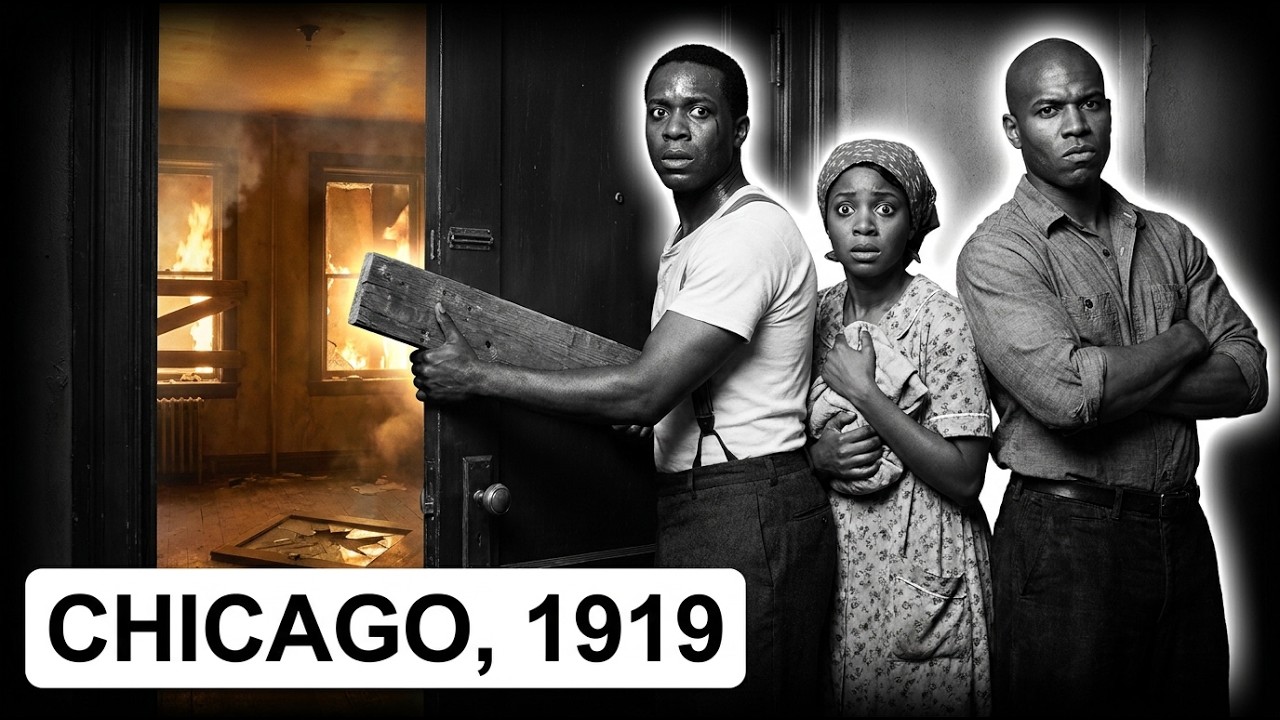
Within hours, the city erupted into the worst racial violence in Chicago’s history. The unrest that became known as the Chicago Race Riot of 1919 lasted eight days. By the time it ended, 38 people were dead — 23 Black and 15 white. More than 500 were injured, and over 1,000 Black families lost their homes to deliberately set fires.
Roughly 8,000 Black families were effectively trapped inside their neighborhood, unable to leave their homes without risking their lives. The seed of the violence was planted long before the stone was thrown. Chicago in 1919 was rigidly segregated. Black residents were confined to the “Black Belt,” a narrow corridor along State Street on the South Side, stretching roughly from 22nd Street to 39th Street.
During the Great Migration, the city’s Black population grew by 148% between 1916 and 1919, as tens of thousands of Southern Black workers arrived seeking jobs in stockyards, steel mills, and packing plants. The Chicago Defender, the nation’s most influential Black newspaper, actively encouraged this migration. Housing conditions in the Black Belt were explosive. Families of eight to ten people were squeezed into apartments designed for two.
Landlords divided units into kitchenettes and charged rents that consumed half a family’s income. When Black families tried to move outside the Black Belt, they were met with immediate violence. Between 1917 and 1919, more than 20 bombings targeted Black homes and the homes of white realtors who sold to Black buyers. No one was ever arrested.
On the day of Williams’s drowning, a Black man named James Crawford, overwhelmed by anger and grief, fired a gun at a group of police officers. He was killed on the spot — the second Black victim of the day, after Eugene Williams. This set off a spiral of violence. By Monday, July 28, the attacks escalated.
Black stockyard workers heading to their jobs were assaulted on streetcars and in the streets near the Union Stockyards. White gangs patrolled the boundaries of the Black Belt in cars, firing into crowds. Black men and women were dragged from streetcars, beaten, and in some cases killed. Workers who reached the stockyards were attacked inside the plants, while those who stayed home were confined to a neighborhood under siege.
By Tuesday, the Black Belt was under blockade. White gangs controlled the streets around the neighborhood. They stopped streetcars and forced Black riders off. They attacked Black pedestrians with bricks, clubs, knives, and guns.
Arsonists set fire to homes along the edges of the district, particularly along Wentworth Avenue, the informal boundary between Black and white neighborhoods. Estimates suggest a thousand Black families were burned out. Families fled deeper into the neighborhood, packing into relatives’ homes, sleeping on floors, in hallways, and in basements. Within the besieged district, the community organized its own defense.
Black veterans of World War I, who had fought in France and returned to a country that refused to treat them as citizens, put on their uniforms, armed themselves, and took to the streets. Veterans of the Eighth Regiment — an all-Black Chicago unit that had served with distinction in France — were especially prominent. They had trained for combat and been shot at by Germans; now they were being shot at by their own countrymen. They fought back, organizing armed patrols and defending the boundaries of the Black Belt.
The white mobs had expected the same passive submission of earlier racial violence; they did not get it. The poet Claude McKay, a Jamaican-born writer living in Harlem, captured this spirit in a July 1919 poem titled “If We Must Die,” published in The Liberator. It concluded: “Like men we’ll face the murderous, cowardly pack, pressed to the wall, dying, but fighting back. ”
The violence in Chicago was part of a national wave.
During the summer of 1919, known as Red Summer, more than 25 cities experienced racial violence, from Washington, D. C. , to Knoxville, Omaha, and Elaine, Arkansas. Chicago’s riot was the largest and deadliest.
The Illinois National Guard was finally deployed on Wednesday, July 30, four days after the violence began. Governor Frank Lowden had resisted calling out the Guard, hoping city police could restore order. They could not. The police force was understaffed, and many officers were openly sympathetic to white rioters.
The Chicago Commission on Race Relations later documented cases of police officers standing by while white mobs attacked Black residents — and some officers actively participating in the violence themselves. The violence did not fully subside until Saturday, August 2, when heavy rain fell on the city. The rain cleared the streets in a way that police and the National Guard could not. During the week of rioting, the Black Belt was effectively cut off from the rest of the city.
Streetcar service stopped, Black workers could not reach their jobs, the stockyards closed for days, and food supplies into the neighborhood were disrupted. Thousands of families rationed what they had, with mothers dividing a single loaf of bread among six children and neighbors sharing beans. Churches opened their doors and distributed what food they had. The National Guard eventually brought supplies, but the logistics took days to organize.
The Chicago Commission on Race Relations, created by Governor Lowden, issued its report in 1922. Titled The Negro in Chicago, it ran over 600 pages and documented the role of athletic clubs, police failures, the housing crisis, job competition, and the structural racism that made the riot not just possible but inevitable. But the report produced no consequences. No one was ever tried for the murder of Eugene Williams.
George Stauber was never arrested. The athletic club members who organized attacks on Black neighborhoods were never held accountable. The officers who stood by or participated were never disciplined. The report documented everything and changed nothing.
The aftermath deepened segregation. White homeowners’ associations intensified their efforts to keep Black families out of white neighborhoods. Bombings continued. Housing restrictions multiplied.
Black Chicagoans were confined to the Black Belt for another generation, and post-war public housing projects created a new geography of segregation that was in many ways worse. Eugene Williams was buried in Lincoln Cemetery in far south Chicago. There is no monument at the beach at 29th Street where he drowned. A small plaque was placed there in 2009, funded by students from a suburban high school.
Most Chicagoans are unaware of it. The unrest of 1919 came after the end of World War I. More than 380,000 Black soldiers had served in the American armed forces. The 369th Infantry Regiment, known as the Harlem Hellfighters, spent more consecutive days in combat than any other American unit.
The 370th Infantry, based in Chicago, was the only American unit led entirely by Black officers, from squadron leaders through the regimental staff. These men crossed the ocean to fight a war to make the world safe for democracy, and returned expecting democracy to apply to them too. It did not. W.
E. B. Du Bois addressed Black soldiers directly in an editorial in The Crisis in May 1919, two months before the Chicago riot: “We return. We return from fighting.
We return fighting. Make way for democracy. We saved it in France, and by the Great Jehovah, we will save it in the United States of America, or know the reason why. ”
The role of the Chicago police during the riot reflected a broader pattern.
The Chicago Commission on Race Relations documented that officers arrested Black victims instead of white attackers, stood by while white gangs beat Black people, refused to respond to calls from Black neighborhoods, and in some documented cases, participated in violence against Black residents. The commission noted that police response during the first four days showed a marked weakness in dealing with white rioters and an excessive willingness to arrest Black people. Many officers were Irish Americans from the same neighborhoods as the athletic clubs. They shared the same racial attitudes, the same political connections, and the same understanding of who was entitled to protection under the law.
The white gangs that terrorized the South Side were not random mobs — they were organized and armed. The most notorious were the Ragen’s Colts, an Irish American athletic club turned criminal organization based in Canaryville. By 1908, it claimed over 2,000 members. Their motto was reportedly: “Hit me, and you hit 2,000.
” They had close ties to the Democratic Party, the police department, and the emerging organized crime network that would later become the Capone gang. Other gangs included the Hamburgers, the Aylwards, the Our Flag, the Standard, and the Sparklers. The Chicago Commission on Race Relations identified these athletic clubs as largely responsible for the violence. The Black press played a crucial role during and after the riot.
The Chicago Defender, under editor Robert S. Abbott, published detailed accounts of the violence, named victims, identified attackers where possible, and urged the Black community to defend itself. The paper’s front page of August 2, 1919, listed the dead and wounded in the style of wartime casualty reports. It did not call for patience or restraint; it called for self-defense and justice.
The Defender had helped bring many of these families to Chicago in the first place, with stories of opportunity and freedom in the North. Now it documented the reality those families had found. The experience of being besieged inside the Black Belt left a deep mark on the community. For the families who lived through it, the riot was a revelation: the city they lived in was not their city, the police were not their police, and the laws were not their laws.
It also revealed that when the situation turned deadly, the community was capable of defending itself. The veterans who took to the streets in uniform, the mothers who fed their neighbors’ children, and the churches that opened as shelters all proved that the Black Belt bent and bled, but did not break. The riot’s legacy shaped Chicago for the rest of the century. The boundaries of the Black Belt, contested before the riot, became more fortified after it.
White homeowners’ associations organized more strongly. Bombings of Black homes continued. Restrictive covenants spread. The city government did nothing to address the root causes.
The police department was not reformed. The athletic clubs were not disbanded. The same conditions that caused the 1919 riot continued to fester for decades, contributing to new waves of violence in 1943, 1966, and 1968. The 1919 riot was not an isolated event.
It was the first chapter of a story that continued to unfold. One detail from the riot haunts more than any statistic. During the peak of the violence, a group of white men in a car spotted a 10-year-old Black boy on the street. They stopped the car, grabbed the boy, stripped him, burned his skin with lit matches, urinated on him, slapped his face, and forced him to run home naked.
The details were recorded by James T. Farrell in his novel Studs Lonigan, inspired by the actual riots and the behavior of the white gangs who committed them. The boy’s name was never recorded. The commission report of 1922 concluded with a series of recommendations: improving police performance in Black neighborhoods, enforcing housing laws, prosecuting bombers, and fostering interracial dialogue.
None were implemented. The report remains in libraries, cited by historians, read by students. Nothing changed. The riot ended on August 3, 1919.
But the conditions that caused it did not end on any date. Eugene Williams was 17, floating on a raft with friends on a hot Sunday afternoon, when he drifted across a line he could not see. A man threw a stone. Everything that followed — 38 dead, 500 injured, thousands of families burned out, 8,000 families trapped inside their apartments, the National Guard with bayonets in the streets of an American city — came from a stone and a refusal to act.
The water at 29th Street beach is still cold, the sand still warm, and children still play there on hot summer days. But the boy who drowned is still beneath the surface of the tragedy, named Eugene Williams. He was 17 years old, and he deserved to turn 18.