In the fall of 2005, a construction crew digging a wastewater pit for a university campus expansion in Stockton, California, struck human bones just a few feet beneath the soil. The digging stopped and the site was cordoned off as investigators realized the remains were not isolated. In the weeks that followed, officials estimated that as many as 30 people lay buried there without headstones or records. They were forgotten patients of California’s first insane asylum, a hospital that once stood on the same ground and had been closed for nearly a decade.
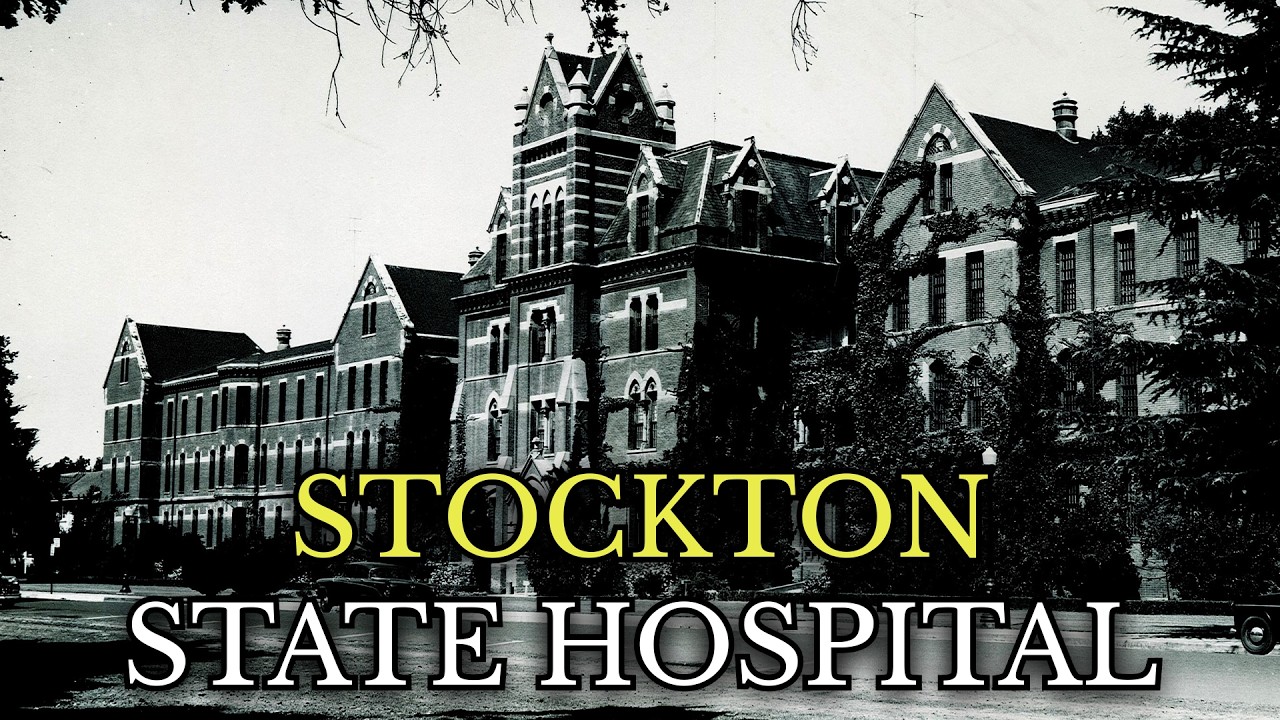
For much of its history, that hospital, Stockton State Hospital, did not treat the comfort or dignity of its patients as a priority. Patients labeled dangerous were kept in basement dungeons. At mealtimes, staff handed out only spoons, terrified that a fork or knife might become a weapon. That rule outlived generations of superintendents and remained in effect in an unheated dining hall until 1950.
The hospital was born out of the chaos of the California Gold Rush. After gold was discovered in January 1848, California’s population exploded from a few thousand to more than 100,000 people by the end of 1849. Many were men who had crossed oceans and continents chasing fortune, only to watch their promises collapse. Loneliness, cheap alcohol, and violence were common.
A portion of these men and women broke under the strain, and the state had almost nothing in place to care for them. California became a state on September 9, 1850. Its jails, poor houses, and streets became unofficial asylums for the mentally ill. By 1851, lawmakers authorized the creation of the state’s first public hospital dedicated to the insane, to be built in Stockton, a gateway to the southern mines.
Captain Charles Maria Weber, the town’s founder, donated 100 acres for the project. The facility opened modestly as Stockton General Hospital, caring for both the sick and the mentally ill under one roof. On May 17, 1853, it was formally renamed the Insane Asylum of the State of California. In its earliest years, the physicians embraced a philosophy called moral treatment, believing that structure, kindness, useful work, and a calm environment could heal troubled minds.
Of more than 2,000 patients admitted between 1852 and 1862, nearly 40 percent were discharged within six months. Many of those cases involved men whose breakdowns were tied to heavy drinking and resolved once the alcohol left their system. But the discharge numbers also reflected physicians who genuinely believed recovery was possible. The institution’s early leadership was unstable.
In April 1856, the second superintendent, Dr. Samuel Langden, and his assistant physician, Dr. William Ryer, settled a dispute by fighting a duel. Langden took a bullet to the knee, a wound serious enough to end his tenure as superintendent.
The incident demonstrated that the asylum’s ideals and its reality did not always match. As California’s population continued to climb, the modest wards quickly became too small. Work on a proper female building began in 1865, but the wings were not finished until 1874, nearly a decade after construction began. The completed structure could house 325 patients, but overcrowding became a defining feature of daily life.
Staff placed chairs and beds in the hallways, and patients considered difficult to manage were strapped into these chairs for hours in semi-darkness. The building had only two chimneys, and heat and light were concentrated in a few spaces. In 1869, administrators authorized a stopgap solution: a row of wooden structures known as the cottage ward. These temporary buildings ended up housing 160 men for years because a permanent solution was slower and more expensive.
In 1884, the men’s building, known as the Bricks, opened on Grant Street. It was the largest single ward on the property, built to hold 387 patients. In its basement were rooms that staff referred to as dungeons, where the most severely disturbed men were confined below ground, away from daylight. At mealtimes, patients were issued only a spoon, no fork or knife.
The rule persisted for decades. The dining room had no heating system at all, and patients shivered through meals until 1950, when heat finally reached the room. For 66 years, patients had been eating cold meals in a cold hall. The building originally rose with three steeples along its roofline, giving it the silhouette of a church.
Recreation did not arrive until around 1954, when the first dedicated club room was established. For 70 years, the building’s primary purposes had been housing, feeding, and containing patients. In April 1888, investigative reporter Frank A. Peltrit of the San Francisco Examiner faked insanity and got himself admitted to the hospital as a patient.
He lived, ate, and slept as a patient for several weeks, observing the wards, staff, and routines from the inside. His release was arranged by a colleague working the story from outside. Given the conditions inside institutions like Stockton, readers might have expected an exposure of cruelty. Instead, Peltrit’s account was largely favorable.
He wrote that his weeks inside had been better than he expected. He did not describe a house of chains and screaming, but a functioning institution doing its best within real constraints. His recommendations pointed to practical gaps: the asylum needed workshops, more variation in the dining hall menu, more physicians on staff, and closer supervision and better training of attendants. In 1909, California passed a sterilization law, becoming the third state to give its institutions authority to sterilize patients.
By 1921, California accounted for roughly 80 percent of all sterilizations performed in the entire United States. Among California’s institutions, Stockton led, accounting for nearly half of every sterilization performed statewide. The population subjected to this policy extended beyond adults formally diagnosed with severe mental illness. Some young boys sent to Stockton had committed nothing more than petty theft and were never formally classified as mentally deficient, yet they remained subject to the same sterilization regulations.
In 2003, Governor Gray Davis issued a formal apology on behalf of California, acknowledging the sterilization program as what he called a sad and regrettable chapter in the state’s history. Decades later, the state established a compensation program for survivors of forced or involuntary sterilization. Most of the people it might have helped were already in their 80s or older, and many had died before any apology reached them. Across more than a century of operation, thousands of people passed through Stockton’s gates.
The vast majority are lost to history, but a few documented lives survive. Sarah Althia Hill, a San Francisco socialite who had been a central figure in a sensational 1880s legal battle over a possible secret marriage to a powerful senator, spent decades as a patient at Stockton carrying a diagnosis of schizophrenia. She died in 1937. Martin Ramirez, a Mexican-born man diagnosed with schizophrenia, spent years institutionalized and began producing an extraordinary body of drawings built from trains, tunnels, animals, and religious imagery.
His work was treated as a curiosity until decades after his death in 1963, when he came to be recognized as one of the most significant self-taught artists of the 20th century. His drawings eventually found their way into major museum collections. Ad Wolgast, a celebrated lightweight boxing champion of the early 1900s, saw his mental health decline sharply after his career. He spent his final years institutionalized and died in 1955.
The hospital’s own cemetery also held, at least for a time, William Troy, a recipient of the Medal of Honor. On the darker end of the spectrum, Carol Cole, later convicted as a serial killer responsible for murders across multiple states, spent time institutionalized at Stockton before the crimes that defined his name. The exact circumstances of that stay are not well documented. On November 30, 1938, a patient inside the Bricks set fire to a pile of oily rags stored in a closet.
The flames tore through ward 6 and climbed into the steeple above it. In the chaos, a number of patients escaped the building entirely. The hospital patched what could be patched, and the two remaining steeples were eventually removed due to structural weakness and leakage. The fire of 1938 marked a turning point, a visible sign that the building itself had begun to fail.
Administrative functions began shifting elsewhere. A new administration building opened in 1953, and a professional building was completed in 1962, absorbing the last offices. Deactivation began in February 1958 and continued until August of that year. Full demolition was completed in 1964, and crews removed an estimated 3,250,000 bricks from the site.
In 1973, the state folded physical and mental health programs into the Department of Health. In 1978, officials broke the department back apart, and Stockton was placed under the newly formed Department of Developmental Services. In 1986, the institution was renamed the Stockton Developmental Center. By the 1990s, deinstitutionalization had become impossible to ignore.
The Coffelt settlement agreement, a legal resolution addressing the state’s obligations to residents of its developmental centers, set in motion the downsizing that would close Stockton for good. Over the fiscal year spanning 1995 to 1996, the center wound down its operations entirely, discharging or transferring its remaining residents and closing its doors after roughly a century and a half of continuous operation. The first sign of what lay beneath the old hospital grounds surfaced in 1990, when crews working on another part of the property uncovered human remains belonging to former patients. The state arranged for cremation and purchased plots at the Stockton Rural Cemetery to hold the unidentified remains.
In the fall of 2005, construction crews working on the Stockton campus of California State University, Stanislaus, struck bone almost immediately while digging a wastewater pit. Officials estimated that the remains of as many as 30 former patients lay in that single location, individuals who had died within the hospital’s walls and been buried with no headstones in ground that had since been paved over. Local historians and grave site researchers were not entirely surprised. One researcher who had spent more than a decade examining burial sites arrived within a day of the discovery, arguing that the ground should be treated as a cemetery until every remain had been properly removed.
According to estimates drawn from historical hospital records and advocacy groups, as many as 4,200 patients who died at Stockton may have been interred in unmarked or mass graves scattered across the property. Today, the identifiable remains connected to Stockton rest primarily in two places. At Park View Cemetery in the nearby town of Manteca, two mass plots hold the cremated remains of 2,284 people who died at Stockton. At Stockton Rural Cemetery, two additional unidentified plots remain, marked by a simple granite marker standing in for names that no one alive can any longer recover.
The old hospital carries an official designation as California Historical Landmark Number 1. Several of the surviving hospital buildings still stand on the property, repurposed now for lecture halls and offices. A university campus sits literally on top of an asylum, its lawns and parking lots resting above ground that may still hold thousands of the institution’s forgotten dead.
Students attend classes without knowing they are walking paths where patients once shivered through meals with nothing but a spoon.