On February 9, 2026, a nursing class took their seats in a new $54 million academic building in Stockton, California. Beneath that lawn lies the site of Stockton State Hospital, the first asylum established in the state of California. In 2005, workers digging a wastewater pit on the campus unearthed as many as 30 sets of human remains. Coffins, square-headed nails, and bone were brought up, but no names.
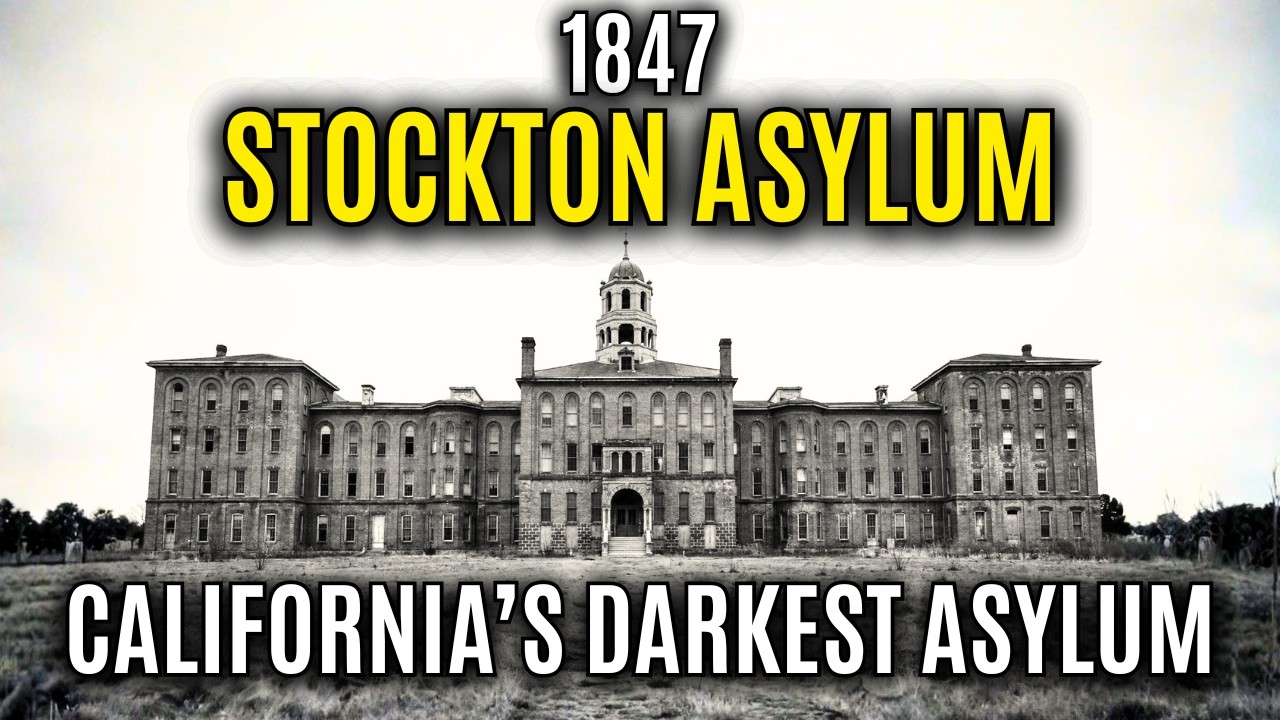
The discovery was never fully explained. The institution’s history did not begin in 1853, and it did not begin on land at all. It started on a boat. In 1849, San Francisco had no penitentiary.
It had one log jail so flimsy that a prisoner once walked out carrying the door on his back. The Gold Rush had emptied ships in the bay and filled the streets with people the city could not account for. On October 8, 1849, the town council purchased the brig Euphemia and moored it beside the central wharf. The conversion of the ship into a jail cost $1,033.
75 in lumber, and the balls and chains arrived in late January 1850 at a cost of $523. 80. Below decks sat a cell block, and above it a guardhouse. The Euphemia did not only hold criminals.
She also held, in the language of the day, any suspicious, insane, or forlorn person found strolling about the city at night. The ship served as the city brig from October 1849 until May 1851, and it is regarded as California’s first facility for the insane. The state’s solution was practical rather than humanitarian. In May 1852, the legislature ordered that every mental patient in the state be sent to a general hospital in Stockton, 90 miles inland.
The state itself recorded that the site was chosen for ready access to the gold fields. Three founding dates exist because the institution evolved in stages: the hospital opened in 1851, the state began sending the insane there in 1852, and on May 17, 1853, it was formally designated the Insane Asylum of the State of California. The first superintendent, Dr. Robert King Reed, ran the institution from its opening until 1856.
He kept meticulous weather records, taking temperature readings three times a day and adding barometric pressure readings in 1853. The institution was built on the doctrine of moral treatment, which held that kindness was the medicine. That philosophy is essential context for what came later. Over the course of 94 years, the same institution that forbade a raised voice against a patient ended up performing 245 lobotomies, defining a cure as a patient too emotionally flattened to speak up at all.
The female building, begun in 1865, was not finished until 1874. One history, reprinted widely but never confirmed against appropriation records, puts its cost at $249,500 and its capacity at 325, with a central tower rising more than 200 feet, high enough for river pilots to use as a navigation mark. The state’s landmark plaque credits Captain Charles Maria Weber with donating part of the site. The rulebook from 1861 survives.
It was printed in Stockton and called the Rules and Regulations of the Insane Asylum of California. It describes a place organized around control and routine. Meals were served by season, and knives, forks, and spoons were counted after every meal. Patients were bathed on Wednesday and Saturday mornings.
Cutting the hair of the insane close to the head was, in the document’s own phrase, positively forbidden. Restraint existed, recorded as muffs, sleeves, wristbands, or other means of confinement. It could only be used on a doctor’s order. An attendant who struck or kicked a patient was dismissed immediately, and threats and taunts were forbidden outright.
The rules called attendants the companions, not the keepers, of the patients. Somebody had thought about dignity, even as every letter to or from a patient had to pass through the superintendent. The rulebook borrowed freely from another institution. Its final page says the resident physician made free use of the published rules of other institutions, particularly the Illinois State Hospital for the Insane.
California’s founding document of mental care was largely borrowed from Illinois. The numbers tell part of the story. The finished female building held 325. In 1869, a row of wooden sheds called the cottage ward put 160 men in them.
In 1884, the men’s brick building opened with room for 387. The census year by year is not online; it sits in 132 bound volumes at the California State Archives. In 1875, the state opened a second asylum at Napa for the express purpose of relieving overcrowding at Stockton. The bill was written by Stockton’s own superintendent, Dr.
G. A. Shurtleff, who resigned in 1883 with his health broken by overwork. From 1873 to 1887, the territory of Arizona had no asylum of its own, so it paid California to house its insane citizens in Stockton.
When Phoenix opened its own facility, 61 people were shipped back across the desert, 49 men and 12 women. Statewide, the institutional population grew from 6,864 in 1910 to 36,403 in 1955. The clearest measure of the problem at Stockton comes from the state’s own statistical report for the year ending June 30, 1947: more than 4,000 patients were cared for by just 11 physicians, roughly 364 patients for every doctor. California passed its first sterilization act on April 26, 1909.
It was replaced with a broader law in 1913 and widened again in 1917. There was no appeal, no written notice, and no hearing. Before 1964, 20,108 people were sterilized in California, one third of the national total. Stockton was out in front early.
Historian Dr. Joel Braslow, who read the hospital’s patient files, found that by June 1926, physicians here had performed more than ten times as many sterilizations as Agnews State Hospital, nearly 40 percent of the state’s total to that date. What made Stockton distinct was the justification offered. Doctors did not write about race or heredity; they wrote about the patient.
They recorded that sterilized patients showed marked improvement, and they sterilized women on the stated grounds that it spared them the strain of childbirth. Braslow titled his study in the name of therapeutics. The first electroshock machine arrived in 1943. Then came the surgery.
Between March 1947 and June 1954, physicians here performed 245 lobotomies on 232 people. Of the 241 patients whose sex could be identified from the surgical summaries, 205 were women. That is 85 percent, even though men outnumbered women in the hospital. The files show that in 400 sampled records from the same period, women and men received electroshock at equal rates.
The skew was specific to the knife. The files also record the rationale. One physician recommending a third operation on a woman who had already had two wrote that staff might be released for more useful work elsewhere if no longer required to restrain her. In a clinical conference, another doctor observed that the operation leaves patients flat and indifferent.
A colleague answered, Maybe that is what cures them. The rulebook of 1861 forbade a raised voice. The clinical conference called a patient who could not raise one recovered. The program stopped abruptly in 1954, not because of a lawsuit or an inspection, but because two drugs arrived: reserpine and chlorpromazine.
A ward could be kept quiet with a pill. The institution did not end in a riot or a scandal. No reporter exposed it, and no court found it cruel. What ended 145 years of institutional life was a settlement agreement and a line in a budget.
In 1994, a class action called Coffelt v. Department of Developmental Services was settled. The state agreed to move 2,000 people out of its institutions and to stop admitting anyone new. The department chose which of its seven facilities to close and picked the oldest and the smallest.
The human cost is recorded in individual lives as well. On March 8, 1907, a man named William Troy died in Stockton, California. Thirty-six years earlier, he had been an ordinary seaman aboard the U. S.
S. Colorado. At the capture of the Korean forts on June 11, 1871, Troy fought beside Lieutenant Hugh McKee. McKee was mortally wounded.
Troy was badly wounded himself, and McKee commended him by name before he died. General Order 169 awarded William Troy the Medal of Honor. When he died, he was buried in the asylum’s cemetery. Nothing in the record says whether he was a patient, how long he had been there, or why a decorated sailor from Boston ended up in the ground behind a California asylum.
An earlier controversy ended in gunfire. Dr. Robert Reed was pushed out in 1855 when the governor declared his post vacant and accused him of using patient labor to build himself a house and of buying land beside the hospital. The fight resulted in a duel between the governor’s appointee and the assistant physician, who fired early and hit the appointee in the knee, ending his tenure as superintendent.
In April 1888, a reporter for the San Francisco Examiner had himself committed as an insane man. He stayed for weeks until a colleague got him out. His report was mostly favorable, asking for workshops, more variety at dinner, more physicians, and better trained attendants. Then there was Dr.
Margaret H. Smith, who appears in a staff photograph outside the receiving building in 1928. In 1929, she became the first woman to run Stockton State Hospital, a position she held for 17 years. She struck the words asylum and insane out of the institution’s vocabulary.
On her retirement in 1946, Governor Earl Warren said she had done more to advance the treatment of the mentally ill than anyone else in the state. Her tenure sits exactly on top of the sterilization decades. The lobotomy program began in March 1947, the year after she left. No document connects Smith personally to a single sterilization recommendation.
The institution kept beautiful books. The farm charged itself with the wages paid for labor, and every hour of patient work was written down. Patients plowed, planted, picked, laundered, and sewed. No clothing was purchased outside the asylum if it could be manufactured in the sewing rooms.
The hospital dressed itself with the hands of the people it held. The clerk was ordered to calculate one figure in particular every month: the average cost of each patient per day. That number was never made public. The ghost stories are folklore and should be reported as such.
In September 2013, the novelist Kim Fielding, who modeled a fictional asylum on this one, wrote that people find the place spooky and that there are stories it is haunted. She had walked the corridors at night and found it sad rather than frightening. The big claim about bodies requires scrutiny. You will hear that more than 4,000 patients were dumped in an unmarked mass grave under the campus.
A podcast episode in March 2024 put it in those words. The figure traces back to a line in the Lodi News Sentinel from November 2005, attributing the number of as many as 4,200 to a website run by a group called Californians Saving Graves. What was actually unearthed in 2005 was as many as 30 people. The Department of State Hospitals records 2,284 cremated remains at Parkview Cemetery in Manteca, shared between Stockton and Modesto.
One transcriber working from commitment entries counts 4,467 burials at the first cemetery between 1852 and 1870, of which only 1,619 were moved when the site closed in 1875. If those figures are accurate, roughly 2,800 people were left where they were and built over. That is worse than the legend, and it is not a mass grave. It is a filing failure.
Nobody hid these people. Nobody had to. Stockton State Hospital and the Stockton Developmental Center are the same institution, renamed in 1986. The Lanterman Act of 1969 built California’s regional center system and began moving people out of institutions.
By the early 1970s, Stockton had stopped being a mental hospital in any recognizable sense and had become a place that trained people with developmental disabilities. The state took another 27 years to act on the warnings. In 1990, a group called Protection and Advocacy filed a class action on behalf of 13 families. An organization called VOR, which opposed the closures, says a survey of more than 5,000 developmental center families found 98 percent did not want to join the lawsuit.
Take that number with the source attached. The settlement came in 1994: 2,000 residents to be moved, no new admissions. Through 1995, the several hundred people still living at Stockton were dispersed to other state facilities and to community homes. Many were moved more than twice.
One source describes revolving door placements and transfer trauma, citing research published between 1996 and 1999, finding mortality risk between 72 and 88 percent higher in community settings than in developmental centers. That research is cited at one remove. In February 1996, the patient records left the building. On May 17, 1996, the state bolted a bronze plaque to the site, placed jointly by the Department of Parks and Recreation and the Department of Developmental Services.
The plaque says the center spearheaded the movement to provide services outside the institutional setting. That is institutional language for we shut it. William Troy did not stay in that ground. At some point, his remains were lifted out of the Stockton State Hospital Cemetery and taken south to the San Joaquin Valley National Cemetery at Santa Nella.
He has a stone with his name on it. The people buried beside him did not get that. In 1990, remains unearthed elsewhere on the old hospital grounds were placed in two plots at the Stockton Rural Cemetery under a flat granite marker that reads, Unidentified from the State Hospital. The site is called University Park now, 102 acres in Stockton’s historic Magnolia district.
Acacia Court, nearly 250,000 square feet of old hospital, has been converted into classrooms and labs. The Magnolia Mansion stands across the street, 16 rooms built in the late 1800s. This is the only public four-year institution in San Joaquin County. In 2024, State Senator Susan Talamantes-Eggman stood on that ground and said, This used to be an old state hospital, a place of sadness.
Consider what happened to the others. Napa, opened in 1875 to relieve this very hospital, is still running, with roughly 4,368 people buried on it between 1875 and 1924. Agnews lost more than 100 patients in the 1906 earthquake and let its last resident walk out in March 2009. Camarillo, opened in 1936 with 406 patients, held over 7,000 by 1957, and closed in 1997.
It is a university campus now, too. Stockton got a plaque, a lawn, and a lecture hall. They dug it up in 1990. They dug it up in 2005.
They dug it up for a wastewater pit and filled it back in with dirt. They dug it up, and nobody could say who anybody was. A general hospital, an insane asylum, a state hospital, a developmental center, a university. One block away in the Stockton Rural Cemetery, a flat granite marker lies in the grass.
It is not moved. It reads, unidentified from the state hospital. California wrote a rule book in 1861 promising no voice would ever be raised against a patient inside. It kept that promise in the end by taking the voices.
The question that remains is what a state owes the people it can no longer name.