Four minutes. That is how long John Sweeney needed to strangle Dominique Dunne with his bare hands until she stopped breathing. Inside the house, a record was still spinning on the turntable—music Sweeney had asked to be put on moments earlier, a chilling soundtrack to the brutality unfolding on the driveway. In 1982, Hollywood had cleared the way for Dominique Dunne to become an A-list star after the hit film Poltergeist.
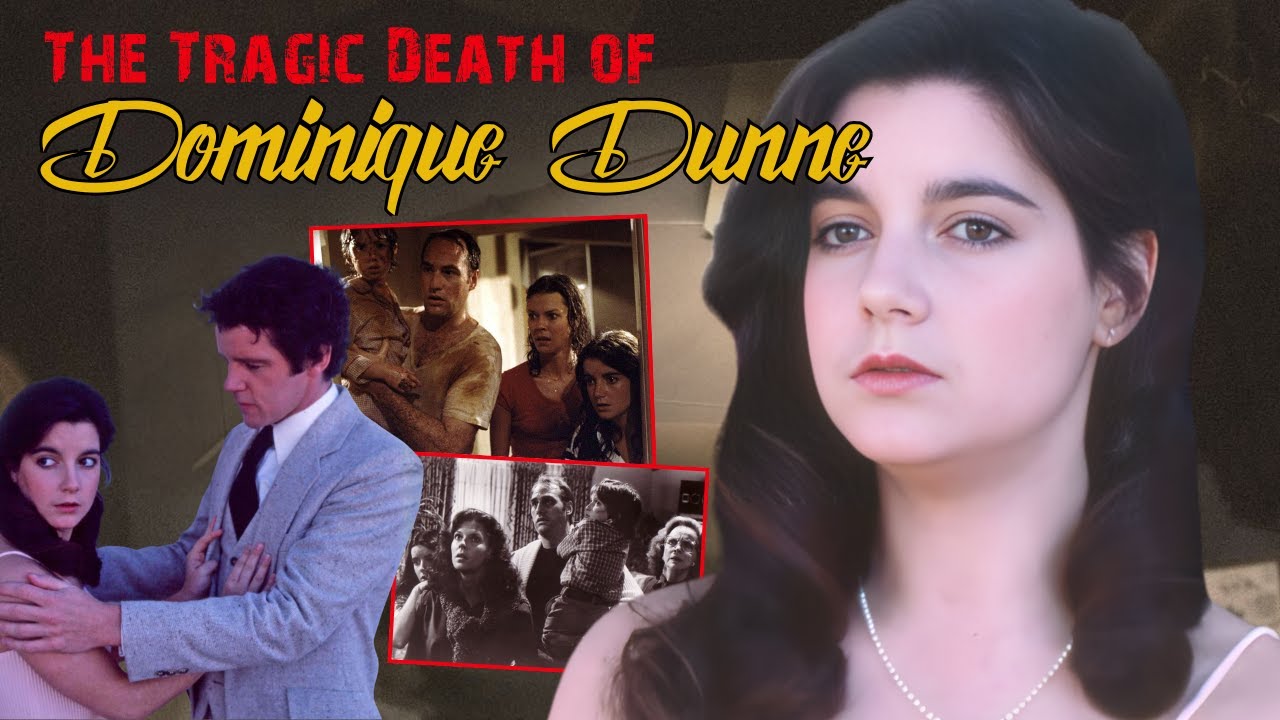
But instead of appearing on the covers of prestigious magazines, as had been predicted, her name abruptly disappeared into the obituaries, with a senseless end at 22 years old. Her death—and the subsequent failure of the justice system—turned her father, a film producer, into America’s most hardened crime journalist. Dominique Ellen Dunne was born on November 23, 1959, in Santa Monica, California. To say she was born into privilege is an understatement.
She was born into what amounted to the aristocracy of mid-century Hollywood. Her father was Dominic Dunne, a man who would eventually become a world-famous investigative journalist, but who at the time was already a rising film producer and an influential figure in society. Her mother was Ellen Beatrice “Lenny” Griffin, heiress to a massive cattle fortune—a woman of Mexican and Irish descent with striking classical beauty and a stoic grace. The Dunne family home stood on North Bedford Drive in Beverly Hills.
In the late 1950s and early 1960s, that address was the epicenter of a particular form of glamour that no longer exists. It was a closed community of black-tie galas, sprawling manicured lawns, and intense social stratification. Growing up in the Dunne household was a masterclass in high-society surrealism. For Dominique, a Sunday brunch was more than just eggs and toast—it was a gathering where Frank Sinatra might casually hang around in the living room, or where you could bump into Elizabeth Taylor in the hallway.
Her godparents were cultural giants: Maria Cooper Janis, daughter of the legendary Gary Cooper, and prolific producer Martin Manulis. Dominique was the fourth of five children, two of whom died at a young age. She was left with her older brother Griffin and her younger sister Alex. In this hectic environment, personalities were strong and egos often fragile.
Griffin Dunne would later become a celebrated actor and director, known for his sharp wit and energy. But amid the whirling chaos of famous guests and industry power plays, Dominique carved out a different role. She was the peacemaker in a home that often felt like a stage set—the grounding presence. When tensions ran high, Dominique was the one who absorbed the shock.
She possessed an innate empathy, a sensitivity that let her instantly read the mood of a room. Her father later remembered her as the glue of the family—the one who remembered birthdays, soothed arguments, and listened while others screamed. She was “the good one. ”
But privilege often acts as a golden curtain hiding deeper problems.
The Dunnes’ marriage was becoming increasingly unstable. Dominic Dunne, as he later brutally admitted, struggled with demons that threatened to tear the family apart. He fought addiction and the enormous pressure of maintaining appearances in a city where you were judged by your latest hit film. The arguments between her parents were frequent and fierce.
For a sensitive child like Dominique, the unraveling of her parents’ marriage was a deep, silent wound. The safe haven of North Bedford Drive was crumbling. In 1967, when Dominique was just seven years old, the marriage collapsed definitively. Dominic Dunne left and fell into a downward spiral of professional and personal suffering before eventually finding redemption years later.
Lenny took the children and moved to a simpler, though still comfortable, life. This transition marked a turning point for Dominique. She had experienced the fragility of the perfect life. She learned early that security was an illusion and that money could not buy stability.
But this trauma did not break her—it forged a resilience that would define her young adulthood. She became protective of her mother and fiercely loyal to her siblings. Dominique’s education consisted of a tour through elite West Coast institutions: Harvard-Westlake School, Taft, and Fountain Valley in Colorado. But she was not merely a socialite in training.
She had an artistic soul that was restless within the walls of American private schools. After graduation, she did not immediately dive into the family business or enroll in a predictable Ivy League university. She did something brave. She went to Florence, Italy.
There is a specific anecdote from this period that is essential to understanding Dominique’s character—a story that refutes the idea that she was a helpless girl who needed saving. When she arrived in Italy, barely twenty years old, fate struck. Her luggage was lost during the trip. She was alone in a foreign country, her knowledge of Italian was rudimentary at best, and she had none of her belongings.
A spoiled Hollywood child might have burst into tears, called her father, and demanded a flight home. Dominique did none of that. She navigated the labyrinthine chaos of Italian public transport, communicated with gestures and broken sentences, and found her way to the Michelangelo School, where she had enrolled to study art. She found housing.
She survived. In fact, she thrived. She immersed herself in the culture, learned to speak Italian fluently, and developed a refined eye for art and design. That year in Florence was her cocoon.
She learned she could exist without the safety net of the Dunne name. She discovered she was capable, resourceful, and independent. She returned to the United States not merely as a producer’s daughter, but as a young woman of substance. Upon her return to the U.
S. in 1979, after a period of dormancy, she was seized again by the acting bug. She enrolled at Loyola Marymount University, ostensibly to earn a degree. But her heart was already on the film set.
The academic world could not hold her. She decided to drop out and devote herself fully to acting. Here, Dominique’s integrity shines most clearly. In Hollywood, where nepotism is the norm, she could easily have used her father’s name or the fame of her aunt Joan Didion to get ahead.
She refused. She found her own agent and sat in waiting rooms with hundreds of unknowns, determined to succeed on her own merit, not on her pedigree. She wanted to earn it. And she was good.
She was very good. The camera loved her—not because she was a classic bombshell, but because she possessed a relatable, vulnerable humanity. She had a febrile, electric energy, a kind of desperate desire to connect that translated beautifully on screen. Casting directors began to notice her.
She landed roles on the biggest television series of the era. She appeared in Lou Grant, Hart to Hart, and Fame. In CHiPs, she played a character that required a mix of innocence and perseverance. She shone in the dark TV movie Diary of a Teenage Hitchhiker.
With each role, her confidence grew. She proved to herself and her family that she was a professional. Then came the moment that would change her career forever. Steven Spielberg and Tobe Hooper were casting a new horror film titled Poltergeist.
They were looking for an actress to play Dana Freeling, the teenage daughter of the tormented family. The role required a specific balance. Dana had to be a typical teenager—annoyed by her family, focused on her boyfriend, eager to grow up—but she also had to exude pure, primal terror as the supernatural events began to unfold. Spielberg did not want a polished, plastic Hollywood star.
He wanted someone who felt real. Dominique auditioned and beat out hundreds of other actresses. When she got the call, it was confirmation of her hard work. Poltergeist, released in June 1982, became a worldwide phenomenon.
The film redefined the horror genre, moving terror from gothic castles to sunny American suburbs. Dominique held her own alongside heavyweights like JoBeth Williams and Craig T. Nelson. There is a scene in the film where Dana realizes what is happening to her family.
The look in Dominique’s eyes at that moment is terrifyingly authentic. Overnight, Dominique Dunne was everywhere. The film was a box office smash. She was recognized in supermarkets.
Interviews, photo shoots, and scripts began to pile up. She was 22 years old, beautiful, talented, and on the threshold of lasting stardom. She was quickly cast for a leading role in the highly anticipated science-fiction miniseries V. This was no small role—it was a career-defining part that would have made her a household name for the rest of the 1980s.
From the outside, her life seemed like a fairy tale. She had the background, the talent, and now the fame. But while her professional life shot into the stratosphere, her private life was quietly and treacherously sliding into a dark, suffocating spiral that no one—not even her closest friends—fully understood until it was too late. “Peacemaker” had met a man, and she was about to discover that the monsters in movies were nothing compared to the monsters who claim to love you.
Domestic violence rarely begins with a fist. It almost always begins with a flower. In November 1981, at a party in Los Angeles, Dominique was introduced to a man named John Thomas Sweeney. The 25-year-old Sweeney was a man of intense charisma.
He was handsome in a brooding, rugged way that sharply contrasted with the polished private-school boys Dominique had grown up with in Beverly Hills. But more than his looks, it was his talent that drew people to him. Sweeney was the chef at Ma Maison. In the early 1980s, Ma Maison was not just a restaurant—it was the culinary beating heart of Los Angeles, the meeting place of the rich and famous.
A place with a secret phone number where Orson Welles held court and Wolfgang Puck was revolutionizing American cuisine. Being chef at Ma Maison meant being a rock star in the making. Sweeney was ambitious, hardworking, and driven. On the surface, the two were a study in contrasts.
Dominique was the princess of Hollywood—highly educated, refined, deeply connected. Sweeney came from Hazleton, Pennsylvania, the son of an alcoholic father, raised in a working-class environment full of hardship and scarcity. He had worked his way up from washing dishes to the top of the LA restaurant world. When they met, the chemistry was immediate and explosive.
Sweeney was overwhelmed by Dominique. She represented everything he wanted: beauty, class, and acceptance into a world he had always longed to join. For Dominique, Sweeney represented something raw and authentic. He wasn’t part of the industry in the traditional sense.
He cooked with his hands. He was passionate. They fell in love at a dangerously fast pace. Within weeks of their first meeting, they were inseparable.
Within a few months, they had moved into a small, single-story house on Rangely Avenue in West Hollywood. It was a modest, comfortable, cozy home—the perfect starter home for a young, ambitious couple. To their friends, they seemed like a golden couple. They threw dinner parties where Sweeney cooked exquisite meals and Dominique charmed the guests.
But behind the closed doors of Rangely Avenue, the fairy tale began to rot from within. The dynamic changed abruptly. Sweeney’s admiration turned into possessive obsession, tormented by deep-seated insecurities and threatened by her skyrocketing success. He didn’t want to just love Dominique.
He wanted to own her. He began to isolate her, criticizing her friends and demanding to know where she was at every moment. The peacemaker tried to soothe him by making herself smaller so he could feel bigger—without realizing she was feeding a black hole that could never be filled. If he was angry, she tried to fix it.
If he was insecure, she reassured him. The psychological abuse inevitably escalated into physical violence. The first major documented incident occurred on August 27, 1982. The couple was at the house on Rangely Avenue.
An argument broke out, probably over something trivial, fueled by Sweeney’s jealousy. But this time he didn’t just scream—he attacked. John Sweeney, a man who earned his living with the strength of his hands, grabbed Dominique by her hair. Her hair was one of her most defining features: thick, glossy, and dark.
He yanked her head back with such brute force that he pulled clumps of hair out by the roots. Terrified and in pain, Dominique managed to break free. She fled the house and drove straight to her mother Lenny’s home. She was hysterical.
The illusion of a happy relationship was shattered. But then the vicious cycle of abuse kicked in again. Sweeney showed up at Lenny’s door. He was no longer angry.
He was broken. He was crying. He fell to his knees. He offered elaborate apologies, claiming that the stress of his work, the pressure, and the fear of losing her had made him snap.
With tears in his eyes, he promised he would never touch her in anger again. Dominique, looking at the man she loved, saw his pain and confused it with remorse. She forgave him. She went back to him.
It is a decision that frustrates those looking back on the case, but it is one that millions of victims of domestic violence make every year. She believed she could save him. She was wrong. The violence was not a mistake.
It was a method. A month later, on September 26, the monster returned—and this time it was deadly. Another argument broke out at the house on Rangely Avenue. This time, Sweeney did not grab her by her hair.
He grabbed her by her throat. He threw her to the ground and wrapped his hands around her neck. He began to strangle her. Strangulation is a unique form of violence.
It is intimate. It takes time. It requires the attacker to look the victim in the eyes as life drains away. It is the ultimate form of control: I decide whether you breathe.
Dominique fought for her life. As her vision blurred, she realized he would not stop. In a surge of adrenaline, she managed to scratch, kick, and loosen his grip just long enough to run. She ran to the bathroom and locked the door.
But a closed door meant nothing to a raging Sweeney. He started pounding on it, breaking the wood. Dominique knew that if he got into that room, she would die. She opened the bathroom window.
It was small, high, and hard to negotiate. But she climbed through it and tumbled into the side yard. She didn’t look back. She ran to her car.
As she stood there, terrified and gasping for air, fumbling with her keys, Sweeney stormed out of the house. He saw her in the car. He ran toward her. As she hit the gas and pulled away from the curb, John Sweeney hurled himself onto the hood of her moving car, screaming at her through the windshield.
She slammed the brakes or swerved—the details are chaotic—but she managed to shake him off and drive away. This time there would be no forgiveness. The spell was broken. Dominique realized the man she loved was capable of killing her.
She went into hiding. She stayed with friends. She told her mother. And then she did the hardest thing a victim can do—she broke off the engagement.
She called Sweeney and ended the relationship. She told him he had to move out. Amazingly, he agreed. Perhaps he thought this was just a game he could win later.
He packed his bags and left. Dominique moved back into the house on Rangely Avenue, but she was not naïve. She immediately called a locksmith. She had all the cylinders in the house replaced.
She installed extra locks. She told her friends she was afraid of him. She stopped answering his calls. For a few weeks in October 1982, it seemed as though she had escaped.
She threw herself into her work. Rehearsals for V were intense, and she developed a good rapport with her co-stars, particularly an actor named David Packer. She was 22 years old. She was single.
And she was safe. At least, that’s what she thought. Sweeney wouldn’t let her go. He was like a ghost haunting her life.
He constantly called the house and hung up as soon as she answered. He showed up at places she frequented. He was losing control. He had lost his job at Ma Maison due to his erratic behavior.
He had lost the princess. He had lost control. And for a narcissist like Sweeney, losing control is a psychological emergency. Dominique tried to act normal.
She went to parties. She prepared for Halloween. She looked forward to the future. But there was a shadow over her.
Her friends later remembered that the sadness in her eyes seemed to deepen during that time. It was the look of someone waiting for fate to strike. Saturday, October 30, the day before Halloween. The autumn air in Los Angeles was crisp.
Dominique was at home on Rangely Avenue. She had invited David Packer over to rehearse lines for V. They sat in the living room, scripts in hand, talking, maybe laughing. It was a moment of normalcy.
The phone rang. Dominique answered. It was a friend. They chatted for a while.
Then there was a click on the line. The operator’s voice came on: “I have an emergency call from John Sweeney. ” The operator asked, “Will you accept the charge? ”
Dominique froze.
She looked at David Packer. She looked at the safety of her living room. She could have said no. She should have said no.
But the impulse to do the right thing was still there, overriding her survival instinct. She was afraid something terrible had happened to him. Maybe he was injured. “Yes,” she said.
“I’ll accept the call. ”
Sweeney was on the line. He was in a panic. He claimed he was having a nervous breakdown.
He begged her to let him come see her. He said he just wanted five minutes to talk to her to get closure. He wanted her to tell him it was truly over so he could move on. Dominique held firm.
“No, John, you can’t come over. I have company. ” He said, “I’m already on my way. ” She hung up the phone.
A cold, threatening feeling descended over the house. She told David Packer that her ex-boyfriend was coming over and that he was unstable. Ten minutes later, headlights shone through the front window. A car door slammed.
Heavy footsteps crossed the driveway. John Sweeney stood at the door. It was around 8:50 p. m.
Inside, David Packer sat frozen. Dominique was separated from Sweeney by just a closed wooden door and a thin metal screen—the last physical barriers between a young woman’s future and her ruin. Dominique had told him, “He’s crazy. I’m afraid of him.
” She hadn’t left the safety of the living room to welcome Sweeney, but to contain him—to keep him outside, away from her sanctuary and her guest. Dominique opened the wooden front door but kept the screen door locked. She spoke with Sweeney through the mesh. We will never know the exact words exchanged in the cool night air.
We can assume Sweeney pleaded. We can assume he used the same manipulative script as in August—the tears, the claims of self-destruction, the “I can’t live without you. ” He was likely playing on her empathy, begging for just one moment of physical closeness, a hug, a final farewell. Whatever was said, it worked.
Or perhaps Dominique simply realized he wouldn’t leave until she looked him in the eye. Against all her survival instincts, she opened the screen door. She stepped out onto the porch. The conversation initially continued in whispers.
David Packer, straining his ears from inside the house, heard the murmur of their voices. Then the tempo changed. The voices grew louder. The pleading turned into arguing.
The arguing turned into shouting. And then a sound that David Packer would probably never forget: a sharp, sickening slap. It was the sound of a hand hitting flesh. Then a scream—Dominique’s scream.
And then silence. It wasn’t a gradual silence. It was an abrupt, terrifying disappearance of all sound. No more words, no more footsteps—just a heavy, suffocating silence hanging over the neighborhood.
What happened on the porch was a scene of calculated cruelty. John Sweeney, the man who claimed to love her, grabbed Dominique by the neck. He threw her to the ground. He dragged her body from the porch to the driveway, toward the bushes—perhaps to conceal his actions from the street or the house.
He knelt over her. He placed his large, powerful hands around her throat and squeezed. According to medical jurisprudence, unconsciousness from strangulation can occur within 10 to 15 seconds. But death—or the irreversible brain damage leading to death—takes much longer.
It takes four to six minutes of sustained, unrelenting pressure. Four minutes is an eternity. Try holding your breath for four minutes. Look at a clock and watch the second hand go around four times.
It is an eternity. This was not an impulsive decision. This was not a moment of lost self-control. This was not a mistake.
This was sustained physical exertion. For four to six minutes, John Sweeney looked down at the woman he loved and squeezed the life out of her while she lay helpless beneath him. Inside the house, David Packer was panicking. He knew something was wrong.
The silence was louder than the screaming. He called Dominique’s name. No answer. He called the police.
And here we hit one of the most frustrating details of this entire tragedy—a failure of the system that feels almost cinematic in its cruelty. According to Packer’s later statements, when he got on the line with the operator and desperately explained that his friend was being attacked, he was told that the residence on Rangely Avenue fell outside their jurisdiction. West Hollywood was then a patchwork of jurisdictions, lying between the LAPD and the Los Angeles County Sheriff’s Department. At the crucial moment—when seconds meant the difference between life and death—bureaucracy slowed the rescue.
Packer was terrified. He was alone in the house with a violent man right outside. He called a friend and reportedly said, “If I die, John Sweeney is the one who killed me. ” Eventually, no longer able to bear the silence, Packer gathered the courage to leave the house.
He went out the back door, walked around the property, and approached the driveway from the entrance. He saw a scene of total devastation. John Sweeney was kneeling in the bushes. Dominique lay on the ground.
She wasn’t moving. She was blue. Packer walked over to Sweeney. “John,” he asked, “what have you done?
” Sweeney looked up. His demeanor was chillingly calm. “I killed my girlfriend,” he said. “And I tried to commit suicide.
”
Finally, the police arrived. Officers from the West Hollywood sheriff’s station reached the house. They encountered a surreal scene. Sweeney didn’t run.
He didn’t resist. He walked toward the officers with his hands raised. He repeated his confession: “I killed my girlfriend. ” He told the officers he had swallowed a bottle of pills in a suicide attempt.
But the officers who responded noted something crucial in their reports—something that would later prove vital. Sweeney wasn’t slurring. He wasn’t stumbling. He was clear-headed.
He was alert. He was stable. If he had taken pills, they hadn’t had any effect. Or, as the prosecution would later argue, the suicide attempt was a performance—a way to win sympathy before the handcuffs even went on.
Dominique was unresponsive. Paramedics desperately tried to resuscitate her. Her heart had stopped. In fact, she had died on that driveway.
She was rushed to Cedars-Sinai Medical Center, the best hospital in Los Angeles. The trauma team performed a miracle. They managed to restart her heart. A pulse returned—but it was a mechanical victory.
The oxygen deprivation to her brain had been total and prolonged. She was placed on life support. For the next five days, the girl with the big brown eyes lay in a hospital bed, a tangle of tubes and wires keeping her body alive. The physical toll of Sweeney’s attack was horrific.
Her neck was purple with bruises. But the most heartbreaking detail was her face. Her brain had swollen so enormously from the trauma that her features were distorted. To relieve the intracranial pressure, doctors had to shave her beautiful hair and perform surgery that placed a bolt in her skull to monitor the swelling.
The Dunne family gathered. Dominic, who was in New York, flew in immediately. Lenny was there. Griffin was there.
They kept vigil at her bedside, talked to her, played her favorite music, and prayed for a sign of brain activity. But the line on the monitor remained flat. On November 4, the doctors delivered the final news. There was no brain activity.
There was no hope of recovery. Dominique Dunne was dead. The family faced the heartbreaking decision no parent should ever have to make. They gave permission to remove life support.
Dominique Dunne died at 22 years old. But even in death, her character—the essence of “the good one”—lived on. Dominique had checked the box on her driver’s license. She was an organ donor.
Her kidneys were harvested and given to patients in need. Her heart—the heart that had been so open and trusting—was given to someone else. Somewhere, two people received the gift of life because Dominique Dunne had lost hers. Two weeks after her death, a cruel coincidence occurred.
An episode of the popular television series Hill Street Blues aired. Dominique had a guest role in the episode, playing a young woman who was a victim of child abuse. The makeup artist had applied fake bruises to her face for the role, but there was a scene in the episode where her character appeared with fresh, non-makeup bruises. Dominique had filmed that episode only days after the strangulation attempt of September 26.
The bruises millions of viewers saw on national television were real bruises, inflicted by John Sweeney. It was a haunting experience for the nation to watch a woman who was already gone re-enact her own tragedy. The funeral was held at the Church of the Good Shepherd in Beverly Hills. It was a gathering of the Hollywood elite, but without any pretense.
It was a room full of people broken by the senselessness of the loss. She was buried at Westwood Village Memorial Park Cemetery—a small, hidden cemetery tucked behind office buildings in Westwood, the final resting place of Marilyn Monroe, Truman Capote, and her family friend Natalie Wood. Her headstone is simple. It bears her name, her date of death, and a short, concise three-word inscription that was not a cliché but a factual observation: “Beloved by all.
”
As the earth settled over her grave, the community’s initial shock gave way to cold resolve. John Sweeney was in custody. He had confessed. He had been found kneeling over her body.
The police had a history of abuse. For the Dunne family and for anyone with common sense, this was an open-and-shut case. It was premeditated murder. They believed justice would prevail quickly.
They believed the system would work. They were wrong. The murder of Dominique Dunne was over. The destruction of her memory was about to begin.
The trial of the People v. John Thomas Sweeney would not be a search for truth. It would become an absurdist theater, presided over by a judge who seemed determined to silence the victim from beyond the grave. The year was 1983.
The location was the courthouse in Santa Monica. The atmosphere was less that of a legal proceeding and more that of a gladiator arena. The murder of Dominique Dunne had struck a nerve in Los Angeles, exposing the dark side of Hollywood glamour and the terrifying reality of domestic violence. For the Dunne family—Dominic, Lenny, Griffin, and Alex—the trial was supposed to be the final act of their nightmare.
They believed in the sanctity of the legal system. They believed that when a man confesses to murdering a woman, her body is found, and he has a violent past, the outcome is a formality. They expected a conviction for first-degree murder. They expected life imprisonment.
They were about to receive a brutal lesson. In the American justice system, the truth is often the first casualty. The case was assigned to Judge Burton Katz. In the annals of Los Angeles legal history, few figures are as polarizing as Katz during this trial.
To the defense, he was a stickler for procedure. To the prosecution—and certainly to the Dunne family—he was an obstructionist determined to purge the trial of the most gruesome, yet relevant, details. From the start, Katz made clear he intended to keep a tight grip on proceedings. But his definition of “tight” involved the systematic exclusion of evidence that portrayed John Sweeney as a chronic abuser.
Katz seemed preoccupied with protecting the defendant’s right to a fair trial—which is a judge’s duty. But in doing so, he may have trampled the victim’s right to tell her story. The defense was led by Michael Adelman, a skilled and aggressive attorney. Adelman knew he had a problem.
His client had confessed. There was no question of identity. Everyone knew that John Sweeney had killed Dominique Dunne. The only question was why—and, more importantly, what the law would call it.
Adelman chose a defense strategy as old as it is repugnant: heat of passion. The story they constructed was simple, insidious, and devastatingly effective. They argued that John Sweeney was not a cold-blooded killer. He was a tragic lover—a man from a poor background who had been seduced and then discarded by a spoiled Hollywood princess.
They painted Dominique not as a victim, but as a manipulator, a woman who played with Sweeney’s emotions until he simply snapped. They argued that on the night of October 30, Dominique had been cold and dismissive. They claimed she had led him to believe there was a chance of reconciliation, then dashed his hopes. They alleged Sweeney, in a moment of blinding, uncontrollable emotion, had lost his mind.
He hadn’t intended to kill her. He had simply been overwhelmed by the heat of passion. This defense rests on the disturbing assumption that a woman can be so aggravating, so cruel, or so confusing that a man is justified—or at least partially excused—in strangling her. The prosecution, led by Steven Barshop, was determined to dismantle this narrative.
They had the evidence to show this was no isolated outburst. They wanted to show that John Sweeney was a ticking time bomb, a man with a documented history of serious violence against women. They had a key witness. Her name was Lillian Pierce.
Lillian Pierce was John Sweeney’s ex-girlfriend. She had flown to Los Angeles, ready to testify. Her story was a blueprint of the violence Dominique had endured. During her relationship with Sweeney, Lillian had been hospitalized not once, but ten times.
She was prepared to testify that Sweeney had beaten her so brutally that she had suffered a collapsed lung. He had perforated her eardrum. He had broken her nose. This was not passion.
This was a pattern. This was pathology. Prosecutor Barshop argued that Lillian’s testimony was essential. It proved that Sweeney’s attack on Dominique was not a unique reaction to a specific emotional trigger, but his standard operating procedure when he lost control over a woman.
It proved intent. It proved malice. The crucial moment of the trial—the moment the case was definitively lost—came when Judge Katz ruled on the admissibility of Lillian Pierce’s testimony. In a ruling that legal scholars still debate and the Dunne family still mourns, Judge Katz refused to allow Lillian Pierce to testify.
He declared her testimony prejudicial. He argued that the jury might convict Sweeney for his earlier crimes against Lillian instead of the crime against Dominique. That wasn’t all. He also ruled that testimony from Dominique’s mother, Lenny, and her friends about the specific details of the earlier assaults—the hair-pulling incident in August and the strangulation attempt in September—was largely inadmissible or severely limited.
The jury was effectively blindfolded. They were not allowed to see the monster. They were only allowed to see the man in the suit sitting at the defense table, crying into a handkerchief. They had to judge the events of October 30 in a vacuum.
Without the context of prior violence, the heat-of-passion defense became plausible. Without the history, the strangulation looked like a tragic accident rather than the culmination of a campaign of terror. The trial dragged on. John Sweeney took the stand.
He was the embodiment of remorse. He cried. He spoke softly. He told the jury how much he loved Dominique.
He described the night of the murder and how a haze had enveloped him. He claimed not to remember the strangulation itself, only waking up and finding her on the ground. Dominic Dunne sat in the front row every day. He carried a notebook.
He began to write. It was his way of keeping his sanity. He watched the man who had murdered his daughter put on a performance for the jury—and the judge enabling it by suppressing the truth. There were moments of surreal cruelty.
At one point, Judge Katz reportedly rebuked Dominic Dunne for his visible emotional reactions in the courtroom and warned him he would be removed if he couldn’t control himself. The victim’s father was silenced, while the murderer was given the floor. The jury deliberated for eight days. The long deliberation gave the family hope.
After all, they were fighting for a murder conviction. Surely someone in that room saw through the performance. On November 21, 1983, the jury returned. The courtroom was packed.
The tension was palpable. The clerk read the verdict. Not guilty of first-degree murder. Not guilty of second-degree murder.
The room held its breath. The jury had found John Thomas Sweeney guilty of manslaughter and battery for the September 26 assault. Manslaughter. In the eyes of the law, Dominique’s death was deemed an unintentional killing—the result of a sudden quarrel or heat of passion.
Dominic Dunne, the man who had kept his composure through the funeral, the investigation, and the trial, finally broke. He stood up in the courtroom and screamed. It was a primal, heartbreaking cry of injustice. He shouted at the judge, at the jury, at the legal system.
“You just gave a license to kill,” he reportedly cried. The maximum sentence for manslaughter at the time was six years. Add the six months for the battery, and John Sweeney faced a maximum of 6. 5 years in prison.
6. 5 years for a life. But it was worse. With time off for good behavior and time already served, he would serve only a fraction of that sentence.
When the jurors were later interviewed by the press, the tragedy deepened. Several jurors admitted they had struggled with their decision. When reporters told them about the excluded evidence—about Lillian Pierce, her collapsed lung, the ten hospitalizations—the jurors were devastated. “We didn’t know,” one juror said, weeping.
“Had we known, we would have convicted him of murder. ” Judge Katz’s decision to keep the truth out had led directly to the acquittal. During the sentencing hearing, the anger in the room was palpable. Even Judge Katz seemed to recognize the severity of the verdict and sentenced Sweeney to the maximum the law allowed.
But it was a hollow victory. The math had already been done. John Sweeney was sent to the medium-security prison in Susanville, California. For the Dunne family, the verdict meant a second death.
They had lost Dominique to violence, and now they had lost her to a legal system that treated domestic violence as a lesser crime. They felt betrayed by the country, by the courts, and by the very concept of justice. But in the depths of that despair, a fire was ignited. Dominic Dunne realized silence was the enemy.
He realized the only way to fight back was to expose the system. He picked up his pen. He began writing an article for Vanity Fair, titled “Justice,” a father’s account of the trial of his daughter’s killer. It was raw.
It was furious. It was brilliant. It launched his career as the nation’s foremost chronicler of crime and punishment. And while Dominic wrote, Lenny Dunne walked a different path.
She began to organize. She reached out to other parents who had lost children to violence. She began building a movement. John Sweeney thought his punishment was over when the judge’s gavel came down.
He was wrong. The Dunne family was just getting started. In the American penal system, 6. 5 years is rarely a literal sentence.
It is a calculation, a starting point from which days are subtracted for good behavior and time already served. John Sweeney entered prison in 1983. He was released in September 1986. He had served 3 years, 7 months, and 27 days.
The brevity of his imprisonment was a final insult to the Dunne family. Dominique was gone from the earth. Her future, her children, her art—all of it had been taken from her. In return, John Sweeney lost less than four years of his life.
He was a free man, not yet thirty years old. His health, his hands, his career potential—all intact. But if John Sweeney thought he could simply step back into the sun and resume his life as a celebrated chef, he had gravely underestimated the fury and determination of the Dunne family. The legal system had failed them, but the family had not given up.
After his release, Sweeney tried to return to what he knew best: the culinary world. He was talented, and in the frantic world of restaurant kitchens, talent forgives many sins. He landed a prestigious job as chef at The Chronicle, a chic restaurant in Santa Monica. It was a bold—perhaps arrogant—move to work in the same city where he had strangled a local celebrity.
The Dunne family found out. What followed was a scene of vigilante justice that could have come straight out of a movie—except it was the hard, painful reality. One evening, guests arriving at The Chronicle for dinner were met by a striking older woman and a young man standing on the sidewalk. It was Lenny Dunne and her son Griffin.
They weren’t shouting. They weren’t violent. They were simply handing out flyers to the well-heeled diners stepping out of their cars. The message on the flyers was devastatingly simple: “The food you are about to eat was prepared by the hands that murdered Dominique Dunne.
”
The impact was immediate. Diners turned away in horror. The restaurant management, facing a public relations nightmare, had no choice. Sweeney was fired.
He tried again. He found another job at another restaurant. The Dunnes showed up. The flyers appeared.
The rumors started. The job vanished. Dominic Dunne made it his personal mission to ensure Sweeney could never outrun his past. He hired private detectives.
He tracked Sweeney’s movements. When Sweeney fled Los Angeles to escape the heat and moved to the Pacific Northwest, the Dunnes watched. Realizing he could no longer exist as John Sweeney, the killer tried to erase himself. He officially changed his name to John Maura.
He disappeared into the anonymity of the hospitality industry, moving from city to city, hoping to blend into the crowd. But the past has a way of resurfacing. Years later, Dominic Dunne received a tip. John Maura was living in a quiet neighborhood and, frighteningly, was engaged.
The thought that another young woman might unknowingly marry the man who had strangled Dominique was unbearable to her father. Dominic Dunne did something that crossed the ethical boundaries of journalism—but defended the moral high ground of a father. He contacted the parents of the unsuspecting fiancée. He told them who John Maura really was.
He told them about the hair-pulling. He told them about the four minutes of strangulation. He told them about the trial. The engagement was immediately broken off.
Once again, Dominique’s story—from beyond the grave—saved a woman from possible harm. While the family kept tracking Sweeney, they also channeled their grief into public advocacy for others. Lenny Dunne, the stoic matriarch, turned her pain into activism. She founded Justice for Homicide Victims, an organization dedicated to supporting families who must endure the nightmare of the legal system.
She became a fixture in California courtrooms, sitting beside grieving mothers, holding their hands, explaining confusing legal jargon, and validating their anger. Her work had such an impact that she was eventually recognized at the White House by President George H. W. Bush.
She transformed her daughter’s memory into a movement for victims’ rights. And then there was Dominic. Before the murder, Dominic Dunne was a Hollywood producer and socialite, a man preoccupied with parties and status. After the murder, he became a prophet of justice.
His Vanity Fair article, “Justice”—a father’s account of the trial of his daughter’s killer—struck a chord in the American psyche. It was raw, vulnerable, and rage-filled. It exposed how lawyers twist the truth and how judges can abandon victims. Dominic reinvented himself as the country’s most prominent crime journalist.
He wrote about the Menendez brothers. He wrote about Phil Spector. Most famously, he covered the O. J.
Simpson trial. When he sat in the courtroom during the Simpson trial, he was not just a reporter. He was a surrogate for the families of Nicole Brown Simpson and Ron Goldman. He knew what it felt like to watch a team of celebrity defenders tear down a victim’s memory.
He knew the pain of an acquittal. He became the conscience of the courtroom, always on the side of the dead, always reminding the world that behind the sensational headlines were people who had been loved. He often said that every word he wrote, every story he told, was for Dominique. She was his silent co-author.
Dominic Dunne died in 2009. Until his dying day, he spoke of Dominique with a reverence and grief that never faded. In his final interviews, he admitted he had never forgiven John Sweeney. He had never found peace.
He didn’t believe in peace. He believed in remembrance. John Sweeney—or John Maura—is still alive, an old man living in obscurity. He has likely disappeared into the background of an unremarkable town, but he remains a man marked by his crime—always looking over his shoulder, always knowing his name is synonymous with cowardice and brutality.
It is easy to remember Dominique Dunne as the girl from the movie with the ghosts. It is easy to look at the tragic events surrounding the cast of Poltergeist and sigh about curses and supernatural forces. But we must resist that tendency. Blaming a curse is letting a man go free.
Dominique Dunne was not a victim of a ghost. She was a victim of domestic violence—a very human, very preventable evil that thrives in silence, isolation, and victim-blaming. She was a young woman of enormous talent and perseverance. She was the girl who traveled alone through Rome without luggage.
She was the actress who refused to use her father’s name to get a job. She was the good one who tried to save everyone—even the man who would ultimately kill her. Her legacy is not found on a DVD of a horror film. It is found in the laws that have since been amended to better protect stalking victims.
It is found in the organization Justice for Homicide Victims, which is still active. It is found in the recognition that domestic violence is not an argument between lovers—it is a crime. Do not think of her screaming in Poltergeist. Think of the photo of her with those big, brown, radiant eyes.
Think of the kindness behind them. Think of the brave young woman who opened that door that night—not because she was weak, but because she wanted to protect her friend inside. Dominique Dunne was 22 years old. She was beloved by all.
And though her voice was silenced in 1982, her story continues to speak clearly, demanding that we never look away again.