In the summer of 2018, Dr. Rebecca Torres, a historian specializing in early 20th-century American immigration and labor movements, was examining fragile photographs in the low-lit archives of Harvard University’s Widener Library. She pulled a photo from a Manila envelope labeled “Boston Railway Station Collection 1900–1905. ” It showed a woman in worn clothing embracing an eight-year-old boy, possibly on a train platform.
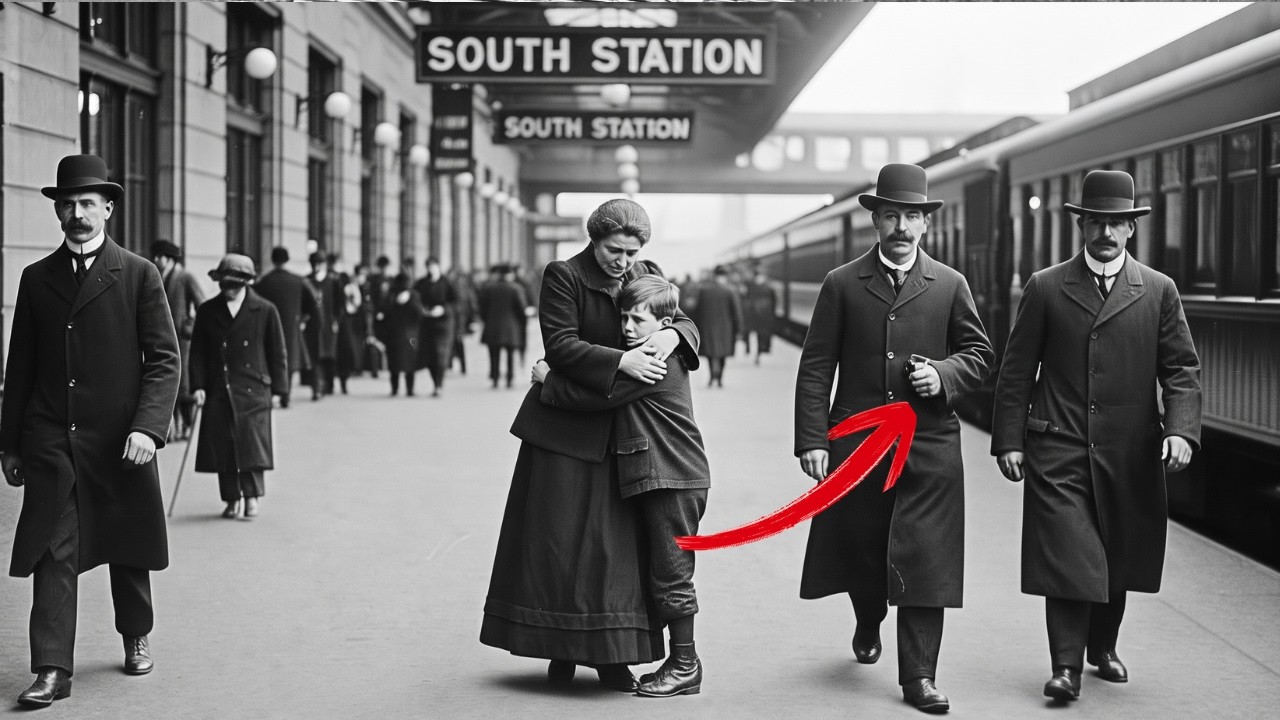
The woman’s face was turned downward, her posture conveying immense sorrow. The boy stared directly into the camera with empty, tired eyes. The image was ordinary at first glance, yet something about it compelled her. She submitted it for the university’s ongoing digitization project, which uses high-resolution imaging to reveal details invisible to the naked eye.
Three weeks later, she received an email from the digitization team with the subject line, “Item NATOR 1847 – unusual finding. ” Curious, she downloaded the high-resolution scan. The clarity was remarkable. She could see the threads of the woman’s dress, the grain of the wooden platform, even the texture of the boy’s worn boots.
But there was something else. In the boy’s small hand, pressed into the folds of his mother’s clothing, was an object she had not noticed in the original. She zoomed in. It was a small metal disc—a medal of some kind.
This was not an ordinary family portrait. Rebecca contacted her colleague, Dr. James Mitchell, a military historian specializing in late 19th and early 20th-century American conflicts. He studied the enlarged image carefully.
“It’s a military medal,” he said, his voice calm but certain. “The shape and the ribbon attachment—I believe it’s from the Spanish-American War era, 1898 or 1899. ” The photo was dated 1900, just two years after the war that established America as a world power. Why would a small boy be clutching a military medal hidden in his mother’s clothing?
And why did the mother appear so devastated? James noted that the medal’s size and shape matched campaign medals given to soldiers who served in Cuba or the Philippines. “If this boy is holding his father’s medal, and his mother appears to be in mourning, we might be looking at a widow and an orphan,” he said. The Spanish-American War had killed thousands of soldiers, many not in combat but from disease, particularly yellow fever and malaria.
The archive’s original notes were incomplete: “Mother and child, platform seven, early morning departure. ” No names. No destination. The two historians began their investigation.
Rebecca worked on identifying the railway station, while James delved into military archives, searching for Irish immigrant soldiers who had served in the Spanish-American War and either died or gone missing shortly after. Rebecca identified the station as South Station in Boston, which opened in 1899. She found a note in the station’s historical archives dated September 14, 1900: Platform 7, morning departure for Providence, Hartford, and New York. But no passenger names were listed for that date.
James, meanwhile, found that 47 Irish-born soldiers from the Boston area had died during or just after the Spanish-American War. Of those, 12 had files marked “status disputed” or “records incomplete. ” Some were listed as deserters, others as missing in action, and some had conflicting death reports. Rebecca searched Boston immigration records, city directories, and church documents.
On the fourth day, at the Archdiocese of Boston’s historical archive, she found a promising lead. A parish registry from St. Augustine’s Church in South Boston, an area with many Irish immigrants, contained a baptismal record from 1892 for a boy named Thomas, son of Patrick and Mary, immigrants from County Cork. The father’s name appeared on James’s list of disputed military records.
Patrick had enlisted in August 1898, assigned to Company K, 2nd Massachusetts Volunteer Infantry, deployed to Cuba. His status was listed as “deserter” as of October 1898. For an immigrant family, this label would have destroyed their reputation, cut off all military benefits, and marked Patrick as a coward in the eyes of the community. James worked with archivists at the National Archives to track down Patrick’s full military record.
He found that the desertion charge was based on a report filed by Lieutenant Howard Sterling, who claimed Patrick had left his post during a skirmish near Santiago de Cuba in October 1898. There was no investigation, no supporting testimony, no follow-up. But deeper in the file, James found a handwritten note from November 1898 by Captain William Harrison, a different officer: “The man reported as a deserter by Lieutenant Sterling, I saw fall during combat with the enemy on October 4. The terrain prevented recovery of the body.
I recommend a review of his status. ”
Patrick had not deserted. He had died in battle. But Lieutenant Sterling’s report had been accepted as official, and Captain Harrison’s eyewitness account was ignored.
Bureaucratic indifference or perhaps prejudice had stained the memory of an immigrant soldier and destroyed his family’s future. “Patrick died a hero, and his family spent their lives under the shame of a lie,” James told Rebecca emotionally. Rebecca turned her attention to what happened to Mary and Thomas after 1900. In Boston Public Library records, she found a heartbreaking picture.
In 1899, Mary was listed as living at a boarding address on East 4th Street, working as a laundress. By 1900, she had moved to a smaller, cheaper residence on West Broadway. By 1901, she was gone from the city directory entirely. Rebecca also found records showing Mary had applied for a military widow’s pension in early 1899.
Because Patrick’s status was listed as deserter, the application was rejected. Mary applied twice, each time writing letters requesting an investigation into her husband’s death. Both applications were rejected with form letters. Rebecca found one of Mary’s letters deeply moving: “My husband Patrick was a good man.
He loved his country. He went to war proudly. Please, my son needs help. Please look again.
He did not run away. He died fighting. ” No one listened. Rebecca found more pieces in an unexpected place.
Records from the St. Vincent de Paul Society noted that Mary requested assistance in August 1900 for a train ticket for her son to travel to Providence, Rhode Island. The note stated she was sending him to live with her sister’s family because she could no longer afford to feed him. The photograph suddenly made sense.
It was a mother’s farewell—a forced separation caused by poverty and injustice. Mary was sending away her only child, Patrick’s last memory, because bureaucratic error or deliberate discrimination had stripped her of her husband’s pension and her ability to survive. But why was Thomas clutching the medal? Rebecca found a possible answer in a small diary written by a volunteer at the Providence City Mission, preserved at the Rhode Island Historical Society.
The entry from September 1900 mentioned a boy named Thomas from Boston, who had come to live with his aunt’s family. The boy carried a military medal, which he said his mother had given him before the train departed. She had told him it was his father’s, that his father had been a brave soldier, and that no matter what anyone else said, he was never to forget this truth. Rebecca sat alone in the reading room, tears blurring her vision.
Mary had given Thomas the medal—the only proof of Patrick’s service and honor—as a final gift, ensuring her son would carry this part of the truth with him when everything else had been taken. It was an act of profound love and defiance. James became increasingly concerned about Lieutenant Howard Sterling, the officer who had filed the desertion report. His research revealed an uncomfortable picture.
Sterling came from a wealthy Boston family with deep political connections. He had attended Harvard and received his commission through family influence rather than merit. His service record showed a pattern of conflicts with enlisted men, particularly those of immigrant background. James found several disciplinary complaints filed against Sterling by fellow officers, accusing him of favoritism toward soldiers from established American families and contempt toward immigrant soldiers.
A report filed by Captain Harrison—the same officer who witnessed Patrick’s death—accused Sterling of improper conduct and discriminatory treatment of soldiers under his command. But Sterling’s family connections protected him. The complaints were dismissed. After the war, Sterling returned to Boston and built a career in business and local politics, even serving on the city council in the 1910s.
James found Sterling’s post-war correspondence preserved at the Massachusetts Historical Society. In a letter to a friend dated 1899, Sterling wrote lightly about his time in Cuba: “The immigrant low-class types proved as unreliable as expected. One Irish fool got himself killed trying to play the hero. I marked him as a deserter and saved the government a pension, and taught the rest their place.
”
Those words made James feel sick. Patrick’s fate was not just bureaucratic failure. He had been deliberately dishonored by a bigoted officer who viewed immigrant soldiers as unworthy of respect. The deserter report was not a mistake—it was an act of malice.
Rebecca’s response was immediate and strong. “We have to fix this. We have to tell Patrick’s story and clear his name, even if it’s more than a century late. ” James expressed caution—Sterling’s descendants might still be influential in Boston.
But Rebecca insisted: “This isn’t about destroying Sterling’s legacy. It’s about restoring Patrick’s honor. Mary and Thomas carried that shame their whole lives. If we can give them the truth, we have to.
”
The two historians began searching for what had happened to Thomas after 1900. Rebecca found that Thomas lived with his aunt’s family in a working-class neighborhood near the Providence River. School records showed Thomas attended irregularly between 1901 and 1905, often absent for weeks at a time, likely working to help the family. Teachers described him as quiet, serious beyond his years, and hardworking when present.
In 1906, at age 14, he appeared in city records as an apprentice at a textile mill, one of the dominant industries in Providence. What had happened to Mary? Rebecca searched Boston records—death certificates, hospital admissions, poorhouse registers. She found the heartbreaking answer.
Mary died at Boston City Hospital in February 1902. The cause of death was listed as pneumonia and physical exhaustion. She was 31 years old. Records indicated she had been brought from a lodging house where she worked as a cleaner, in critical condition.
She died alone, with no family name listed and no possessions beyond the clothes she wore. Rebecca sat in the archive room, overwhelmed by grief. Mary had sacrificed herself to give her son a chance to survive, then worked herself to death over the next two years. Rebecca found the answer to whether Thomas knew his mother had died in an unexpected place: a letter preserved in the archives of the Rhode Island Catholic Orphanage.
The letter, written by Thomas’s aunt in March 1902, requested help because she could no longer care for her nephew after her sister’s death. The letter noted that Thomas had been told of his mother’s passing and was devastated. Orphanage records showed Thomas was admitted in April 1902, at age 10, and stayed until 1906, when he reached the age to work full-time. Notably, the orphanage’s inventory list from 1902 recorded: “A small military medal, brass, worn ribbon, the boy’s own property.
” Despite everything—the separation from his mother, her death, the years in the orphanage—he had kept the medal. It was the physical proof of a truth he refused to let go. Rebecca’s research into Thomas’s adult life revealed a man shaped by the deep shadow of his childhood grief. After leaving the orphanage in 1906, he worked in textile mills for several years.
When America entered World War I in 1917, he enlisted in the U. S. Army at age 25. National Archives records show his enlistment documents listed his father’s name and history.
Where the government had declared Patrick a “deserter,” Thomas wrote instead: “Killed in Cuba, 1898. ” It was a silent act of defiance, a refusal to accept the lie that had destroyed his family. Thomas served with distinction in France with the 26th Infantry Division, fighting in several major battles. He was wounded twice but survived and returned to Providence in 1919.
James found his discharge papers, which included citations for bravery in the field. Like his father, Thomas had proven himself a courageous soldier. In 1921, Thomas married a woman named Catherine. Their marriage certificate is preserved in Providence records.
Between 1922 and 1928 they had three children—two daughters and a son. Thomas worked as a foreman at a textile mill and provided his family a stable, industrious life. But Rebecca found evidence that the past affected Thomas deeply. In a collection of personal papers donated by one of his descendants, she found a diary Thomas kept in the 1930s.
Most entries were brief and practical—notes about work and family. But one entry stood out. Dated September 14, 1940, exactly 40 years after the photograph was taken, Thomas had written: “Today I remembered the day mother saw me off. I was 8 years old and I was very afraid.
Mother put father’s medal in my hand and told me that no matter what the government says, remember he was brave and good. Mother was crying, but trying to hide it. I knew I might never see her again. I still carry the medal today.
My children know the story. They will pass it on. The truth will not die with me. ”
Thomas kept the story alive as a mission through generations, ensuring Patrick’s honor would outlast the lie that had stained it.
Rebecca discovered Thomas died in 1964 at age 72, survived by his wife, children, and several grandchildren. His obituary in the Providence Journal did not mention his father’s service or family history, but it noted he was a devoted father and grandfather, a World War I veteran, and a man of quiet dignity and firm principles. Rebecca then faced an important question: did any of Thomas’s descendants still live in the area, and did they know about the medal, the photograph, and the story Thomas had been so determined to preserve? Using genealogical databases, obituary records, and public documents, she traced the family line over decades.
Thomas’s son had died in 1998, but his two daughters survived into the 2000s. Their children and grandchildren were scattered across New England. After weeks of careful research, Rebecca contacted a woman named Sarah, Thomas’s granddaughter, who lived in Cranston, Rhode Island, just outside Providence. She was 71, a retired public school teacher.
Initially a bit skeptical, Sarah wrote in her first response: “My grandfather didn’t talk much about his childhood. It was clearly painful for him. But he did tell us about his father, the soldier who died in Cuba, and he always insisted the official records were wrong. He kept a medal in a wooden box.
I remember seeing it as a child. ”
The medal had survived. Over a century later, the physical proof of Patrick’s service still existed. With Sarah’s permission, Rebecca and James visited her home in November 2018.
Sarah welcomed them into her comfortable house, filled with family photos from across generations. She offered them tea and sat in an armchair, a mixture of curiosity and caution on her face. “Before I show you anything,” Sarah said carefully, “I need to understand what you’re trying to do. My grandfather fiercely protected his father’s memory.
If this is just academic research that will end up in a dusty archive, I’m not sure I want to be part of it. ”
Rebecca explained everything: the photograph, the hidden medal, Patrick’s wrongful deserter status, Lieutenant Sterling’s prejudice, Mary’s desperate struggle and early death, and Thomas’s determination to preserve the truth. She showed Sarah the documents, letters, and military records. Sarah listened in silence, her eyes welling with tears as the full story of her family’s tragedy came into focus.
When Rebecca finished, Sarah rose and left the room without a word. She returned holding a small wooden box, worn smooth by generations of use. “My grandfather gave this to my father before he died,” Sarah said quietly, placing the box on the coffee table. “My father gave it to me.
I’ve been waiting my whole life to know what to do with it. ” She opened the box. Inside, on faded velvet, lay the medal from the photograph. Even 120 years later, a faint luster remained.
The engraving was still visible—a campaign medal for service in Cuba during the Spanish-American War. On the back, someone had carefully scratched a name: “Patrick. ”
“He was a brave man,” Sarah said softly, touching the medal. “My grandfather told me that again and again.
He said his mother had made him promise never to forget it, and he never did. He passed that promise down to us. ” James carefully photographed the medal, documenting every detail. Rebecca explained what they wanted to do next: publish their research, formally petition the Department of Defense to review Patrick’s service record, and posthumously restore his honorable status.
“It’s more than a century late,” James added, “but it still matters. Your great-grandfather’s name should be cleared. ” Sarah looked at the medal, then at the researchers who had uncovered her family’s hidden truth. “Do it,” she said firmly.
“Do whatever it takes. Let’s finish what my great-grandmother started when she put this medal in my grandfather’s hand. ”
Over the following months, Rebecca and James worked with military historians, legal advisors, and the Department of Defense’s Board for Correction of Military Records to build a comprehensive case for Patrick’s posthumous discharge correction. They submitted every piece of evidence: Captain Harrison’s testimony, Sterling’s prejudiced correspondence, Mary’s pension applications, and the medal itself, which Sarah agreed to lend as evidence.
The process was bureaucratic and slow, but the evidence was irrefutable. In June 2019, nearly 121 years after Patrick’s death in Cuba, the Department of Defense issued a formal correction to his military record. His status was changed from “deserter” to “killed in action,” and the recognition he had earned in 1898 was posthumously awarded. Rebecca organized a small ceremony in August 2019 at the Massachusetts State House, where she invited Sarah and her family, military officials, and representatives from Irish-American veterans’ organizations.
The atmosphere was solemn and emotional as a military official handed Sarah her great-grandfather’s corrected service record and honorable service certificate. “Patrick served his country with courage and died with honor,” the official said. “The error in his record was a profound injustice to him and his family. Today, we correct that record.
” Sarah accepted the documents with trembling hands, tears streaming down her face. Beside her stood her children and grandchildren—Patrick’s descendants, carrying forward the lineage he had given his life to protect. Rebecca spoke briefly at the ceremony, telling the story of the photograph, the hidden medal, and the family’s century-long struggle for truth. She spoke of Mary’s sacrifice, Thomas’s resolve, and the unbroken chain of memory that had kept Patrick’s honor alive across five generations.
“This photograph,” Rebecca said, holding up a large print of the 1900 image, “captured one of the most painful moments in this family’s history. A mother saying goodbye to her son, both carrying the weight of an injustice they couldn’t fight. But hidden in that moment was an act of profound defiance. A medal passed from one hand to another, a truth protected against all odds.
Your great-grandmother Mary wanted her son to remember that his father was brave and good. She gave him the only proof she had, and he kept that promise. Today, at last, the world knows the truth he protected. ”
After the ceremony, Sarah approached Rebecca and James privately.
“I have something to tell you,” she said. “My grandfather kept a diary. I found an entry from September 1940 about the day his mother gave him the medal. He wrote, ‘The truth will not die with me.
’ I used to think it was his way of coping with grief. Now I understand it was a mission, and you have helped him complete it. ”
The photograph that had sat neglected in an archive for 118 years now holds a place of honor in Harvard’s collection, accompanied by a full account of the family’s story. The medal has returned to Sarah’s family, where it will be passed down through generations—no longer a symbol of a hidden truth, but a marker of justice finally achieved.
Rebecca often thought of Mary, standing on that platform in 1900, pressing the medal into her son’s hand and whispering the words of truth and love she knew he would need to survive. Mary died believing her husband would be remembered only as a deserter, never knowing that her final gift to her son would one day restore everything they had lost. But Thomas knew. He carried that medal for 64 years, defending his father’s honor with the same courage Patrick had shown in Cuba.
And now, five generations later, the truth has prevailed over the lie.