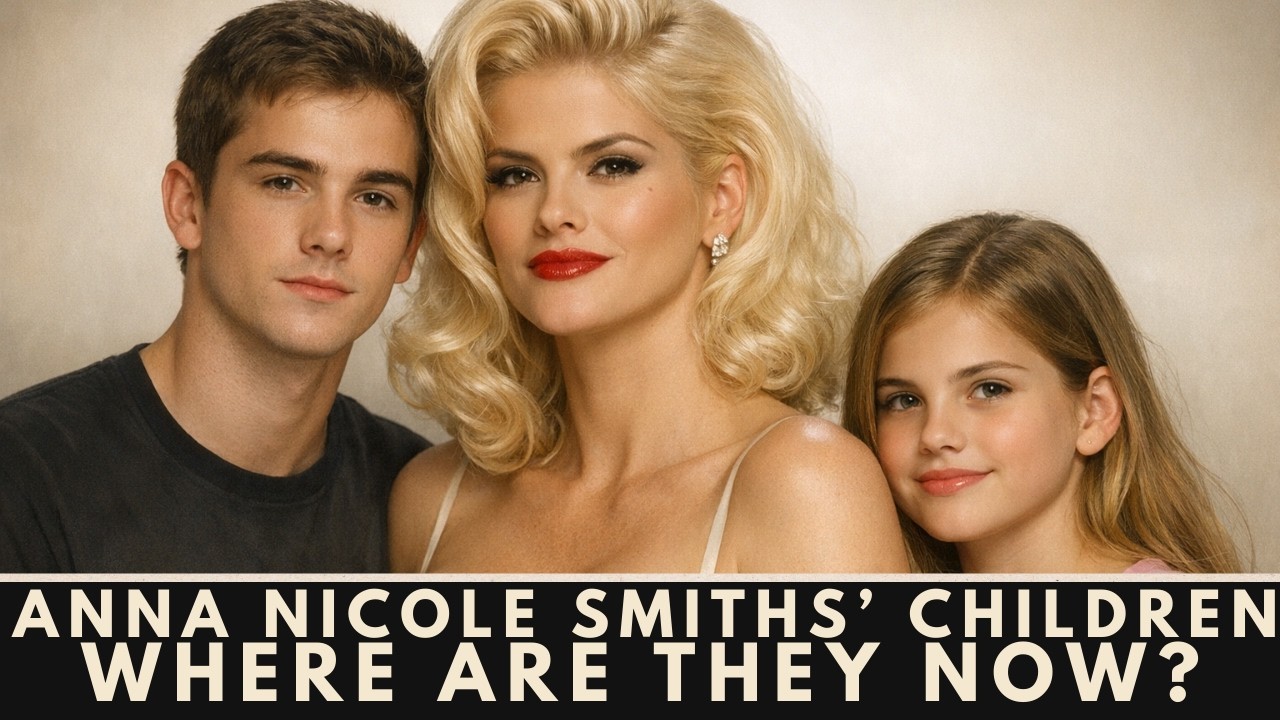
Anna Nicole Smith was one of the most photographed women in America, a Playboy Playmate, a Guess model, and a reality television spectacle. She lived her life in front of cameras, celebrated, criticized, mocked, and dissected in real time. But beyond the headlines were two children: one who grew up beside her during her rise, and one born into the middle of the storm. Long before she became Anna Nicole Smith, she was Vickie Lynn Hogan.
Born in 1967 in Houston, Texas, she grew up in the small town of Mexia. Her parents separated when she was young, and she was raised primarily by her mother and aunt in modest circumstances. She later described her childhood as strict and religious. In interviews, she said she often felt out of place.
She dropped out of high school in the 10th grade. By 17, she was working at Jim’s Crispy Fried Chicken in Mexia, where her life took a decisive turn. That’s where she met Billy Wayne Smith, a cook at the restaurant. In 1985, when she was still a teenager, they married.
Within a year, she was pregnant. In January 1986, she gave birth to her son, Daniel Smith. She was 19 years old. Years later, she would describe Daniel as “the love of my life” and “my heart.
” In one interview, she said, “He was my best friend from the day he was born. ”
The marriage did not last. By the time Daniel was still an infant, she and Billy Wayne Smith separated and eventually divorced. Vickie was now a teenage single mother in Texas with no diploma and limited income.
She worked various low-paying jobs to support her son, and she spoke openly about how difficult those early years were. Friends from that period recalled that Daniel was rarely far from her side. She doted on him, carried him everywhere, and was fiercely protective. But something restless remained in her.
She later said, “I didn’t want my son to grow up the way I did. ”
In the late 1980s, she left Mexia and moved to Houston. She began working as a dancer in clubs, a decision she would later describe as pragmatic rather than glamorous. “I did what I had to do,” she said.
“I had a child to feed. ”
It was during this period that she began transforming herself physically, socially, and psychologically. The name Vickie slowly faded. Anna Nicole was emerging.
But through every reinvention, Daniel remained constant. He had known her before the cameras, before the surgeries, before the Guess billboards. In 1992, she appeared on the cover of Playboy magazine. The following year, she was named Playmate of the Year.
The magazine’s founder, Hugh Hefner, immediately recognized something in her. He later described her as having genuine star quality and compared her directly to Marilyn Monroe, not just in appearance but in presence. “She had that rare combination of sensuality and innocence,” Hefner once said. “She wasn’t pretending to be Marilyn.
She had that same kind of vulnerability. ”
In 1993, she signed a Guess campaign. Billboards with her image appeared across the country. Overnight, Vickie Lynn Hogan became Anna Nicole Smith, and Daniel was still a child.
He had gone from living in small-town Texas to watching his mother become a national symbol. Before her Playboy breakthrough, while dancing in Houston in 1991, Anna Nicole met J. Howard Marshall. He was 89 years old.
She was 23. Marshall was a billionaire oil tycoon and corporate attorney. He began visiting the club regularly. According to Anna Nicole, he treated her with gentleness and attention.
“He never asked me for anything,” she later said. “He just wanted to talk. ”
When they married in 1994, media reaction was immediate and brutal. The 63-year age gap dominated headlines.
Comedians mocked her relentlessly. Talk shows framed the marriage as transactional. Anna Nicole publicly defended herself. “I loved him,” she insisted in multiple interviews.
“He loved me. That’s all that matters. ”
Hugh Hefner stood by her publicly during this time. He later said that the media caricature of her was unfair.
“She was not calculating,” Hefner said in interviews after her death. “She was much more naive than people realized. ”
Daniel, meanwhile, was entering his teenage years. While his mother became a punchline, Daniel became increasingly private.
Those who observed him during public appearances described him as shy and introspective. On red carpets, he often stood slightly behind her, polite, quiet, rarely seeking the camera. When The Anna Nicole Show aired in the early 2000s, Daniel occasionally appeared on screen. Viewers noticed the contrast.
Where Anna Nicole leaned into absurdity, exaggerated gestures, chaotic energy, and self-aware humor, Daniel often seemed subdued. Crew members later described him as respectful and soft-spoken. He preferred video games and staying in his room over performing for reality television. During this period, Anna Nicole was fighting an increasingly complicated legal battle over Marshall’s estate.
After his death in 1995, she claimed he had verbally promised her financial security. His family contested that claim, and the case stretched through multiple appeals, eventually reaching the US Supreme Court. For more than a decade, her name was tied to lawsuits, depositions, appeals, and headlines questioning her motives. Daniel was growing up in that environment, a home life intertwined with legal teams and press conferences.
Friends have said he was protective of his mother, aware of how she was portrayed publicly. Some accounts suggest he struggled with seeing her mocked on television. By the mid-2000s, the narrative around Anna Nicole had shifted. She was no longer just a model or widow; she was a spectacle.
The reality show amplified both her charisma and her instability. Viewers laughed, but the tone had changed. It was no longer glamorous chaos; it was erratic chaos. By the mid-2000s, Daniel Wayne Smith was no longer just Anna Nicole’s son.
He was 20 years old. Born in January 1986, he had lived through every version of his mother’s life: the struggling Texas waitress, the Playboy Playmate, the billionaire’s widow, the reality TV figure, the courtroom headline. According to people close to the family, Daniel and Anna were inseparable. Howard K.
Stern once said that Daniel was, without question, the most important person in Anna’s life. She often called him her best friend. In interviews, she said, “He is my heart. He is my life.
” Daniel had even given her a plaque that read, “I love you, Mom. Your son forever. ” She reportedly kept it close. Despite growing up in front of cameras, Daniel did not aggressively pursue fame.
He did appear in a few of his mother’s projects, including small roles in her films To the Limit (1995) and Skyscraper (1996). He also appeared alongside her on The Anna Nicole Show, but those who watched closely noticed something different about him. He was quieter than the show’s energy, more reserved, less performative. After high school, Daniel enrolled at Los Angeles Valley College in 2006.
That detail matters. It suggests he was building something separate, an education, a path not entirely defined by celebrity. He reportedly enjoyed video games, private time, and staying out of the spotlight. In September 2006, Anna Nicole traveled to the Bahamas to give birth to her daughter, Dannielynn.
Daniel flew out to see her. On September 7th, she delivered via C-section. The night after the birth, Daniel reportedly helped his mother move around her hospital room while she recovered. According to reports, he even assisted her to the bathroom, an intimate caretaking gesture that underscored how close they were.
Three days later, on September 10th, Daniel was found unresponsive in his mother’s hospital suite. He was pronounced dead at age 20. Toxicology reports later revealed a lethal combination of methadone, the antidepressant Lexapro, and Zoloft in his system. Authorities ruled it an accidental overdose.
There was no indication of suicide, but the timing, in the same hospital room where his sister had just been born, turned the event into something almost surreal. Witnesses described Anna Nicole as inconsolable. Reports later stated that she clung to his body and had to be pulled away. At his funeral, she reportedly attempted to climb into the coffin and had to be sedated.
In the months after his death, she told friends she dreamed about Daniel every night. “I can’t live without him,” she reportedly said more than once. Those close to her would later suggest that Daniel’s death broke something fundamental in her. He had known her before the reinvention, before Playboy, before the billionaire, before the ridicule.
He was the only person who had lived through every transformation with her, and at 20 years old, he was gone. When Daniel died in September 2006, Anna Nicole Smith was already in recovery from a C-section. She was also in the middle of a very public question: Who was the father of her newborn daughter? In the weeks following Dannielynn’s birth, multiple men publicly claimed paternity.
Among them were photographer Larry Birkhead, Anna’s companion Howard K. Stern, and even a European prince who briefly asserted a claim. The situation escalated into an international media spectacle. DNA tests were ordered.
Court proceedings unfolded in both the Bahamas and the United States. Meanwhile, Anna appeared increasingly fragile. In interviews during late 2006, her speech sometimes seemed slowed. Her physical condition drew concern.
Friends later said she was heavily medicated both for physical pain and emotional distress following Daniel’s death. But publicly, she insisted she was moving forward. In one of her final interviews, she spoke about Dannielynn with hope, describing her as a blessing and a reason to keep going. Behind the scenes, however, instability was growing.
On February 8th, 2007, Anna Nicole Smith was found unresponsive in a hotel room in Hollywood, Florida. She was 39 years old. Authorities later determined that she died from an accidental overdose involving multiple prescription medications, including sedatives and other drugs. There was no evidence of foul play.
Her death came just five months after Daniel’s and just five months after Dannielynn’s birth. The public reaction was immediate and intense. News coverage replayed her career arc. Critics revisited old narratives.
Commentators debated what had gone wrong. But amid the spectacle, a five-month-old child was left without a mother. In April 2007, DNA test results were released. They confirmed that Larry Birkhead was the biological father of Dannielynn.
He was granted custody. The cameras that had once followed Anna Nicole now turned toward him and toward the infant at the center of the legal storm. But Larry made a clear decision. He would not raise his daughter in Hollywood.
He took her to Kentucky, not Los Angeles, not New York, not the center of celebrity culture. In interviews over the years, Larry has repeatedly said that he wanted his daughter to have a normal life. He has described intentionally limiting media exposure, declining certain opportunities, and avoiding reality television. “She knows who her mom was,” he has said, “but she’s just a regular kid.
”
Dannielynn grew up attending regular school. She was not homeschooled for publicity reasons. She was not launched into child acting. She was not positioned as a reality star.
There were occasional public moments, but controlled ones. The most consistent tradition has been their annual appearance at the Kentucky Derby. Anna Nicole had once attended the Derby, and Larry and Dannielynn have continued the tradition together, often wearing coordinated outfits. These appearances generate headlines every year, mostly because of how much Dannielynn physically resembles her mother.
But beyond those moments, her upbringing appears structured around privacy. In interviews, Larry has described his daughter as creative and independent. She has shown an interest in art and fashion, sometimes designing outfits or expressing strong opinions about style. At times, she has modeled for small projects, including campaigns connected to Guess, the brand that helped launch her mother’s career.
But these appearances have been occasional, not career building. She reportedly enjoys typical teenage activities: school events, spending time with friends, creative hobbies. In some interviews, Larry has mentioned that she has asked questions about her mother as she grows older, wanting to understand who she was beyond the headlines. There has been no sustained push toward Hollywood.
No reality series, no publicized auditions, no aggressive brand partnerships. If there is a strategy behind her upbringing, it appears to be stability. For years, Anna Nicole’s name was tied to one of the most public inheritance battles in American legal history. After her death, the case continued.
Eventually, the long-running fight over J. Howard Marshall’s estate ended without Anna Nicole securing the enormous fortune she had pursued in court. That means the narrative of billions transferred to her daughter did not materialize as many once assumed. While Dannielynn is believed to have some financial security, the myth of unlimited inheritance was largely media exaggeration.
In practical terms, her life has not been defined by extreme wealth, nor by the courtroom drama that once dominated headlines. The contrast between Anna Nicole’s two children is stark. Daniel grew up inside the rise, inside the ridicule, inside the courtroom battles and reality television. He was exposed to chaos during formative years.
Dannielynn, by contrast, was raised deliberately outside of it. She was born into spectacle, but raised in restraint. As she moves through adolescence, there is little evidence that she is attempting to replicate her mother’s trajectory. She resembles Anna Nicole physically, but her life has followed a different structure.
When people talk about Anna Nicole Smith, the conversation usually circles back to spectacle: the marriage, the lawsuits, the reality show, the overdose. But for her children, the story looks different. Nearly two decades later, what remains is not the courtroom spectacle or the tabloid framing, but the long-term consequences of fame on two very different childhoods.