A 27-ton steel needle hung suspended above Manhattan, 860 feet below it, architect William Van Alen stood on the sidewalk watching with his stomach churning. If the cable snapped, 54,000 pounds of metal would tear through 70 stories and crash onto Lexington Avenue. Rumors had circulated for weeks that the Chrysler Building was getting, of all things, a flagpole. This was no flagpole.
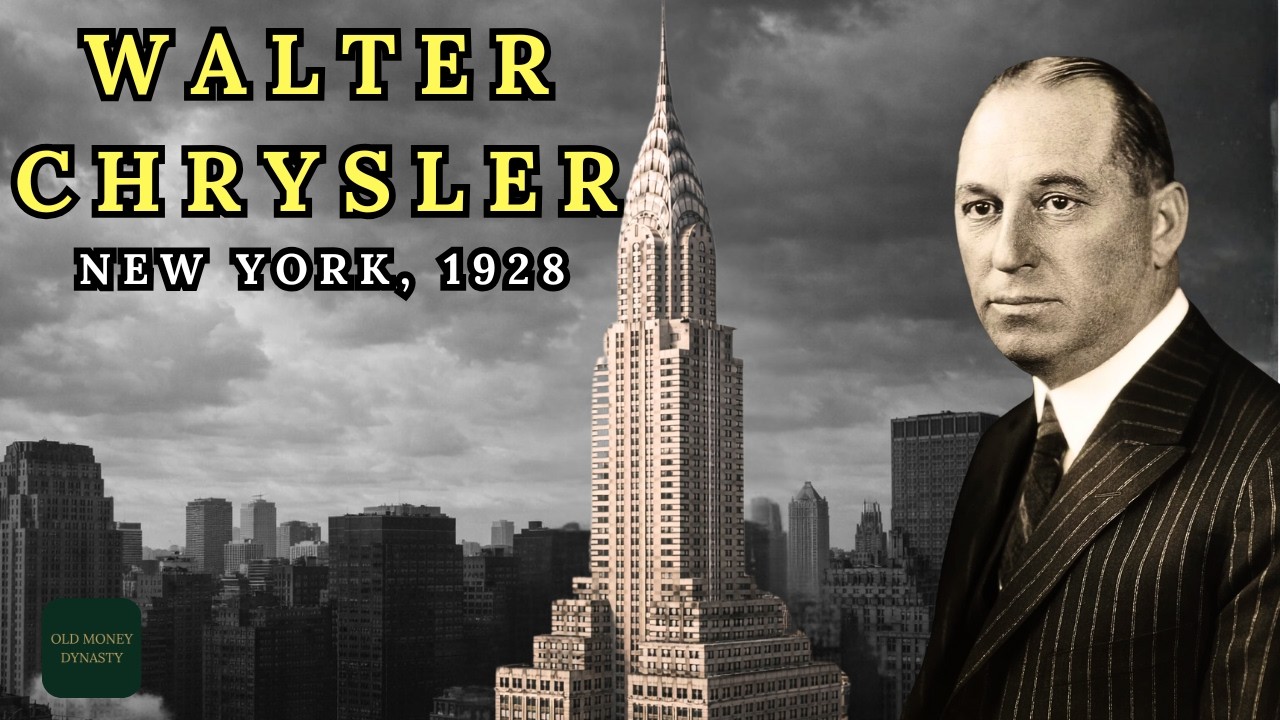
Workers began pulling, and the first section of the spire rose through an opening in the building’s dome, descending into the 66th floor. Then came the second piece, then the third. Within 90 minutes, all four sections had been riveted together, and a 185-foot spire pierced the sky. The Chrysler Building had just become the tallest structure ever built by human hands at 1,046 feet.
Twenty-four hours later, the stock market collapsed. This was the culmination of one man’s obsession. Walter Percy Chrysler was born on April 2, 1875, in Wamego, Kansas, to a railroad locomotive engineer and a homemaker. Raised in the frontier town of Ellis, young Walter was surrounded by steam engines.
He dropped out of school at 15, delivered groceries 16 hours a day, and at 17 talked his way into an apprenticeship at the Union Pacific Railroad shops for 10 cents an hour. Over the next two decades, Chrysler roamed the American West working for one railroad after another, building a reputation as a mechanic who could solve problems that stumped supervisors. By his early 30s, he had reached the pinnacle of his railroad career as works manager at the American Locomotive Company in Pittsburgh, earning $8,000 a year. Then came the 1908 Chicago Auto Show.
Chrysler had never driven a car, but when he saw a cream-colored Locomobile on the exhibition floor, something shifted. The vehicle cost $5,000, more than half his annual salary. He bought it anyway, financed with a loan co-signed by a colleague. When the car arrived, he didn’t learn to drive.
Instead, he pushed it into his barn and took it apart piece by piece. He studied the engine, the transmission, the brakes. He reassembled it, then took it apart again. By some accounts, he disassembled that automobile dozens of times before he ever turned the ignition key.
Three years later, in 1911, a banker named James Storrow arranged a meeting with Charles Nash, president of Buick Motor Company. Nash needed a production chief who understood machines. The position paid $6,000 a year, half of Chrysler’s railroad salary. He accepted without hesitation and left the railroad industry forever.
Within five years, Chrysler transformed Buick into the most profitable division of General Motors. But he clashed repeatedly with GM founder Billy Durant, who favored expansion at any cost. In autumn 1919, Chrysler had had enough. Durant bought his shares for $10 million, making the railroad mechanic one of the wealthiest men in America at just 44 years old.
Rather than retire, Chrysler took on the failing Maxwell Motor Company. He hired three brilliant engineers who had been developing an advanced six-cylinder engine. The result debuted at the New York Automobile Show in January 1924. The Chrysler 6 featured hydraulic brakes on all four wheels and a high-compression engine, priced under $2,000.
Dealers sold 32,000 units in the first year. Maxwell was reorganized into Chrysler Corporation on June 6, 1925. Three years later, Chrysler purchased Dodge Brothers for $170 million and was named Time magazine’s Man of the Year. He had built the third-largest automobile company in America, but he wanted something permanent.
He turned his attention to Manhattan real estate. The plot at Lexington Avenue and 42nd Street belonged to Cooper Union, leased to Brooklyn real estate developer William Reynolds. Reynolds had built Dreamland, a spectacular Coney Island amusement park that burned to ash in 1911, and he now wanted to construct the tallest structure in the world. In 1927, he hired architect William Van Alen, who had studied in Paris and understood the emerging Art Deco style, to design a tower with an innovative domed crown.
Construction began in September 1928, but Reynolds ran out of money. On October 15, 1928, Walter Chrysler purchased the entire project for over $2. 5 million. He initially treated it as a real estate investment for his children, but after seeing the architectural model, he involved himself in every decision, demanding a grander lobby and a taller tower.
The original Reynolds design called for 67 stories. Chrysler wanted taller, and the plans kept growing. No corporate funds financed this tower; Chrysler wrote personal checks. The final construction cost reached approximately $14 million, the equivalent of $220 million today.
Van Alen transformed the design into a celebration of the machine age, with stainless steel cladding from Germany, triangular windows, and a stepped silhouette unlike anything on the skyline. But Chrysler faced a problem. Another tower was rising downtown at 40 Wall Street, designed by Van Alen’s former partner H. Craig Severance.
Their 13-year partnership had dissolved in a bitter dispute over credit, making them bitter enemies. A rivalry that began in 1911 had become a race to build the tallest structure on Earth. Severance’s building was planned for 47 floors, then 60. By April 1929, his client announced the building would reach 840 feet, surpassing the Woolworth Building and the Chrysler.
Van Alen revised his plans to reach 925 feet. Severance countered with a design reaching 927 feet, two feet taller. Newspapers called it the race into the sky. Reports tracked each revision, each additional floor.
Construction at 40 Wall Street began in May 1929, with three shifts working 7 days a week. Uptown, Van Alen worked on something Severance could not see. The announced height of the Chrysler Building was a lie. Inside the fire shaft at its center, an 185-foot steel spire was being assembled in secret sections.
On November 13, 1929, 40 Wall Street topped out at 927 feet, and Severance invited the downtown elite to celebrate his victory. He was three weeks too late. In late October, workers at the Chrysler Building had hoisted the hidden spire through an opening in the dome. The Chrysler Building now stood 1,046 feet, 119 feet taller than 40 Wall Street, taller than the Eiffel Tower, the tallest structure ever built by human hands.
Severance considered adding more height, but the foundations would not support it. He argued the spire should not count because it contained no usable space. No one listened. The two men never spoke again.
The rush to complete the Chrysler Building came at tremendous pace. Workers averaged four stories per week, which seemed reckless, yet not a single man died during the steel work. The expected casualty rate for a project this size was one death per level above the 15th. More than 60 men should have fallen.
None did. Chrysler required safety measures other developers considered expensive: scaffolds with guard rails, tarpaulins to catch falling tools, and a hospital on site with a physician on duty every shift. The job site functioned like one of his assembly plants. The numbers reveal the scale: 20,961 tons of structural steel, 391,881 rivets, nearly 4 million bricks, and 3,862 windows fitted into frames of German stainless steel.
Some 3,000 men performed this work, and not one died. In spring 1930, the crown emerged from its scaffolding, and New York had never seen anything like it. Seven radiating arches rose in terrace layers. Triangular windows pierced every surface in patterns radiating outward like the rays of a rising sun.
The material covering those arches was Nirosta steel, an 18% chromium and 8% nickel alloy never used on an American building at this scale. It resisted corrosion and cleaned itself whenever it rained, gleaming as brightly decades later as on the day it was installed. Below the crown, automobile imagery appeared at every setback. On the 61st floor, stainless steel eagles crouched at the corners, enlarged replicas of the 1929 Chrysler hood ornament.
On the 31st floor, replicas of Chrysler radiator caps decorated the facade. This was a monument to industry, to commerce, to the belief that machines could be beautiful. The lobby matched the exterior’s ambition, sheathed in red Moroccan marble and amber onyx. Above stretched the largest mural in the world at the time, Edward Trumbull’s “Transport and Human Endeavor,” covering nearly 8,000 square feet of ceiling, depicting airplanes, ocean liners, and the Chrysler assembly line.
The most exclusive space, however, was the Cloud Club, which opened in July 1930 for 300 wealthy members of the city’s business elite. Walter Chrysler maintained his own suite on the 67th floor with black etched paneling and views of Central Park through triangular windows. The club operated only during daylight hours and remained open until 1979. The building’s completion did not mark the end of its creator’s troubles.
In January 1931, Van Alen attended the Beaux Arts Ball dressed as his own building, the star of the evening. It was the last public triumph of his career. He had made a catastrophic mistake when he accepted the Chrysler commission: he never signed a contract. When he submitted an invoice for $840,000, the standard 6% architectural fee on the $14 million building, Walter Chrysler refused to pay, claiming without evidence that Van Alen had received bribes from suppliers.
Van Alen sued and won his full fee, but the lawsuit destroyed his career. Clients did not hire architects who took their patrons to court. The Great Depression had frozen most construction in New York. Van Alen never received another major commission.
He retreated to teaching sculpture and died on May 24, 1954, with brief obituaries. Decades later, the Beaux Arts Institute renamed itself the Van Alen Institute in his honor, and everyone agreed the Chrysler Building was a masterpiece. He never lived to see that consensus form. The Empire State Building opened on May 1, 1931, and the Chrysler Building was no longer the tallest structure on Earth.
John Jacob Raskob had watched Van Alen’s spire trick with alarm, adding a 200-foot mooring mast for dirigibles. The airships never docked, but the mast put him beyond anything Chrysler could add. The reign had lasted exactly 11 months. Walter Chrysler died in August 1940.
His children inherited the tower and sold it in 1953 to William Zeckendorf for $18 million. The decline began almost immediately. Successive owners cut maintenance costs, the observation deck closed, and the Cloud Club lost members. By the early 1970s, with New York City careening toward bankruptcy, the occupancy rate fell to 17 percent.
Designation as a national historic landmark in 1976 offered legal protection but not salvation. Jack Kent Cooke, owner of the Washington Redskins, purchased the building in 1979 and restored the lobby closer to Van Alen’s original vision. In September 1981, 580 fluorescent tubes illuminated the triangular windows of the crown for the first time, and the building glowed against the night sky as the architect had always intended. The building continued changing hands through the decades that followed.
The critical consensus shifted entirely. Lewis Mumford, who had called the building a series of restless mistakes, was proven wrong by a new generation of architects and historians who called it a masterpiece. The Chrysler Building still holds one record that can never be taken: it remains the tallest steel-supported brick building in the world. More importantly, it remains the building New Yorkers point to when asked which tower they love most.
Walter Chrysler wanted a monument. William Van Alen gave him one. Nearly a century later, it still gleams above Lexington Avenue, dissolving into the sky exactly as its architect intended.