On the afternoon of December 26, 1944, a German officer watched the main road from the edge of a small Belgian village called Assenois, a few miles south of Bastogne. The town had been under siege for a week. American airborne troops and armored units trapped inside were desperately short of ammunition, medical supplies, and food. German forces surrounding the perimeter had been ordered to hold it until the town fell.
Everyone knew an American relief force was coming from the south. General George Patton’s Third Army had been fighting northward through snow and forest for days, taking village after village. German defenders on the southern side of the encirclement positioned themselves along the main roads, expecting an armored column to approach through the obvious entry points. Assenois was not one of them — it sat on a secondary road, and the officer watching its outskirts expected little more than a reconnaissance probe.
Just after 4 p. m. , a sudden and intense artillery barrage struck the village directly. Before the smoke cleared, American tanks raced down the road at full speed, firing as they advanced, and pushed straight through Assenois and out the far side.
They did not stop, deploy, or slow down — they drove directly through the German lines and kept going. Within an hour, the lead American tank reached the outer positions of Bastogne’s defenders. The siege had been broken. The officer leading the force that achieved this was not a general.
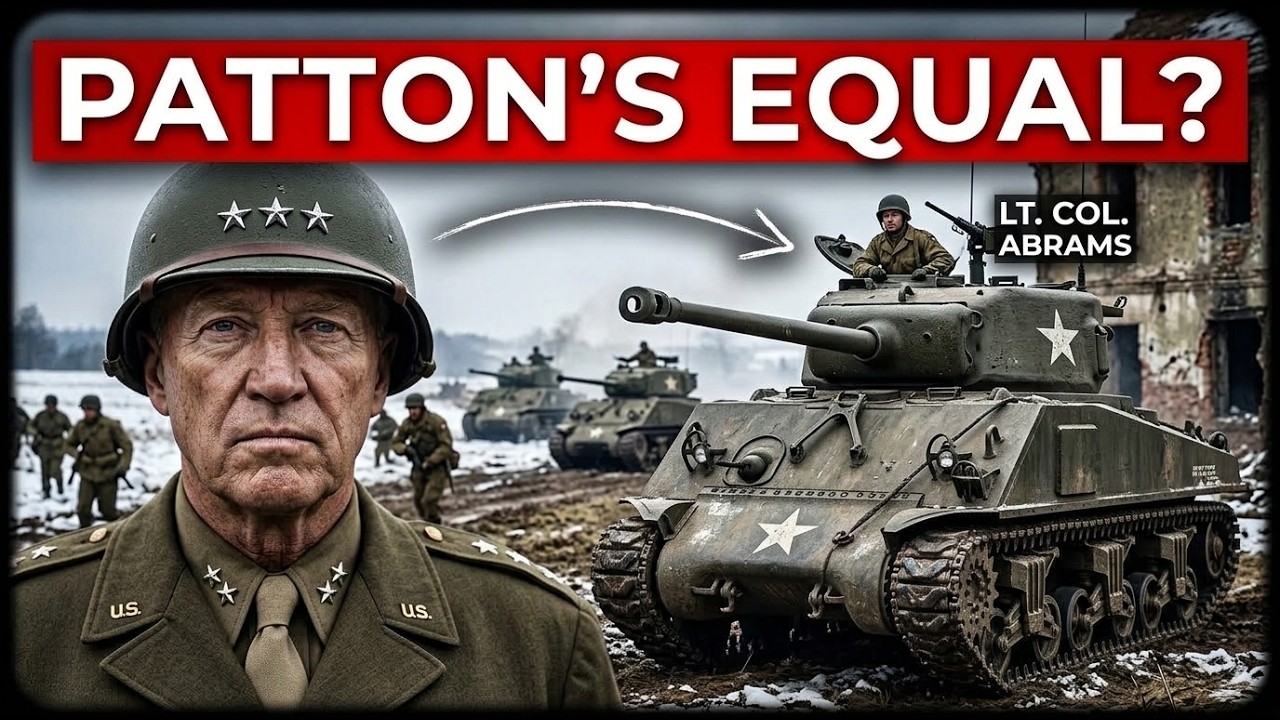
He was a lieutenant colonel commanding a tank battalion — a stocky man who smoked cigars and had decided, on his own initiative, that the fastest way to Bastogne was not the route everyone expected, but the road through Assenois. His name was Creighton Abrams. Patton, who commanded the entire Third Army and considered himself one of the finest armored commanders in the world, said something about Abrams that he never said about anyone else. In the most commonly repeated account, Patton remarked that he was supposed to be the best tank commander in the army, but he had one peer — Abe Abrams.
Patton called Abrams the world champion. That was an extraordinary statement coming from a four-star general leading a field army of hundreds of thousands of men. Patton had been an armor officer since the early days of tanks in World War I. He was arrogant, proud, intensely competitive, and thoroughly convinced of his own genius.
He did not hand out praise easily, and he certainly did not describe other officers as his equals. The man he singled out was not one of his senior commanders or division leaders. He was a lieutenant colonel in charge of roughly 50 tanks and their crews. To understand why Patton said that, one has to understand what Abrams actually did.
Born in Massachusetts in 1914, Creighton Abrams graduated from West Point in 1936. He was a cavalry officer during the years the army began taking tanks seriously, and he transferred to the new armored forces as they were built up in the early 1940s. By 1944, he commanded the 37th Tank Battalion of the 4th Armored Division, one of the divisions that spearheaded Patton’s Third Army when it broke out of Normandy that summer. A tank battalion commander’s war was very different from a general’s war.
A general commanded from headquarters, studying maps and issuing orders to formations of thousands of men. A battalion commander in an armored division fought near the front, often inside his own tank, directing his companies by radio while the battle raged around him. He had to read the ground, the enemy, and his own men in real time and make decisions in seconds that a general might take hours to consider. Abrams led from the front in his own tank, which he named “Thunderbolt.
” When one was knocked out or disabled, he took another and gave it the same name. Over the course of the campaign, he went through an entire series of them. His fighting style — and the style for which the 4th Armored Division became known — was not to wait. When his battalion met German resistance, his instinct was not to stop, dig in, and call for help.
It was to hit the enemy before it could settle, using the speed of his tanks and the firepower of his armored infantry and attached artillery to overwhelm a position or swing around it while the Germans were still reorganizing. A tank battalion in an armored division did not fight alone. It operated alongside an armored infantry battalion traveling in half-tracks, with field artillery ready to respond by radio. Abrams became expert at using these three elements together — tanks to attack, infantry to clear and hold, artillery to smash anything in the way.
His 4th Armored Division commander, Major General John S. Wood, was an unconventional and highly aggressive officer who believed an armored division should move fast, strike hard, and let the rear catch up. The division was known for its speed and confidence. It was one of the few American divisions that deliberately refused to adopt a nickname, with its men proud of being known for what they did rather than for a slogan.
Abrams fit that culture perfectly. When the division broke out of Normandy and advanced into Brittany in early August 1944, his battalion was among the units that pushed the farthest and fastest, often covering dozens of miles ahead of any infantry support in areas that might contain German units. Tank columns swept through towns where German garrisons had not yet heard the Americans were coming. By all accounts, Abrams remained completely calm under enemy fire — cigar in his mouth, radio headset on his ear, directing his companies through the battle as if discussing the weather.
After the Normandy breakout in the summer of 1944, the 4th Armored Division swept across France, then turned east and raced toward the German border, covering distances in days that the German army expected to take weeks. In September, as the advance reached Lorraine, the Germans launched a counterattack. They threw newly formed panzer brigades equipped with new tanks — including the heavy Panther, which theoretically outmatched the American Sherman in armor and firepower — in an attempt to cut off and destroy the advanced elements of the 4th Armored Division. The battles around the small town of Arracourt became some of the largest armored engagements fought by the U.
S. Army in the West. They lasted for days, mostly in thick autumn fog that kept aircraft grounded and confined the fighting to close range. Abrams’s battalion was in the heart of the action.
The Germans had better tanks, but the Americans had better tactics. American tank crews used the fog and rolling terrain to get close to the heavier German tanks, maneuvering to hit them in the flanks and rear where their armor was thinner, fighting as coordinated teams while the German units — many newly formed with inexperienced crews — struggled to coordinate. Abrams’s battalion attacked German columns, withdrew, reappeared elsewhere, and attacked again. The German panzer brigades that fought at Arracourt came out badly shattered.
American losses were real but far lighter. In the fog, Abrams could not see most of his battalion. He relied on radio reports — one company commander reporting enemy contact, another reporting a lost tank, a third calling for artillery support. He built a picture of the battle in his mind and made decisions based on it, all while his own tank was part of the fighting.
Every American tank had a radio, and the battalion commander could speak directly to his companies and hear them. The Germans had radios too, but many newly formed panzer units at Arracourt were thrown into battle without enough time to train together — and a unit that had not learned to fight as one could not use its radios effectively, no matter how good they were. For his leadership in those battles, Abrams was awarded the Distinguished Service Cross, the second-highest U. S.
military decoration for valor. Three months later came Bastogne. When the German offensive crashed into the Ardennes in mid-December 1944, the vital crossroads town of Bastogne was surrounded. The 101st Airborne Division and elements of armored units held the perimeter against repeated German attacks.
They were short of everything, including artillery ammunition and medical supplies. Patton turned key elements of his Third Army northward to relieve them, an extraordinary achievement in brutal winter conditions, with the 4th Armored Division leading the attack. For days, its combat commands fought northward through snow, cold, forests, and stiff German resistance, taking village after village and suffering heavy losses. By December 26, Abrams’s battalion, part of a combat command attacking from the southwest, was a few miles from the perimeter.
His battalion was badly worn down — its tank companies had lost a large proportion of their vehicles, and his men were exhausted. The planned route took his forces toward a village called Sibert, which was expected to be defended. Abrams looked at the map and the situation in front of him and decided to change the plan. Instead of taking the expected route, he chose to go through Assenois — the shorter, more direct road to Bastogne.
It was risky. The village was defended, but it was the fastest way in, and every hour counted for the men inside the perimeter. What followed was a classic Abrams operation. He arranged for a short, intense artillery bombardment of Assenois.
The moment it lifted, his tanks and armored infantry drove straight into the village, the tanks pressing forward and firing as they advanced. The force that made the attack was small — Abrams’s tanks, reduced to a fraction of their original number, working alongside the armored infantry of the 53rd Battalion, whose commander had been fighting alongside Abrams for months. Artillery fire from several battalions converged on the village in a concentrated, rapid barrage. As it lifted, the tanks advanced directly behind it, some of the last shells still falling as the lead vehicles entered the streets.
Behind the advancing tanks, infantry fought to clear the village house by house, because the corridor to Bastogne was only useful if it stayed open. German troops that had taken cover from the barrage came out of cellars and engaged in the fighting. Some half-tracks following the tanks got stuck in the village, and the fight there continued into the evening. But the lead tanks did not stop to help — they had one mission, and they kept moving.
The tank at the head of the column was a heavily armored version of the Sherman, commanded by a young lieutenant named Charles Boge, and named “Cobra King. ” It still exists today, preserved as a memorial to that day. Late in the afternoon of December 26, Boge’s tank reached the positions of Bastogne’s defenders. The siege was broken.
It was initially a small opening, a narrow corridor that had to be expanded and held under enormous German pressure in the following days. But that breakthrough ended the encirclement. For his actions in relieving Bastogne, Abrams was awarded the Distinguished Service Cross a second time. There is a famous saying attributed to Abrams from the Lorraine battles, when he was told his battalion was surrounded.
The popular version has him responding that the Germans were surrounded — that his tanks were in the middle of them and could now fire in every direction. As with many wartime sayings, the exact wording and circumstances are uncertain, but it has been repeated for 80 years because it captures the essence of the man: his refusal to think defensively and his instinct to see a crisis as an opportunity. It is important not to turn Abrams into a myth — he would have hated that. His battalion paid a heavy price for its successes.
Men died in the Thunderbolt tanks and in the tanks around them. Abrams gave credit to his men, not himself, and by all accounts he was sincere. He was not a lone genius — the 4th Armored Division as a whole was one of the best American formations of the war, thanks to a succession of outstanding commanders. The relief of Bastogne was the work of many units and many men, and the defenders inside the perimeter always pointed, rightly, to their own endurance.
Abrams’s achievement was real, but it was part of a larger story. What made him exceptional was a combination of courage, calm, a deep understanding of how tanks, infantry, and artillery worked together, and a willingness to make a decision on his own, on the spot, without waiting for orders from above. The U. S.
Army of 1944 was an army in which a lieutenant colonel could look at a map in the snow outside Bastogne, decide the plan was wrong, change it, and have the support to make it work. After the war, Abrams continued to serve. He held command positions during the Korean War and the Cold War. In 1968, he took command of U.
S. forces in Vietnam, the hardest and most thankless task of his career. In 1972, he became Chief of Staff of the U. S.
Army, the service’s highest position, and set about rebuilding an army badly damaged by the long Vietnam War. Those who served under him in those final years described the same qualities his tank crews saw in 1944: candor, calm, complete modesty, and deep loyalty to the ordinary soldier. The cigar was remembered, as was his habit of simplifying complex problems and reaching a decisive conclusion. He died in office in 1974.
A few years later, the army named its new main battle tank after him, and it is still known as the Abrams. So what about Patton’s remark? It was not flattery, and it was not one of his exaggerations. It was a professional judgment from a man who knew armored warfare as well as anyone alive, about a battalion commander who did what Patton valued above all else: he attacked, kept advancing, and never let the enemy settle.
Patton commanded an army; Abrams commanded 50 tanks. The general looked down the chain of command, past his corps and divisions, and saw in a lieutenant colonel what he considered most important. The German officer at Assenois is a composite figure.
Abrams’s background, his command of the 37th Tank Battalion, his series of tanks named Thunderbolt, the Battle of Arracourt, his decision to attack through Assenois, the breakthrough to Bastogne led by Lieutenant Charles Boge on December 26, his two Distinguished Service Crosses, Patton’s famous remark, and Abrams’s later career are all part of the historical record — with the caveat that the exact wording of some famous quotations attributed to both men varies between sources.