In the summer of 1893, U. S. Army engineers built a mattress 900 feet long and 250 feet wide out of willow brush and steel wire, loaded it with stone, and deliberately sank it to the bottom of the Mississippi River at New Madrid, Missouri. They were trying to stop the river from moving.
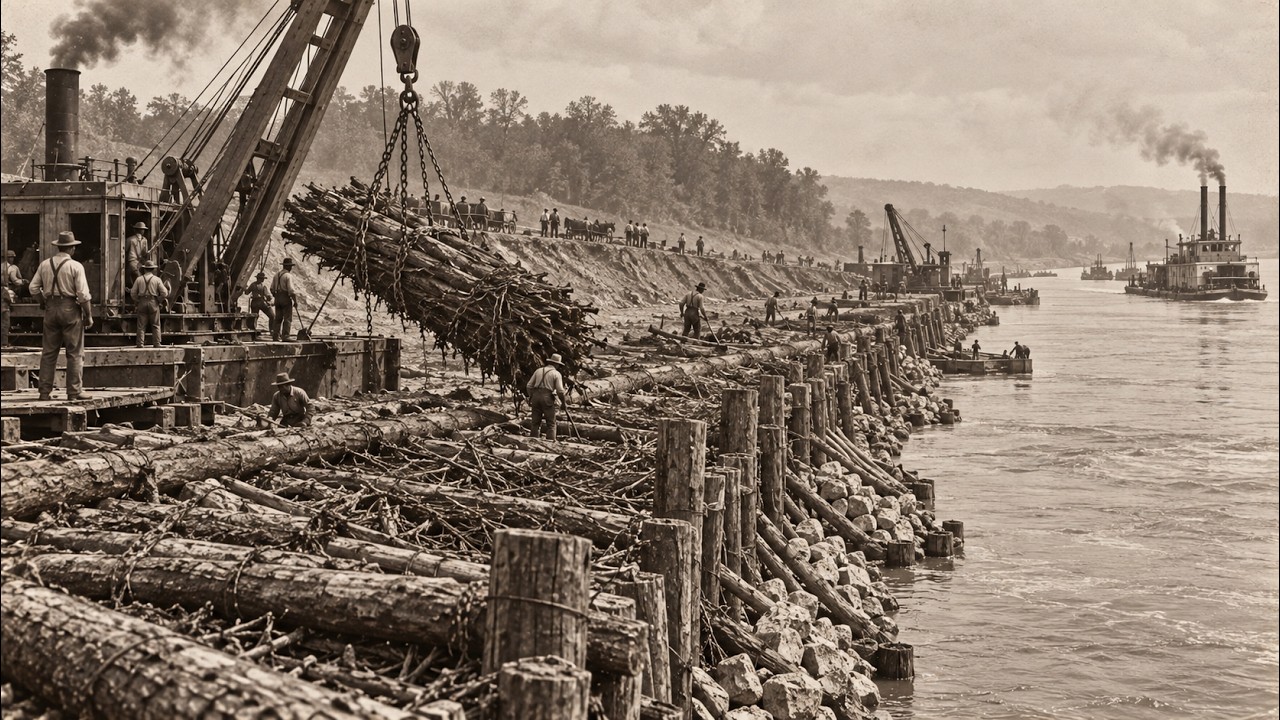
The bank under the town was caving into the water every year, and the Army’s own report described the erosion as an invasion of the town. Congress had provided $25,000, only a quarter of what full protection would have cost. The woven willow mat worked, and New Madrid was just one name on a long list. For about half a century, willow mats held the worst bends of the lower Mississippi, one bank at a time.
The records of that effort come from the Mississippi River Commission’s annual reports, a bank protection manual prepared in 1922, Mark Twain’s account of his 1882 trip down the river, and trade reporting that still follows the Army’s mat-sinking operations today. Two men carry the story through those records. One is Captain S. W.
Rosler, an Army engineer in Memphis, who wrote that by the end of one season his foreman could sink a huge mattress with hardly a word spoken. The other is Major Edward Murphy Markham, who sent a diver to the bottom of the Mississippi to check on something no willow crew had ever built. Twain put the problem better than any engineer when he wrote that the river is always moving bodily sideways. The mechanics are simple.
Water runs faster around the outside of a curve, so it cuts into that bank and carries dirt away. On the inside of the same curve, the water slows and drops sand, building a bar out from the shore. One bank keeps losing ground while the bar across from it gains, and the whole bend creeps sideways across the valley every year. When a bend loops around far enough, the river can break straight across the narrow neck of land at its base, leaving the old loop behind as a lake.
Geologists call that a cutoff. In the 1870s, the river made three cutoffs near Memphis and Vicksburg in less than ten years, shortening the Mississippi by more than sixty miles. Twain reported that at a place called Piltcher’s Point, people had moved their cabins back 300 yards in three months, and the caving bank had already caught up with them again. The towns were only the visible part of the problem.
The hidden reason the Army cared was the levees. By the 1880s, the earthen walls that kept floods off the farms of Mississippi, Arkansas, and Louisiana were built along those same banks, and a levee sitting on a caving bank was in danger. At Lake Bolivar, about sixty river miles above Greenville, the commission had to armor 4,250 feet of bank in 1889 because caving was threatening a large levee. In the Lower Tensas levee district of Louisiana, the report counts 56.
75 miles of levee lost to caving or abandonment between 1882 and 1893. There was a third job riding on the same banks. The commission was trying to narrow and deepen the channel for steamboats, and it wrote in 1887 that its channel works would be left utterly useless unless the current was held where it struck the bank. Every plan for the lower river, for the towns, for the levees, and for the boats came down to the same question: how do you stop a bank from caving when the damage is happening underwater where nobody can see it?
The commission’s first answer failed fast. In July 1881, it authorized mattresses of brush and wire for the caving banks of Plum Point Reach, one of the hardest stretches to navigate above Memphis. Late that season, crews hung wire screens from wooden piles and laid a small mat 500 feet long. The high water of 1882 washed out the piles and destroyed the mat.
The commission’s own manual records the result in four words: the experiment was a failure. At Memphis, they tried building mats on dry land. Crews put up slanted ways 200 feet long on the shore, laid out a grid of cottonwood poles, and piled three layers of green willow brush on top. Every mat came out 120 feet long, 60 feet wide, and 2 feet thick.
They were solid but small, cost too much to build, and could not reach the deep water where the river was doing its damage. In 1882, the Army moved the whole factory onto the river. Picture two barges anchored over the underwater slope of a caving bank with a sloping wooden deck built across them. Crews laid 30-foot willow poles across the deck, then wove willow brush about 30 feet long over one pole and under the next like a basket.
Men with heavy wooden mallets hammered each piece down tight. As the mat grew, the barges slid downstream a pole’s length at a time, and the finished mattress floated off the deck behind them. An assistant engineer on that work recorded exactly who did what. His crew made 60 to 70 feet of mattress a day with 52 men: 30 did the weaving, six worked the mallets, six handed the willows from the barge to the deck, six bound the poles, and four handled the lines.
Each finished mat overlapped the next by at least 15 feet so the river couldn’t slip through a seam. Then came the part that made the whole thing sound impossible. Boats full of rock were tied along the outer edge of the floating mat with lines every 10 feet, and crews loaded rock onto it until those lines were straining. At a word, the lines were cut.
The mattress dropped toward the bottom, and as it went down, the barges were pulled across the water where it had been, with men throwing out more rock to pin it to the riverbed. On a steep bank, crews drove sharpened piles through its shore edge so it couldn’t slide. Above the waterline, the bank got its own treatment. When Twain passed Plum Point by night in 1882, he saw the lights of the commission’s fleet and a whole village built for its offices and workers.
He described crews cutting the timber back 50 yards from the edge and shaving the banks down to low water at the slant of a house roof, then paving them with stone. The reason a woven mat could hold a bank comes down to how riverbanks fail. Water doesn’t push a sand pile over; it picks grains off the bottom edge until the top slumps in on its own. Lay a doormat over the foot of that pile, put a few pebbles on it, and the water has nothing left to pick at.
The Mississippi’s banks failed the same way from the underwater foot up, and the mattress covered that foot. The brush slowed the water moving through it, so it caught mud and filled with silt, and because it was brush, it could bend when the river dug at its edge. That flexibility turned out to be the whole fight. The manual describes the woven mat as very flexible but of little strength, and over the next decade the river kept proving it.
In his reports from Memphis, Rosler listed why the old mattresses had broken. They were too narrow, so the river dug a hole under the outer edge and the mat fell into it. They were too stiff to follow the hole down without tearing. And they were too loose, so water draining out of a soaked bank when the river fell carried the dirt right out through the brush.
At Bullderton, the commission’s earliest mats had been only 100 feet wide. In May 1893, the commission told its district officers to design an underwater mattress whose outer hundred feet could bend to follow the scour, that was thick enough that nothing could wash through it, and that would last once it was down. That summer, it let Rosler try a new kind at New Madrid. Work started on July 21 and finished on the last day of August.
The new mattress was built from fascines, long tight bundles of brush. Three gangs did the work. One gang handed the willow down off the supply barges. The second laid it into wooden forms in two layers with the tops pointing opposite ways, and every 8 feet an iron chain went over the bundle with a lever through a ring at the end.
One or two men leaned their weight on that lever to squeeze the bundle while it was bound in steel wire until it was 10 to 12 inches thick. The third gang slid each bundle down the skids into the mat, where a steel strand was passed over and under it and pulled as tight as four to six men could haul with a block and tackle. Rosler also planned for the day his own wire would rust away. Rows of poles ran along the top of every mat 16 feet apart, tied down with silicon bronze wire that wouldn’t corrode, so the brush would stay in place long after the steel was gone.
The work was a race against the river’s own mud. The packed bundles soaked up silt so fast that if the stone went on slowly, part of a mattress could be dragged under before the crews were ready to sink it. So they ballasted fast and sank at once. At Ashport Bend that fall, his crews built the first mat at just under 75 feet a day.
By the sixth mat, they were making almost 110, and their best single day reached 160 feet. By the end of the season, Rosler wrote that the foremen were so well drilled that a large mattress could be sunk with scarcely a word of command. New Madrid held. Rosler had the river sounded over that mattress in September and again the following May.
There was no scour at its river edge and very little caving for several hundred feet above or below it. Start with Memphis, where the Army was already sinking mattresses before the commission even existed. Between 1877 and 1880, Major W. H.
H. Benyaurd of the Corps of Engineers was sinking mats of poles and willow brush along the Memphis waterfront, and by 1881 he had swapped the pole frames for a net of wire. Memphis needed it badly because the city sits on a bluff and the river was working at the foot of that bluff. The commission’s report for 1894 lays out the whole Memphis riverfront like a ledger.
From the mouth of the Wolf River down to the railroad bridge, the city front ran 13,300 feet. A continuous revetment covered the bank from the Wolf River to the foot of Beale Street, started in 1878 and finished in 1887. Below Beale Street, another 2,100 feet was held by spur dikes built in 1886 and 1887. The commission noted that this lower work under a crumbling bluff was done mainly at the expense of private citizens.
People in Memphis paid out of their own pockets to keep their riverfront from sliding into the Mississippi. The river was doing two things to Memphis at the same time. Below Beale Street, it was cutting the bank upstream just below the mouth of the Wolf River. A sandbar had grown over more than a mile of the city front and blocked the landing at the grain elevator and about two-thirds of the paved levee.
The report warned that boats would no longer be able to land against the pavement at low water. Across the river on the Arkansas side, the Army was fighting for the other half of the bend. The Hopefield Bend revetment was begun in 1882 and built out to more than 3 miles by 1889. The report says the work went on continuously except when revetment work was interdicted by Congress.
That phrase nearly killed everything in this story. The lower two miles of Hopefield Bend took the full force of a very fast current and had to be almost completely rebuilt. When the flood of 1893 broke through two stretches, crews patched them with the new fascine mats 310 feet wide and extended the work another 500 feet to cover Hopefield Point, which had started to cave. Even so, Memphis wasn’t finished.
In 1894, 3,800 feet of the city front were still unprotected, and the report says the caving there, formerly slow, had become more active during the past year. Memphis has one more connection to all of this. The Army’s mat-sinking unit on the Mississippi today still runs with a towboat named the Benyaurd, the boat that moves the barges where the crew lives. Greenville, Mississippi, had a different problem because it sits in a run of sharp loops known as the Greenville Bends.
The commission’s engineers called that stretch a torturous course and counted four necks of land wrapped inside its loops. Between 1887 and 1889, they built spur dikes along the Greenville city front, and the report says those dikes gave immediate relief. But the caving in the bend just above the city was so fast that the dikes were going to be lost unless the whole bend was covered. So in 1891 and the season after, crews laid 11,150 feet of revetment up that bend.
The river answered within a couple of years. After a rise in the water, the upper dike at Greenville was severely damaged. The revetment just above it settled, and the underwater mat began pulling away from the revetment on the upper bank. The engineers wrote that the damage appeared to be spreading upstream.
At the top of those four necks sat Ashbrook Neck. Starting in 1890, crews laid 8,900 feet of revetment on it, and the report is plain about the reason: it was to keep the river from cutting straight through the neck and abandoning its own channel. At the bottom end of the same bends sat Leland Neck, and the commission’s surveys there read like a countdown. In 1882 the neck was 5,500 feet across at its narrowest point.
By 1903 the river had eaten it down to 3,500 feet, and the commission built a dike more than 6,000 feet long along the neck. By 1910 the neck was down to 2,600 feet. The floods of 1922, 1927, and 1929 started scouring a trench across it, so the commission added a permeable dike a mile long. In June 1933, the Mississippi broke through that dike anyway.
The break didn’t turn into a new channel right away, but the water on the upstream side of the neck stood 3. 5 feet higher than the water below it, and the commission worried that the next flood would tear a cutoff through on the river’s own terms. So the commission stopped fighting the bends and moved its own plan forward, cutting the Greenville Bends off on purpose at Leland, at Tarpley, and at Ashbrook. After four decades spent trying to stop the river from cutting through those necks, the Army cut through them itself.
Vicksburg had already lost that fight once. Twain came down the river after it happened and described it with a straight face. The town of Delta, across the river in Louisiana, used to sit 3 miles below Vicksburg. After a recent cutoff, it sat 2 miles above it.
That cutoff came in 1876, and the commission’s history says it left the Vicksburg harbor isolated from the main channel of the river. A city that had been built on the Mississippi was suddenly looking out at a lake. The point of land across from Vicksburg was called Delta Point, and the commission wrote that holding it was an essential condition of all projects for the improvement of Vicksburg Harbor. If Delta Point kept caving, every plan to bring the river back to the city got harder and more expensive.
So between 1878 and 1884, crews covered 10,700 feet of that bank with brush and stone. It held. By 1894, the Delta Point revetment had needed no repairs for several years, but the river had started scouring along its outer edge, the same undermining that had wrecked narrower mats upstream. That season the crew sank another mat 1,000 feet long and 300 feet wide at the upper end of the work.
The same report shows what time did to the willow above the water. Wherever the brush had rotted out, the Army replaced it with 10 inches of rock. At Lake Bolivar, the engineers put a number on it, writing that brush above the waterline lasted about three years before it rotted. Below the water, the willow was another story.
Vicksburg today is where the Mississippi River Commission keeps its headquarters, and when the Army’s mat-sinking unit heads out for a season on the river, the towboat William James pushes it out of the port of Vicksburg. The Army’s river crews now work out of the same city the Mississippi left behind in 1876. The mats Rosler’s crews were building at Ashport Bend in the fall of 1893 were partly a rebuild, and the reason was the flood that spring. Crews had started revetting Ashport Bend in 1891 at the top of the caving and laid 3,250 feet that first year.
In the 1892 season, they pushed the work 8,500 feet farther downstream before high water shut the season down in February 1893. Then the flood came and went straight for the downstream end of that new work. The river dug out its own bed along the edge of the mattress, 32 feet deeper on average and 50 feet deeper at the worst spot, until there was more than 100 feet of water where the channel ran beside the bank. Fourteen hundred feet of mattress sank into that hole, settled across its whole width, and tore away from the stone paving on the bank above, and the paving was destroyed.
In a report dated September 27, 1893, Rosler judged that it wasn’t safe to repair those 1,400 feet with anything less than a complete new bank protection built on a mattress 300 feet wide. A little way up the river at Daniels Point, the commission made a choice that reads surprisingly in a government report. About a mile of revetment had been laid there in 1889 and 1890 at the foot of a caving bend, and the river had been attacking it at its upstream end and along its outer edge ever since. After that flood, rebuilding it would have cost more than building it new.
So the commission decided to let the revetment yield to the attacks upon it, wait for the river to finish destroying it, and start over once the bank had worn back into an even line. The flood wasn’t the first time the woven forest nearly lost. In the winter after Congress’s 1882 appropriation, the cold was so hard through December and January that stone couldn’t come down from the Ohio and the upper Mississippi. At Plum Point and Lake Providence, whole mattresses were already floating in place, waiting for rock.
They were lost because there was nothing to sink them with. Then a flood nearly as big as the one before it came through. The spring turned so sickly that the commission called its labor scarce and inefficient, and the brush near the work ran out, so crews hauled material from as far as 70 miles away. Then Congress turned on the idea itself.
No appropriation passed for the commission in 1885 at all. In 1886, Congress sent $2 million with a string attached: no bank protection or revetment could be built until it was proven that other channel works alone would not stabilize the river’s banks. The commission wrote back that the idea of fixing the river with those works alone was purely visionary and theoretical, contradicted by experience. Congress lifted the restriction two years later, but by then the commission had lost four working seasons, and much of the revetment it had built up to 1884, left unfinished or waiting for repairs, had been destroyed.
The 1890s brought a different kind of doubt, and this one came from the engineers’ own arithmetic. The fascine mattress worked. The commission believed it could hold any caving bank on the river, barring extraordinary accidents. But it cost $30 for every running foot of bank, two and a half times what the commission had first estimated.
At that price, protecting the 600 river miles from Cairo to Vicksburg could run as high as $63 million. Worse, those dense mattresses swallowed about five times as much willow per mile as the early ones, and the commission figured the willow growing along the whole river from Cairo to Vicksburg could supply only about 15 miles of revetment a year. So in 1896, the commission changed course. Its annual report said the job could be done more cheaply and more quickly by dredging the sandbars at low water and building up the levees.
For the year ending in June 1897, it gave bank revetment and channel work no money at all except for the experiment still running at Plum Point and Lake Providence. Fifteen years after the first mat went down at Bullderton Bar, the commission itself had stopped paying for mattresses, and the banks were still caving. By 1900, the river was making the decision for them. The commission had bet on levees instead of mattresses, and the caving banks went after the levees.
In the 11 years after 1900, the river took about 27 million cubic yards of earth out of the levee line, more than a fifth of the 125 million cubic yards that federal, state, and local governments had piled up. In 1907, the commission counted the bank line between Cairo, Illinois, and the mouth of the Red River. Of 790 miles of bank, 749 were actively caving at low water. Out of every 20 miles of riverbank, 19 were falling in.
Year after year through 1911, the commission went back to Congress for money, and every request leaned on the same line: the urgent necessity for further revetments for the preservation of the levee system. Then the record floods of 1912 and 1913 came down the valley one after the other. Revetment was back at the top of the commission’s list. But now the Army had a new problem, and it was the willow itself.
This was the problem Major Markham took on. In October 1914, Markham brought the commission a set of studies for something new on the lower river. He wanted to replace the willow mattress with concrete. The commission gave him $2,500 for what it called experimental revetment, and he made it go a long way.
His crews rigged up barges, poured eight concrete slabs 4 inches thick right on the decks, and launched them into 10 to 40 feet of water. The biggest ones were 40 feet wide and 100 feet long. In that first test, the only thing holding each slab back as it slid into the river was a set of lines handled by hand. Then he needed to know what had happened to them on the bottom, and nobody could see them from the surface.
So a diver went down. The commission’s manual records what he found in one sentence: the diver found them intact and fully effective for revetment purposes. The commission sent Markham $25,000 more in April 1915. In June 1916, he wrote up what he had learned.
His plan was, in his words, shingling caving banks with large sheets or mats of reinforced concrete. He built the slabs on two lumber barges treated with creosote, with a third barge carrying the machinery and a row of hinged trusses that held each slab as it slid off. He had moved a slab 122 feet long and 47 feet wide, weighing 215,000 pounds, from the barge into suspension without serious trouble. The Bureau of Standards was asked how to make the concrete cure faster, and it reported that adding calcium chloride to the mixing water would do it, so a slab could be launched about 48 hours after it was poured.
Markham explained what the concrete in one of these mats actually does. It has no real work to do as a beam, he wrote. It rests somewhat as an inert load in a hammock of metal. The concrete is mostly weight; the steel mesh inside it is what holds the mat together.
Markham also laid out in plain numbers why the willow was running out of time. A single crew building willow mats in the channel, he wrote, would not average more than 50 feet a day, and it needed about 22 barges and two quarter boats to do it. Worse, an estimate of the suitable willows left along the river pointed, in his words, to their certain exhaustion in but a few years once revetment demands grew as large as expected. He also noticed the wood barges were likely to leak or even collapse under a lopsided load, and he wanted the real plant built in steel.
This time the money came. Out of the River and Harbor Act of July 27, 1916, the commission set aside $150,000 to build one complete plant of the kind Markham recommended, and the commission wrote down exactly why: it was to substitute concrete for the standard willow fascine mattress. The plant was finished and scheduled for its first real tryout in the working season of 1922. Meanwhile, down at Vicksburg, the engineers of the commission’s third district were working on a version of their own.
In January 1922, their assistant engineer described mats made of small reinforced concrete slabs 3 inches thick, 11 to 12 inches wide, and just under 4 feet long, tied together with welded wire. The manual prints a photograph of a floating concrete mixer pouring those slabs, and the caption gives the size of each finished unit: 4 x 25 feet, made of 25 slabs, photographed on the way from a mixing plant on a gravel bar out to the mat-sinking plant. The commission hadn’t invented the concrete mat from nothing. It borrowed the idea of lapped slabs and jointed concrete revetment from Japan.
Engineering News-Record archives show articles on Japanese concrete mats as early as 1912. Through the 1920s, the Corps kept turning toward concrete, but the willow crews didn’t disappear overnight. Willow and timber mats stayed in use right alongside the new slabs. Above the waterline, the change had come sooner, and from 1915 on the crews were paving the upper banks with concrete 4 inches thick.
By the late 1920s, the concrete side of the operation was running on a stopwatch. A batch took a minute and a half to mix, 15 seconds to dump, and 15 seconds to fill the forms, then six days to cure. A standard concrete mat ran 140 x 250 feet, and the operation could place 70,000 square feet of it in a day. By 1930, the Corps was casting two standard sizes: small slabs 1 x 4 feet strung together on cables and blocks 5 x 7.
What makes the concrete mattress the direct heir of the willow is how it moves. One big rigid slab can’t follow the river down when the current digs a hole under its edge, and that’s exactly how the stiff early mats had failed. So the version that won was a mat of small slabs joined with wire, able to bend at every seam and settle down into the scour the way Rosler’s brush bundles had. Markham went on to become the Army’s chief of engineers from 1933 to 1937.
But the switch he started on those barges took three more decades to finish. Long before Markham, the Army had already started counting what all that willow cost. In April 1908, Captain William D. Connor, in charge of the commission’s first and second districts, sat down and worked out what one season of revetment actually cost in willow.
A willow bar grown up with 3-inch willows gave about 35 cords of brush to the acre. A single running foot of mattress used about 3. 9 cords of brush and poles. So a season of 9,000 feet of revetment needed about 35,100 cords, which meant cutting close to 1,000 acres of willow bar every year.
The good news in his report was that willow grows back fast. Cut to the stump, it was big enough to use again in three years, and from seed it took four. So Connor figured on five years to be safe, which meant keeping about 5,000 acres of river bars in rotation, and he counted roughly 40,000 acres of bars in his districts. The commission had also asked its district officers to look for something to use in place of willow, even strips split from the trunks of small trees.
Connor built a test mattress out of sawed lumber strips 2 x 2 inches, bundled seven to a fascine. His conclusion was that the cheapest long-term answer might be for the government to buy land and grow its own willows, though his numbers said it wasn’t needed yet. When an Army captain starts talking about going into the willow farming business, you know how completely the whole river program had come to depend on one kind of tree. The trees were already thinning out.
Back in 1894, Rosler had written that the brush bars near his work had been badly depleted by earlier seasons, so his crews were taking bigger brush than they wanted. As the valley’s bottomland was cleared for farming, the willow supply along the river kept shrinking. Rosler’s own bill of materials shows how much forest went into a single stretch of bank. For every thousand feet of his 300-foot mattress, his crews used 446 cords of brush, 122 cords of poles, 2,741 cubic yards of stone, more than 14,500 pounds of iron wire, almost 1,900 pounds of silicon bronze wire, and 3,696 cable clamps.
The money side of the ledger was just as heavy. Between 1881 and 1931, the Mississippi River Commission spent $89. 3 million on revetment. In 1932, Major General Lytle Brown, the chief of engineers, told a House committee, “Revetment is the most expensive thing we have to do.
”
The human side is harder to count because these reports measure mattress by the foot and men by the day. At Hopefield Bend, Rosler’s best day built 175 feet of mattress with about 340 days of labor, and in a single day that works out to a crew of more than 300 men on one bank. Down in the fourth district, where the crews built framed mattresses on the willow bars and slid them into the river, an assistant engineer noted that the end of the floating platform they worked on went underwater from the weight of the mattress, and with part of the crew in rubber knee boots, they could all keep their feet dry. At its biggest, a willow mattress job was a floating camp.
Engineering News-Record’s history of the work describes willow mattresses 150 to 300 feet long built right on the water by crews of about 100 men, with four boats just to house the workers, barges loaded with willow and stone, a crane on a barge, and a pump barge for the hoses. Each mat was ballasted with stone and sunk from the waterline down the underwater slope and 50 feet out along the riverbed. Then came the great flood of 1927 and the Flood Control Act that Congress passed on May 15, 1928. That law created the project that still runs the lower river today, and bank revetment was written into it from the start.
In the early 1930s, the commission tried something that looks at first like giving up. Instead of holding every dangerous bend, between 1933 and 1942, 16 cutoffs together with other straightening work shortened the channel between Baton Rouge and Cairo by about 170 miles. By May 1937, the cutoffs finished so far had let the commission stop revetting nearly 200 miles of troublesome bends that the river no longer used. Nobody has to armor a bend the river has already left behind.
The boats noticed too. Before the cutoffs, the average downstream trip from Helena to Baton Rouge took 67 hours and 27 minutes. By 1938, on a river 116 miles shorter, the same trip took 56 hours and 45 minutes. But the river pushed back on that too.
A shorter river runs faster, and the faster current went to work on the banks of the new channel. The river started winning its length back, and by 1962 only 114 of those 170 miles were still gone. The way to keep the rest was to armor the banks of the new straighter river mile after mile, and by then the Army was doing it with concrete. The machine for that job was the mat-sinking unit built in 1946, which worked on the river by 1948.
It laid articulated concrete mattress and never needed another acre of willow. That unit is still working. An Army engineering research report on it in 2021 says it has placed more than 1,000 miles of articulated concrete mat along the Mississippi from Head of Passes in Louisiana up to Cairo, Illinois. The U.
S. Geological Survey credits revetment with a 90% drop in bank caving on the lower river and says revetments have kept the channel at about the same length and in the same place since the 1970s. Where the mats went down, the Mississippi stopped moving. The season still runs on the same clock Rosler’s crews used.
The unit works the low-water months, roughly July through December, when the banks are exposed. About 300 people are part of the operation, and around a hundred of them work the deck of the mat-laying barge. They live aboard a quarter boat and work 10-hour shifts a dozen days at a time. The concrete squares they lay are 4 x 25 feet, the same unit size the Vicksburg engineers were pouring off a floating mixer in 1922.
Cranes swing the squares onto the deck, and the crew ties them together into a mat with pneumatic tools that weigh 55 pounds apiece. They lay somewhere between 1,300 and 2,000 squares a day. In 2020, the chief of the unit, Barry Sullivan, told the Waterways Journal, “The only things that keep us from working are ice and lightning. ” The unit’s safety specialist called the operation organized chaos and a synchronized dance, and described the job in terms Rosler would have recognized: “We’re trying to keep the river from taking out what’s left of the bank.
”
The squares come from casting fields at Richardson Landing in Tennessee and at Delta and St. Francisville in Louisiana. Each stack barge carries 585 of them, and the 2021 report counted 43 of those barges moving squares from the fields to the unit. In an average season, the crews lay about 120,000 squares, and in 2019 they laid about 170,000.
On August 18, 2026, the Army broke ground at Richardson Landing near Drummonds, Tennessee, on an automated casting plant meant to turn out about $150,000 worth of squares a year, a project worth almost $44 million and scheduled to be finished in the fall of 2028. It’s built to feed the next machine. On September 4, 2025, the shipyard at Lockport, Louisiana, launched the barge for Armor 1, the robotic mat-sinking unit that’s supposed to double the old unit’s output. The places those crews work are names familiar from the history.
Hickman, Kentucky, where a thousand feet of revetment stopped the caving in front of the town in 1890. New Madrid, where the first big fascine mattress went down. The Memphis riverfront below the bluff. Helena, Arkansas, where crews protected 3,000 feet of caving bank in front of the town in 1889 and 1890.
Greenville. Lake Providence, where the commission revetted three and a half miles of Louisiana Bend in 1891 and 1892. Vicksburg. Natchez, where two cutoffs began in 1933 at Glasscock Point and Giles Bend bracketed the town.
Donaldsonville, where the unit was sinking mats in 2020. New Orleans, where mats sunk with brick instead of stone near Allier’s Point in 1899 were all still in place in 1915. And all the way down to Plaquemines Parish near the end of the river. David Jenkins, a deputy chief of operations for the Vicksburg District, put the whole problem in one sentence in 2024: “That river wants to re-plumb itself all the time.
” The same article carries one more detail from Jenkins. The Waterways Journal wrote, “Amazingly, some of the old willow tree mattress remains. ” Jenkins said, “Somewhere under that brown water, a piece of the woven forest is still down there. ”
That willow mattress at New Madrid went down at a word in the summer of 1893.
More than 130 years later, the Army is still sinking mattresses into the same river, and the river is still pushing. In central Louisiana, the Old River Control Structure, finished in 1963, still holds the Atchafalaya to no more than 30% of the Mississippi’s water because the river is still trying to change course.